Tag Archives: attack

Ice formation in W Hudson Bay slower than 2015 but not likely as slow as 1983

After a great start this year for Churchill-area polar bears of Western Hudson Bay – who came off the ice in better than usual condition after what must have been a good spring hunting season – ice maps suggest that freeze-up will be later than last year, an impression confirmed by on-the-ground observers.

Ice coverage this year at 7 November (2016):

sea-ice-extent-canada-2016-nov-7_cis

Ice coverage last year at this date (7 November 2015), see this post for details:

UPDATED 23 November 2021: see below.
Continue reading

The polar bear problem no one will talk about – the downside to large populations

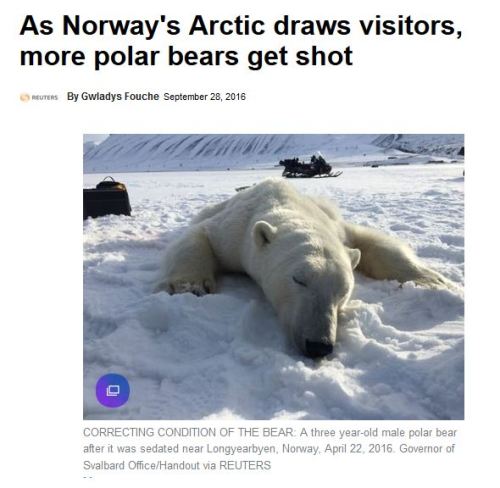
A large polar bear population with lots of adult males – due to bans on hunting – means more survival pressure on young bears, especially young males. To blame more problems with young male bears on lack of sea ice due to global warming ignores the downside to the reality Norway asked for when it banned hunting more than 40 years ago.

More hungry young males coming ashore looking for food is one of the potential consequences of living with a large, healthy population of polar bears. Biologist Ian Stirling warned of such problems back in 1974.

UPDATE: added below 6 Oct. 2016, statistics of defense of life shootings of polar bears in Svalbard since 1973.

svalbard-more-visitors-more-bears-shot_28-sept-2016-yahoo

Svalbard area polar bear numbers have increased 42% since 2004 and more hungry young polar bears almost certainly mean more polar bear problems, as folks in Svalbard (see map and quotes below) have experienced this year.
Continue reading

RCMP shot fearless polar bear that came ashore on Fogo Island, Newfoundland

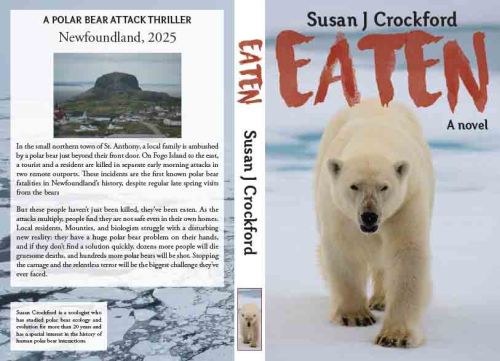
Just look at the polar bear on the cover of my new novel (right sidebar) and image that bear coming towards you with no intention of stopping. That’s what a Newfoundland RCMP officer faced yesterday – and he did what he had to do.

Fogo polar bear shot_CTV May 2 2016

This is the usual time for polar bear visits to northern Newfoundland but this one had a sad ending. The bear that came ashore at Deep Cove (where some of the action in my novel EATEN takes place, near the artist studio pictured in the photo shown above) on Fogo Island (map below) was killed by RCMP due to fears for public safety when it kept approaching officers even after warning shots were fired.

Maps and quotes from the 2 May CTV report below:

UPDATE 4 May 2016: more detailed (and accurate) information added below from a new CBC report – apparently, the bear was a large juvenile male, not an adult as originally reported, and was larger than initial reports indicated.

Continue reading

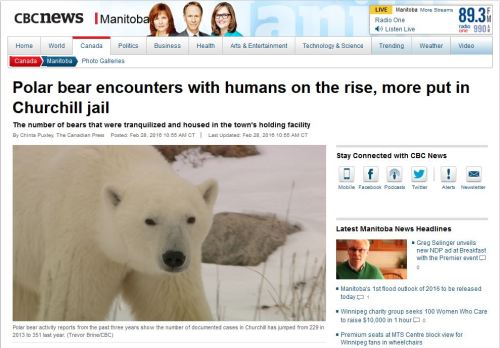
More Churchill polar bear captures due to increased vigilance not global warming

Polar bear specialists just don’t get it: virtually no one except the ever-gullible media believes their exaggerated stories of doom. Yet they keep trying and with every lie and misrepresentation of fact, they erode the confidence of the public. Unfortunately, it’s not just trust in polar bear specialists that’s being eaten away, it’s trust in science generally.

Churchill polar bear encounters up in 2015_CBC headline Feb 28 2016

This time, it’s a head-line grabbing piece about the number of problem polar bears in Churchill, Manitoba (written by Chinta Puxley) that made the usual media rounds yesterday (CBC News, CTV News, Global News, Huffington Post, Winnipeg Sun, The Globe and Mail). The main culprits are Daryll Hedman, regional wildlife manager for Manitoba Conservation, and polar bear biologist Andrew Derocher.

However, it’s hard not to see that the increased number of bears captured by Manitoba Conservation officers around Churchill can be best explained as a natural reaction by officials to a particularly frightening polar bear attack in 2013. Continue reading

Amazon reviewer said of my new polar bear attack novel: “I couldn’t put it down”

And another emailed me to say of EATEN:

“Your explanation of the relationship of seals, bears and ice was a treat. Congratulations, “Eaten” is a real page turner.”

EATEN_cover full sm

Update: The review referred to in the title is from the UK store, which has not (a.m. 8 December) been added to the Amazon.com site.

The perfect gift for those fiction readers on your list that love a good scary story. Speculative fiction of the horrifying kind – it could happen, it just hasn’t yet.

Find the paperback at Amazon  and Barnes & Noble

Amazon Kindle ebook

Barnes & Noble NOOK ebook

Kobo bookstore ebooks

Apple device ebook (via iTunes, under “Suspense and Mystery”)

Overdrive ebooks for libraries (see if your library has it: if not, suggest they get it).

Polar bears are not hungriest in summer when scientists are busy in the Arctic

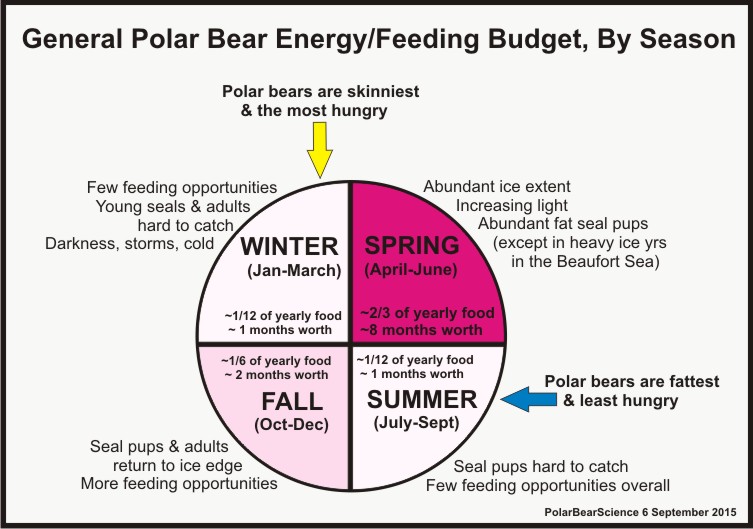
Polar bears are leanest – and therefore, hungriest – at the end of March, not in the summer, as chemist Crispin Halsall stated in a recent article about working in the Arctic.
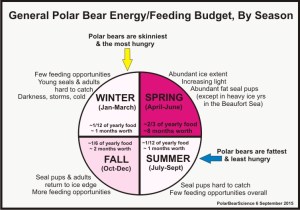
Polar bear feeding budget_PolarBearScience_6Sept2015

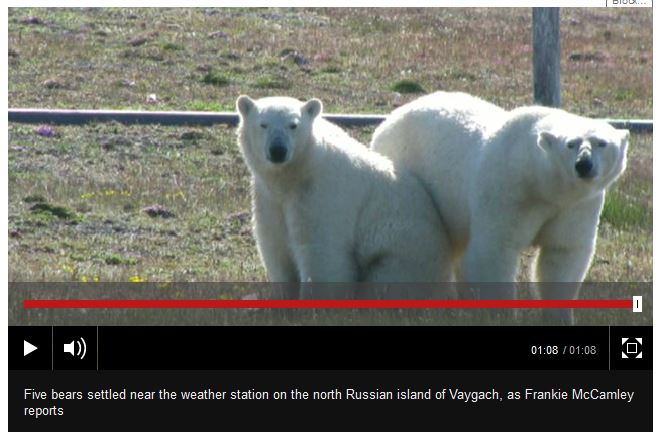
Recent September 1st stories by CNN and the BBC, based on a press release by WWF Russia on 27 August 2015, that five bears in the southern Kara Sea were hanging around a weather station and frightening workers there, apparently prompted chemist Crispen Halsall to make a nonsensical statement about polar bears being at their “hungriest” in summer (first here, reproduced here and picked up yesterday (September 5) by The Guardian here).

“In the path of the polar bears: what it’s like to be an Arctic scientist” (4 September 2015; Crispin Halsall, Reader in Environmental Chemistry at Lancaster University) had this to say:

“The case of Russian scientists trapped in their remote Arctic base by a group of inquisitive yet hungry polar bears does not come as a surprise. By late summer, Arctic sea ice is at a minimum and polar bears are effectively landlocked in coastal areas eagerly awaiting the return of ice during the autumn freeze and the chance to hunt seals again.

The Arctic summer is also the time of year when scientific activities are at their maximum, with bases operating at capacity and fieldwork operations at full flow, particularly in tundra and coastal regions. Polar bears are hungriest when scientists are busiest – “encounters” are inevitable. [my bold]

Polar bears are leanest – and therefore, the hungriest – at the end of winter (when it is more likely to kill with the intent to consume human prey) as stated clearly by Stirling and Øritsland (1995:2603):

Polar bears reach their lightest weights for the year in late March, just prior to the birth of the next cohort of ringed seal pups, which also suggests that it is the success of their hunting in spring and early summer that gives them the body reserves they need to survive through the rest of the year.” [my bold]

A polar bear that has not fed properly in spring – because it was young and inexperienced, too old or too young to defend its kills from bigger, stronger bears, or simply sick or injured – it might be unusually hungry in summer but it’s not the norm.  Polar bears eat nothing or very little over the summer (whether on land or on the ice) because they live off their stored fat – the physiological condition known as ‘fasting.’

The photos and video in the September 1, 2015 BBC story of the Russian bears shows this: the bears are fat, not skinny (“Video caption: Five bears settled near the weather station on the north Russian island of Vaygach, as Frankie McCamley reports”):
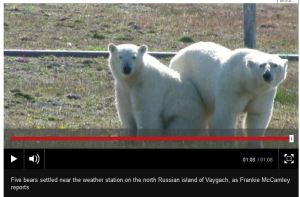
Beseiged by bears Russia BBC video Sept 1 2015

Polar bears might approach humans working in the Arctic during the summer because they are curious and/or bored, and they might attack and even eat humans because they have a drive to eat whenever the opportunity arises. But it’s not because they are “hungriest” in the summer.

References
Stirling, I. and Øritsland, N. A. 1995. Relationships between estimates of ringed seal (Phoca hispida) and polar bear (Ursus maritimus) populations in the Canadian Arctic. Canadian Journal of Fisheries and Aquatic Sciences 52: 2594 – 2612. http://www.nrcresearchpress.com/doi/abs/10.1139/f95-849#.VNep0y5v_gU

Barents Sea polar bear research in the good old days – 1968/69 – with video

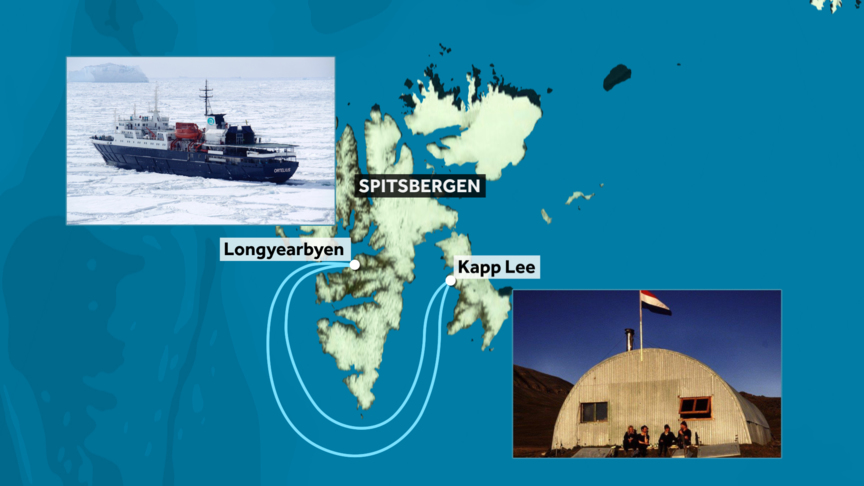
Here is some old footage shot in 1968-1969 of four Dutch researchers – none of whom had any experience with large carnivores – sent to study polar bears at Kapp Lee on Edgeøya (eastern Svalbard). It’s in Dutch so I don’t know what they’re saying but given the choice of music (Beatles, “All You Need is Love”) I can guess the message.

Still, the images are kind of cool, it’s interesting to see how research was conducted at the time by inexperienced personnel. FYI, I began my university studies in 1968, I was not much younger than these students at the time.

Overwintering Spitsbergen 1968-1969 [Uploaded to youtube 21 October 2012; length 45:55]

Description: In the winter of 1968-1969 stayed four Dutch students on the island Edgeøya east of Spitsbergen to do research as to polar bears. During that expedition, this film made by Paul van de Bosch and Hans Sweet and exhibited by the NOS on Dutch television in 1969. 

[Barents Sea polar bear subpopulation background here and here]

I found some additional background that I’ve included below, which shows how naive these young men were, although clearly they had enthusiasm. Dutch researcher Piet Oosterveld was one of the original four on the 1968 expedition and according to a recent news report (see below), will accompany a new expedition to study the effects of global warming. Map below is from the Dutch News story cited below. Spoiler alert: in 1987, Oosterveld was attacked by a polar bear and seriously injured, blamed in part on the rapid increase in polar bear numbers due to their protected status.

Dutch expedition route map
Continue reading

Keeping track of problem bears in Churchill

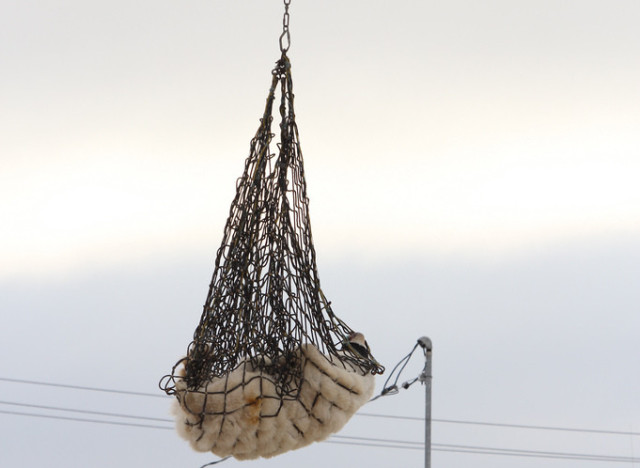
The City of Churchill has recently taken to posting its problem bear reports on its Facebook page. This is something to keep an eye on, so let’s catch up so that future reports can be put into context.

Figure 1. A bear is transported to Churchill’s polar bear holding facility, from a 2011 Huffington Post article “Polar Bear Prison.”

Photo above:  A bear is transported to Churchill’s polar bear holding facility (from a 2011 Huffington Post article, “Polar Bear Prison”).

Continue reading

Polar bear encounter in the Canadian High Arctic reminiscent of recent attacks

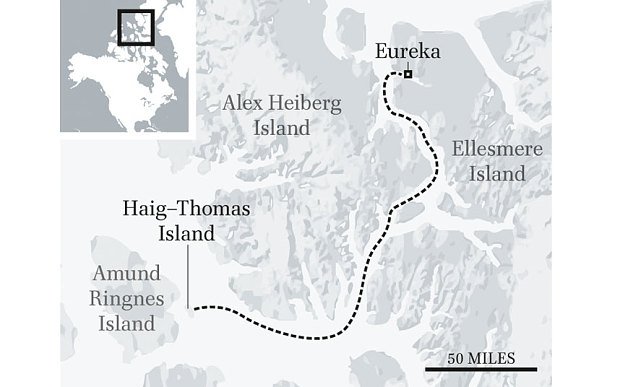
Men recreating the 1938 expedition of explorer David Haig-Thomas have a mid-April 2015 polar bear encounter reminiscent of two recent polar bear attacks (Labrador, 2013, Svalbard, 2011) but with a happier ending.

Haig-Thomas expedition map_Telegraph_April 18 2015

Continue reading

“Meltdown: Terror at the Top of the World” — new book exploits polar bear attack to sell fear of sea ice decline

The polar bear attack that was all over the news last summer is now an ebook about global warming. The Maine lawyer who was mauled by a bear while on a hiking trip to Labrador (and lived to tell the tale) has allowed his story to be co-opted by an activist journalist to promote fears of sea ice decline, polar bear extinction, and man-made global warming.

Melt-down_Terror at the Top of the World_Nov 12 2014 press release book cover

The press release issued yesterday by the news group that published the book and employs author Sabrina Shankman (InsideClimateNews), described it this way:

“A riveting new e-book about the battle between man, beast and Nature in a warming world. Called Meltdown: Terror at the Top of the World, the e-book tells the story of the hikers’ harrowing encounter with a polar bear; of the plight of the polar bear in general, facing starvation and extinction as the sea ice melts and its habitat disappears; and of the Arctic meltdown, the leading edge of man-made climate change.”

I have little doubt the man mauled by the bear was indeed terrified and that his companions were as well. However, that horror is exploited shamelessly in this book as a means to promote anxiety over the future survival of polar bears and instill panic over a prophesied Arctic “meltdown.”
Continue reading