Tag Archives: climate change

Only the gullible still buying ‘polar bear died of climate change’ nonsense

The media promote this ‘polar bear who died of climate change’ rubbish because it’s good for business but there is no evidence to support it. The Daily Mail today is running a piece that encourages the self-serving, sensationalist claim made by a photographer trying to sell his book. 
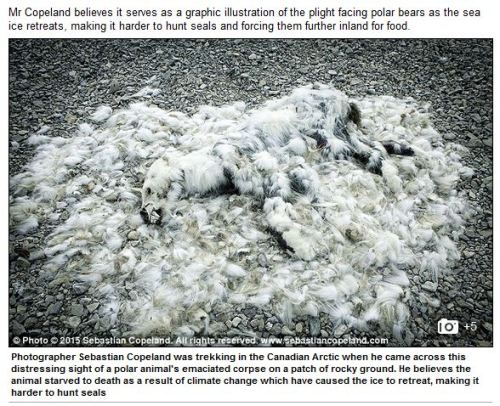
Daily Mail screencap_polar bear that died of climate change_Feb 18 2016

Read the whole thing here but remember this: the leading cause of death for all polar bears is starvation, in part because they have no natural enemies. Polar bears die of starvation every year, with or without ‘climate change.’

This bear might have died of starvation but that does not mean global warming is to blame. It’s bad enough when it’s a leading polar bear biologist making such a ridiculous claim but there is no reason at all to take the scientifically baseless word of Sebastian Copeland on this matter.

Previous posts where I have addressed similar claims:

Last year’s dead Svalbard polar bear used for this year’s propaganda

Polar bear behaviour gets the animal tragedy porn treatment – two new papers

Cannibalism in polar bears: spin and misrepresentation of fact galore posted

Ian Stirling’s howler update: contradicted by scientific data
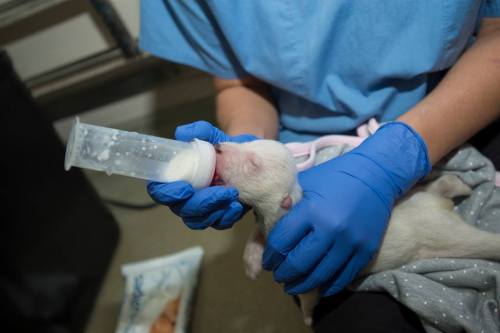
 

Zoos use polar bears to spur action on climate change – not to save them

Media outlets have recently been having collective orgasms over photos and videos of a three month old polar bear cub born at the Columbus Zoo in Ohio, which has again raised the issue of why it is now acceptable for polar bears to be held and bred in captivity.

Zoo bear at Columbus_after birth in November 2015

Newborn polar bear cub ‘Nora’ Columbus Zoo handout

The myth being propagated by zoos and their supporters is that it’s necessary to save polar bears from extinction.

Actually, nothing could be further from the truth – this is all about pressuring people to care about climate change. Polar bears are merely  a marketing tool to spur action on climate change.  That’s not my opinion but the plan put in place in 2012 by the Association of Zoos and Aquariums and Polar Bears International.

Oddly, few animal rights activists are objecting (or at least, not objecting very strenuously) to zoo displays of captive polar bear cubs – obvious money-making draws for zoos – which were so vehemently condemned in the 1970s that most zoos gave them up.

Now, the practice is defended and everyone seems to feel this is the greatest thing since the invention of the telephone. [Update 19 February 2016: courtesy the BBC, we can add Highland Wildlife Park in Scotland to the list of zoos using “we’re saving the polar bears” justification for breeding the bears in captivity]

The surprise is that disgraced climate scientist Michael Mann, promoter of the infamous hockey stick of global temperatures, is involved in all this.

Continue reading

Polar bears roaming Labrador in winter due to climate change, says minister

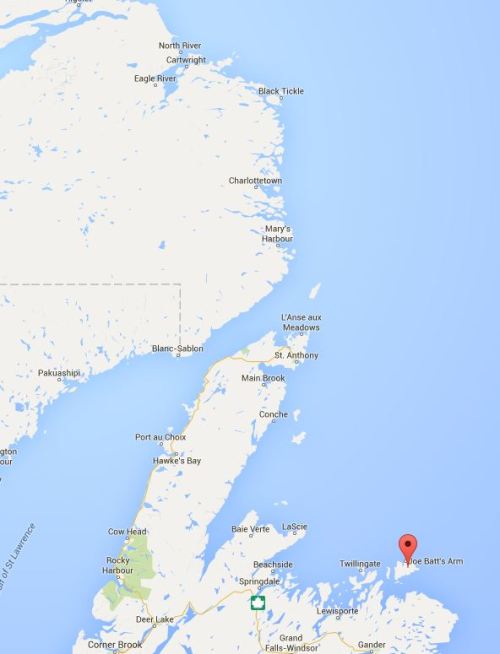
This is a follow-up to a post on my book blog that I wrote this morning because it’s relevant to the scenario I describe in my novel, set in the year 2025 in northern Newfoundland. I’m cross posting it for the benefit of regular readers here.

It appears that most of the blame for this phenomenon of multiple sightings of hungry bears onshore in the dead of winter (creating havoc and roaming among houses in the coastal Labrador communities of Black Tickle and Charlottetown) has been placed squarely on…climate change. By a government minister. You have to hear this man’s words to believe it.

Labrador south and Fogo Nfld marked

Continue reading

Polar bear myths perpetuate from the mouth of stuck-in-the-past Ian Stirling

In my last post, I complained about “vague and misleading statements” made by polar bear specialists and conservation advocates. Here’s a recent example of that phenomena, from veteran polar bear biologist Ian Stirling.


stirling_UA faculty page photo accessed July 22 2012

The magazine of Canada’s North, UpHere, published an interview with Ian Stirling this month. The piece begins:

“No fear-mongering. No exaggeration. For Ian Stirling, it’s purely about the science.”

Yeah, well – judge for yourself. Here’s a sample:

“We have lost on average about half the sea ice that we had in 1979, which is the first year that satellite coverage of the Arctic was taken [he’s talking about September ice here]. Places like Hudson Bay are breaking up three weeks earlier than they used to and freezing up a couple weeks later. We’re going to have even more significant effects over a much wider area in the Arctic. We’re likely to lose another 30 or 40 percent, or even half of the bears that we have today in the middle of the century, and unchecked, we will likely have very few bears left at the turn of the next century. In 2100, we’ll probably just have a few small remaining pockets in the northern Canadian Arctic islands and northern Greenland.”

Read the rest here.

Stirling’s opinion about polar bears and climate change hasn’t changed since at least 2004 despite the following scientific developments: Continue reading

Many otherwise intelligent people believe only a few hundred polar bears remain

The other day, I got a call from an international journalist who admitted he’d done no research into the polar bear issue but believed, based on media reports he’d heard, that there must only be about 100-200 bears remaining in the Arctic. I know he’s not alone.

polar-bears-3-large_USGS

This journalist was utterly astonished to learn that the IUCN Red List assessment in 2015 put the polar bear population total at 22,000-31,000 bears and demanded proof that this was true.

Here is a summary of the Red List report, with references and links to the report:

The 2015 IUCN Red List assessment update for polar bears (published 18 November 2015) states that the global polar bear population is 22,000 – 31,000 (26,000), that the current trend is ‘unknown’ and that there is only a 70% chance that polar bear numbers will decline by 30% in 35 years (with virtually zero chance that the numbers will decline by 80% or more by 2050) – in other words, zero chance of extinction. [Detailed in a document called 22823 Ursus maritimus]. It classifies the polar bear as ‘vulnerable’ to extinction based on predictions of future sea ice decline due to global warming [similar to ‘threatened’ by other organizations] Pdf here.

Below is a list of what truly worrying species declines look like: that is, animals whose numbers have actually declined, no prophesies involved (Adler 2008).
Continue reading

Paleoclimate + genetic study confirms: Arctic species adapted to sea ice changes

A new paper that combines paleoclimatology data for the last 56 million years with molecular genetic evidence concludes there were no biological extinctions [of Arctic marine animals] over the last 1.5M years despite profound Arctic sea ice changes that included ice-free summers: polar bears, seals, walrus and other species successfully adapted to habitat changes that exceeded those predicted by USGS and US Fish and Wildlife polar bear biologists over the next 100 years.

Healy Aug  24 2015 Polar-Bear V Tim Kenna

Cronin, T. M. and Cronin, M.A. 2015. Biological response to climate change in the Arctic Ocean: the view from the past. Arktos 1:1-18 [Open access] http://link.springer.com/article/10.1007/s41063-015-0019-3

Thomas Cronin is a USGS paleoclimatologist at the Eastern Geology and Paleoclimate Science Center, and Matthew Cronin is a molecular geneticist at the University of Alaska Fairbanks (see previous posts here and here about Matt’s work on the genetics of polar bear evolution).

From the Abstract:

Arctic climatic extremes include 25°C hyperthermal periods during the Paleocene-Eocene (56–46 million years ago, Ma), Quaternary glacial periods when thick ice shelves and sea ice cover rendered the Arctic Ocean nearly uninhabitable, seasonally sea-ice-free interglacials and abrupt climate reversals.

The final discussion and two summary graphics from this paper (copied below) are especially useful:

Continue reading

Hungry polar bear attacks: why my novel “Eaten” is set in early March

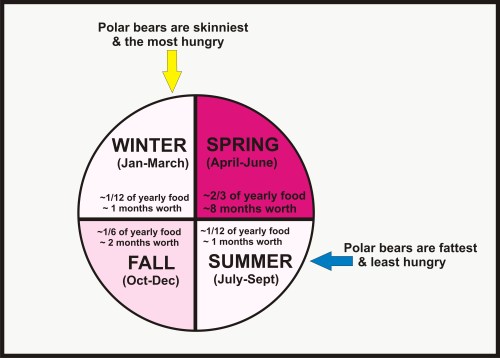
As I’ve pointed out previously, polar bears are leanest – and thus, hungriest and potentially the most dangerous to humans – at the end of winter (i.e. March).

Polar bear feeding by season simple_Nov 29 2015

That is why the unexpected prospect of hundreds of lean and hungry polar bears coming ashore in early March hunting available human prey would be a truly terrifying and daunting experience. Such a speculative scenario stands in marked contrast to an actual incident in July that involved a single well-fed bear that attacked a man asleep in a tent because he and his companions had chosen to dismiss the known risk.

Any predatory attack by a polar bear is terrifying but which is potentially the more deadly? One you can reasonably expect (and thus prepare for) or one that comes out of the blue and catches everyone unprepared?
Continue reading

Paris climate change deal will not stop polar bears dying due to thick ice in spring

Thick spring ice due to natural causes is currently the single biggest threat to polar bears. Not declining summer sea ice – thick spring ice. That could change in the future but right now, the evidence supports that statement.

polar_bear with collar_USGS

Polar bear deaths due to cyclical changes in Arctic sea ice thickness in the spring have continued despite rising CO2 emissions and declining summer sea ice extent (last major incident, 2004-2006): there is no reason to expect this will not continue. Unwarranted attention on summer ice extent has deflected attention from this major cause of local polar bear population decline.

Sea ice models do not address past or future changes in spring ice thickness and predictive models of polar bear survival blame all population declines on summer sea ice declines despite strong evidence to the contrary (Crockford 2015: The Arctic Fallacy). Continue reading

IUCN Red Book officials forced scientific standards on polar bear predictive models

As I reported Thursday, the IUCN announcement of a new Red List assessment for polar bear got the usual overwrought attention from international media outlets. However, not one of these contained a quote from a polar bear biologist.

polarbears-arcticnatlwildliferefuge-suzannemiller-usfws_labeled_sm

Steven Amstrup, science spokesperson for activist conservation organization Polar Bears International, has so far had nothing to say to the media. Yet, Amstrup was a co-author of the IUCN Red List report. Not until late in the day following the release of the report did his his organization’s website post a short, bland news report (“Climate Change Still Primary Threat to Polar Bears”).

Similarly, Ian Stirling, Andrew Derocher, Nicholas Lunn (also a co-author of the IUCN Red List report), and former WWF employee Geoff York – who are usual go-to guys for polar-bears-are-all-going-to-die media frenzies – have so far been silent and invisible on this issue.

In addition, while the IUCN press release [backup here: 2015 IUCN Red List press release_Nov 19 2015] included a quote from IUCN Polar Bear Specialist Group (PBSG) chairman Dag Vongraven, as of this morning (21 November, PST), the website of the PBSG contains no mention of this decision – no item in the “News” category  and, more importantly, no update of the status table  or global estimates to reflect the changes contained in the report  (even though they obviously knew it was coming months ago: the report was submitted to the IUCN Red List 27 August 2015).

In my opinion, this silence says it all: polar bear specialists know this assessment is a severe de facto critique of their 2008 assessment (as well as Amstrup’s predictive models) and it’s a big step backwards for their conservation activism. I expect they are silent because they are royally pissed off.

However, this assessment is good news because finally, some standards of scientific rigor have been applied to polar bear predictive models – even though the PBSG were still been allowed to pretend that summer sea ice coverage is critical to polar bear health and survival (Crockford 2015).  Continue reading

Only a 70% chance that polar bear numbers will decline by 30% by 2050

Despite the stupendously unwarranted hype being generated out of the recent release of the 2015 update to the IUCN Red List status assessment for polar bears, in fact the prognosis is better than it has been for years.

That’s because polar bear experts have been forced by the IUCN standards committee to acknowledge the great deal of uncertainty in their predictive models. They now admit there is only a 70% chance that number will decline by 30% over the next 35 years: only slightly higher than a 50:50 chance.

That means there is a 30% chance that the numbers WILL NOT decline by 30% over the next 35 years. See my detailed analysis, where you will find copies of the report and links to the online IUCN Red List assessment.

That has not stopped all major news outlets from treating this report as a new pronouncement of gloom:

CBC, Canada: (“Polar bear numbers to fall as Arctic ice shrinks: study
Population will decline by more than 30% over next 35 to 40 years, experts say”). Except the first sentence admits this is merely “likely”, not “will”:

“Polar bear populations are likely to fall by more than 30 per cent by around mid-century as global warming thaws Arctic sea ice, experts said on Thursday in the most detailed review of the predators to date.”

Mirror UK: “Polar bears facing extinction as numbers ‘to fall by a third over next 40 years’: There is now a high probability numbers of the species will decline by more than 30%, experts claim”

Express UK: “Nearly 8,000 polar bears to ‘DIE OUT’ as vulnerable giants hurtle towards ‘obliteration’: POLAR bears face a “decimation” in the next couple of decades with more than 30 per cent in population set for complete wipe-out in the most terrifying warning yet.”

The Guardian UK: ” Climate change is ‘single biggest threat’ to polar bear survival: ‘High probability’ of a 30% decline in polar bear numbers by 2050 due to retreating sea ice, IUCN study finds”

[Except, as I noted in my previous post, the IUCN report did not evaluate extinction risk].