Tag Archives: Derocher

Polar bears of W. Hudson Bay came ashore in 2009 as late as in 1992

It’s like pulling teeth, getting up-to-date information on breakup dates of Hudson Bay sea ice. You’d think with the importance of this seasonal event to the polar bears of Hudson Bay (some of which, we’re told, face the most perilous future of all polar bears worldwide), we’d get a press release every summer alerting us to the precise date of sea ice breakup and the subsequent arrival of the bears onshore. I’m thinking of something similar to the dispatches we get from the National Snow and Ice Data Center (NSIDC) when Arctic sea ice reaches its yearly maximum (e.g. March 2012) and its yearly minimum extent (e.g. September 2012).

Sadly, this is not the case.

So I was intrigued to see that a new paper just out in the Journal of Animal Ecology, by Seth Cherry (a Ph.D. student of Andrew Derocher) and colleagues, dealt with Hudson Bay breakup dates. I was hoping for some data beyond 2007, which has been the limit of information provided so far by polar bear biologists (see previous posts here and here). Unfortunately, because the methods for determining breakup dates in this paper are so different from previous ones (more detail below), the new data (1991-2009) can’t be compared to earlier studies that go back to 1979. But there is some good news.

Although you wouldn’t know it by the author’s conclusion, the results of the study confirm for this region my previously stated contention that polar bears need spring and early summer ice (March through June) for gorging on young, fat seals and documented declines in sea ice have rarely impinged on that critical feeding period – by which I meant, bears have seldom, if ever, been forced off the ice of Hudson Bay as early as June.

The study also confirms that there has not been any kind of spectacular retreat of sea ice breakup dates – coming earlier and earlier in the season – over the last 19 years and that polar bears did not arrive on shore in 2009 until very late – approximately 22 August – the same date they came ashore in 1992.

Below are two figures from the paper: one (the map) necessary to understand the new “Cherry method” of calculating breakup dates for Hudson Bay (no disrespect intended) and the other (the graph), which presents the data collected. The table with my converted breakup dates is below them. A few quotes from the study and some comments on it follows.

UPDATE (March 21 2013; 6:12 PM PST). A typo in the table has been fixed (2001 is Jun 21 not Jul 21) and the post amended accordingly.
UPDATE 2 (July 7, 2013) The Cherry et al. paper is now in print, the references have been updated accordingly.

Continue reading

Stirling and Derocher’s sea ice trick – omitting facts to make polar bears appear endangered

Polar bear biologists Ian Stirling and Andrew Derocher continue to insist that western Hudson Bay (WHB) polar bears are already showing negative effects of reduced sea ice due to global warming. In their 2012 summary paper (Stirling and Derocher 2012), they updated someone else’s graph of global sea ice (to 2011) but used a graph for Hudson Bay (HB) ice breakup dates that ended in 2007. However, we know from other evidence that at least one of those years (2009) would have required extending the scale of the breakup date graph upwards and flattened the slope of the trend line. Updating the HB breakup date graph would not have supported Stirling and Derocher’s premise that polar bears in WHB are starving due to increasingly earlier sea ice breakup, so they simply left the data out (see Fig. 1).

In other fields, this is called fraud.

Is it fraud here? You decide.

I’ve expressed my outrage about this before (here and here), because we know from news reports that in 2009, breakup of Hudson Bay sea ice was unusually late: the Port of Churchill (in WHB) did not open for ship traffic until Aug. 12, a full three weeks later than average (July 21) – and the latest opening of the Port since records began in 1974.

I try not to keep thinking of Stirling and Derocher’s unscientific behaviour but was reminded of it again on Monday (March 4) when I attended a lecture at the University of Victoria given by paleoclimatologist Michael Mann. To my disbelief, Mann tried to argue that global temperatures predicted by NASA scientist James Hansen in 1988 have “closely resembled” actual temperatures since then – by presenting a graph of actual temperatures (observations) that ended in 2005, despite the fact that recent temperatures have not risen at the rate depicted in his graph (see previous post, #8). He did say, as an aside, that “you could argue that if the data were extended out to the present, the line might more closely resemble scenario C [a flat line]” but then continued with his story that observations were matching the ever-rising-temperatures of Hansen’s scenario B (see Figure 2 below).

For both parties – Stirling/Derocher and Mann – the recent data points left off their graphs did not fit their narrative: sea ice in Hudson Bay is not on a steady, precipitous decline and global temperatures have not continued to rise as predicted by Hansen in 1988. The graphs look like science, but they are not.

Continue reading

Ten good reasons not to worry about polar bears

IMPORTANT UPDATE March 13, 2013 Benny Peiser over at the Global Warming Policy Foundation has just posted an essay by well-known author Matt Ridley, entitled “We should be listening to Susan Crockford” which is included as a foreword to a pdf of this very post (“Ten good reasons not to worry about polar bears”), suitable for sharing. I encourage you to have a look.

[Update September 28, 2013: See also this follow-up post “Polar bears have not been harmed by sea ice declines in summer — the evidence.”]

Polar Bear-Cubs-Canada_Wallpaper

PB  logo colouredThis year marks the 40th anniversary of the signing of an international agreement to protect polar bears from commercial and unregulated sport hunting. The devastating decades of uncontrolled slaughter across the Arctic, including the Bering Sea, finally came to an end. And so in honor of International Polar Bear Day (Wed. February 27) – and because some activists are calling 2013 The Year of the Polar Bear – I’ve made a summary of reasons not to worry about polar bears, with links to supporting data. I hope you find it a useful resource for tuning out the cries of doom and gloom about the future of polar bears and celebrating their current success.

Continue reading

Where were the appeals to feed starving polar bears in 1974?

The so-called “policy paper” that polar bear biologist Andrew Derocher has been promoting over the last few weeks, which I commented on briefly when the press release came out, is still grabbing headlines. Online news outlets continue to run stories on this bizarre discussion of what officials might decide to do 40 years from now if global warming causes Western Hudson Bay polar bears to spend 6 months on land (Molnar et al. 2010), causing some of those polar bears to starve (see here, here, and here) – as if this is something likely to happen within the next couple of years.

But forget imagined future starvation: where was the media attention on the plight of starving polar bears back in 1974  and 1975 when polar bears were actually starving in large numbers in the eastern Beaufort Sea?

At least two of the co-authors of the paper getting all the attention – Drs. Ian Stirling and Nick Lunn – witnessed polar bears starving in the Beaufort in 1974 because of an especially cold winter and said nothing even though polar bear populations worldwide at the time were already low due to the wanton slaughter of previous decades. Did Stirling and Lunn humanely euthanize the bears they saw starving? Contact the media? [If they did, I’d like to know.] Appeal to governments to make a plan in case it happened again? Apparently not, because it did happen again, at least twice in the following two decades – with no attendant hue and cry then either. No, those Beaufort Sea bears starved to death, time and time again, without a word to the media from Ian Stirling and Nick Lunn.
Continue reading

Andrew Derocher refuses to accept that polar bears have been saved

Andrew Derocher, an known polar bear advocate, has been making headlines again, this time promoting a new “policy paper” he is lead author on that has just been accepted for publication. He and his colleagues simply refuse to accept that the polar bear has been saved (population numbers have rebounded dramatically since protective legislation was introduced in 1973) and it seems all they can think of to do now is press for ever more restrictive regulations.

The timing of the release of this paper is very convenient: Fish and Wildlife biologists and polar bear activists worldwide are actively campaigning to get CITES, at their meeting next month, to make it illegal to trade in legally harvested polar bear parts (see previous post here). Canada is also under international pressure to up-list the status of the polar bear to “threatened,” see post here.

The article itself is behind a paywall (abstract and co-author list below), so it is unlikely that many people outside the choir of conservation advocate subscribers of the journal will ever read it, so Derocher is talking it up big time, with the help of his university PR department. Timely indeed. [h/t WUWT]

Update Feb 12, 2013 – I now have a copy of the Derocher et al in press paper. If anyone would like to see it, please send me a note via the “Commments-Tips” page above

Update October 20, 2013 – the Derocher et al. paper is now in print and I’ve updated the citation information below

Continue reading

Canada under international pressure to list polar bears as threatened, so far holds out

[Updated Jan. 27, 2013 at 7:55 am PST Footnote added]

I was inspired to write this post after perusing the Q & A portion of the “What scientists say” section at Polar Bears International. One of the questions is this one:

Are Canadian scientists opposed to listing the polar bear as threatened, as some news organizations have reported?

While I don’t know when it was posted, this question appeared quite timely when I came across it, given the recent news (Nov. 30 2012) that “Canada is being forced to explain its policies to an international environmental watchdog” (Maclean’s magazine; see also the Calgary Herald story) because of a petition filed by the ever-litigious Center for Biological Diversity.

This petition, presented to the Commission on Environmental Co-operation by the CBD, followed on the heels of the news that Canada’s “Species at Risk Act” (SARA) will continue to list the polar bear as a species of “special concern” but not threatened or endangered (CBC story here).

The original petition was filed in November 2011 and re-issued in October 2012. It seems Canada now has until January 23, 2013 to respond to the Commission, after which an investigation could be launched.

We should hear their answer any day now – but guess what? Outspoken PBSG polar bear biologist Andrew Derocher looks to have at least inspired this petition, if he was not party to it.

Continue reading

How long have polar bears lived in Hudson Bay?

The unique geographical position and oceanographic properties of Hudson Bay make it very different from other Arctic regions that polar bears inhabit.

Hudson Bay is a large shallow basin that freezes over every winter – somewhat like an enormous salt-water lake. This ice cover melts completely every summer, in part because it is well south of other truly “arctic” regions. As a consequence, while Hudson Bay offers excellent seal-hunting conditions for polar bears from winter through early summer, the long ice-free period with no or few feeding opportunities presents a unique challenge that polar bears elsewhere do not routinely encounter (see previous posts here, here and here).

Modern polar bears on the sea ice of Hudson Bay (Wikipedia photo and map).

But Hudson Bay also has a unique geological history. Since the end of the last ice age Hudson Bay has been available as polar bear habitat about half as long as other Arctic regions. This phenomenon is rarely discussed in the polar bear literature (although Andrew Derocher, in his new book [reviewed here] does mention it). In this post, I’ll summarize the geological history of Hudson Bay over the last 30 thousand years, as it pertains to polar bear habitat.

Continue reading

Critical evidence on polar bears in W. Hudson Bay is unpublished

In my last post, Western Hudson Bay polar bears are not like the others – Part 1 I stopped at the point where the following question arose: “The documented decline in cub survival and condition of females documented above occurred between 1985 and 1992 – what about now?

I promised to address that question in a separate post because it revealed some interesting issues that deserve star billing.

What I found might surprise you: apparently, virtually all of the data supporting a decline in the western Hudson Bay polar bear population since 1985 has been collected but has not been published. This revelation came from none other than the 2012 summary by Ian Stirling and Andrew Derocher that I’ve mentioned before here.

[updated Sept. 28, 2012 – reference added, see below]

continue reading

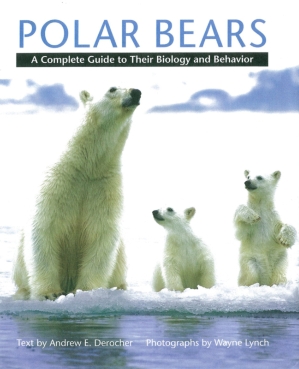
Another polar bear advocate writes a book: Derocher and Lynch 2012

Polar Bears: A Complete Guide to their Biology and Behavior (2012) Text by Andrew E. Derocher, Photographs by Wayne Lynch, in association with Polar Bears International. Johns Hopkins University Press 264 pp. 153 color photos, 4 maps. 978-1-4214-0305-2    $39.95 hardcover

Here is the promotional description of this book:

“Derocher and Lynch have spent decades following polar bears, and this book offers the most comprehensive and readable review of their biology, ecology, behavior, and conservation.” From the JHUPress catalogue

This statement suggested to me that I would find Andrew Derocher’s new book upbeat and primarily concerned with explaining the biology, behavior and life history of polar bears, as the title suggests. I’d buy a book like that, I thought.

I was also eager to see how Derocher’s effort compared with Ian Stirling’s book that came out last year (2011), which I reviewed in July. The title of Stirling’s book – Polar Bears: The Natural History of a Threatened Species – did at least hint at the advocacy found within.

Would Derocher’s book be substantially different, despite his strident advocacy on display just last month in the press “Bleak future for polar bears, U of A scientists say” and in his most recent co-authored scientific paper (Stirling and Derocher 2012, now in print), that I discussed briefly in my first post? Continue reading

Is there insufficient ice for polar bears to den offshore?

In an earlier post (July 26), I had some critical things to say about an article in the Edmonton Journal (July 17, 2012) by veteran Arctic science writer and photographer Ed Struzik called “Bleak future for polar bears, U of A scientists say“, which was picked up by news outlets across Canada.

The Struzik article publicized a summary academic paper written by polar bear biologists Ian Stirling and Andrew Derocher (a former Ph.D. student of Stirling) that appeared “in press” behind the paywall at the journal Global Change Biology on July 9.

The academic paper is a summary of Stirling and Derocher’s dire predictions on the future fate of polar bears as a result of melting of Arctic sea ice over the next few decades, one of the prophesied catastrophes of anthropogenic global warming. These views mirror to a large degree the chapter on “climate warming” in Ian Stirling’s book on polar bears released in 2011, which I reviewed recently here.

Let’s look at one of the statements made in the Struzik article:

In Alaska, many bears are denning on land because there is insufficient ice for them to give birth offshore.

Update added Aug. 28, 3:35 PM  below the post
Continue reading