Tag Archives: facts

My Polar Bear Facts & Myths book for kids is being translated into Dutch & Norwegian

In celebration of International Polar Bear Day on Tuesday 27 February, I’m pleased to announce the up-coming publication of Dutch and Norwegian translations of my popular childrens’ science book Polar Bear Facts & Myths.

Lying bear shutterstock_244419640_Cropped_web size

Ijsberen Feiten en Mythen

Isbjørn Fakta og Myter

This means my powerful little book that provides the straight goods for kids on polar bear science will soon be available in five languages: English, French, German, Dutch and Norwegian.

Watch for them!

Coffee house discussion about polar bear science & conservation in Toronto on Tuesday

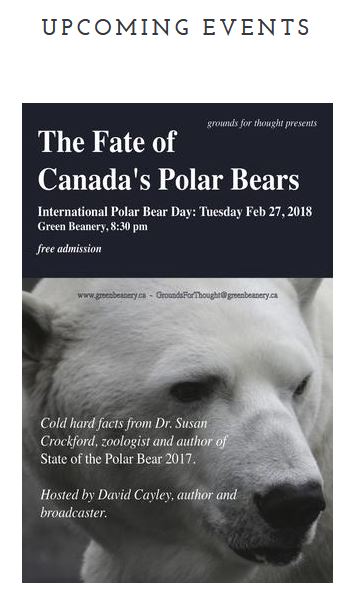
In conjunction with the launch of my State of the Polar Bear Report in Toronto next week, Benny Peiser (from the Global Warming Policy Foundation) and I will be participating in a coffee house discussion about polar bear conservation and survival issues on the evening of Tuesday, 27 February 2018 at 8:30 pm.

If you’re in town, come and celebrate International Polar Bear Day with a frank discussion about polar bear science.

Grounds for Thought at GreenBeanery_Feb 27 2018

I am very much looking forward to meeting the public at this evening discussion and to chat with media representatives and colleagues at the press luncheon in the early afternoon. Journalist/opinion writer Terry Corcoran recently billed the luncheon as part of a Polar Bear Battle since conservation organization Polar Bears International (where biologist Steven Amstrup, co-author of the Harvey et al. Bioscience paper and developer of the failed 2007 polar bear survival model, is employed as chief scientist) is holding a gala fundraiser dinner the same night, just a block away.

In addition to Benny Peiser from GWPF, a number of familiar names will be at the State of the Polar Bear launch and press luncheon, including Terry Corcoran,  Larry Soloman, Joe Oliver and Conrad Black (all journalist/opinion writers at the Financial Post and/or National Post), journalist/writer Donna Laframboise who blogs at No Frakking Consensus, as well as science colleagues Chris Essex, Ross McKitrick, and Steve McIntyre of Climate Audit fame. Details below.

Continue reading

State of the Polar Bear Report 2017 to be released Feb 2017 at press lunch Toronto

My “State of the Polar Bear Report 2017” will be unveiled at a Global Warming Policy Foundation press conference and luncheon in Toronto on Tuesday, 27 February, in celebration of International Polar Bear Day. There will be a video presentation as well.

State of Polar Bear Report cover_12 Feb 2018 image

The report summarizes clear, reliable and concise information on the current state of polar bears relative to historical records. It highlights up-to-date data and research findings in a balanced and factual format that avoids hype and exaggeration, all in one place. It is intended for a wide audience, including scientists, teachers, students, decision-makers and the general public interested in polar bears and Arctic ecology.

The launch will be held on Tuesday 27 February at 11:00am at the Toronto Public Library, Founders’ Room, 789 Yonge St, Toronto, ON M4W 2G8.

Programme

* Welcome (Dr Benny Peiser, Director of the GWPF)
* Introduction: Prof Chris Essex (Chairman of the GWPF’s Academic Advisory Council)
* Short video screening
* Presentation: Dr Susan Crockford (author of the report)

For further information and to schedule interviews, please contact Harry Wilkinson (harry.wilkinson@thegwpf.org)

A copy of the report will be posted on Polar Bear Science Tuesday.

BioScience pushback update and plea for a virtual beer

Writing this blog takes a lot of time and effort but it gives me immense personal and professional satisfaction. I get emails from readers all over the world saying how much they appreciate what I do for science. The fact that my colleagues felt threatened enough to publish a malicious hit piece attacking my scientific credibility tells me I’m reaching a wide and influential audience that are convinced by the science I present.Crockford and Polar bear_0245 sm

My books are getting good reviews. I discount the few Harvey et al. supporters that showed up in the days after the BioScience paper appeared in late November to write some Harveyesque comments in the Amazon review section for my Polar Bear Facts & Myths kids’ science book. A thuggish stunt but predictable given the nasty tone of the paper.

I’m not worried, though: book sales over the last couple of months have been very good, even though my university didn’t issue a press release to promote my kids book like Penn State did today for Harvey et al. co-author Michael Mann. I know that folks will head to Polar Bear Facts & Myths for a child-appropriate science book about polar bears, and to Mann’s Tantrum book if they want their kids to be petulant activists before they finish elementary school.

You might be interested to know I’ve decided not to take legal action against the Harvey cabal responsible for the defamatory BioScience paper.  I’m not backing down. I will definitely be pushing back (already started) but doing so will take time away from my paid work.

Beer clipart-3706-freeSo if you’d like to buy me a virtual beer to help defray costs, it would be much appreciated. I’ll keep you posted on progress.  My new donate button is upper right on the sidebar: “Support Polar Bear Science” — it takes credit cards or PayPal.

Cheers!


Polar bear numbers not declining despite media headlines suggesting otherwise

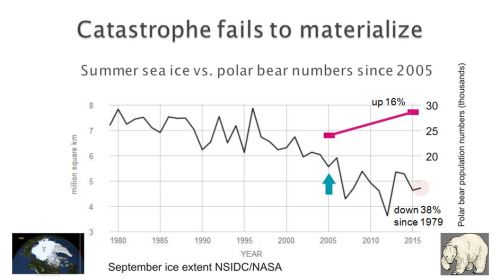
In scanning comments generated by the recent flurry of internet interest in polar bears and blogs I noticed that a good many people, fed alarming media stories, are still convinced that polar bear numbers are declining rapidly when nothing could be further from the truth.

Crockford 2017_Slide 12 screencap

Continue reading

Science, optimism, and the resilience of polar bears in an ever-changing Arctic

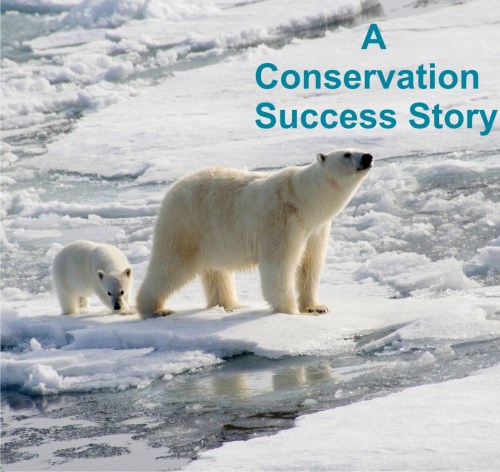
Optimism in conservation science — which the Smithsonian says we desperately need (Earth Optimism Summit 21-23 April 2017, apparently a huge success) — means it’s time to acknowledge and celebrate real conservation success stories. The Smithsonian folks probably won’t say it but I will — one of those successes is the recovery of polar bears.

Female with cub_Shutterstock_PolarBearScienceIt’s time to abandon the focus on prophesies of impending loss and accept that recovery of polar bears from the over-hunting of last century has continued despite a decade of low summer sea ice (Aars et al. 2017; Crockford 2017; Dyck et al. 2017; SWG 2016; York et al. 2016). Why not focus on the numerous images of fat, healthy bears rather than the anomalous starving ones?

It’s time to let go of imagined future catastrophes based on pessimistic failures of adaptation (Amstrup et al. 2007, 2008; Atwood et al. 2016; Stirling and Derocher 2012) and acknowledge that polar bears and Arctic seals, just like Pacific walrus (MacCracken et al. 2017; US Fish & Wildlife Service 2017), are resilient species with adaptive capabilities we are only just beginning to comprehend (Crawford and Quakenbush 2013; Crawford et al. 2015; Escajeda et al. 2018; Rode et al. 2014; Stirling and Lunn 1997; Stirling et al. 1975a; Vibe 1965). Continue reading

Breaking: 2016 W. Hudson Bay polar bear survey shows the population is still stable

A just-released report on the most recent (2016) survey shows Western Hudson Bay polar bear numbers were still stable despite predictions that this subpopulation would be wiped out completely (reduced to zero) due to low Arctic sea ice.
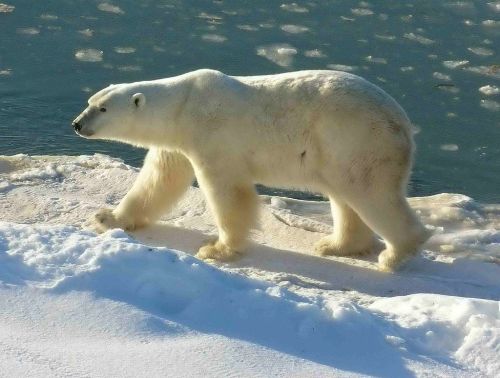
Churchill_Polar_Bear_2004-11-15 Wikipedia

The authors of the report on the August 2016 aerial survey of the Western Hudson Bay polar bear subpopulation (Dyck et al. 2017) state clearly that the only trends they could find were that the number of adult males increased somewhat over 2011 estimates and the number of females either declined or remained stable. The overall population estimate was a bit lower (11% less) compared to the 2011 survey but the difference is not statistically significant. Therefore, the population status must be stable.

2011 estimate: 949 bears (using comparable data, range 618-1280), litter size 1.43

2016 estimate: 842 bears (using comparable data, range 562-1121), litter size 1.63

[cf. Foxe Basin [stable], from 2009-2010 survey (Stapleton et al. 2016) litter size was 1.54]

An 11% decline in WH numbers since 2011 is most definitely NOT the decline to ZERO (extirpation) we were told to expect with Arctic sea ice as low as it has been since 2007 (Crockford 2017, see list of annual minimum extents 2007-2017 here).

Note: The percentage decline from 2011 to 2016 for Western Hudson Bay polar bears is 11%, NOT 18% as claimed recently by Andrew Derocher on twitter: it is not appropriate to compare the official 2011 estimate of 1030 (Stapleton 2014) to the 2016 estimate of 842 because the methods used to generate the estimates were different (Dyck et al. 2017). The authors of the report state that the estimate for 2011 that’s comparable to 2016 is 949.

An 11% decline from 1030 would be 917 bears, a statistically insignificant decline that is also biologically insignificant and therefore, so slight as to indicate a stable population.

https://twitter.com/AEDerocher/status/908423171967139840

Predicted sea ice at 2050 and 2080 shown below (see Crockford 2017 for details):
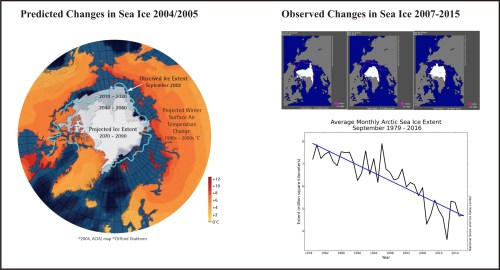
Crockford 2017 sea ice graphic

Quotes, map, and table from the Dyck et al. 2017 report (pdf here) are copied below.

Continue reading

Video: Death of a Climate Icon, the polar bear’s demise as a useful poster child

Last week I asked: “What’s causing the death of the polar bear as a climate change icon?”

I was echoing the conclusion of a commentator at the Arctic Institute (22 August 2017) who lamented: “The polar bear is dead, long live the polar bear” and climate scientist Michael Mann, who told a lecture audience a few months ago that polar bears are no longer useful for generating “action” on climate change.

Crockford 2017_Slide 15 screencap

This is slide 15 from my presentation at ICCC-12 in Washington, D.C. in March 2017.

Now here’s the video. Watch “The Death of a Climate Icon” (31 August 2017):

The video was made possible with the assistance of the Global Warming Policy Foundation.

Kind of makes you wonder: is Al Gore’s recent climate change movie, An Inconvenient Sequel: Truth to Power, tanking at the box office because he couldn’t include polar bears as an example of the effects of human-caused global warming as he did in his award-winning 2007 effort? Did too many polar bears doom Gore’s 2017 movie?

Conclusions in the video about the predictions of polar bear decline vs. the current status of polar bears and sea ice are documented in my 2017 published paper:

Crockford, S.J. 2017. Testing the hypothesis that routine sea ice coverage of 3-5 mkm2 results in a greater than 30% decline in population size of polar bears (Ursus maritimus). PeerJ Preprints 19 January 2017. Doi: 10.7287/peerj.preprints.2737v1 Open access. https://peerj.com/preprints/2737/

Crockford 2017 sea ice graphic

Pacific walrus haulout two weeks early, US gov’t agency blames “earliest” ice loss

Walrus 2012 July USGSThis year’s baseless media frenzy over walrus survival and loss of summer sea ice blamed on human-caused global warming was initiated by a press release from US Fish and Wildlife last week (16 August 2017, pdf here: “Pacific walruses haul out near Point Lay earlier than in previous years“). Quote below, my bold:
In the first week of August, several hundred Pacific walruses were observed on a barrier island near the Native Village of Point Lay, a small, Iñupiaq community on the northwest coast of Alaska. This is the earliest date yet for the haulout to form…This year, sea ice has retreated beyond the continental shelf earlier than in previous years

But is this all true? In a word, no — and it didn’t take much research to uncover the truth.

UPDATE 24 August 2017: A few minutes after this post was published, I became aware that just yesterday, 20 conservation activist organizations, lead by the Center for Biological Diversity (who led the polar bear listing charge) issued a press release regarding a letter (pdf here) pressuring the US Fish and Wildlife Service to list Pacific walrus as threatened or endangered under the Endangered Species Act. Apparently, a decision must be made by the end of September on whether to actively list walrus or not. The text below has been amended to reflect this development.
Continue reading

Fat polar bears [and lots of them] drive public confidence in future of the species

What is causing the death of the polar bear as a climate change icon? Fat bears are part of it, but mostly it’s the fact that polar bear numbers haven’t declined as predicted.

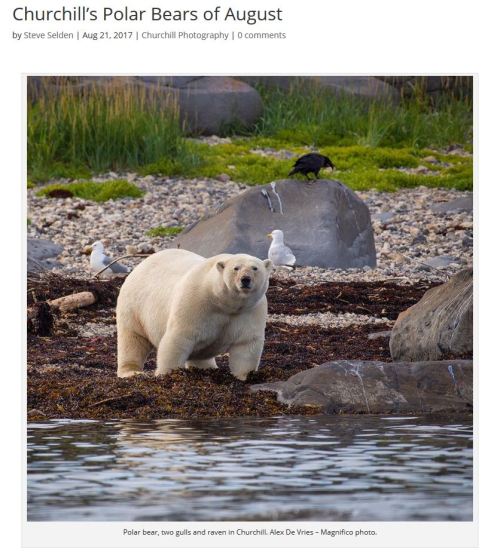
Western Hudson Bay polar bears around Churchill, Manitoba appear mostly in good shape this summer despite the very late freeze-up last fall, including the very fat bear caught on camera below (see more great pictures here):

Churchill_PolarBears_FAT bear post_21 Aug 2017

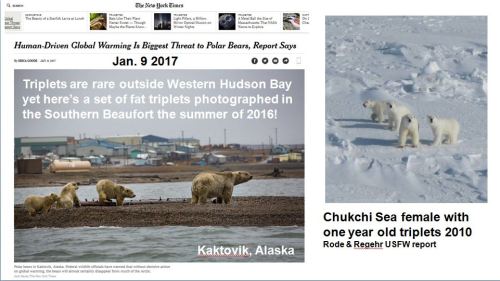
Not only have we been seeing pictures of fat bears rather than starving bears in recent years but there are lots of them, in Western Hudson Bay and other seasonal sea ice regions where there should be none (if the models had been correct). No wonder polar bears are falling out of favour as an icon for catastrophic human-caused global warming.

[Here’s another picture of a fat bear, this one from Svalbard]

Excuses for why the public is no longer worried about the future of polar bears include a recent claim by climate scientist Michael Mann that “by making polar bears and penguins the poster child for climate change, we have wrongly conveyed that this is some exotic problem far off.

But none of these apologists acknowledge the simple truth: the models that  predicted catastrophe for polar bears due to diminished summer sea ice turned out to be wrong. The sea ice declined but polar bears flourished. Polar bears in seasonal sea ice ecoregions like Western Hudson Bay and Baffin Bay didn’t die off due to climate change as people were told would happen — why should they believe any of the other scare stories?

In and around Churchill, where tourists flock to see Western Hudson Bay polar bears up close and personal, one bear in good condition recently ran through town:

Overall, there have been fewer problems or conflicts this year in Churchill compared to last (after 6 weeks of onshore living), see below.

Polar bears are no longer a useful global warming icon because they are thriving despite diminished sea ice: Churchill area polar bears are a good example.

Continue reading