Tag Archives: global warming

Bioscience paper and starving polar bear follow-up

Between the two stories (the attack by my colleagues and the starving polar bear hype), views at my blog have gone through the roof and one Arctic biologist speaks out on what SeaLegacy folks should have done when they saw a starving polar bear on Baffin Island this summer.
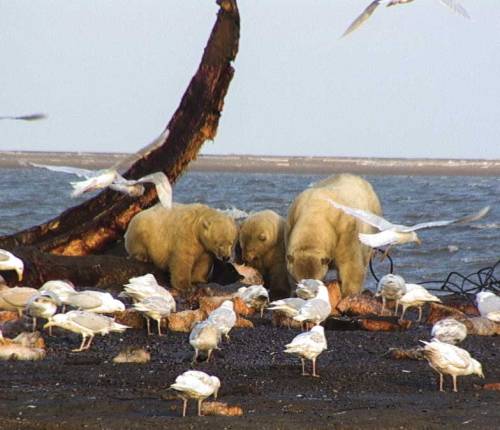
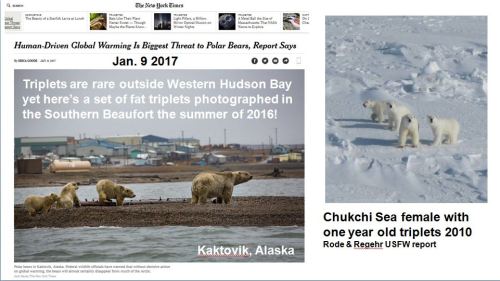
polar_bear_sow_two_cubs_feeding_with_gulls_Kaktovik_USGS

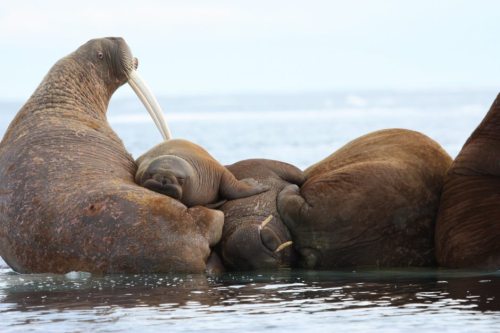
For the two weeks prior to the release of the Harvey paper (rounding to the nearest 100) the number of page views was 11,400 while for the two weeks since the Harvey et al. paper was released views were at 72,300 (with 14,900 views yesterday, 23,300 views the day before, and 12,500 the day before that). Prior to the Harvey et al. incident, my highest-ever one day blog view tally was 10,400 (a walrus haulout post!).

Several blogs were discussing the Harvey et al. paper and its implications from the first day (29 November) and a few have contacted me to say their blog views are way up as well. Terry Corcoran at the National Post wrote a supportive column, here.

So much for shutting down non-conforming opinion and criticism, especially mine. Now folks know exactly where to go for an unbiased take on polar bear issues.

One reader contacted me via my ‘contact me’ page and insisted he wanted to make a cash donation to support my blogging efforts:

“First, I apologize for adding to your (probably) overflowing inbox, but wanted to let you know that I have followed recent developments and applaud your response to these ignorant accusers.

I would be happy to assist you with monetary support in order to help defray any expenses you have incurred recently, or anticipate soon. If there is a method to do that, please let me know.

The stress and time away from your regular work is precisely what prompted me to contact you. To me this attack on your work is similar to a person that has had a fire in their home. Everything is put on hold while they tend to all of the mitigation, insurance response, etc. It takes time, energy and money.”

I wish I could have said “it’s not necessary” but he’s absolutely right. I’ve had to take time off work to deal with the issue, and it’s not over yet. Christmas is fast approaching. I don’t have a donate button here at PolarBearScience but we figured out a way to make it happen. His generous contribution is much appreciated. I’ve had dozens of emails of support, from known colleagues to people I’ve never heard from before.

Comments on the starving polar bear below.

UPDATE 11 December 2017: shortly after posting, I came across James Delingpole’s just-published column on the starving polar bear issue, read it here.

UPDATE 11 December 2017: I forgot to say that I have yet to hear back from the editors of Bioscience regarding my retraction request, except they did respond to my second email on Friday asking for confirmation that they received the letter sent three days earlier. I shouldn’t have had to prompt them: confirming receipt of such document is common courtesy and good business practice.  (h/t Anthony Watts)

UPDATE 11 December 2017 7:00 PM PST: Finally, after the damage has been done, polar bear specialists have spoken out (sort of) on the SeaLegacy “starving polar bear as victim of climate change story.” An article in the National Post was published in the early evening and features an interview with Andrew Derocher, with comments from Ian Stirling and Inuit representative Terry Audla (“What everybody got wrong about that video of a starving polar bear“). CBC covered a similar change of tune here. Too little, too late, I say. And over at the Globe and Mail, Margaret Wente has a hard-hitting piece today on why this kind of exaggeration is bad for everyone.
Continue reading
Bioscience article is academic rape: an assertion of power and intimidation

Characterizing a professional, respected scientist as an unqualified vengeful opinion writer is the same kind of power attack as rape. It’s meant to humiliate and intimidate.

Amstup

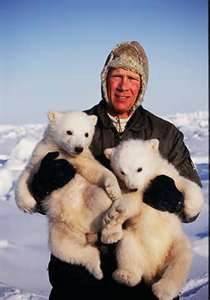
I said this as part of a response to a comment at WUWT late yesterday (copied in full below). The picture above shows Steven Amstrup holding polar bear cubs against their will — not for any scientific purpose, just for a photo that shows he can.

Also yesterday, Tom Fuller at ClimateScepticism wrote a hard-hitting critique of the Bioscience article that similarly noted the sexist nature of this harassment and the fact that this is the way Michael Mann and his colleagues behave toward female scientists who cross them or their supporters. He concludes:

“The purpose of these papers is not to communicate.

It is to excommunicate.”

As I said when this paper first came out, this response is all about my reasoned and fully referenced criticisms of Steve Amstrup’s work in particular (although I have taken issue with some of Stirling’s recent work as well).

The evidence that Steve Amstrup is willing to lie in order to publicly degrade me and my work in retribution for not taking everything he says as the gospel truth comes from an article at Motherboard yesterday. In it, Amstrup was quoted as saying:

 “You don’t have to read far in her material to see that it is full of unsubstantiated statements and personal attacks on scientists, using names like eco-terrorists, fraudsters, green terrorists and scammers,” Amstrup said.

I wrote Motherboard and asked for clarification that this was indeed what Amstrup said because I know it to be a lie. Check for yourself using the search function on my blog, it’s easy to do. I have never used any of those terms to refer to anyone, let alone a fellow scientist.

Late in the day, I got this response from the writer of the piece:

“Thank you for your note. A clarification has been added to the article. (my emphasis)

“You don’t have to read far in her material to see that it is full of unsubstantiated statements and personal attacks on scientists, using names like eco-terrorists, fraudsters, green terrorists and scammers,” Amstrup said. In a follow-up email on Friday, Amstrup clarified that these statements to Motherboard were meant to reflect the climate denier community as a whole, rather than Crockford in particular.

Except Amstrup specificially referred to my work. I insisted further clarification was necessary but rather than noting that I had, in fact, never used those terms on my blog, the author added this statement:

“In an email to Motherboard, Crockford denied using those terms on her blog.”

So, the author of the Motherboard piece was willing to take Amstrup’s word for an egregious accusation and when Amstrup was caught in a lie, was unwilling to make that clear. And the media wonder why they have lost the public’s trust.

However, this is all a day late and a dollar short. The cat’s out of the bag regarding Amstrup’s failed predictions. My critique (Crockford 2017) is a thorough scientific exposé of his unsuccessful model (which used assumptions based on Amstrup’s expert opinion) and people in power are taking it seriously. The Bioscience paper says more about its authors than it says about me.

References

Crockford, S.J. 2017. Testing the hypothesis that routine sea ice coverage of 3-5 mkm2 results in a greater than 30% decline in population size of polar bears (Ursus maritimus). PeerJ Preprints 2 March 2017. Doi: 10.7287/peerj.preprints.2737v3 Open access. https://doi.org/10.7287/peerj.preprints.2737v3

Continue reading

Polar bears refused to die as predicted and this is how the propheseers respond

The polar bear experts who predicted tens of thousands of polar bears would be dead by now (given the ice conditions since 2007) have found my well-documented criticisms of their failed prophesies have caused them to lose face and credibility with the public.

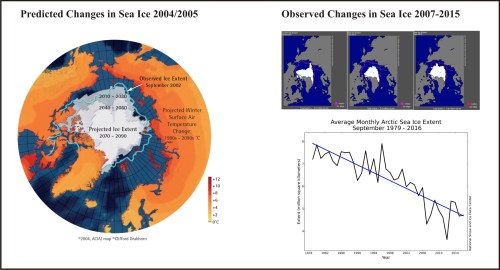
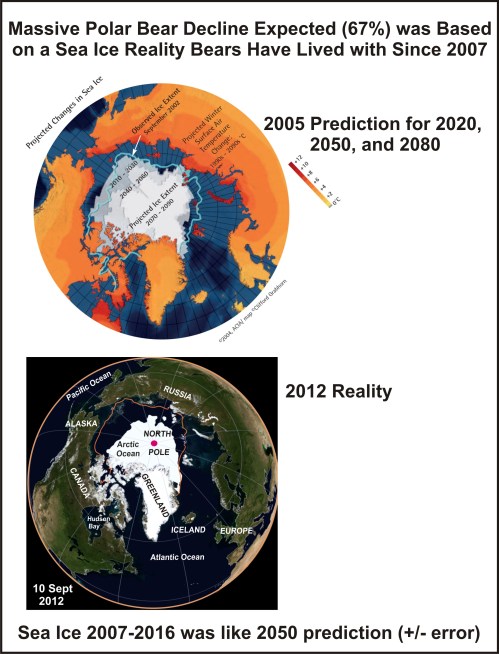
Fig 3 Sea ice prediction vs reality 2012

Predicted sea ice changes (based on 2004 data) at 2020, 2050, and 2080 that were used in 2007 to predict a 67% decline in global polar bear numbers vs. an example of the sea ice extent reality experienced since 2007 (shown is 2012). See Crockford 2017 for details.

Although the gullible media still pretends to believe the doomsday stories offered by these researchers, the polar bear has fallen as a useful icon for those trying to sell a looming global warming catastrophe to the public.

Here’s what happened: I published my professional criticisms on the failed predictions of the polar bear conservation community in a professional online scientific preprint journal to which any colleague can make a comment, write a review, or ask a question (Crockford 2017). Since its publication in February 2017, not one of the people whose work is referred to in my paper bothered to counter my arguments or write a review.

They ignored me, perhaps hoping the veracity of my arguments would not have to be addressed. But it has not turned out that way. Now, too late, they have chosen a personal attack in the journal BioScience (Harvey et al. 2018 in press).

UPDATE 30 November 2017: See a detailed criticism of this nasty paper here and a shorter one below.

Continue reading

Published essay: the conservation fiasco that is the ESA listing of polar bears

In early October, the US Fish & Wildlife Service reversed its 2011 decision to list Pacific walrus as ‘threatened with extinction’, saying they could not “determine with certainty that walruses are likely to become endangered “in the foreseeable future.” [details below]

I have argued that the 2008 decision by the USFWS to list polar bears as ‘threatened’ is similarly lacking in certainty (Crockford 2017) and as for walrus, the previous determination of ‘threatened’ for polar bears was premature and should be reversed.

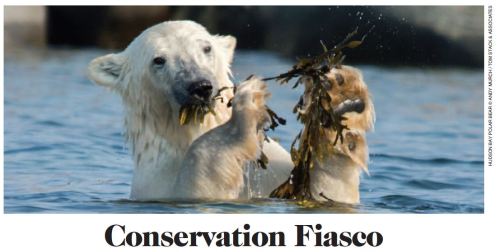
Conservation Fiasco_lead photo_WINTER 2017 RANGE

A prominent biology colleague and I recently put it this way in a newly published essay:

“Is it ethical or fair to the many citizens impacted directly and indirectly by the 2008 polar bear ruling for the FWS to allow polar bears to remain on the Endangered Species List?”

Read our piece in the winter 2018 issue of RANGE Magazine (open access), authored by myself and Dr. Valerius Geist, professor emeritus of environmental science at the University of Calgary, Alberta.

Crockford, S.J. and Geist, V. 2018. Conservation Fiasco. Range Magazine, Winter 2017/2018, pg. 26-27. Pdf here.

PS. You’ll find an excellent piece on wildfires by biologist Jim Steele in the same issue.

See also Crockford, S.J. 2017. Testing the hypothesis that routine sea ice coverage of 3-5 mkm2 results in a greater than 30% decline in population size of polar bears (Ursus maritimus). PeerJ Preprints 2 March 2017. Doi: 10.7287/peerj.preprints.2737v3 Open access. https://doi.org/10.7287/peerj.preprints.2737v3

Details on the USFWS decision on the walrus is below. Note that like the walrus, if ESA protection on the polar bear was reversed, the bears would still be strongly protected under the Marine Mammal Protection Act (as they have been since 1972), and like the walrus, polar bears have shown an ability to adapt that was not foreseen in 2007 (as evidenced by their failure to die off droves in response to recent sea ice declines).

Continue reading

Death of the polar bear as climate change icon validates Mitch Taylor’s skepticism

You could call it karma — the death of the polar bear icon after the shameful hubris of polar bear experts back in 2009.

That year, the IUCN Polar Bear Specialist Group booted 20-year member Mitch Taylor out of their organization, explaining that his skeptical views on human-caused global warming were “extremely unhelpful” to their polar bear conservation agenda.

Said chairman Andrew Derocher in his email to Taylor:  “Time will tell who is correct.”

It’s now clear that Mitch Taylor was right to be skeptical of sea ice models based on pessimistic climate change assumptions; he was also right to be more optimistic than his PBSG colleagues about the ability of polar bears to adapt to changing sea ice conditions (Taylor and Dowsley 2008), since the bears have turned out to be more resilient than even he expected.

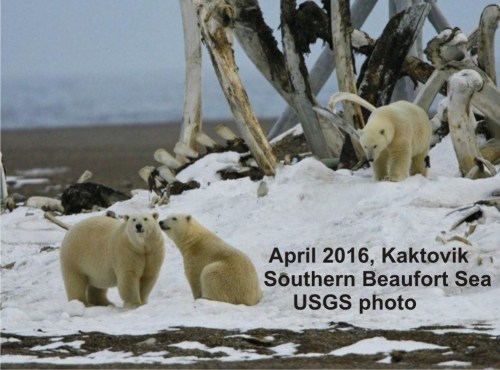
Fat mother and cubs_Southern Beaufort April 2016_USGS

Fat polar bears — not starving ones — dominate photos taken in recent years. The total failure of polar bear numbers to crash as predicted in response to the abrupt decline in summer sea ice in 2007 and persistent low summer sea ice levels since then (Crockford 2017), is vindication for Mitch Taylor. It’s time someone said so.

More on the 2009 incident below.
Continue reading

Video: Death of a Climate Icon, the polar bear’s demise as a useful poster child

Last week I asked: “What’s causing the death of the polar bear as a climate change icon?”

I was echoing the conclusion of a commentator at the Arctic Institute (22 August 2017) who lamented: “The polar bear is dead, long live the polar bear” and climate scientist Michael Mann, who told a lecture audience a few months ago that polar bears are no longer useful for generating “action” on climate change.

Crockford 2017_Slide 15 screencap

This is slide 15 from my presentation at ICCC-12 in Washington, D.C. in March 2017.

Now here’s the video. Watch “The Death of a Climate Icon” (31 August 2017):

The video was made possible with the assistance of the Global Warming Policy Foundation.

Kind of makes you wonder: is Al Gore’s recent climate change movie, An Inconvenient Sequel: Truth to Power, tanking at the box office because he couldn’t include polar bears as an example of the effects of human-caused global warming as he did in his award-winning 2007 effort? Did too many polar bears doom Gore’s 2017 movie?

Conclusions in the video about the predictions of polar bear decline vs. the current status of polar bears and sea ice are documented in my 2017 published paper:

Crockford, S.J. 2017. Testing the hypothesis that routine sea ice coverage of 3-5 mkm2 results in a greater than 30% decline in population size of polar bears (Ursus maritimus). PeerJ Preprints 19 January 2017. Doi: 10.7287/peerj.preprints.2737v1 Open access. https://peerj.com/preprints/2737/

Crockford 2017 sea ice graphic

Pacific walrus haulout two weeks early, US gov’t agency blames “earliest” ice loss

Walrus 2012 July USGSThis year’s baseless media frenzy over walrus survival and loss of summer sea ice blamed on human-caused global warming was initiated by a press release from US Fish and Wildlife last week (16 August 2017, pdf here: “Pacific walruses haul out near Point Lay earlier than in previous years“). Quote below, my bold:
In the first week of August, several hundred Pacific walruses were observed on a barrier island near the Native Village of Point Lay, a small, Iñupiaq community on the northwest coast of Alaska. This is the earliest date yet for the haulout to form…This year, sea ice has retreated beyond the continental shelf earlier than in previous years

But is this all true? In a word, no — and it didn’t take much research to uncover the truth.

UPDATE 24 August 2017: A few minutes after this post was published, I became aware that just yesterday, 20 conservation activist organizations, lead by the Center for Biological Diversity (who led the polar bear listing charge) issued a press release regarding a letter (pdf here) pressuring the US Fish and Wildlife Service to list Pacific walrus as threatened or endangered under the Endangered Species Act. Apparently, a decision must be made by the end of September on whether to actively list walrus or not. The text below has been amended to reflect this development.
Continue reading

Fat polar bears [and lots of them] drive public confidence in future of the species

What is causing the death of the polar bear as a climate change icon? Fat bears are part of it, but mostly it’s the fact that polar bear numbers haven’t declined as predicted.

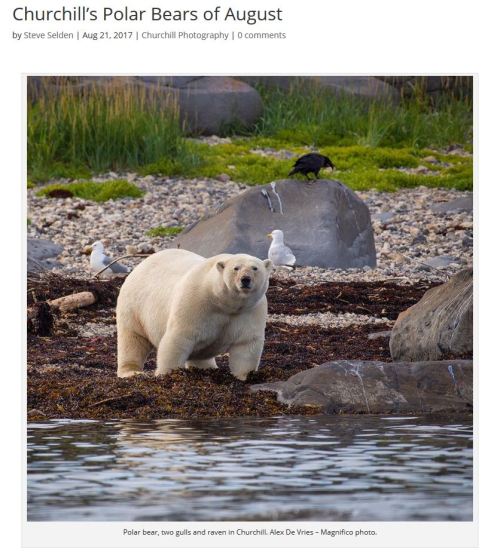
Western Hudson Bay polar bears around Churchill, Manitoba appear mostly in good shape this summer despite the very late freeze-up last fall, including the very fat bear caught on camera below (see more great pictures here):

Churchill_PolarBears_FAT bear post_21 Aug 2017

Not only have we been seeing pictures of fat bears rather than starving bears in recent years but there are lots of them, in Western Hudson Bay and other seasonal sea ice regions where there should be none (if the models had been correct). No wonder polar bears are falling out of favour as an icon for catastrophic human-caused global warming.

[Here’s another picture of a fat bear, this one from Svalbard]

Excuses for why the public is no longer worried about the future of polar bears include a recent claim by climate scientist Michael Mann that “by making polar bears and penguins the poster child for climate change, we have wrongly conveyed that this is some exotic problem far off.

But none of these apologists acknowledge the simple truth: the models that  predicted catastrophe for polar bears due to diminished summer sea ice turned out to be wrong. The sea ice declined but polar bears flourished. Polar bears in seasonal sea ice ecoregions like Western Hudson Bay and Baffin Bay didn’t die off due to climate change as people were told would happen — why should they believe any of the other scare stories?

In and around Churchill, where tourists flock to see Western Hudson Bay polar bears up close and personal, one bear in good condition recently ran through town:

Overall, there have been fewer problems or conflicts this year in Churchill compared to last (after 6 weeks of onshore living), see below.

Polar bears are no longer a useful global warming icon because they are thriving despite diminished sea ice: Churchill area polar bears are a good example.

Continue reading

Polar bears of W Hudson Bay utilizing a substantial patch of thick first year ice

There’s been no word as yet, either from tour operators or polar bear researchers, that Western Hudson Bay polar bears have come ashore for the summer/fall season. Andrew Derocher reported at the end of June that the bears tagged by his team were still on the ice and as I write this, has not yet reported them ashore.

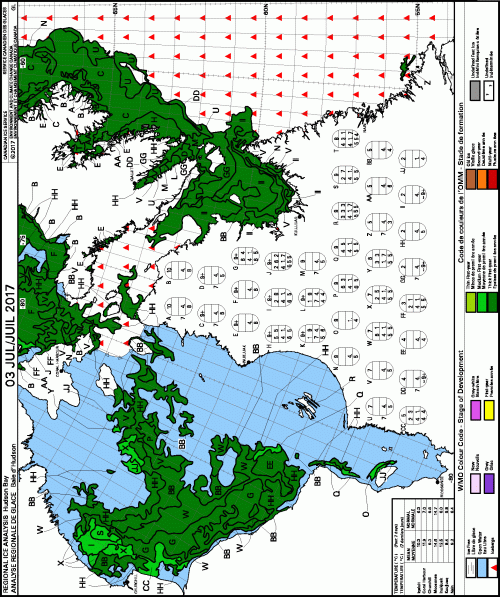
That pattern is consistent with the presence of thick ice along the west coast of the Bay — from well north of Churchill to the south of Wapusk National Park — for the last few weeks. The weekly chart for 3 July 2017 below from the Canadian Ice Service shows that virtually all of the ice remaining is thick first year ice (>1.2m, dark green on this map):

Hudson Bay weekly ice stage of development 2017 July 3

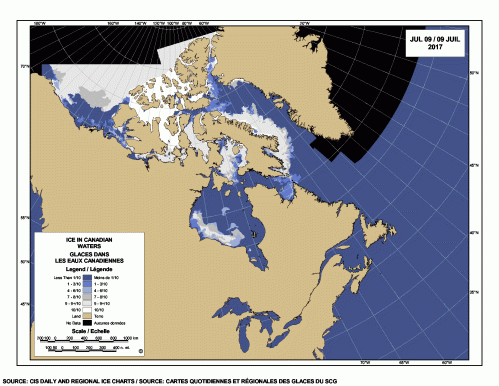
By the 9 July, the extent of this patch of ice was somewhat reduced but still a very prominent feature over the Bay, suggesting that if adult seals are using this ice as a refuge while molting, some bears may still be attempting to hunt even though their success rate may not be very high:

Sea ice Canada 2017 July 9

Bottom line: As has been the pattern for more than a decade, 2017 will not go down in history as an especially early year for WHB polar bears coming off the ice for the summer/fall season but instead may be as late as last year, when lots of bears were reported off the ice by mid-July at Seal River (just north of Churchill), all in excellent condition.

It remains to be seen if the condition of bears will be as good this year as they were in 2016, given the late start to the season. But it does mean that the lack of trend in breakup dates since 2001 continues: breakup of the sea ice in WHB since 2001 has been about one week later than it was before 1998 (Castro de la Guardia 2017; Cherry et al. 2013; Lunn et al. 2016).

If some polar bear struggle to survive this year it will be due to the late freeze-up date last fall combined with challenging winter conditions over Hudson Bay, not because of an early breakup of the sea ice.

And while it is certainly true that the overall trend in time spent onshore by WHB polar bears since 1979 has increased by about three weeks, the lack of a continued trend since 2001 is not what was expected or predicted, especially given the marked decline in global sea ice levels that have made headlines since 2007 (Crockford 2017), and the predictions of how devastating such low levels of ice would be to polar bears in areas like Hudson Bay that have to deal with a total disappearance of sea ice in summer and early fall.

Continue reading

Heavy ice off East Coast 2017 caused by winds, cold temperatures, and icebergs

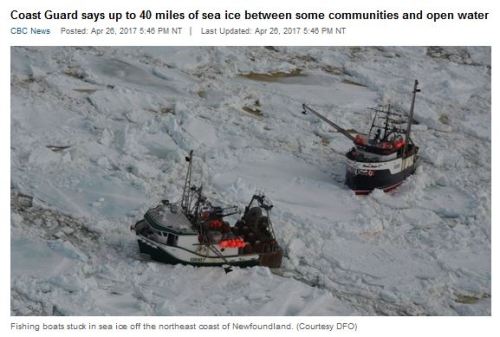
Heavy sea ice off Newfoundland and southern Labrador has been an issue for months: it brought record-breaking numbers of polar bear visitors onshore in early March and April and since then has hampered the efforts of fisherman to get out to sea.

Newfoundland fishing boats stuck in ice_DFO_May 26 2017 CBC

Let’s look back in time at how the ice built up, from early January to today, using ice maps and charts I’ve downloaded from the Canadian Ice Service and news reports published over the last few months.

The tour is illuminating because it shows the development of the thick ice over time and shows how strong winds from a May storm combined with an extensive iceberg field contributed to the current situation.

Bottom line: I can only conclude that climate change researcher David Barber was grandstanding today when he told the media that global warming is to blame for Newfoundland’s record thick sea ice conditions this year.  I suspect that because Barber’s expensive research expedition was scuttled, he simply had to find a way to garner media attention for his project — and the media obliged. Read to the end and decide for yourself.

Continue reading