
Tag Archives: IUCN

Polar Bear Specialist Group meeting postponed until 2014

[Update October 14, 2013: correction regarding Davis Strait population estimate, noted below]

I heard via the grapevine that the IUCN Polar Bear Specialist Group (PBSG) meeting, tentatively slated to be held this July (Obbard et al. 2010), has been postponed until 2014. [That will be the 16th Working Meeting, as they are called]

Word has it that shifting the meeting forward will allow the group time to put together a new population estimate that will incorporate recent survey results.

So which subpopulations are slated to be updated?

Figure 1. Polar bear subpopulations defined by the Polar Bear Specialist Group (PBSG). Note that Baffin Bay, Davis Strait, Western Hudson Bay and Southern Hudson Bay are all similar in that they become ice-free by early fall (the September minimum) or before.

Polar bear subpopulations defined by the Polar Bear Specialist Group (PBSG). Courtesy the PBSG.

As far as I can determine, there are at least two that haven’t quite been finished: Baffin Bay and Southern Beaufort. The Baffin Bay survey was supposed to be completed this spring, so the numbers just need to be crunched. Southern Beaufort has a survey in progress, planned to continue through the fall of 2013.

Here are some comments on the 2012 Southern Beaufort field season (USFWS Newletter 2013:17):

“The number of polar bears observed in 2012 was high relative to similar surveys conducted over the past decade. During August and September surveys, the majority of bears were observed east of Prudhoe Bay, primarily near Kaktovik. Body condition appeared relatively normal for this time of year with most bears reported to be in average condition.” [my bold] [see previous post here re: Kaktovik bears]

There are new counts for Foxe Basin (estimated at ~2,580 bears, similar to the early 1990s estimate of ~2,200; Stapleton, Peacock and Garshelis 2012) and Western Hudson Bay (estimated at ~1,000 bears, similar to the 2004 estimate of ~935; Stapleton, Atkinson et al. 2012) based on aerial surveys. These numbers have not yet been incorporated into the global total, although the studies suggest both of those populations have been stable since the last survey.

CBC News (June 26, 2012):

“A study has found that the polar bear population in the Foxe Basin region of Nunavut is stable and the bears are in good health.

The territorial government did an aerial survey of the bear population in 2009 and 2010. The survey results show the population is about the same size as it was in 1990 – about 2,580 bears.” [my bold]

There is also the new population estimate for Davis Strait (Peacock et al. 2013) that needs to be incorporated into the global total – in this case, there has been an increase from the previous estimate (up from ~1,400 to ~2,158). [corrected Oct. 14 2013] The population increase for Davis Strait has already been incorporated into the current global estimate. The new numbers were available by 2009 (the time of the last PBSG meeting) but the peer-reviewed publications (with all of the pertinent details) were not produced until recently (2012-2013, discussed here and here).
Continue reading
Global population of polar bears has increased by 2,650-5,700 since 2001

The official population estimates generated by the IUCN Polar Bear Specialist Group (PBSG) give the impression that the global total of polar bears has not changed appreciably since 2001:

2001 PBSG report                  21,500-25,000

2005 PBSG report                  20,000-25,000

2009 PBSG report                  20,000-25,000

2013 PBSG website                20,000-25,000

2015 IUCN Red List              22,000-31,000 [see latest update note]

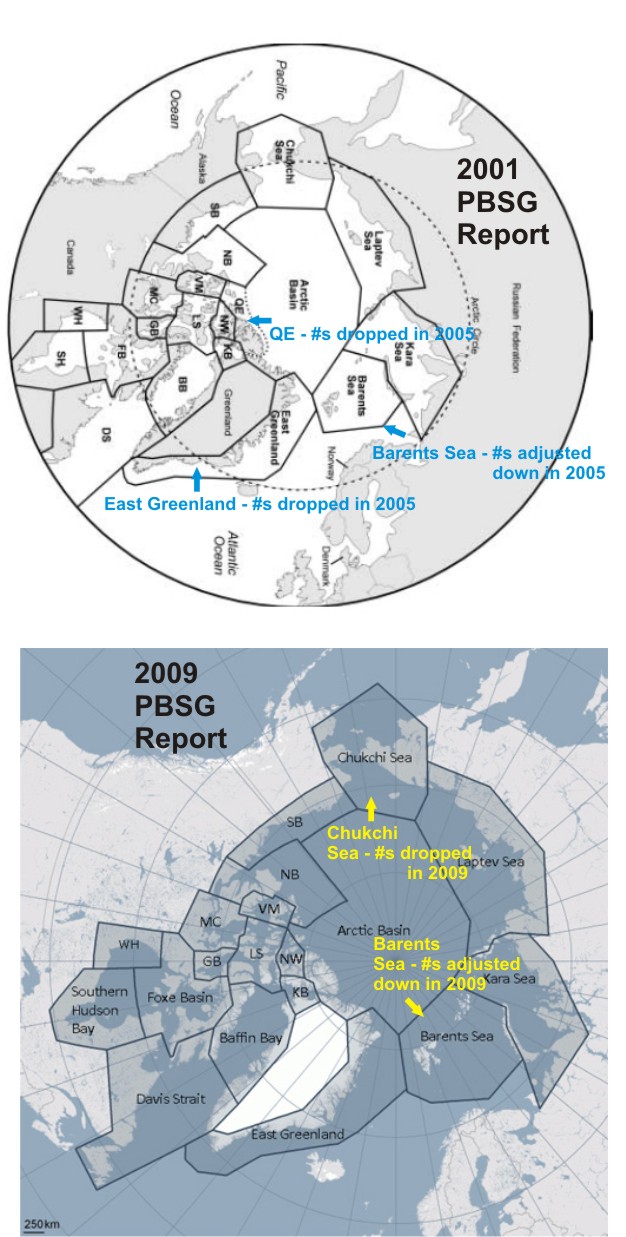
However, some accounting changes were done between 2001 and 2009 (the latest report available) that mean a net increase in numbers had to have taken place (see summary map below and previous post here. Note this is a different issue than the misleading PBSG website graphic discussed here).

And while it is true that population “estimates” are just that — rather broad estimates rather than precise counts — it is also true that nowhere do the PBSG explain how these dropped figures and other adjustments were accounted for in the estimated totals. 

The simple details of these changes are laid out below, in as few words as I could manage, to help you understand how this was done and the magnitude of the effect. It’s a short read — see what you think.

UPDATE 15 May 2016: In late November 2015, the IUCN Red List of Threatened Species published a new assessment for polar bears that estimated the global population at 22,000-31,000 and stated the trend was ‘Unknown’. See details here and here – which includes links to the official report and the press release. Sorry for the delay in updating this post.

UPDATE 31 May 2015: See the latest population numbers here.

UPDATE 5 December 2014: Links to more recent posts relevant to this issue added below. [including this one: Status of Canadian polar bear populations has been changed – more good news October 28, 2014

UPDATE February 14, 2014a new status table has been released, see new post here 

UPDATE February 18, 2014 — see graphs of the 1981-2013 estimates here.

Polar bear subpopulations as defined by the PBSG: Top, in the 2001 report; Bottom, 2009 report. Map courtesy PBSG, with a few labels added and the subpopulations identified where “accounting” changes or adjustments to estimates took place.SB, Southern Beaufort; NB, Northern Beaufort; VM, Viscount Melville; MC, M’Clintock Channel; LS, Lancaster Sound; GB, Gulf of Boothia; NW, Norwegian Bay; KB, Kane Basin; WH, Western Hudson Bay. Click to enlarge.

Polar bear subpopulations as defined by the PBSG: Top, in the 2001 report; Bottom, 2009 report. Map courtesy PBSG, with a few labels added and the subpopulations identified where “accounting” changes or adjustments to estimates took place.
SB, Southern Beaufort; NB, Northern Beaufort; VM, Viscount Melville; MC, M’Clintock Channel; LS, Lancaster Sound; GB, Gulf of Boothia; NW, Norwegian Bay; KB, Kane Basin; WH, Western Hudson Bay. Click to enlarge.

Continue reading

Polar Bear Specialist Group adds WWF and PBI activists as full voting members

In a previous post I noted:

In 2009, for the first time, the polar bear biologists that make up the IUCN’s Polar Bear Specialist Group (PBSG) invited four professional advocates – not one or two, but four – to their exclusive, once-every-four-years meeting of top polar bear biologists (called “delegates”) from the world’s Arctic nations (Canada, Russia, USA, Greenland/Denmark and Norway) – two from World Wildlife Fund (WWF) and two from Polar Bears International (PBI).

In that post, I mentioned that there was an “exclusive members-only meeting” scheduled for October 24-27, 2013.

Well, I just came across a notice on the PBSG website that tells us what went on at that meeting.

The Polar Specialist Group (PBSG) voted unanimously to embrace World Wildlife Fund activist Geoff York and Polar Bears International activist Steve Amstrup as delegates with full voting rights until 2016. This is a first: never before have employees of activist organizations been made full member-delegates of this formerly exclusive organization.

With this move, the PBSG are telling the world that they are an advocate association first and a scientific organization second.

Continue reading

Buffet time for polar bears – spring/early summer is for eating baby seals

Spring is the busiest and most important season for polar bears: it is the most important feeding period and it is also when mating occurs. The fat that polar bears put on during the spring and early summer is critical for their survival over the rest of the year and for females, determines whether they can successfully produce cubs the following year.

Mothers and new cubs emerge from their winter dens in late March to early April and those who have chosen to den on land soon head towards the sea ice. For a fabulous photo of a polar bear female and her two young cubs, just out of their winter den, feeding on a bearded seal pup, pop over here. All other bears, including females with older cubs, will already be on the ice, feeding on the first newborn ice seals of the season and any other seals they can catch.

It’s buffet time for polar bears but the most dangerous time for cute baby seals. Continue reading

Misleading “State of the Polar Bear” graphic still not fixed

UPDATE FEBRUARY 19, 2014The misleading “State of the Polar Bear” graphic is now GONE (as of January 31, 2014). A new 2013 status table is offered by the PBSG here. It has detailed text explanations and harvest information, with references, hyperlinked to each subpopulation entry (“Press the subpopulation hyperlink and more information will appear“) and may have replaced the “State of the Polar Bear” graphic that the PBSG commissioned for upwards of US$50,000, although the PBSG website says it is being “updated [A pdf copy of the 2013 colour table is here, and my commentary on it is here.] I have left the original post as is, below.

This is an update regarding the IUCN Polar Bear Specialist Group (PBSG)’s fancy, multilevel State of the Polar Bear web graphic that I discussed previously here, here, and here.

To refresh your memory, two points about this graphic stand out, both regarding polar bear population estimates:

1) The population estimates listed on the Nations map (copied below) add up to 22,600-32,000 – far higher than the official estimate of 20,000-25,000 polar bears worldwide.

2) The population estimates listed on the upper layer of the Subpopulation map add up to just 13,036 – not even close to the official estimate of 20,000-25,000 polar bears worldwide.
Continue reading

Canada under international pressure to list polar bears as threatened, so far holds out

[Updated Jan. 27, 2013 at 7:55 am PST Footnote added]

I was inspired to write this post after perusing the Q & A portion of the “What scientists say” section at Polar Bears International. One of the questions is this one:

Are Canadian scientists opposed to listing the polar bear as threatened, as some news organizations have reported?

While I don’t know when it was posted, this question appeared quite timely when I came across it, given the recent news (Nov. 30 2012) that “Canada is being forced to explain its policies to an international environmental watchdog” (Maclean’s magazine; see also the Calgary Herald story) because of a petition filed by the ever-litigious Center for Biological Diversity.

This petition, presented to the Commission on Environmental Co-operation by the CBD, followed on the heels of the news that Canada’s “Species at Risk Act” (SARA) will continue to list the polar bear as a species of “special concern” but not threatened or endangered (CBC story here).

The original petition was filed in November 2011 and re-issued in October 2012. It seems Canada now has until January 23, 2013 to respond to the Commission, after which an investigation could be launched.

We should hear their answer any day now – but guess what? Outspoken PBSG polar bear biologist Andrew Derocher looks to have at least inspired this petition, if he was not party to it.

Continue reading

PBSG invited WWF and PBI advocates to its last polar bear experts meeting

In 2009, for the first time, the polar bear biologists that make up the IUCN’s Polar Bear Specialist Group (PBSG) invited four professional advocates – not one or two, but four – to their exclusive, once-every-four-years meeting of top polar bear biologists (called “delegates”) from the world’s Arctic nations (Canada, Russia, USA, Greenland/Denmark and Norway) – two from World Wildlife Fund (WWF) and two from Polar Bears International (PBI).

[Recall that 2009 was also the year that PBSG Chairman Andrew Derocher stripped veteran Canadian polar bear biologist and long-time PBSG member Mitch Taylor of his delegate attendee status because he did not have the appropriate attitude to global warming (see previous post here). Update – just to be clear, Mitch had retired from his government polar bear research job (a valid reason for not being included as a delegate) but with more than 30 years experience and his vast publication record on polar bears – as well as his long association with the PBSG as a delegate – he certainly should have qualified as an “invited specialist” at the 2009 meeting]

I expect Canadian journalist and author Donna LaFramboise would call this inclusion of WWF and PBI advocates in an otherwise exclusive meeting of polar bear biologists a behind-the-scenes lobbying opportunity,” similar to the inclusion of WWF personnel in the IPCC review process (see original article here and email interview here and “WWF infiltrates UK gov’t” here).

WWF and PBI are organizations devoted to changing public policy to suit their idea of how the world should be – whether others agree or not. They are passionate lobbyists with money behind them and they use their influence to pressure politicians – and now, supposedly impartial scientific organizations – to make decisions that fit their agenda.

Continue reading

Update: Polar bear population now 22,600-32,000 – when tallied by nation

UPDATE FEBRUARY 19, 2014The misleading “State of the Polar Bear” graphic is now GONE (as of January 31, 2014). A new 2013 status table is offered by the PBSG here. It has detailed text explanations and harvest information, with references, hyperlinked to each subpopulation entry (“Press the subpopulation hyperlink and more information will appear“) and may have replaced the “State of the Polar Bear” graphic that the PBSG commissioned for upwards of US$50,000, although the PBSG website says it is being “updated” [A pdf copy of the 2013 colour table is here, and my commentary on it is here.] I have left the original post as is, below.

[See followup posts here and here (April 1)]

Two days ago, I got a short note from PBSG chairman and website manager Dag Vongraven of the Norwegian Polar Institute, Tromso. He was responding to an email I sent him earlier this week asking about the apparent increase in global polar bear numbers when tallied by nation as depicted in the “State of the Polar Bear” dynamic “tool” featured on the Polar Bear Specialist Group (PBSG) website, which I discussed in a previous post here. The tally by nation in that PBSG document suggests that the world population estimate for polar bears is 22,600-32,000 – far higher than the 20,000-25,000 “official” estimate.

Apparently, this tool was developed by a US-based web company under Vongraven’s supervision. But, he says, he has “not yet had time to review all details in it as well as I should.So, without a careful final review, the document was posted on the front page of the PBSG website, where it has been featured for several months.

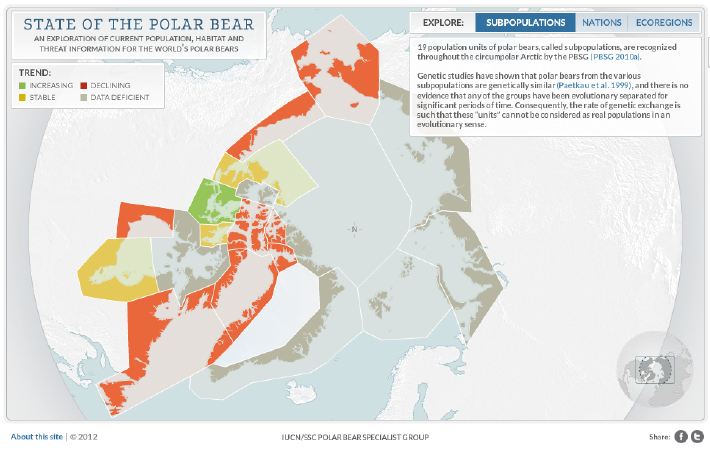
The “tool” consists of three maps – that’s it. They are titled Subpopulations, Nations, and Ecoregions. I previously discussed the population totals by Nation, but when I went back and looked at the Subpopulation numbers, I realized they are very odd as well.

The total population estimate listed on the Subpopulation map add up to just 13,036 – not even close to the 20,000-25,000 “official” estimate. The map (see screen cap below) gives no number (estimate = 0) for the following subpopulations, all of which have an official estimate (see previous post here, estimates from the 2009 PBSG report in square brackets): Foxe Basin [2,197], Viscount Melville [161], Laptev Sea [800-12,00] and Barents Sea [2,650]. On the map below, all of the regions coloured grey have no estimate provided (estimate = 0). In addition, there is no estimate provided for the Chukchi Sea subpopulation, coloured orange in this map, as per the official estimate [you can’t see the numbers given in this screen cap because they only show up when you hover your mouse over the region].

So when you add up the individual estimates provided on each of the two maps on this web tool, you get two different numbers that have no resemblance to the “official” estimate of 20,000-25,000.

"Subpopulation" status, from the Polar Bear Specialist Group special tool, "The State of the Polar Bear." downloaded January 17, 2013

“Subpopulation” status map, from the Polar Bear Specialist Group dynamic web tool, “The State of the Polar Bear.” [downloaded January 17, 2013]. Population estimates for each region show up on the original web-based tool when you hover your mouse over the map. All of the regions coloured grey, as well as one of the orange-coloured regions (Chukchi Sea, centre top), do not have a number provided.

 Vongraven says he is recovering from surgery and so it may be awhile until someone takes a look to see what’s up with this tool. He did not seem overly concerned about it. But he assured me that the official polar bear estimate of 20,000-25,000 has not changed, although it may after the next population review at the PBSG meeting later this year.

The point is this: if you were a high school student or a teacher looking for a simple and authoritative summary on the status of the polar bear, this tool would look very attractive. The IUCN/SSC Polar Bear Specialist Group want us to consider them the ‘premiere’ experts on polar bear numbers worldwide but these maps do not accurately summarize the current state of knowledge about global polar bear population numbers. The maps are misleading and confusing. We may never know who’s bright idea this was but I in my opinion, it’s a dud.

[the “State of the Polar Bear” tool was still up on the PBSG website, in its original state, the last time I looked]

The 32,000 population estimate for polar bears is not an error due to counting overlapping territories twice

UPDATE FEBRUARY 19, 2014The misleading “State of the Polar Bear” graphic is now GONE (as of January 31, 2014). A new 2013 status table is offered by the PBSG here. It has detailed text explanations and harvest information, with references, hyperlinked to each subpopulation entry (“Press the subpopulation hyperlink and more information will appear“) and may have replaced the “State of the Polar Bear” graphic that the PBSG commissioned for upwards of US$50,000, although the PBSG website says it is being “updated” [A pdf copy of the 2013 colour table is here, and my commentary on it is here.] I have left the original post as is, below.

[UPDATE April 1, 2013: see updates here and here ]

This is a brief follow-up to my last post.

I got an email from a reader suggesting that the high numbers for the world’s polar bear population, as given by the Polar Bear Specialist Group (PBSG) on their website in their State of the Polar Bear (SoPB) summary feature – as tallied by nation (22,600-32,000) – may simply be an error resulting from counting overlapping territories twice (i.e. where a subpopulation with one population estimate is shared by two nations, the total amount has been attributed to each nation, rather than giving each of them half of the total).

That is not the case and I’ll tell you why.

If you haven’t yet seen the last post, pop back and have a look – it’s short.

Then note the following:
1) Re: the numbers given for Russia (given as 2,700-4,800 in SoPB-by-nation). Russia has three subpopulations of polar bears: Chukchi (shared with the USA), Kara Sea and Laptev Sea. See previous post here on these estimates by the PBSG.

Chukchi officially has a population of zero because it has never been surveyed. The same is true for the Kara Sea: its population is officially zero and always has been. The Laptev Sea is given a tentative estimate of 800-1,200 in most subpopulation estimates but on the “State of the Polar Bear” summary, it is given as zero. Thus, at the very most, the total for Russia could be 800-1,200.

Conclusion: the estimate of 2,700-4,800 for the Chukchi Sea is not a result of an overlap in count. It’s a new number and there is no information given about where it comes from (it’s remotely possible that the SoPB-by-nation number comes from a recent survey of the Chukchi Sea, see previous post here, but that number has not been made public and the study results have not yet been published).

2) Re: numbers for the USA (given as 1,200-1,800 in SoPB-by-nation). The US has two subpopulations: Southern Beaufort (which it shares with Canada) and the Chukchi Sea (which it shares with Russia). The number usually given for the Southern Beaufort is 1,200-1,800 – so the US share is something like 600-900. While the US shares the Chukchi population with Russia, the Chukchi has never been surveyed – its population is officially zero (half of zero is still zero).

Conclusion: if there has been any “doubling up” going on, it is here. The official (documented) number for the US should be about 600-900.

3) Re: numbers for Greenland (given as 3,500-4,400 in SoPB-by-nation). East Greenland has never been surveyed and the official estimate for that subpopulation is zero. West Greenland comprises three polar bear subpopulations that it shares with Canada: Baffin Bay (total count 1,544-2,604), Davis Strait (total count 1,811-2,534) and Kane Basin (total count 94-234). That comes to 3,449-5,372. Conclusion: if there had been a “doubling” of shared population numbers, the number for Greenland should have been listed in the SoPB-by-nation map as 3,449-5,372 (not 3,500-4,400).

The estimate for the world’s polar bear population, as given by the Polar Bear Specialist Group (PBSG) on their website in their State of the Polar Bear summary feature – as tallied by nation (22,600-32,000) – is not simply an error resulting from counting overlapping territories twice.

Polar bear population now 22,600-32,000 – when tallied by nation

UPDATE FEBRUARY 19, 2014The misleading “State of the Polar Bear” graphic is now GONE (as of January 31, 2014). A new 2013 status table is offered by the PBSG here. It has detailed text explanations and harvest information, with references, hyperlinked to each subpopulation entry (“Press the subpopulation hyperlink and more information will appear“) and may have replaced the “State of the Polar Bear” graphic that the PBSG commissioned for upwards of US$50,000, although the PBSG website says it is being “updated” [A pdf copy of the 2013 colour table is here, and my commentary on it is here.] I have left the original post as is, below.

This afternoon I came across some startling information. [updated here, here from Feb. 10, 2013, and here from April 1, 2013]

According to a dynamic summary report on the home page of the IUCN/SSC Polar Bear Specialist Group website  called State of the Polar Bear, there are now 22,600-32,000 polar bears worldwide, when tallied by nation.

Here are the numbers, by nation, listed in the State of the Polar Bear summary report (see map below):
Canada                              13,300-17,500
USA                                   1,200-1,800
Russia                               2,700-4,800
Norway                             1,900-3,600
Greenland
(Denmark)                        3,5000-4,400
Total                            22,600-32,000

The “Nations” page of the Polar Bear Specialist Group’s “State of the Polar Bear,” a dynamic summary that can be launched from the home page of the IUCN PBSG  http://pbsg.npolar.no/en/dynamic/app/ [published Oct. 15, 2012] Click to enlarge.

The “Nations” page of the Polar Bear Specialist Group’s “State of the Polar Bear,” a dynamic summary that can be launched from the home page of the IUCN PBSG website, http://pbsg.npolar.no/en/ [published Oct. 15, 2012] Click to enlarge.

This is a big change from the 20,000-25,000 that has been touted as the global polar bear population since 2005 (see Aars et al. 2006; Obbard et al. 2010) and my post on polar bear population estimates.
[updated Jan. 9 2013 at 8:20 PST, see end of post]

UPDATE Jan. 7. 2014 – The PBSG has announced that a new population assessment is due later this month, see this January 1 post. The graphic described in this post has moved to the page called “Population information” and the official estimate of 20,000-25,000 is no longer present. There was no press release associated with this announcement.
Continue reading


