Posted onMarch 9, 2024|Comments Off on Hudson Bay polar bears now considered most likely to survive future sea ice loss
Over the last 10 years, Hudson Bay polar bears have morphed from being the “most at risk” across the Arctic to the “least at risk.” Who would have thought?
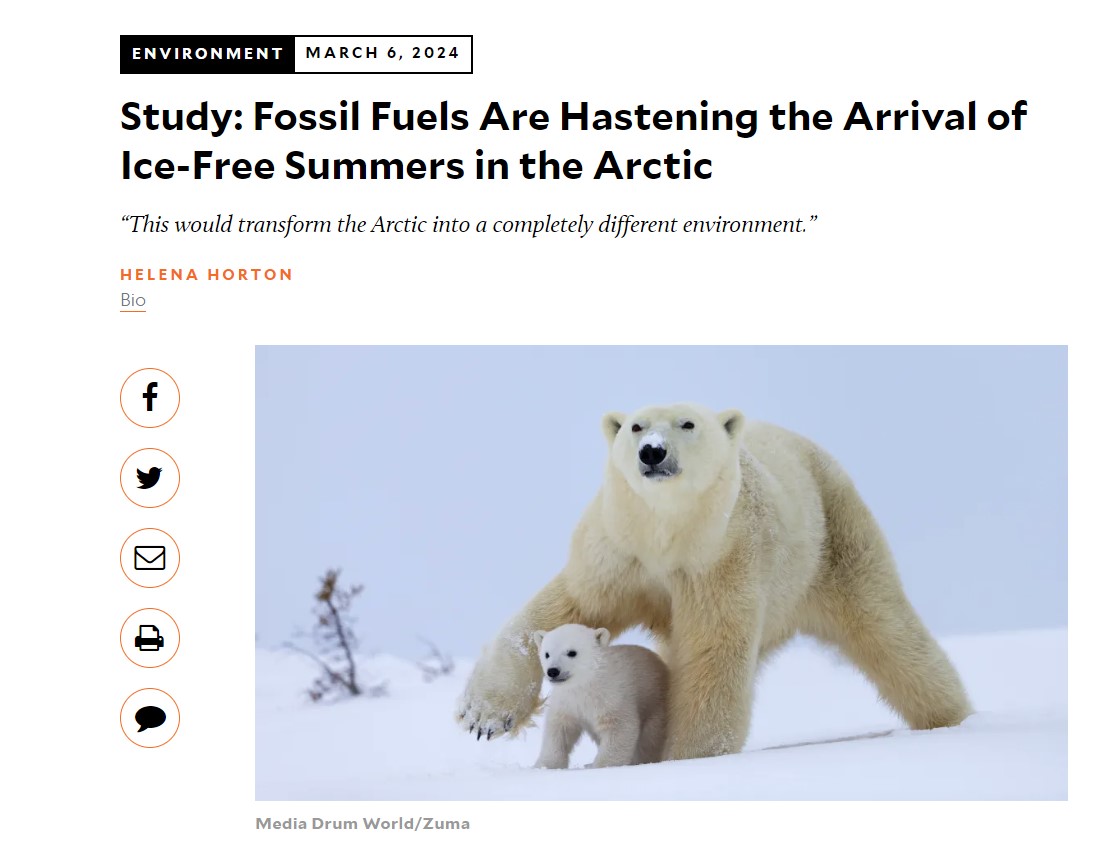
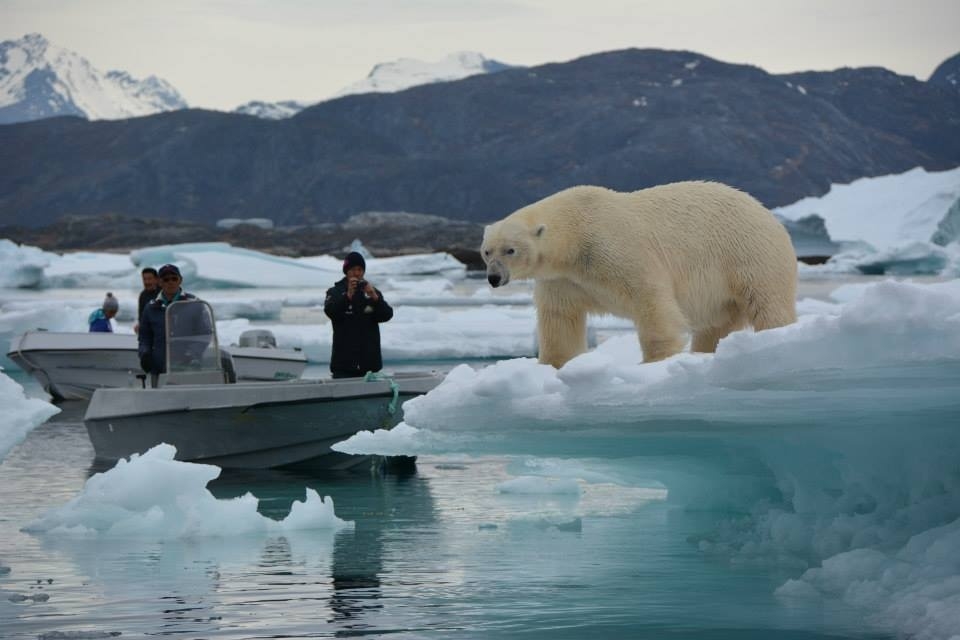
That’s probably because the experts now have to admit that polar bear numbers have not declined since 2004 and bears have been in good body condition since at least 2016. Southern Hudson Bay bears have apparently increased in number since 2016. How ironic is it that the photo above, taken in Hudson Bay — the only Arctic region where trees grow — was used to illustrate a recent Mother Jonesarticle promoting a new prediction of future Arctic summer sea ice loss that’s said to pose a threat to polar bear survival.
Posted onFebruary 20, 2024|Comments Off on NY Times pushes an implausible story of polar bear evolution and what makes a species
Carl Zimmer over at the New York Times penned a misleading story of speciation, using the polar bear as an example. It explains polar bear evolution based on a genetic interpretation that ignores the fossil record, bear behaviour, and geological history. [h/t Kip Hanson].
In my opinion, this kind of ‘science communication’ is more misleading than enlightening because it fails to alert readers to the fact that the topic is actually more complicated and gives the impression that the author considers readers too stupid to understand a more accurate explanation.
Polar Bear Evolution does a better job for those who are really interested in the process: it doesn’t hide the complicated nature of speciation or polar bear evolution. It doesn’t pretend to present “the truth” but explains how a good scientist gets to a plausible explanation that best fits the evidence.
Posted onJanuary 18, 2024|Comments Off on Tom Nelson interview with me about the failed polar bear narrative and rapid evolution
You can watch my interview with Tom Nelson about the latest issues in polar bear conservation and highlights of my latest book, Polar Bear Evolution.
On Youtube:
Tom tells me, “It’s also up on other video sites such as Rumble and BitChute, and will soon be available on other podcast apps such as Apple Podcasts (most, but not all, of those are audio-only). It should also be on Spotify, Google Podcasts, Pocket Casts, Podvine, Overcast, Amazon Music podcasts, Audible podcasts, Castbox, RadioPublic, Twitter, etc.”
Summary: Susan Crockford, a zoologist, discusses the challenges in accurately estimating polar bear populations and the ongoing debate between Inuit communities and polar bear specialists regarding population sizes. She also shares her theory on the role of thyroid hormones in polar bear evolution and the quick adaptation of species to new environments using the example of the Russian foxes.
A list of topics covered, by time-stamp in the interview, is listed below.
Posted onDecember 12, 2023|Comments Off on Churchill end-of-season problem polar bear reports finally published
Today the Town of Churchill finally published the final problem bear reports of the season, which presents an opportunity to do a quick comparison to recent years.
This season lasted 24 weeks, the longest I can remember but apparently only the 5th longest on record. There were a total of 265 incidents by the end of November, more than 100 less than the most recent late-freeze-up year of 2016, which didn’t end until the first week of December (after bears had spent 22 weeks onshore). However, two recent years when freeze-up didn’t come until the end of November (2017 and 2020) had far fewer incidents (more than 100 less each compared to this year).
Posted onDecember 9, 2023|Comments Off on Despite hand-wringing about Churchill polar bears this year, 2023 wasn’t their worst summer
For months, the media has been bleating about the poor polar bears of Churchill suffering from lack of sea ice blamed on human-caused climate change during the so-called ‘hottest year’ on record: in April, July, August, November, and December.
From a Churchill Wild report on the condition of WH polar bears, January 2023
However, while breakup of sea ice on Hudson Bay was indeed early this year and freeze-up came later than usual, Western Hudson polar bears apparently spent only the fifth-longest time on land since 1979, according to a polar bear specialist. How is that even possible, given that sea ice conditions should be getting worse and worse as CO2 levels increase and average global temperatures rise? As I’ve pointed out before, it is apparent that Arctic sea ice is not closely coupled to CO2 levels (as the ‘experts’ claim), which makes me wonder if there is any ecologically-relevant correlation between CO2 and sea ice at all.
Money quote from Geoff York, from Polar Bears International: “As of Nov. 28 this year, the bears in western Hudson Bay had spent 164 days on shore, he said. That’s tied for the fifth-longest amount of time the bears have spent off the ice since 1979.” CBC, 9 December 2023 [my bold]
Posted onNovember 30, 2023|Comments Off on Western Hudson Bay polar bears on their way offshore to hunt seals: freeze-up has begun
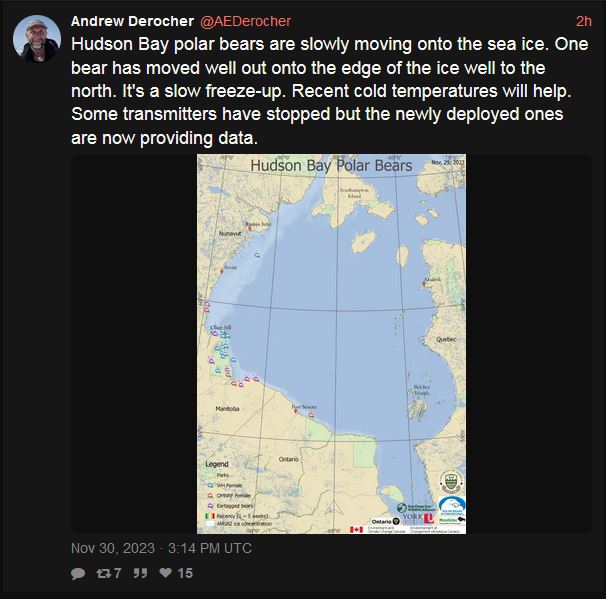
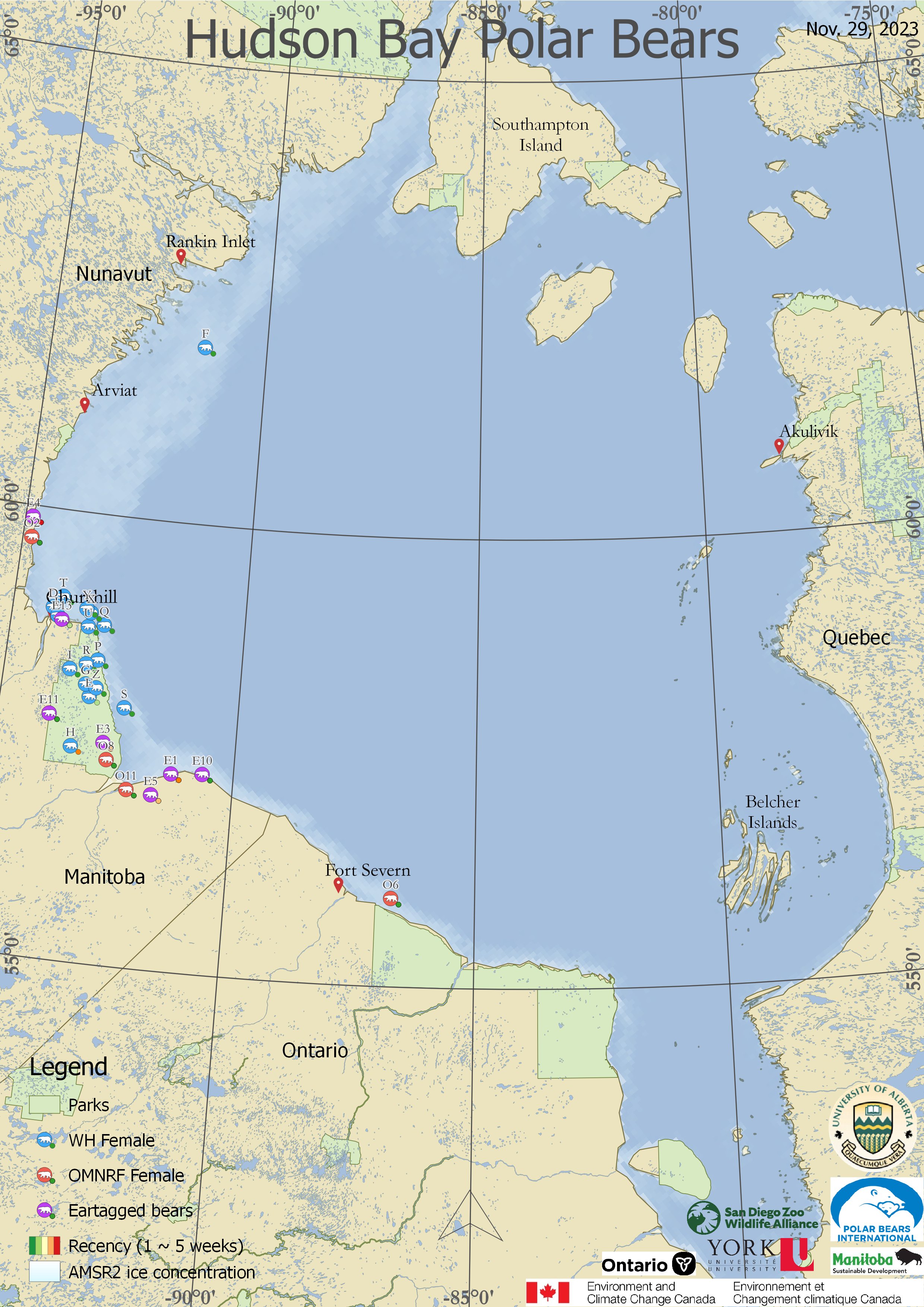
Official confirmation has come in this morning that polar bears that have spent the summer fasting along Western Hudson Bay now have enough ice to move offshore. That makes this year a bit later than usual (average is 16 November) but is not one of the extremely late freeze-ups, as happened in 1981, 2016 and 2021 when bears didn’t leave until the first week of December (Castro de la Guardia et al. 2017; Miller et al. 2022). Since breakup of sea ice came earlier than usual this summer, this means (as of 30 November) many bears will have been off the ice and without food for 166 days or 5.5 months.
Courtesy Andrew Derocher, University of Alberta, who monitors WH bears:
Close-up of the tracking map below. Note that pregnant females will stay ashore to give birth so not all of these tagged bears are expected to head onto the ice this fall to hunt for seals:
Still not a word from the Polar Bear Alert folks in Churchill, who as of today, haven’t released any of their weekly reports since 23 October 2023.
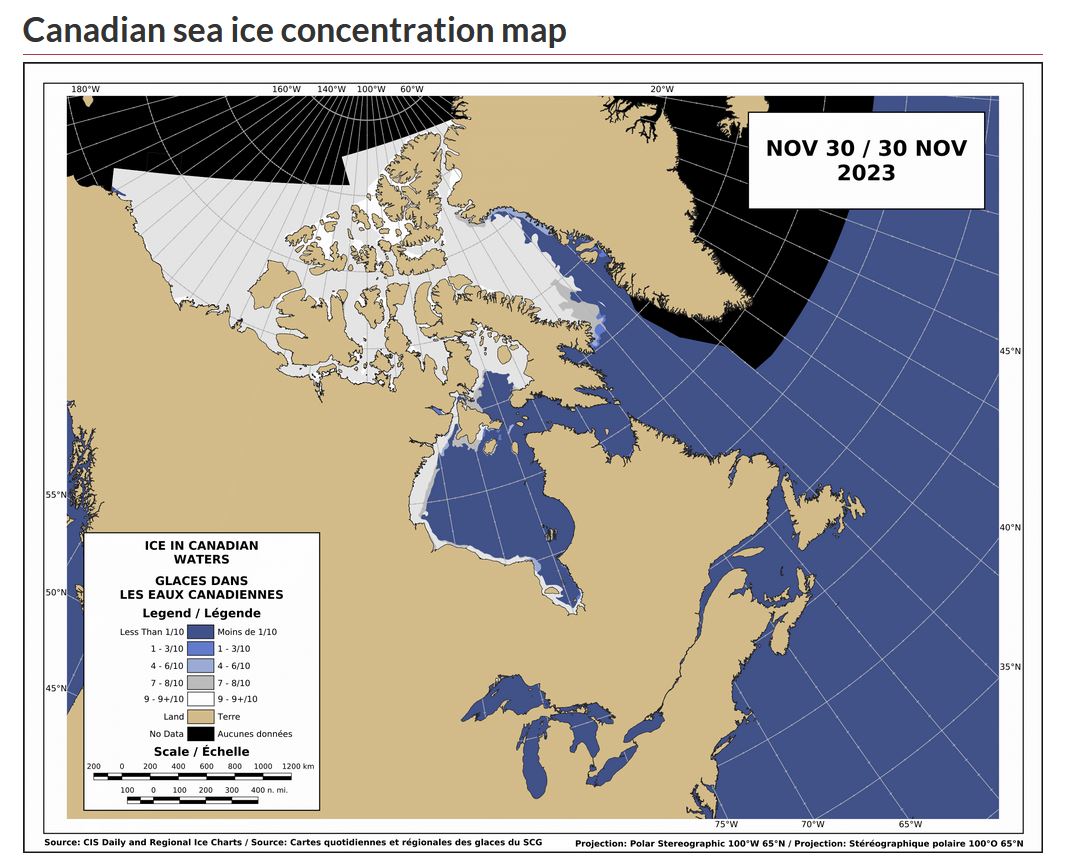
Ice Conditions in Canada
At 30 November 2023, courtesy Canadian Ice Services shows the expanding band of ice developing along the western shore of Hudson Bay but note also that the rest of the Canadian Arctic, as well as the Beaufort Sea, is completely covered in ice, as is most of Baffin Bay and Foxe Basin:
References
Abrahms, B., Carter, N.H., Clark-Wolf, T.J., et al. 2023. Climate change as a global amplifier of human–wildlife conflict. Nature Climate Change 13:224-234. https://doi.org/10.1038/s41558-023-01608-5
Castro de la Guardia, L., Myers, P.G., Derocher, A.E., Lunn, N.J., Terwisscha van Scheltinga, A.D. 2017. Sea ice cycle in western Hudson Bay, Canada, from a polar bear perspective. Marine Ecology Progress Series 564: 225–233. http://www.int-res.com/abstracts/meps/v564/p225-233/
Miller, E.N., Lunn, N.J., McGeachy, D., and Derocher, A.E. 2022. Autumn migration phenology of polar bears (Ursus maritimus) in Hudson Bay, Canada. Polar Biology 45:1023-1034.
Stirling, I. and Derocher, A.E. 2012. Effects of climate warming on polar bears: a review of the evidence. Global Change Biology 18(9): 2694–2706.
Wilder, J.M., Vongraven, D., Atwood, T., et al. 2017. Polar bear attacks on humans: implications of a changing climate. Wildlife Society Bulletin 41(3):537-547. https://doi.org/10.1002/wsb.783
Comments Off on Western Hudson Bay polar bears on their way offshore to hunt seals: freeze-up has begun
Posted onNovember 14, 2023|Comments Off on Walrus and polar bear population size changes in the N. Atlantic over the last 20k years
This is a lesson in how to assess the potential worth of scientific papers. One of two similar Arctic evolution studies got media attention, at least in Canada — about the polar bears, of course — but in my opinion the walrus research conclusions are much better supported, less biased by climate change rhetoric, and lack the hubris present in the polar bear paper.
Both studies use similar sample sizes for the regions they had in common (North Atlantic) and used computer models to determine genetic diversity and population size changes since the LGM. However, the tone of the walrus paper was less emotionally-charged and the caveats of the work were appropriately stated. In my opinion, papers like the polar bear example contribute to eroding the public’s trust in science.
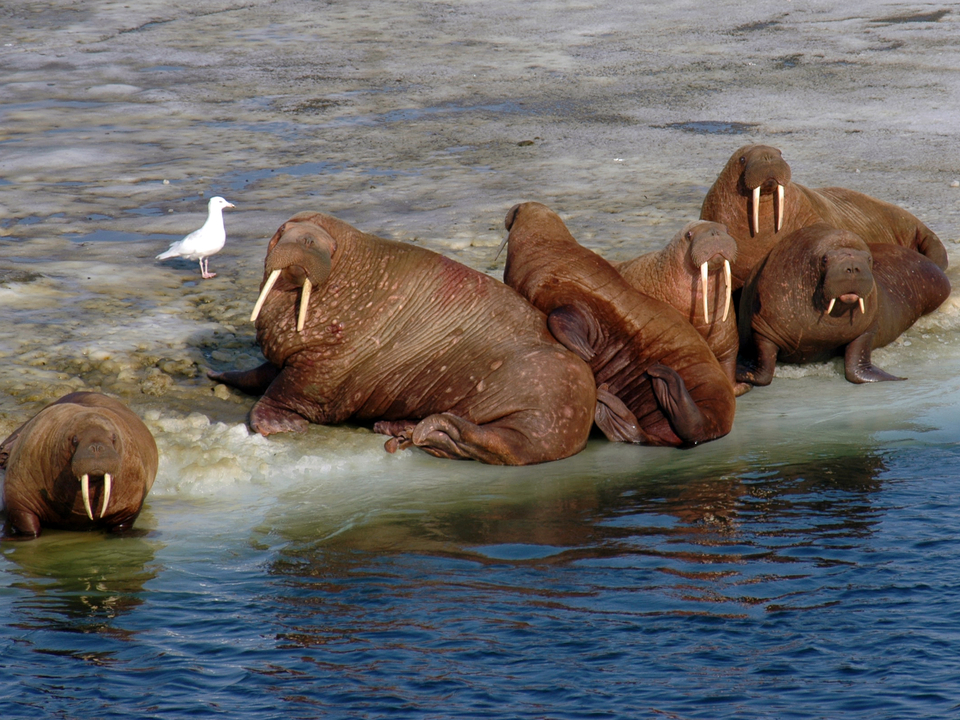
The last Ice Age peaked between about 27,000 and 19,000 years ago. At this time the Arctic was buried under kilometers of glacial ice sheets, and so marine mammals were pushed southwards to areas of ice floes and more open water. Walrus survived in some areas of the Atlantic located further to the south, and as soon as climates warmed again, the ice edge retreated and walrus populations pushed quickly northwards again. This combination of warming and climate-driven dispersal led to local walrus populations becoming more genetically differentiated. Walrus study, Lund University press release 27 September 2023
Posted onNovember 8, 2023|Comments Off on Polar Bear Evolution pre-Christmas book sale: discounts on all formats!
I have reduced prices on all formats of my Polar Bear Evolution book for four weeks starting today (8 November-6 December 2023), in time for holiday gift-giving. The ebook version has the largest price reduction (60% of regular price, to US$17.40) but the other discounts are also substantial. This sale is a time limited offer: don’t miss out! Links below.
The author of Polar Bear Evolution, Susan Crockford, is a good, credentialed scientist. Her writing is clear; her thinking is also. She has a broad understanding of biology and an informed paleo perspective. Crockford condenses a very large literature on polar bear biology and evolution in this book which will help readers understand the science related to the evolution of an Arctic species. Perhaps the most important aspect of this book is its synthesis of information from the fields of wildlife biology, molecular evolution, paleontology, and climate. Her original ideas and hypotheses on thyroid hormone’s role in evolution are very important and add a credible mechanism of phenotypic change which complements the literature on molecular genetic evolution. Polar Bear Evolution is an important contribution to science and its application in evolutionary biology and wildlife biology. Matthew A. Cronin, Ph.D.
Available at the links below (others also available):
Posted onOctober 16, 2023|Comments Off on Polar bear researchers hiding significant increase in Southern Hudson Bay numbers
Last December, researchers vigorously promoted a possible 27% decline in Western Hudson Bay (WH) polar bear abundance but kept hidden the fact that adjacent Southern Hudson Bay (SH) numbers increased by 30% over the same period.
And surprise, surprise: the bombshell SH results call into question everything the ‘experts’ have been saying about polar bears in Hudson Bay for years.
Posted onOctober 6, 2023|Comments Off on Feeding time for Russian polar bears as shorefast ice returns to Laptev Sea, ice-generator of the Arctic
Fall is the second-most important feeding season for polar bears after spring but it comes at different times for different subpopulations. Sea ice formation along shorelines attracts fish and seals and that means polar bears which spent the summer onshore will soon eat again after their summer fast. As usual, the earliest ice formation this year is along the coast of the Laptev Sea, which is one of the primary ‘ice-generators’ of Arctic sea ice. Western and Southern Hudson Bay bears will have longer to wait but the ice will eventually come to them too.
Three adult male polar bears share a seal kill on the newly-formed ice off Wapusk National Park, Western Hudson Bay. 5 November 2020. Buggy cam, Explore.org
Watch polar bear habitat reform in the Canadian Arctic: “last 10 days” Canadian Ice Service animation (works anytime) HERE.
See Quote archive for details.











 polarbearscience
You must be logged in to post a comment.