Tag Archives: polar bear

Ancient polar bear skulls looted from Bering Sea graves to be returned

A different kind of polar bear news story caught my eye this morning: “Funerary polar bear skulls may be returned to St. Lawrence Island.”

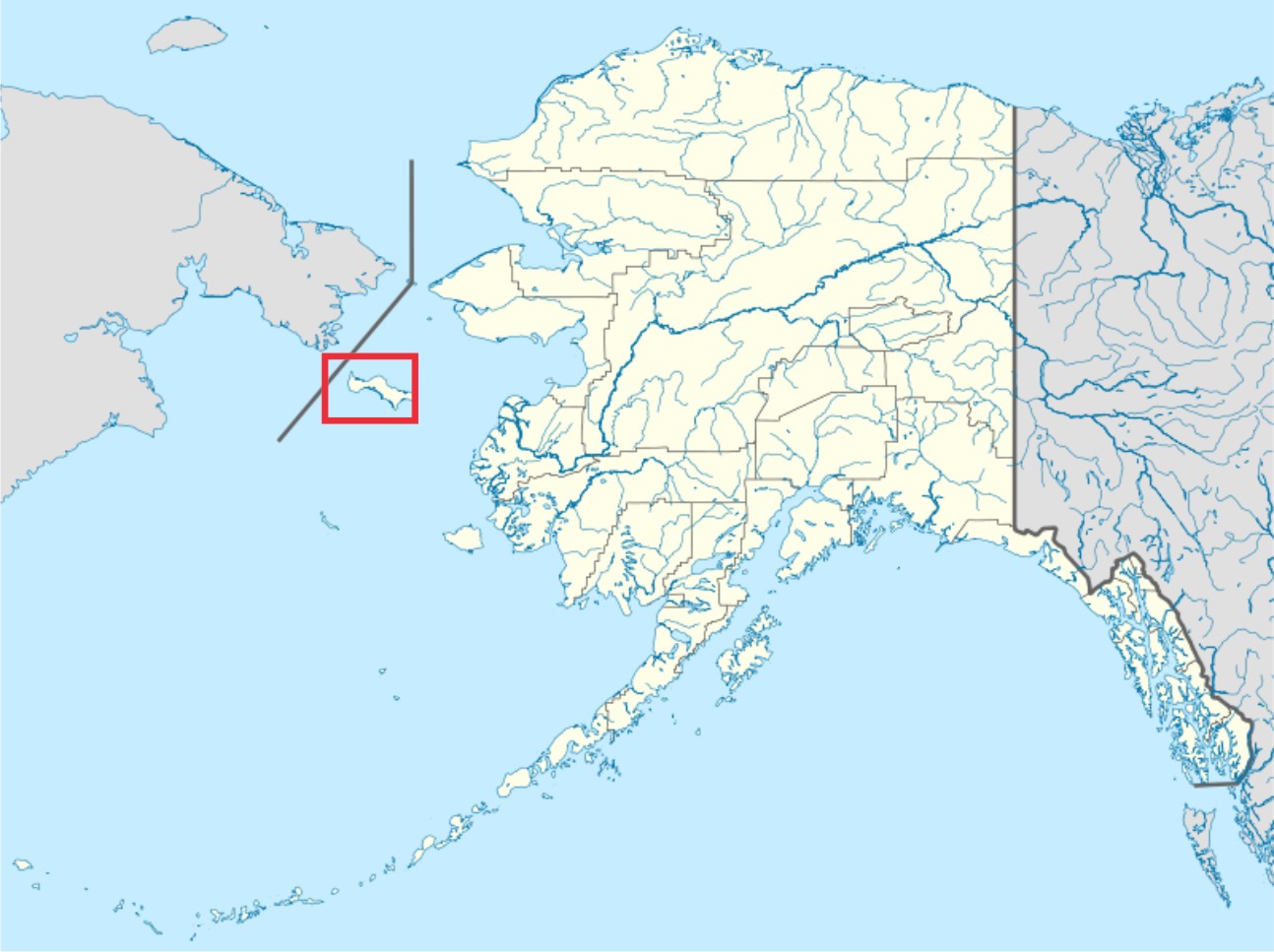
St. Lawrence Island, Alaska lies just south of the Bering Strait (see map below). It has strong historical ties to Russia but lies within US territory; it also lies within the “Chukchi Sea” polar bear subpopulation region.

St Lawrence island wikipedia marked

The story I found talks of “hundreds of polar bear bones, mostly skulls” that had been excavated from ancient human graves on St. Lawrence Island between 1930 and 1960. Hundreds!

These polar bear skulls and other bones had been stored separately from the carved ivory artifacts and other goodies plundered removed from graves (a formerly common practice). The museum in New York had only recently found them in storage and was preparing to return them, as the law now stipulates.

St. Lawrence Island is an important region for understanding the development of Inuit culture and the history of the Arctic. I could tell you a story about that (based on my peer-reviewed published papers) but I’ll save it for another long winter’s night.

However, my knowledge of the region meant I found the short online summary frustratingly devoid of detail, so I went a’Googling and found that a total of 376 polar bear skulls were involved. Worth the effort, I think – have a look.

[Update evening of December 12, 2013 – I’ve been mulling over in my mind all day whether using the word “looting” in my title (and in the text above, “plundered”) was warranted and decided in the end that it was perhaps not quite fair. To be sure, looting of graves and midden sites has occurred on a massive scale on St. Lawrence Island but Dr. Geist was doing archaeology as it was legally practiced in those days, and he did, on one occasion at least (see below), ask permission of relatives to remove items. Still, the people of St. Lawrence Island may well perceive all of the disturbance of their ancestors graves to be looting or plundering. So, I changed the “plundered” in the text to “removed” but left the title as I wrote it — as a reminder for readers to think about whether or not calling these actions “looting” is unfair.]
Continue reading

Furor over a tweet from the Moscow polar bear forum

The ousting of WWF and their cohorts from meetings to which they had initially been invited is the real story (so far) coming out of the International Forum on Conservation of Polar Bears (December 3-6, Moscow). However, that incident never made the mainstream media, so few people will ever know it happened.

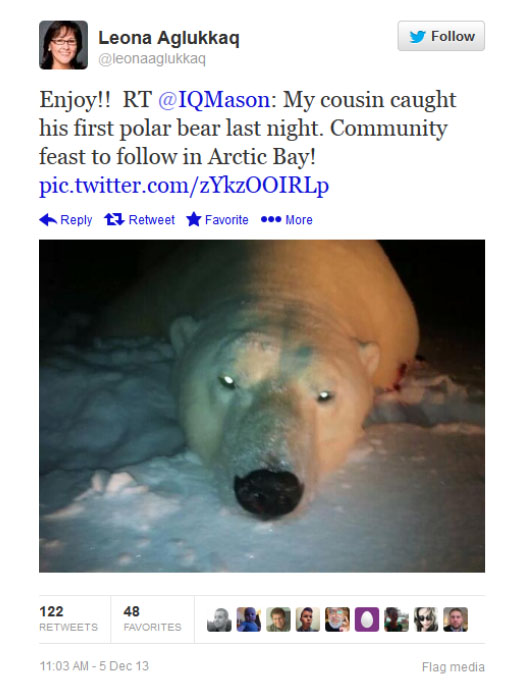
What the public did hear about was the uproar over a tweet.

On the last day of the meeting, Canada’s Environment Minister Leona Aglukkaq drove home, in less than 140 characters and a photo, the point she and her contingent had been trying to make at the meeting.

Aglukkaq tweet_Dec 5 2013
A twitter storm erupted that got really nasty — and the media picked up on it. Within hours, newspapers across Canada had themselves a story.

Continue reading

WWF and cohorts barred from Moscow polar bear forum

Despite the fact that the World Wildlife Fund (WWF) apparently provided a significant portion of the funding for the recently concluded International Forum on Conservation of Polar Bears (December 3-6, Moscow), it appears in the end they and their NGO cohorts were prevented from having an undue amount of influence at the meeting. For that we can thank the delegates of the five Arctic nations: three cheers for common sense!

This news did not emerge until late yesterday (Friday, Dec. 6), after the meeting had concluded: no mention was made of NGOs being excluded in the press releases and stories written before then. For example, see IUCN story, Dec. 5; WWF story, Dec. 4; Times of India report, Dec. 5 and this Arctic Journal story Dec. 6. There was nothing in any of them about NGOs and journalists being barred from parts of the meeting they thought they would be allowed to attend.

Note that biologist Mitch Taylor, booted-out of the Polar Bear Specialist Group because he did not agree with the group’s position on global warming, attended as part of the Canadian contingent (see list at the end of this post), which was a bit of a surprise. However, the exclusion from the meeting of WWF and their buddies is the big news as far as I’m concerned.

[The media seems more interested in the fallout from a twitter message sent on the final day of the meeting by Canada’s Environment Minister Leona Aglukkaq — more on that in my next post].

Continue reading

Polar bear conservation: the next 10 years

As 2013 marks the 40th anniversary of the signing of an international agreement to protect polar bears from commercial and unregulated sport hunting, many eyes are looking to the immediate future. What should polar bear conservation look like over the next 10 years?
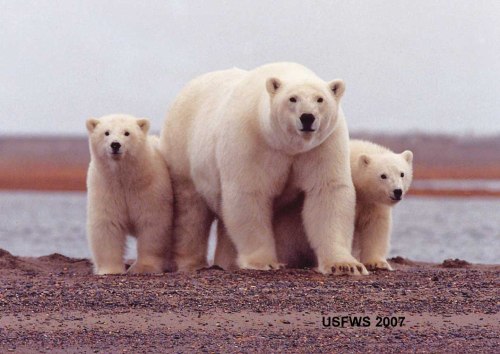
Do we base conservation measures over the next 10 years on the grim computer-generated scenarios predicted to occur decades from now or on the positive news from recent polar bear studies?

Should we base conservation measures over the next 10 years on the grim computer-generated scenarios predicted to occur decades from now or on the positive news coming from recent polar bear studies?

This week (December 3-6), the five Arctic nations that signed the original agreement are meeting in Moscow to examine this issue and renew the vows they took back in 1973 — but with a decidedly new focus (International Forum on Conservation of Polar Bears).

According to the draft agenda, the delegates will address among other things the perceived threats of future sea ice declines due to climate change and trade in polar bear trophies.

However, polar bears are currently doing well despite recent declines in summer sea ice, and CITES rejected a US-led proposal to ban polar bear trade at their meeting last March – as they did in 2010 – because it was deemed unwarranted.

At this time, polar bear numbers have not declined due to climate change: their “threatened” status in some countries is based on computer-modeled predictions of what might happen three or more decades from now, not ten years ahead.

In fact, polar bears are a conservation success story. Their numbers have rebounded remarkably since 1973: there are many more polar bears now than there were 40 years ago. While polar bear numbers appear to have been stable since 2001 (at 20,000-25,000 bears), this is based on creative accounting by the IUCN Polar Bear Specialist Group (PBSG). Numbers have actually increased by about 2,600 to 5,700 bears since 2001.

The last assessment made by the PBSG in 2009 showed only one polar bear population (Western Hudson Bay) had a statistically significant decline in recent years. Numbers of Western Hudson Bay bears declined 22% between 1998 and 2004, which has been blamed on declining sea ice cover over the last 20 years.

[While a new population estimate, showing a further decline in Western Hudson Bay bears, was released to The Guardian (UK) newspaper last week, that estimate comes from a report that has not yet been made public by Environment Canada. Details of the study are unknown.]

Compare this situation to the adjacent population that lives in Southern Hudson Bay. Polar bears in Southern Hudson Bay have experienced the same increase in length of ice-free season as bears in Western Hudson Bay, but the Southern Hudson Bay population has remained stable over the last 30 years.

Why would a slight lengthening of the ice-free season devastate Western Hudson Bay bears but leave Southern Hudson Bay bear numbers unaffected? Perhaps, it’s because the population in the west has been returning to a smaller, sustainable level after rapid population growth in the 1980s: bears had been heavily over-hunted in Western Hudson Bay before the 1973 protection treaty was enacted.

Aside from the documented declines in Western Hudson Bay, a few other populations were assumed by the PBSG in 2009 to be declining. However, these assessments were based on computer projections over 10 years rather than an actual decline in numbers. Since then, there has not been an official PBSG update of the global population estimate.

We do know that in many regions of the Arctic, polar bears are doing just fine. For example, a recent study shows that bears in the Chukchi Sea are in excellent condition and reproducing very well, despite a dramatic decline in summer sea ice. Contrary to what the computer models predicted, Chukchi bears (shared between the US and Russia) are doing better than virtually all other polar bear populations.

In the Chukchi Sea, ringed seals – the primary prey of polar bears everywhere, now listed as “threatened” in the USA – are also doing better now than they were 20 years ago. As a consequence, bears had more food the next spring, not less, despite the marked decline of summer sea ice.

In fact, polar bear populations in a number of regions have not responded as predicted to recent summer sea ice losses, calling into question the accuracy of models that predicted a decline of 2/3 of the world’s polar bears by mid-century.

This is not really surprising, since we know that over geological time, polar bears have survived extended periods of much less ice than today. A recent genetic study indicated that polar bears survived the Eemian interglacial (130,000 to 115,000 years ago) with a relatively large population, despite much less ice than today. Computer models, on the other hand, predicted almost total extinction of polar bears under similar conditions.

Why this disconnect between predictions and reality? It turns out that summer ice melt (the level recorded in September, announced with much fanfare every year) has impacted polar bears much less than expected. That’s because spring is the prime feeding period for the big white bears, and spring ice coverage (March to June) has changed little over the last 30 years.

In other words, the focus on declines in summer sea ice as a major threat to polar bear survival is a red herring.

Polar bears were indeed threatened with extinction by the early 1970s and Arctic nations were quite correct to sign a treaty to protect them from unregulated hunting. But today, polar bears have a large population that is well distributed throughout their available territory, a recognized characteristic of a healthy species.

Polar bears were brought back from the brink of extinction and are now thriving. Instead of rejoicing over the success of 40 years of good conservation practices and planning to do more of the same, the focus of this week’s meeting of Arctic nations appears to be speculating what awful things might happen decades from now.

Everyone wants to see polar bears continue to thrive. In my opinion, what we need over the next 10 years is dispassionate scientific information — something that has been sorely lacking over the last decade. More polar bear research is absolutely a requirement but we need the results presented without emotional appeals for a particular agenda. Objective scientific information will most effectively guide rational polar bear conservation and sound management practices.

What we don’t need is a computer-manufactured crisis to replace a problem that’s already been solved — or a ban on trade of a healthy species, unless there is very strong evidence of organized poaching and illegal trade.

Ultimately, what will the meeting in Moscow accomplish? It appears that any agreement signed by government representatives will not be a legally binding contract, in contrast to the 1973 treaty. Over the next few days, the press releases and news reports will tell us what the parties involved think they achieved.

International polar bear forum, Moscow: who’s invited

Re: International Forum on Conservation of Polar Bears: December 3-6, Moscow.

[Updates added Dec. 2 and Dec. 3, 2013, as noted below]

[Updated Dec. 4, 2013: Final agenda here; and as noted below]

On Tuesday, setup begins for the Moscow meeting of all Arctic nations that signed the original agreement to protect polar bears back in 1973. In my post last week, I introduced the agenda (pdf here).

I’ve also made notes on the interesting mix of folks who’ve been invited.
Continue reading

Polar bear researchers still withholding Hudson Bay data

The latest polar bear propaganda emanating from The Guardian is unscientific nonsense fed to them by activist Canadian polar bear researchers: Polar bear numbers in Hudson Bay of Canada on verge of collapse.

This episode of Goldenberg’s polar bear grandstanding includes a photo caption with a totally unsubstantiated claim that some folks might call a lie:

Melting ice is cutting polar bears off from their food source in Hudson Bay, and death rates have soared.

“Death rates have soared”? Where are all the bodies? Show us the starving bears!

In fact, the ice of Hudson Bay melts every summer and always has done. When it does, polar bears go ashore and live off the many inches of stored blubber they put on during their spring feasting on fat baby seals. The last three years, the open-water season has been only about two weeks longer than it was in the 1980s. There has been no steady increase but lots of variability.

Below I dismantle the rest of this transparently political posturing ahead of the international polar bear forum next week.
Continue reading

Human-polar bear conflicts: Stirling 1974 vs. Amstrup 2013

What a difference a few decades makes to attitudes about human-polar bear conflicts:

Ian Stirling, 1974:

Dr. Stirling felt that complete cessation of hunting, such as exists in Norway, may increase bear-man conflicts. Dr. Reimers replied that the careful harvesting of polar bears was probably desirable, but the total ban now in effect was largely an emotional and political decision rather than a biological one. Last year four bears were killed in self-defense.” [my bold]
(1974 PBSG meeting “Norway – progress reported by [Thor] Larsen”; Anonymous 1976:11).

Stephen Amstrup, 2013:

“We have predicted in no uncertain times [sic – terms?] that as bears become hungrier as the sea ice absence period is longer, more and more of these animals are going to be venturing into communities, venturing into villages, raiding food caches, getting into garbage, and even attacking people. So we predict these kinds of events are going to be more frequent and more severe because of climate change. [my bold]
(The Guardian, November 4, 2013).

Continue reading

Eemian excuses: the warm was different then, polar bears were fine

Today I’ll discuss the response by Polar Bears International representative Steven Amstrup to a comment submitted during their recent “webchat” at The Guardian (Wednesday, November 6), which had to do with the fact that polar bears survived warm periods in the geological past, particularly interglacials.

[Here’s a pdf file of all the questions that were answered by PBI staff: PBI webchat Q&A, also available here]

This is the comment (the first portion of #4 on my list), submitted by MarkBLR:

There was a paper in Science magazine last year (link …) indicating that polar bears became a distinct species about 600kya (+/- 300k years).

This means that they have survived at least two (and possibly eight) previous inter-glacials, in particular the Eemian (130kya to 110kya), when temperatures in the Arctic were 5 to 8 degrees Celcius warmer than current temperatures for several thousand years.

Note that their numbers apparently decreased significantly during the Eemian, and slowly increased as temperatures cooled, but “climate change” was not enough on its own to make them extinct. [my bold]

[We can perhaps forgive Mark for not being able to spell “Celsius” correctly, but Amstrup (see below) has no excuse. The paper in Science Mark refers to is Hailer et al. 2012, discussed in a previous post here. Note that the actual question Mark asked is not included here because Amstrup responded to this portion of his comment only]

Amstrup tries to convince Mark and other readers that polar bear resilience through Eemian warming is irrelevant to the issue of future survival, which I’ll demonstrate is not the case at all.

Here is what Amstrup had to say:
Continue reading

Challenging “save the polar bear” propaganda

[Updates: Note correction to point 6 and links added at the end of the post]

Polar Bears International has mustered the UK newspaper, The Guardian, to provide free publicity for a “save the polar bear” propaganda event coming up tomorrow, November 6.

From The Guardian Environment Blog:

“On Wednesday, 6 November at 10am EST and 3pm GMT you will have a chance to ask a scientist [Steven Amstrup] and a conservationist [Krista Wright] about the latest research on the state of polar bears – and the efforts to protect them.”

The “participants” of this webchat are Polar Bears International (PBI) employees. PBI is a lobbyist organization that uses its influence to pressure politicians and supposedly impartial scientific organizations, like the IUCN Polar Bear Specialist Group (PBSG), to make decisions that fit their agenda. The PBI rallying cry is “Save Our Sea Ice.They are committed to promoting legislation to curtail supposed effects of anthropogenic global warming and are using polar bears as a tool to do so.

Dr. Steve Amstrup is now a full-time, professional activist and spokesperson for PBI (Chief Scientist and Vice President”), a job he took on after a long career as a polar bear biologist. Arranging “webchats” like this is part of the job he is now paid to do.

Krista Wright has a Bachelors degree in Outdoor Education and has worked for NGOs for more than 20 years. She joined PBI in 2009 and is now the Executive Director (i.e., an administrator). She is described as “a passionate conservationist who is deeply concerned about the effects of global warming on polar bears, the Arctic, and the planet.She brings emotion to this event, not science.

Below I dissect some of the fear-mongering background presented at The Guardian, one point at a time; Guardian quotes are in italics, numbered; my responses are below, with links to pertinent previous posts that are fully referenced:

[Links to video and the webchat Q & A have been added at the end of this post as updates]

Continue reading

Churchill polar bear attack shamelessly used to advance global warming agenda

I guess Suzanne Goldenberg, writing for The Guardian, just couldn’t help herself with this latest story (November 4):Polar bear attacks: scientists warn of fresh dangers in warming Arctic. Two people injured in latest attack as hungry bears deprived of access to sea ice increasingly look for food on land.

Reporting on the attack is one thing — several papers covered this over the weekend (see Featured Quote #46, posted yesterday, for links to two of them). However, Goldenberg shamelessly makes this about global warming, aided and abetted by Polar Bears International (PBI) representative Steven Amstrup, a claim that doesn’t hold up to even minor scrutiny.

Continue reading