Tag Archives: polar bear

Polar bear habitat update – January 2014

Sea ice in the Arctic a bit below the 1981-2010 average for this date  but still within two standard deviations, with more ice than average off Canada — indicating we are still within expected natural variation, statistically speaking.

Remember that the National Snow and Ice Data Center (NSIDC) says this about standard deviation:

“Measurements that fall far outside of the two standard deviation range or consistently fall outside that range suggest that something unusual is occurring that can’t be explained by normal processes.”

Ice maps below, click to enlarge.

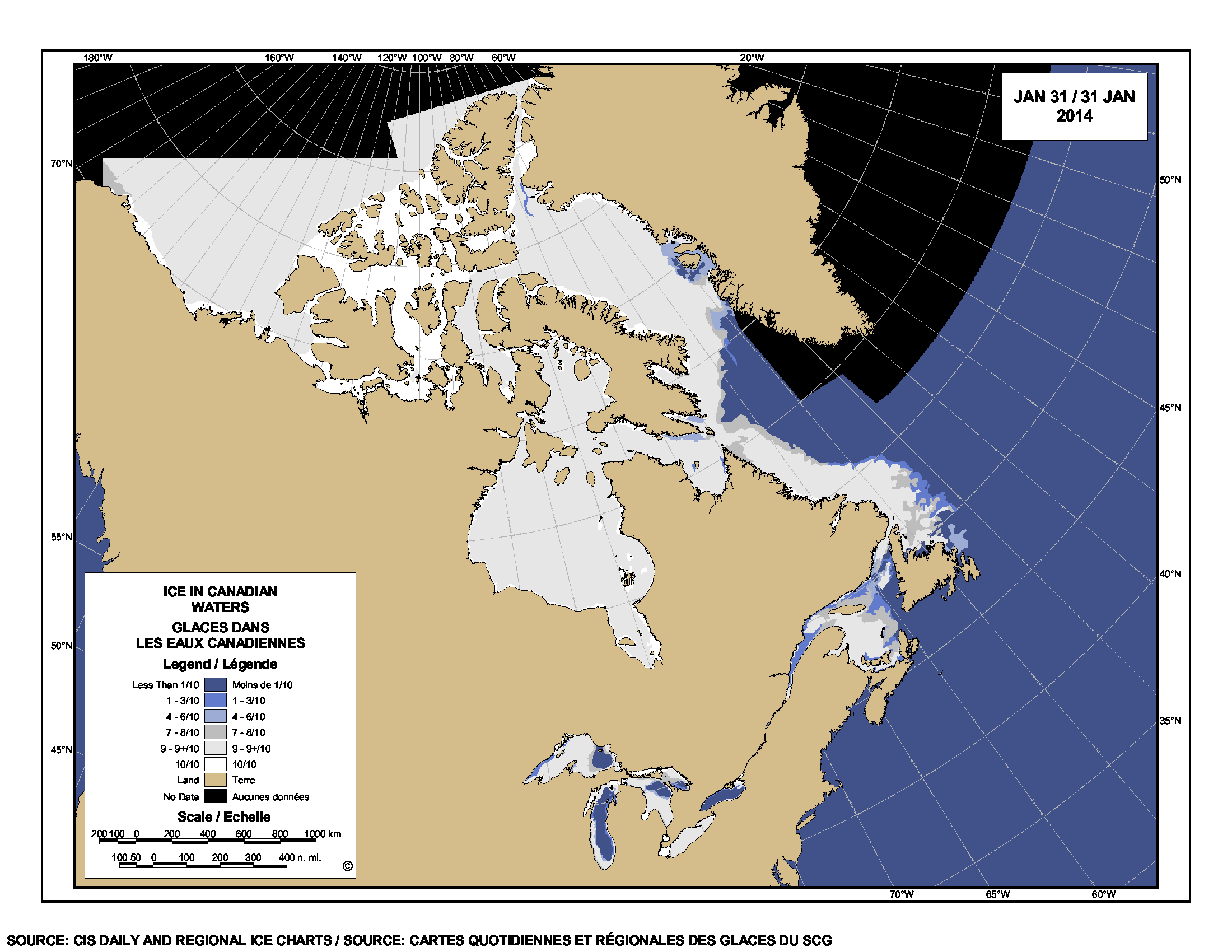
 Figure 1. Sea ice and lake ice concentration from the Canadian Ice Service (CIS) for 31 January, 2014. Note the amount of ice in the east, off Labrador (the “Davis Strait” polar bear subpopulation).


Figure 1. Sea ice and lake ice concentration from the Canadian Ice Service (CIS) for 31 January, 2014. Note the amount of ice in the east, off Labrador (the “Davis Strait” polar bear subpopulation).

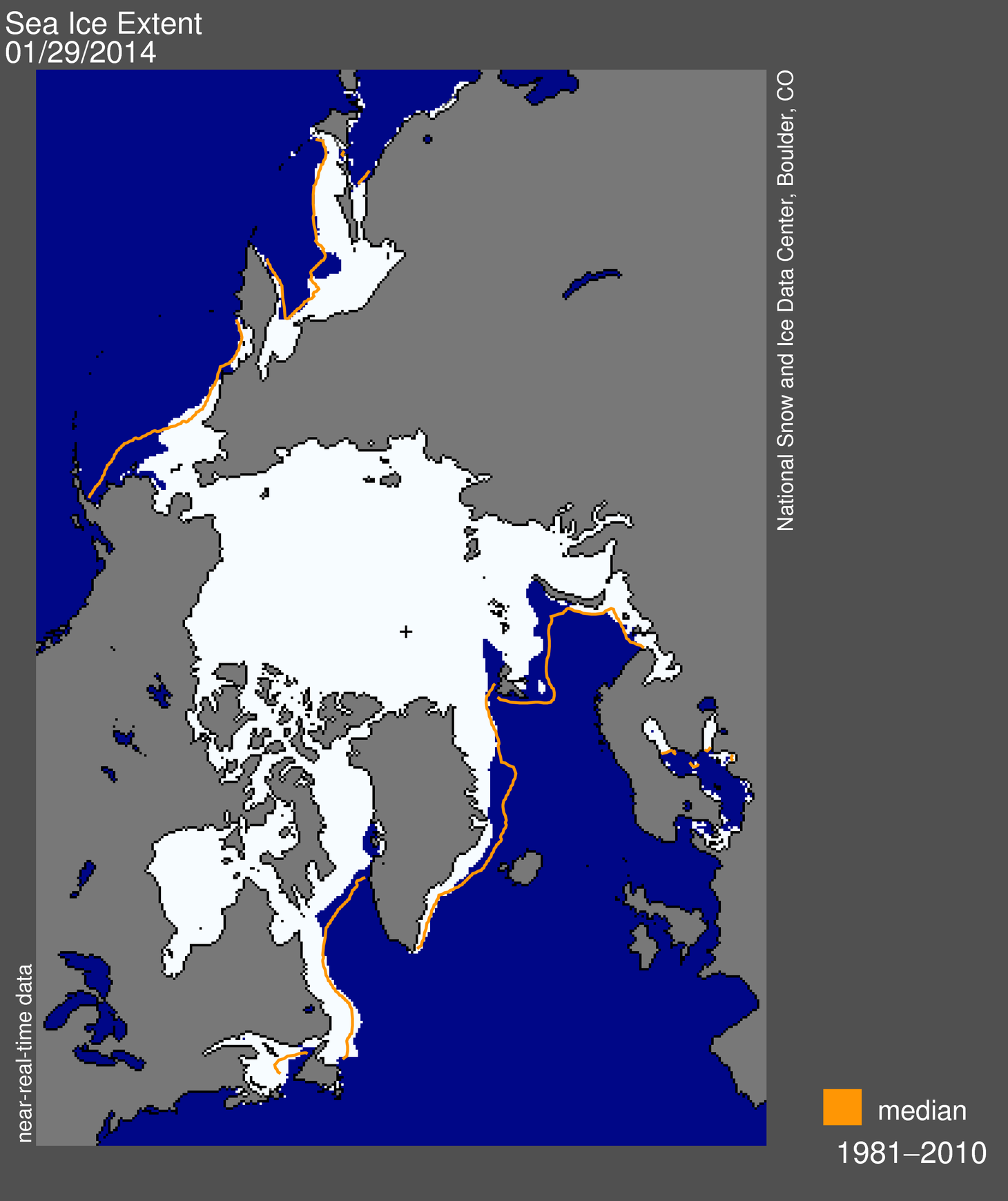
Figure 2. Sea ice extent from the National Snow and Ice Data Center (NSIDC) for 29 January 2014. Note that the extent of ice in eastern Canada noted in Fig. 1 is slightly more than the 1981-2010 average (the orange line), while other areas have slightly less than average for this date. Compare ice growth over the last month to Fig. 3 below.

Figure 2. Sea ice extent from the National Snow and Ice Data Center (NSIDC) for 29 January 2014. Note that the extent of ice in eastern Canada noted in Fig. 1 is slightly more than the 1981-2010 average (the orange line), while other areas have slightly less than average for this date. Compare ice growth over the last month to Fig. 3 below.

Continue reading

New interactive sea ice atlas for Alaska, 1953-2012: check out past polar bear habitat

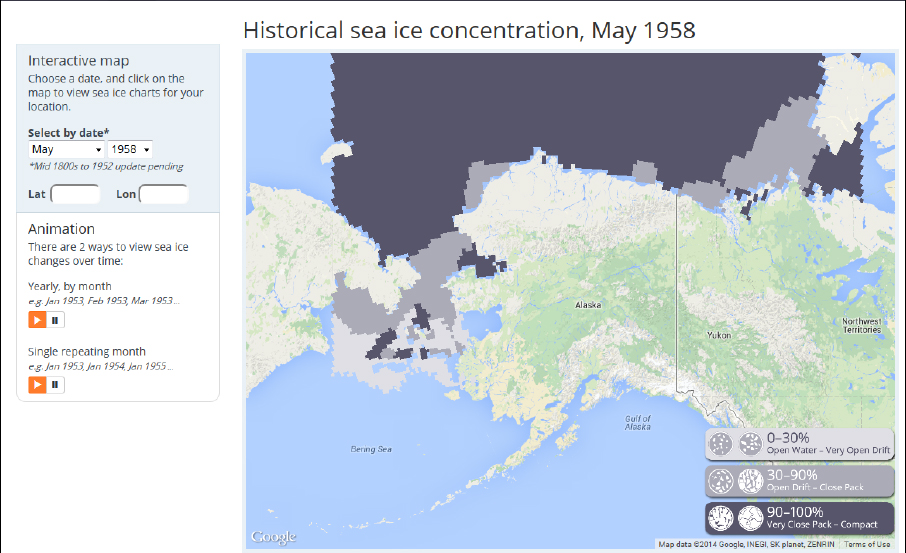
University of Alaska Fairbanks (UAF) is offering a new interactive sea ice map (which they call an atlas), that looks interesting and potentially useful, announced at Alaska Dispatch over the weekend (January 25, 2014: New sea ice map offers a long-term look at climate change).

UAF Sea ice atlas_May 1958 screenshot

At the moment, the years and months available include January 1953 to December 2012. Oddly, 2013 data is not included. The sea ice atlas charts polar bear habitat for the Southern Beaufort and Chukchi Sea subpopulations (including the Bering Sea), as well as the western portion of the Northern Beaufort Sea subpopulation region.
Continue reading

Churchill polar bears eat more caribou and geese now than in 1968 because there are more caribou and geese, new research reveals

The press release (pdf here) issued by the American Museum of Natural History (AMNH) a few days ago, regarding several recent papers on polar bear consumption of terrestrial foods around Churchill, Manitoba (Western Hudson Bay), left a lot to be desired in terms of relaying accurate information.

21 August 2021 UPDATE: I have amended this post to correct some comments I made originally about the definition of ‘spring breakup’ of sea ice on Hudson Bay. While the ice indeed begins to break up in spring (usually defined for the Arctic as April-June, bears rarely come ashore before July 1 (summer being July-September). Confusion comes from the standard meteorological method of the defining ‘breakup’ for Western Hudson Bay as the date when ice coverage drops below 50% of the area, rather than the newer, more relevant date when most polar bears have actually come ashore after the date ice coverage reaches 30% (Castro de la Guardia et al. 2017). Using the modern method, the earliest breakup date was in 1999 (17 June), which was still the case in 2021).

Recent research on polar bear diets by Robert Rockwell and Linda Gormezano, it says, suggests that an increase in the consumption of caribou and snow geese since 1968 is a sign that the polar bears are nutritionally stressed due to recent sea ice changes in spring (blamed on global warming) but may be adapting by changing their summer/fall diet.

As the AMNH press release puts it:

polar bears in the warming Arctic are turning to alternate food sources.”
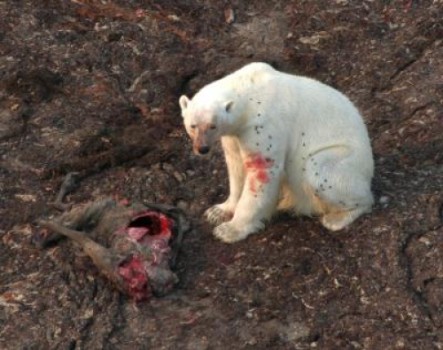
Figure 1. Polar bear feeding on a caribou carcass, taken July 26, 2010. This photo was included in one of the papers cited in the January 2014 press release (Gormezano and Rockwell 2013:3518) and was clearly taken from the air. The caption in the paper says simply, “a polar bear looks up from the recently killed caribou it was eating,” so the bear may not have killed the caribou – some other predator (wolf or grizzly) may have made the actual kill. The dark spots on the bear appear to be flies. Credit Copyright American Museum of Natural History/ R. Rockwell.

Figure 1. Polar bear feeding on a caribou carcass, taken July 26, 2010, from the air. This photo was included in virtually all media reports and in Gormezano and Rockwell (2013a:3518, Fig. 3). The caption in the paper says, “a polar bear looks up from the recently killed caribou it was eating,” implying the bear may not have actually killed the caribou – some other predator (wolf or grizzly) may have made the kill. The dark spots on the bear appear to be flies. Credit: Copyright American Museum of Natural History/R. Rockwell.

However, the AMNH press release fails to mention – as the papers it publicizes certainly do – that Western Hudson Bay populations of caribou and snow geese have increased exponentially since a similar polar bear diet study was done in 1968/69. In other words, there were hardly any caribou or geese around back in the late 60s — little wonder polar bears weren’t eating any.

While evidence of polar bears consuming caribou and geese in recent years is certainly an “increase” over late 1960s levels, that fact says more about the status of caribou and geese populations than it does about polar bears and global warming. Media outlets that quoted the press release verbatim, as many do these days (e.g. here, here, and here), missed this essential part of the story – and of course, so did their readers.

[one story picked up the goose population increase and another revealed the caribou population increase, but none that I saw caught both]

In addition, the AMNH press release makes this erroneous statement that was picked up by every media outlet I saw except one (either exactly as written or reworded slightly):

Climate warming is reducing the availability of their ice habitat, especially in the spring when polar bears gain most of their annual fat reserves by consuming seal pups before coming ashore for the summer.” [my bold]

The earliest breakup dates since 1991 for Western Hudson Bay, where this research was done, have been mid-June (according to the most recent study by Cherry et al. 2013) and for the last few years breakup has occurred in July.

Overall, the press release and resulting media reports seem to be further examples of hyping global warming at the expense of the actual science involved and I have to agree with Andrew Derocher’s interpretation of the significance of terrestrial food items for polar bears. See what you think.
Continue reading

Polar bear gives birth in Munich zoo, with photos and video

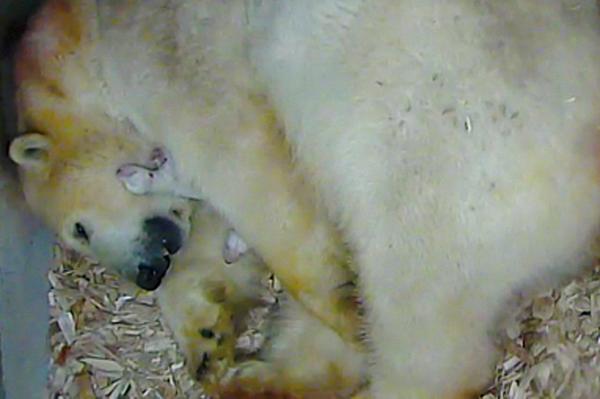
Fabulous photos of 3 week old twin polar bear cubs (born December 9, 2013), have been released by the Hellabrunn Zoo in Munich, Germany. There’s video of the births as well. The newborn cubs are so tiny  — it’s hard to imagine them being born in the dead of winter in a snow den!

PB newborn with mother Munich Zoo Dec 2013

All but one of the photos shown here, including the one above, are of the newborns at 3 weeks of age. The one below is a screen cap taken from the video of the birth, and is the only one that shows the cubs just hours old. They seem to have grown a bit in 3 weeks.

PB newborns birth_11PolarBearTwins2_Zoo screen cap

From this January 1, 2014 account (Hellabrunn Zoo Welcomes Polar Bear Twins”):

“On December 9, a Polar Bear named Giovanna gave birth to two cubs at Munich’s Hellabrunn Zoo. Both births were seen on cameras installed in the birthing den and the connecting corridor to the main den. This is remarkable on two counts: for both births, Giovanna positioned herself so that she was directly in the cameras’ field of view. Secondly, this is the first time that a Polar Bear birth has been filmed in color worldwide!

The cubs were born at 08:39 and 09:43 respectively, to parents Giovanna (7) and Yogi (14). The zoo’s director, Dr. Andreas Knieriem, enthused, “It is as if we were there live watching the labour and birth of a Polar Bear and, as if that weren’t enough, Giovanna showed us not one, but two very different births!”

Continue reading

Polar bears in winter: starving bears and attacks on humans

Winter in the Arctic can be a tough time for polar bears. Between the cold, darkness and ever-thickening sea ice with fewer open leads, polar bears often find that seals are hard to come by.

So it should not be surprising to find out that polar bears are at their lowest body weight at the end of winter (Ramsay and Stirling 1988:613; Stirling 2002:68).

In other words, polar bears lose weight over the winter – not just during the ice-free summer period. That’s why the spring and early summer feeding period is so critical: gorging on young seals rebuilds the polar bears’ fat reserves lost over the winter and packs on even more fat to tide them over the late summer/early fall ice-free period.

Last fall, a potentially serious attack by a polar bear on a Churchill, Manitoba resident on Hallowe’en night (early hours of November 1) got a lot of attention worldwide. Some media outlets suggested that the bear involved in this attack was either starving or so hungry that he was driven to attack. However, this assertion was not supported by any evidence — we simply don’t know whether he was in poor condition or not. While the bear was undoubtedly leaner at the end of October than he was in July, that doesn’t mean he was actually ‘starving.’

So, here’s the question: given that polar bears have a tough time finding seals to eat during the dark and cold Arctic winter and are presumably at their hungriest then, do serious polar bear attacks on humans also happen in winter?
Continue reading

Biggest PBS stories of 2013 involved polar bear experts fudging data

The two top posts I published this year had one thing in common – they exposed polar bear researchers dodging full disclosure of scientific information in a way that outraged a lot of people. These two posts still draw a regular crowd of readers.

#1. “Global population of polar bears has increased by 2,650-5,700 since 2001” (published July 15, 2013) – 8,786 views as of December 30.

#2. “Ian Stirling’s latest howler: the polar bear who died of climate change” (August 7, 2013) – 7,872 views as of December 30.

[Note that #3 was the summary essay, “Ten good reasons not to worry about polar bears” (February 26, 2013), at 5,491 views. Dr. Matt Ridley wrote a foreword introducing that essay (“We should be listening to Susan Crockford”) that appeared in Canada’s Financial Post]

On this last day of the year, I thought I’d make an attempt to put these results into a wider perspective.

Continue reading

Another unsupported claim of starving polar bears in Western Hudson Bay

This time it was Steven Amstrup of Polar Bears International (PBI), via a radio interview on Saturday December 28 “A Scientist’s New Job: Keeping The Polar Bears’ Plight Public.

Amstrup – co-author of the models that predict the extinction of polar bears by the end of this century – had this to say about the polar bear situation in Hudson Bay:

This year, the ice was frozen longer, so he says the bears seem to be in pretty good shape.

“But over the last two or three years, my impression has been, ‘Man, there’s a lot of skinny bears out here.’ “

On average, the sea ice in the Hudson Bay is frozen about a month less per year than it was 30 years ago. Amstrup says bears don’t eat much on land, so they lose about 2 pounds of body fat every day they’re off the ice.

“They’re 60 pounds lighter now than they might have been at this time of year 30 years ago,” he says.” [my bold]

For the last two or three years Amstrup has been seeing “a lot of skinny bears” but hasn’t taken a single photograph that he’s offered for publication or posted at PBI? Makes you wonder, doesn’t it – where are the photos of all the starving bears these guys keep talking about?

Here is a picture of a polar bear that was spending the summer on the shore of Western Hudson Bay 30 years ago, taken in July [bears were on the shore in July this year as well]. Continue reading

Polar bear habitat update, December – still like 2009

From the end of October to mid-December, there has been a rapid expansion of polar bear habitat.

This month, I’ve constructed two all-in-one images that show the progressive growth of the ice relative to some critical polar bear onshore summer refuge areas and denning territory. I’ve also included a map that compares 2013 to 2009 at 18 December with the average for the 1980s, and one that shows ice thickness.
Continue reading

Zoos use myth of disappearing polar bears to breed them in captivity

Ironically, just as I was about to remind readers that we are entering the peak period of polar bear births around the Arctic (see previous post, “December is polar bear nativity month”), I came across an article about breeding polar bears in captivity — getting the bears to give birth in zoos.

Hudson the polar bear cub moved in January 2013 from the Toronto Zoo, where he was hand-raised after being rejected by his mother, to the Assiniboine Park Zoo, Winnipeg. The Assiniboine Park Zoo were also the recent recipients of a cub orphaned when its mother was shot in the aftermath of a polar bear attack in Churchill.

Hudson the polar bear cub is a zoo-born polar bear. He moved in January 2013 from the Toronto Zoo, where he was hand-raised after being rejected by his mother, to the Assiniboine Park Zoo, Winnipeg. The Assiniboine Park Zoo were also the recent recipients of a cub orphaned when its mother was shot after a polar bear attack in Churchill. Photo from Toronto Zoo.

The newspaper article I saw was all about how technically difficult the generation of polar bear cubs has been for the Toronto Zoo (Canada) but it was the premise for the breeding program itself that caught my attention: to save them from extinction.

The zoo is not waiting until the bears are down to the last few hundred (or even thousands) – no, the zoo is starting now, while polar bears are as plentiful as they have been in the last 40 years, to prepare for their demise.
Continue reading

Kaktovik polar bear photos, again no “starving” bears

A Southern Beaufort female with cubs, from the fall of 2007. Note how fat they all are.

A Southern Beaufort female with cubs, from the fall of 2007.
Note the non-starving condition.

Twenty-one amazing photos of polar bears feasting on the remains of a bowhead whale carcass outside of Kaktovik, Alaska, taken by wildlife photographer Michal Tyl, have been posted by the UK Daily Mail (December 12, 2013): Now that’s what you call a spare rib! Pack of bloody-faced polar bears spend day and night stripping a beached whale to its bones.”  Have a look and see if you can spot any “starving” bears! 

What you will see is the relative size of the bears: notice how much larger males are than females, how small cubs-of-the-year are relative to big males. Oh, and notice all the big fat polar bear butts. I can’t include any of the photos here because of copyright rules (the one above is from 2007) but I have included a map showing the location of Kaktovik, a quote from the article, and a link to my previous post on Kaktovik bears, which has a wealth of background information. Continue reading