Posted onApril 2, 2024|Comments Off on A good year for Svalbard polar bears due to abundant sea ice coverage
A sow and a pair of half-grown cubs recently paid a visit to the Polish Research Station in southwestern Svalbard without causing any more trouble than racing heart-rates, according to a report in The Guardian today.
Money quotefrom the leader of the expedition [my bold]:
This year the team had seen more polar bears than usual, he added. Usually there were around 20 bear sightings a year, but this year there had been close to 40 sightings since June and they expected to see more in their final three months.
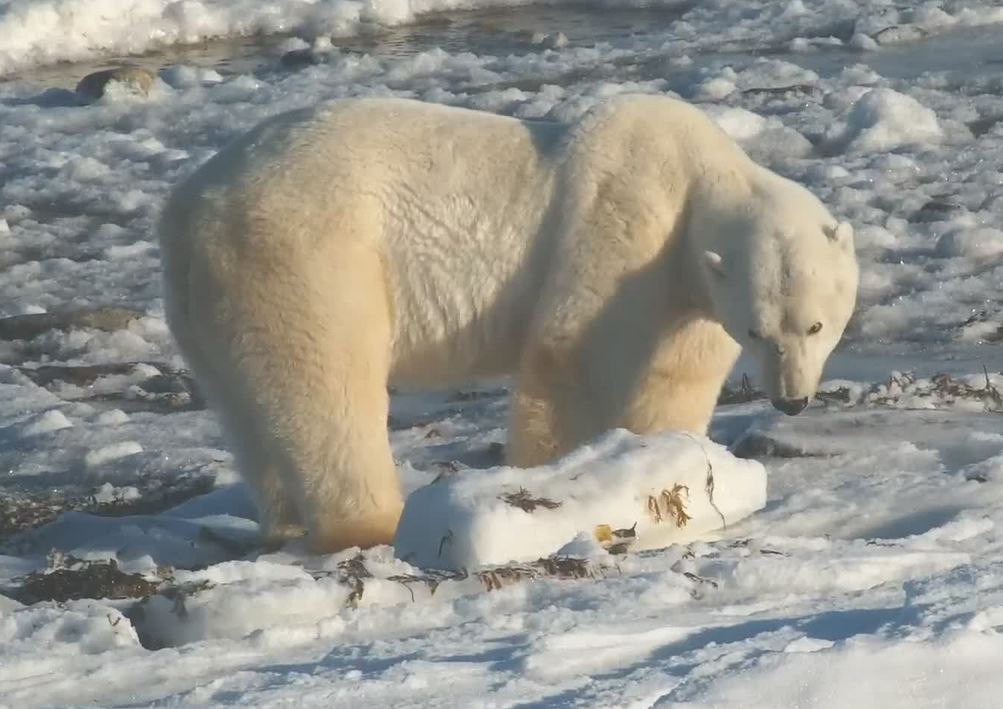
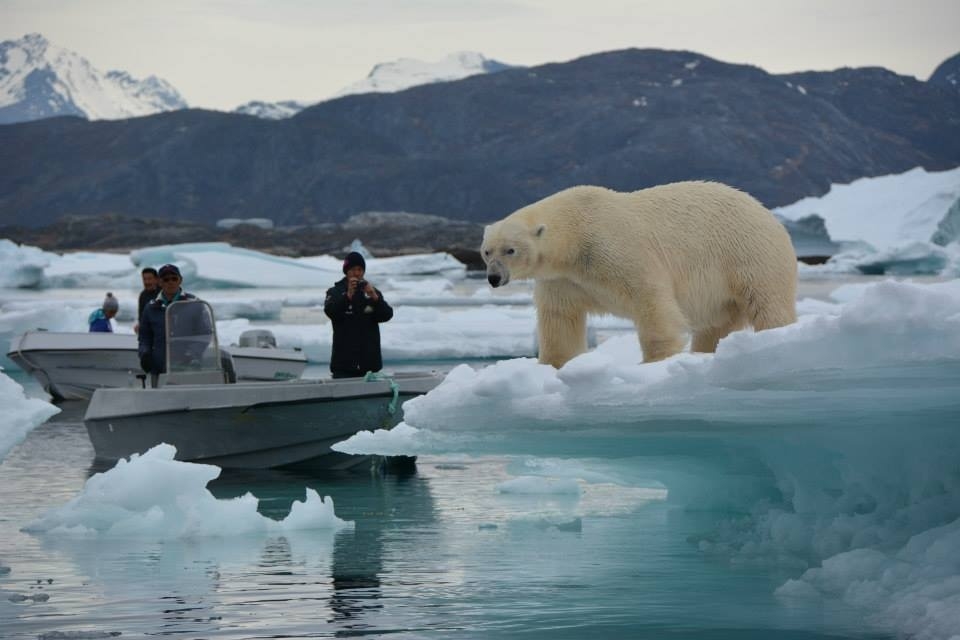
“So far, we have not observed any clearly emaciated individuals. This year is probably a good year for Svalbard’s polar bears because there is a lot of sea ice here compared to recent years,” he said [The Guardian, 2 April 2024, see photo above].
Posted onMarch 25, 2024|Comments Off on 2024 Arctic sea ice maximum a whopping 14th below average following hottest year since 1850
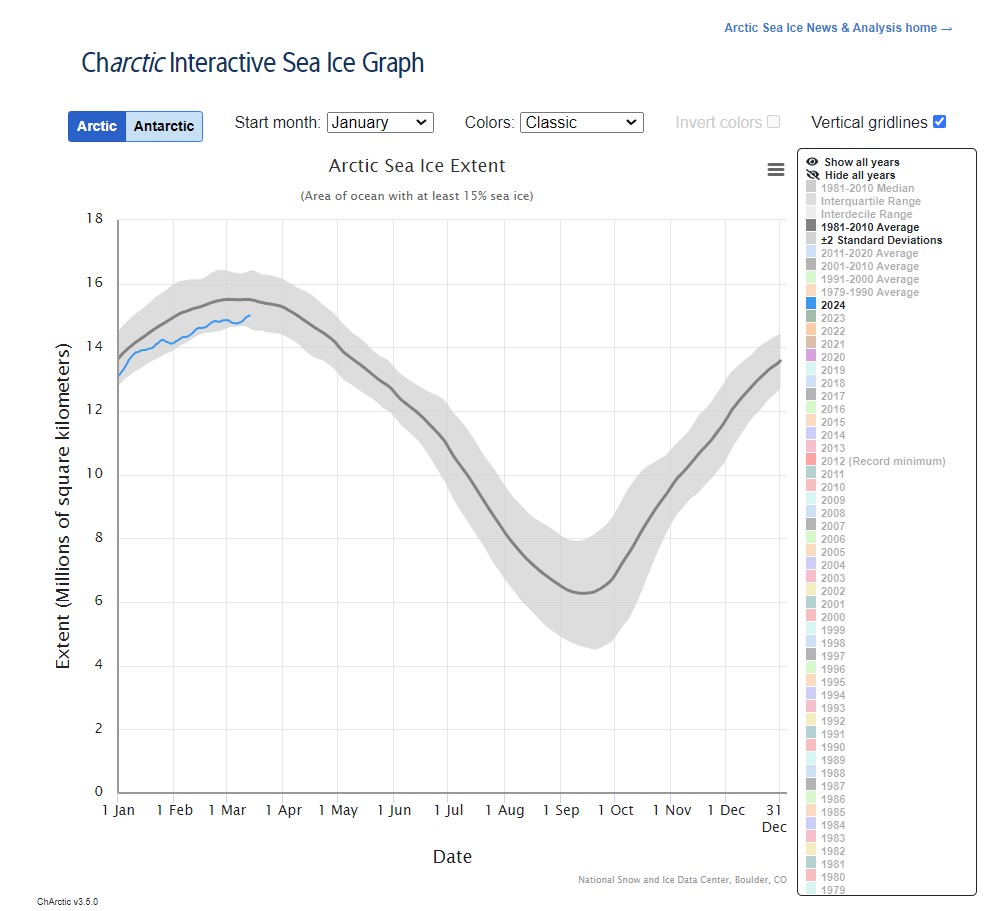
Officially, the maximum winter sea ice extent for 2024 was 15.01 mkm2, reached on 14 March. At an unimpressive “14th lowest” on record, this is astounding news for the winter following the “hottest year on record.” Undeterred, the US government headline writers at the National Snow and Ice Data Center (NSIDC) today went for “Arctic sea ice reaches a below-average maximum.” Note the long-term average (1981-2010) is only 15.65 mkm2 and 15.01 is within 2 standard deviations (see below, screencapped 14 March 2024).
Posted onMarch 9, 2024|Comments Off on Hudson Bay polar bears now considered most likely to survive future sea ice loss
Over the last 10 years, Hudson Bay polar bears have morphed from being the “most at risk” across the Arctic to the “least at risk.” Who would have thought?
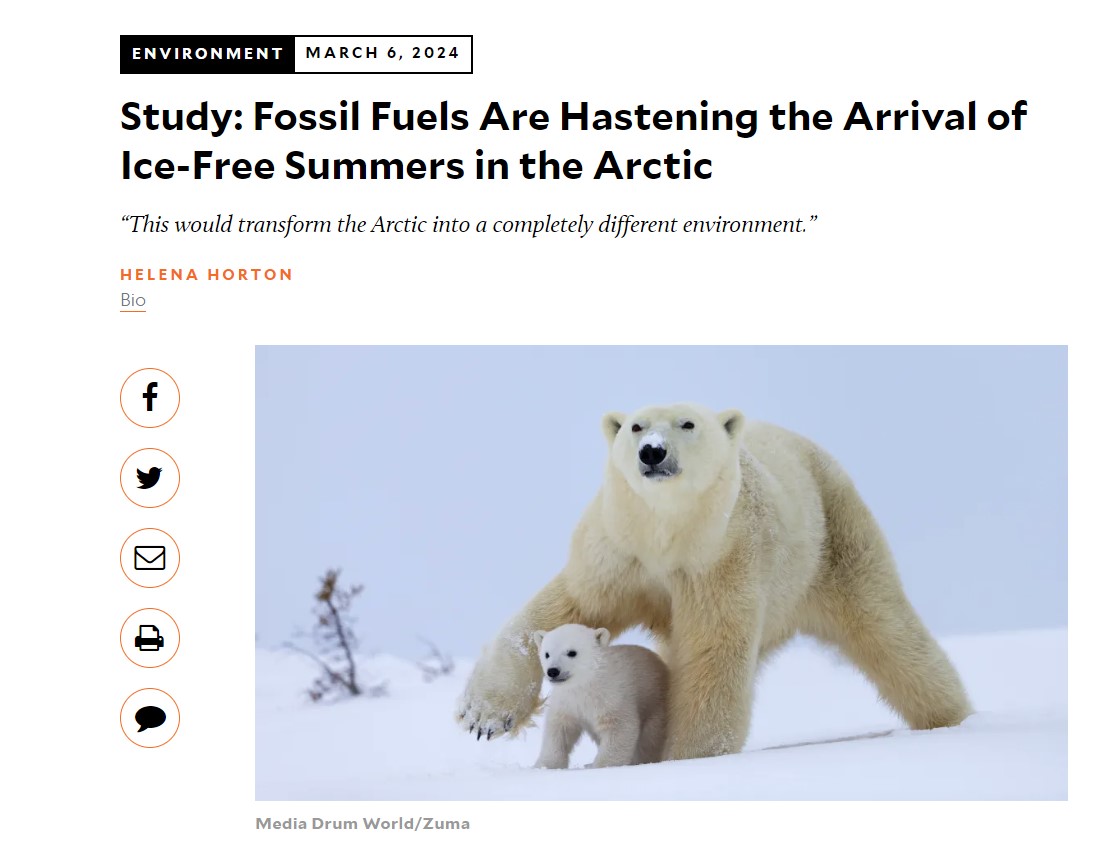
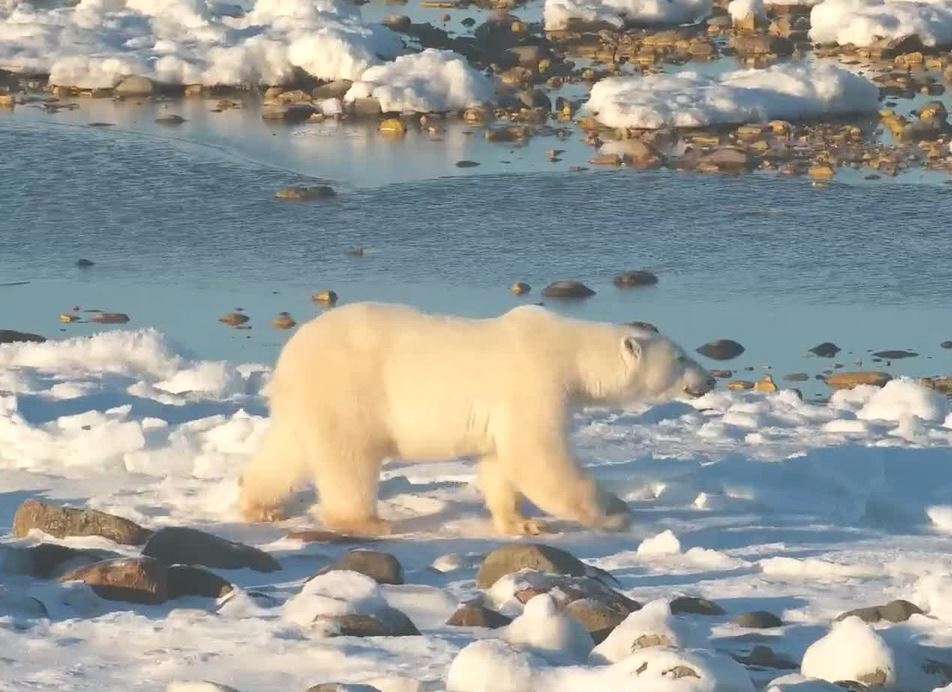
That’s probably because the experts now have to admit that polar bear numbers have not declined since 2004 and bears have been in good body condition since at least 2016. Southern Hudson Bay bears have apparently increased in number since 2016. How ironic is it that the photo above, taken in Hudson Bay — the only Arctic region where trees grow — was used to illustrate a recent Mother Jonesarticle promoting a new prediction of future Arctic summer sea ice loss that’s said to pose a threat to polar bear survival.
Posted onFebruary 27, 2024|Comments Off on State of the Polar Bear 2023: W. Hudson Bay polar bear numbers have not declined since 2004
In my State of the Polar Bear 2023 report for the Global Warming Policy Foundation, I discuss recent news relevant to polar bear conservation and science issues. The most startling of these is the revelation that Western Hudson Bay polar bear numbers have not declined since 2004.
Posted onFebruary 13, 2024|Comments Off on When polar bears die, they die of starvation: new Nature paper is propaganda, not news
Is it a coincidence that a paper reporting the results of a no-news study on polar bears, but which predicts future starvation due to climate change, was published two weeks to the day ahead of a climate change marketing event made up by the activist organization Polar Bears International? I doubt it.
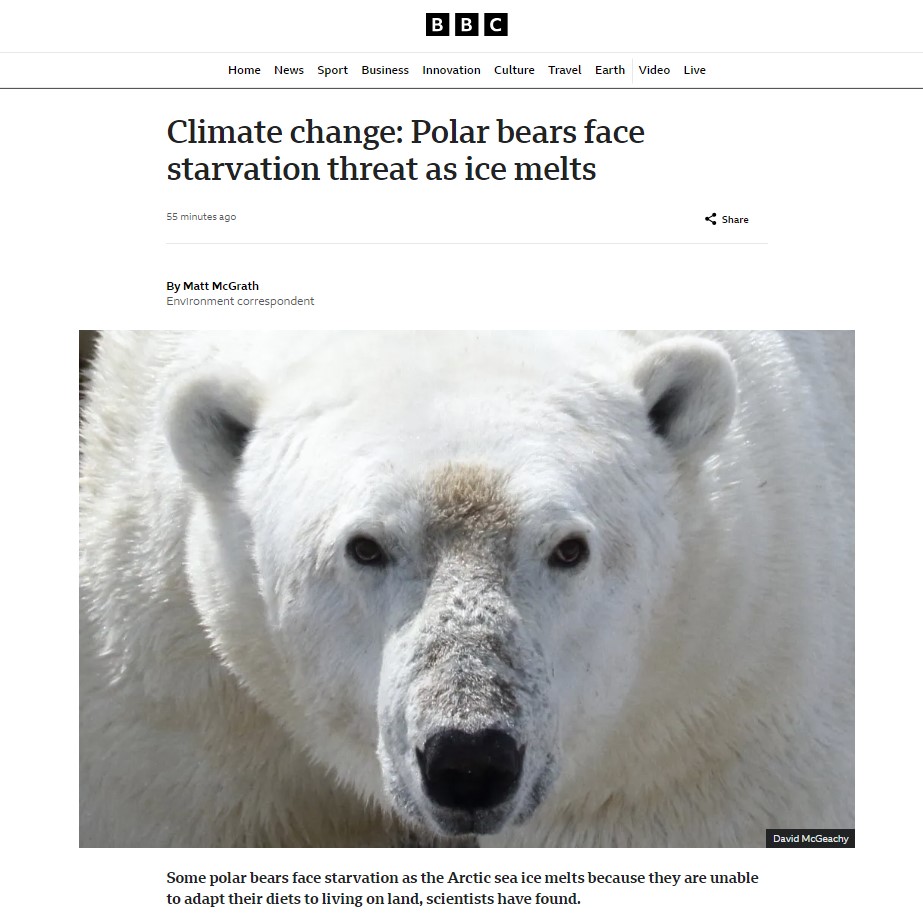
And do I think the high-profile journal Nature Communications would not only agree to publish such a useless bit of propaganda but also rig the timing to advance the climate change emergency narrative? Silly question. And the media worldwide are of course lapping it up, happy for an excuse to promote the perils of climate change, see here, here, and here using images of fat polar bears. Image above is from the BBC headline, 13 February 2024.
They believe this strategy is effective because they think the public is stupid, but they are deluding themselves. Most people are now laughing at their obvious acts of desperation.
Except for the lying and obfuscation that most of us have come to expect, I’ve mostly been left to reiterate that polar bears are not “canaries in the coal mine” indicators of climate change and to point out that Arctic sea ice extent and polar bear survival are not inextricably tied. For example, in some specific areas of interest, like Western Hudson Bay, there has not been a consistent decline in sea ice over the last few decades and bears are not attacking people at increased rates because they are desperately hungry. In other areas, like the Svalbard area of the western Barents Sea, sea ice has declined dramatically in recent years yet polar bears have not been attacking people more than usual.
Contradictions and failed predictions abound.
All in all, a rather boring year for the anticipated implosion of polar bear health and survival, despite my constant tracking of publicly-available information. That said, I would like to take this opportunity to thank you all again for your continued support, and especially those who have donated hard-earned cash over the last few months: your support makes it possible for me to continue my work keeping polar bear science honest. Together, we have made a difference and I know it’s worth the fight. Because if we let evidence-based science die without challenge, we lose our ability to make sense of the world.
Posted onDecember 12, 2023|Comments Off on Churchill end-of-season problem polar bear reports finally published
Today the Town of Churchill finally published the final problem bear reports of the season, which presents an opportunity to do a quick comparison to recent years.
This season lasted 24 weeks, the longest I can remember but apparently only the 5th longest on record. There were a total of 265 incidents by the end of November, more than 100 less than the most recent late-freeze-up year of 2016, which didn’t end until the first week of December (after bears had spent 22 weeks onshore). However, two recent years when freeze-up didn’t come until the end of November (2017 and 2020) had far fewer incidents (more than 100 less each compared to this year).
Posted onNovember 14, 2023|Comments Off on Walrus and polar bear population size changes in the N. Atlantic over the last 20k years
This is a lesson in how to assess the potential worth of scientific papers. One of two similar Arctic evolution studies got media attention, at least in Canada — about the polar bears, of course — but in my opinion the walrus research conclusions are much better supported, less biased by climate change rhetoric, and lack the hubris present in the polar bear paper.
Both studies use similar sample sizes for the regions they had in common (North Atlantic) and used computer models to determine genetic diversity and population size changes since the LGM. However, the tone of the walrus paper was less emotionally-charged and the caveats of the work were appropriately stated. In my opinion, papers like the polar bear example contribute to eroding the public’s trust in science.
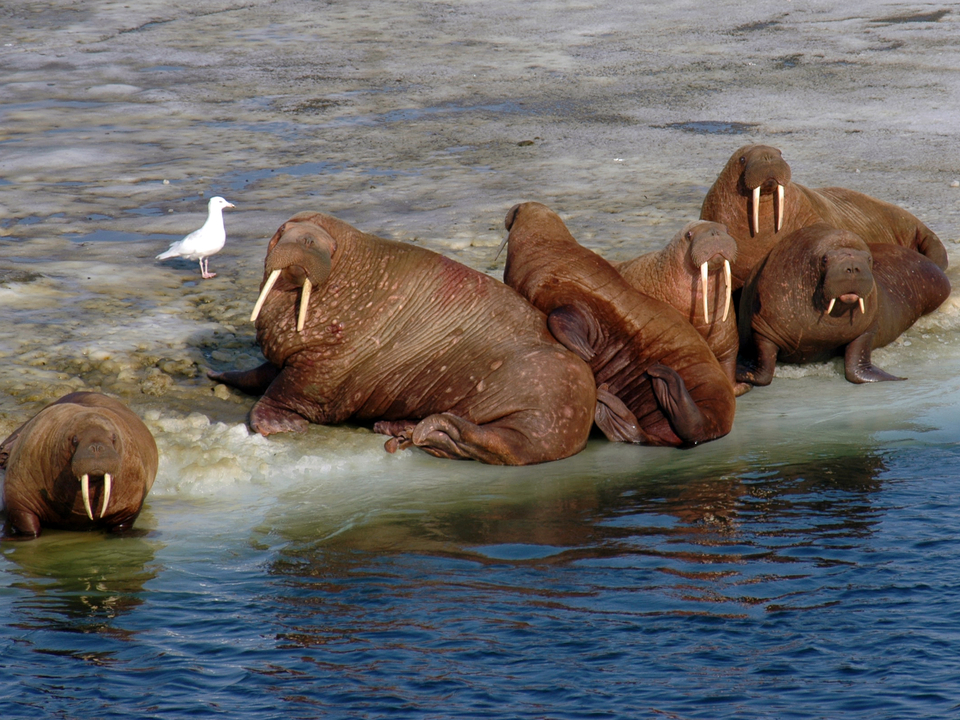
The last Ice Age peaked between about 27,000 and 19,000 years ago. At this time the Arctic was buried under kilometers of glacial ice sheets, and so marine mammals were pushed southwards to areas of ice floes and more open water. Walrus survived in some areas of the Atlantic located further to the south, and as soon as climates warmed again, the ice edge retreated and walrus populations pushed quickly northwards again. This combination of warming and climate-driven dispersal led to local walrus populations becoming more genetically differentiated. Walrus study, Lund University press release 27 September 2023
Posted onNovember 8, 2023|Comments Off on Polar Bear Evolution pre-Christmas book sale: discounts on all formats!
I have reduced prices on all formats of my Polar Bear Evolution book for four weeks starting today (8 November-6 December 2023), in time for holiday gift-giving. The ebook version has the largest price reduction (60% of regular price, to US$17.40) but the other discounts are also substantial. This sale is a time limited offer: don’t miss out! Links below.
The author of Polar Bear Evolution, Susan Crockford, is a good, credentialed scientist. Her writing is clear; her thinking is also. She has a broad understanding of biology and an informed paleo perspective. Crockford condenses a very large literature on polar bear biology and evolution in this book which will help readers understand the science related to the evolution of an Arctic species. Perhaps the most important aspect of this book is its synthesis of information from the fields of wildlife biology, molecular evolution, paleontology, and climate. Her original ideas and hypotheses on thyroid hormone’s role in evolution are very important and add a credible mechanism of phenotypic change which complements the literature on molecular genetic evolution. Polar Bear Evolution is an important contribution to science and its application in evolutionary biology and wildlife biology. Matthew A. Cronin, Ph.D.
Available at the links below (others also available):
Posted onSeptember 25, 2023|Comments Off on Evolution Earth documentary comments on polar bear survival & adaptation: let’s see how they do
Just a heads-up that this week, PBS in North America will broadcast the “polar” episode of a new documentary called “Evolution Earth.” In my area, it’s scheduled for Wednesday, September 27 at 10:00 PM. It remains to be seen whether this is really about evolution or (given those involved in its production) simply more climate change propaganda similar to that promoted by Attenborough, but I intend to watch and report back.
About the Show: “Evolution Earth embarks on a global expedition to reveal the animals keeping pace with a planet changing at superspeed. Heading out across the globe to distant wilds and modern urban environments, five episodes track how animals are moving, using ingenuity to adapt their behavior, and even evolving in unexpected ways.
…We follow heart-warming tales of resilience that redefine our understanding of evolution, and hint at how nature can show us a path towards a sustainable future for Planet Earth. The series is narrated by Dr. Shane Campbell-Staton, who guides us through each episode in an intimate narrative style, drawing on his background as an evolutionary biologist.”
Episode 4 | Ice “At the planet’s frozen extremes, shifts in animal movement and behavior reveal vital information about our future world. Examine polar bears in the Arctic, penguins in Antarctica and other animals surviving in icy worlds.“
UPDATE 27 September 2023: Well, as I expected, this show was full of Attenborough-style nonsense about starving polar bears waiting for sea ice to form along Western Hudson Bay, the bears presented as “canaries in a coal mine” indicators of climate change, with an activist scientist saying she’s “pissed” about climate change. They used charts of the very distinctive pattern of sea ice formation that took place in November 2020 to illustrate how freeze-up was “later and later each year” even though 2020 was one of the earliest freeze-ups on record (bears were successfully hunting from shorefast ice as early as 30 October). A waste of 15 minutes: I couldn’t bear to watch what they did with the penguins.
Watch polar bear habitat reform in the Canadian Arctic: “last 10 days” Canadian Ice Service animation (works anytime) HERE.
See Quote archive for details.








 polarbearscience
You must be logged in to post a comment.