Tag Archives: spring feeding

Ice maps vs. observations in the W. Arctic – polar bear habitat reality check

Last Wednesday (8 June 2016), the US Coast Guard rescued walrus hunters from Shishmaref in the Bering Strait who got stuck in sea ice that is barely visible on sea ice maps. It’s a rare glimpse of what sea ice really looks like up close compared to what you see on the ice maps.

Watch the video here: https://www.dvidshub.net/video/embed/467959

[Unfortunately, the screencaps from the video, like the one below, are less impressive than the film. In the video, you can see the hunters walking on the ice around their trapped boat – the ice does not visibly move]
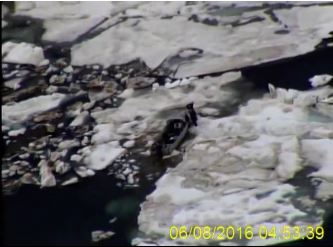
Shishmaref_ice_CoastGuard 02_8 June 2016

Have a look at the sea ice maps below for the day the incident took place. They show what appears to be hardly any ice in the area.

This is a good lesson for assessing what’s been going on in the Beaufort Sea a bit further east, where winds and currents have opened up a rather large patch of open water surrounded by considerable expanses of sea ice – at issue is the possible impact on polar bear spring feeding for April and May.
Continue reading
Harp seal: most abundant Arctic seal is an undervalued polar bear prey species

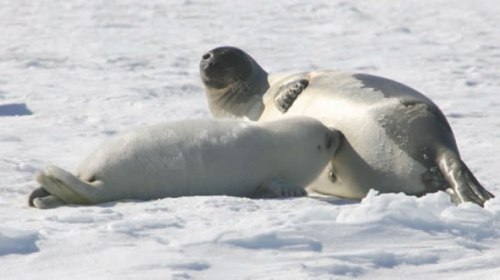
The harp seal is the most abundant seal species in the northern hemisphere (estimated to number more than 9 million animals – that’s more harps than ringed seals) but are found only in the North Atlantic. Partly because they give birth on mobile pack ice, harps have their pups earlier in the season than all other Arctic seals, which means that in some regions, they are a critical food source for polar bears that have eaten little over the winter months.

Harp seal pup_DFO Newfoundland

Although young ringed seals are considered the primary prey of polar bears throughout the Arctic, young harp seals undoubtedly represent an increasingly important resource for populations of Davis Strait, East Greenland and Kara Sea bears.

Most of the harp seals in the NW Atlantic/Atlantic Canada (about 80% of them) have their pups off Newfoundland and Labrador, an area known as the “Front” (the location of my polar bear attack novel, EATEN: special deals all this week). Harps seals at the Front now provide a huge prey base for polar bears of the large (and possibly still growing) Davis Strait subpopulation (photo below courtesy DFO Canada).

There are an estimated 7.4 million harps in Atlantic Canada today (range 6.5-8.3m), an exponential increase over the early 1980s, when perhaps only half a million so remained.  Pagophilus groenlandicus was assigned a conservation status of ‘Least Concern’ by the IUCN Red List in June last year (Kovacs 2015), when it was estimated that the global population size of the harp seal was greater than 9 million animals and probably growing1, 2 due to reduced human hunting:

“…harp seals have been harvested for thousands of years but currently the population is large and the number of animals harvested is declining.” [my bold]

Photographers and animial rights activists love cute, fluffy harp seal pups and rarely mention the carnage that goes on in spring as polar bears devour the naive youngsters. See the video below (from 2008), for an example of the cuteness factor.

Continue reading

Polar bear habit update – day 333 Arctic sea ice hits 11.1 mkm2

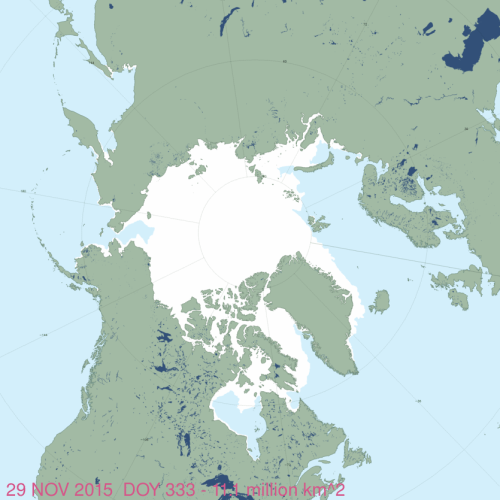
It’s just past the height of fall in the Arctic (Oct-Dec) and polar bear habitat is expanding day by day: according to NSIDC Masie ice charts, the ice has now surpassed 11 mkm2 in extent. Fall is the second most important feeding period for polar bears after spring.

masie_all_zoom_4km 2015 day 333_Nov 29

Only the Barents and Kara Seas (north of Norway and western Russia) are short of ice right now, similar to conditions seen in the fall of 2013. Last fall (2014), conditions were much better and as a consequence, researchers saw a lot of females with healthy cubs in the spring of 2015.

Continue reading