Tag Archives: Svalbard

Five years of polar bear habitat at June 20 around the Arctic

Five years worth of sea ice maps for the same date is hard to come by in this country, since the Canadian Ice Service does not archive their daily sea ice maps. However, due to some forethought, I have at hand ice maps going back to 2012 for the longest day of the year for Canada and archives for other regions provide similar perspective at the solstice.
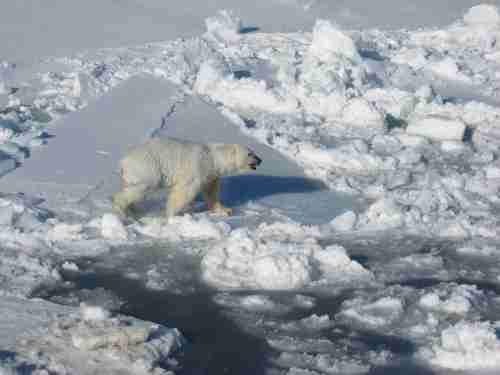
Polar_Bear_male on sea ice_Regehr photo_March 21 2010_lg

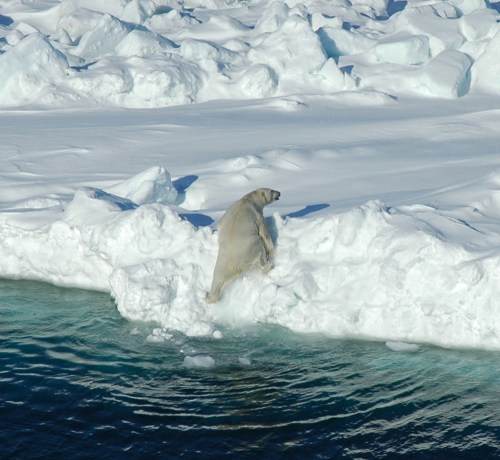
Few photos of polar bears in June likely exist – too early for most bears to come ashore and the ice too unstable for humans to be offshore [photo above is dated March].

Compare the five maps for Canada and eastern Alaska below. Notice the differences for Hudson Bay: it may seem ironic, but 2012 (which had the lowest September minimum since 1979 due to an August storm) had the most typical Hudson Bay breakup/melt pattern compared to previous years. [Keep in mind this recent post about how much ice can remain even when almost none is visible on the ice maps]

In many regions, polar bear hunting efforts are seldom successful after early June because young-of-the-year seal pups have taken to the water to feed, which means the only prey still on the ice are predator-savvy adults and subadults that have an easy time escaping in the rapidly breaking up ice fields. Bears that come ashore in June likely are not missing much – a little less ice than usual at this time of year is not going to make much difference.

Overall, despite doom and gloom predictions we heard in March 2016 (“wintertime extent hits another record low”), sea ice extent (courtesy NSIDC) at 20 June 2016 was the same at this date as it was in 2010 and 2012 at this time of year – which essentially marks the end of the primary feeding period for polar bears (except for those that live in the Canadian Arctic Archipelago, where seals give birth a bit later in the spring).
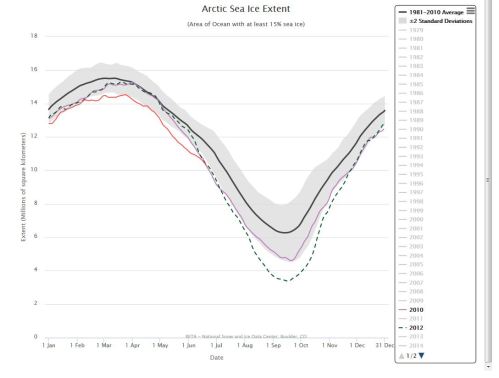
Sea ice at 20 June_2016 vs 2012 and 2010_NSIDC interactive

And did polar bears die in droves due to conditions in 2010 or 2012, in any subpopulation around the Arctic affected by low sea ice levels? No, they did not. In fact, the subpopulation that had the most recent survey done (Svalbard portion of the Barents Sea – 2015) was not only found to be thriving but numbers had increased markedly (42%) over 2004 levels. Now that’s resilience!

Continue reading

Polar bear habitat update end of April 2016: Plenty of sea ice for feeding

So, here we are near the end of the first month of the Arctic spring and there is still more ice than usual off Labrador and conditions in the Barents Sea are improving daily. The fear-mongers can blather all they like about the potential risks of bears swimming in summer – but spring is the critical season as far as sea ice is concerned for polar bears and all polar bear biologists know it. Polar bears consume 2/3 of all the food they need for the year during April-June and so far, ice conditions are looking just fine.

Cambridge Bay_we re OK_from Joe Prins

There is enough ice where there needs to be ice for polar bears to gorge themselves on new-born ringed and bearded seals – and that’s really all that matters. More ice off Labrador means more hunting ground for the Davis Strait polar bears that depend on the tens of thousands of young harp seals born this year off the Front.

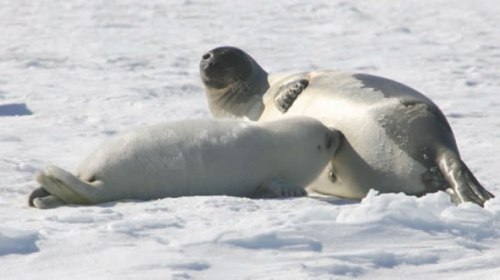
Harp seal pup_DFO Newfoundland
Continue reading

Late winter surge in sea ice habitat and the resilience of Svalbard polar bears

The Barents Sea – and Svalbard in particular – has had very little sea ice this winter but recent evidence suggests pregnant females adapted by moving east to Franz Josef Land to have their cubs. The surge in ice that’s come over the last few weeks will, however, be welcome habitat for the critical hunt of fat newborn seals that takes place primarily in April and May.

Svalbard polar bear_NP015991-isbjorn-JA

It was only last fall that Norwegian biologist Jon Aars (photo above taken by him in August 2015) was touting the fat condition of Svalbard-area polar bears he and his team saw in August and admitted the population had increased by a whopping 42% since 2004 – despite dire predictions of a drastic decline. In fact, 2014/2015 was a great year for the area’s polar bears.

However, in the fall of 2015 sea ice was so late forming around Svalbard that it seemed impossible that any females would get to traditional denning grounds on the east coast in time to give birth. There was no sea ice to speak of until late December, so it seemed virtually certain that all females had gone to Franz Josef Land further east (in Russia) – as they are known to do – to utilized its alternative denning sites.

It’s called resilience – the ability to shift behaviour in response to changing conditions. In this case, all indications are that shifting den locations to Franz Josef Land is a long-standing response of Svalbard area polar bears to low ice conditions. This shift does not even require a movement outside their subpopulation boundaries, let alone a movement outside the ill-defined “sea ice ecoregions” originally defined by Steven Amstrup and colleagues (2008) to support their prediction that polar bears will likely be extinct by 2100, taken up later by others since.

Some polar bear specialists appear to believe that if Barents Sea conditions are not precisely what they were in the 1980s (examples here and here), polar bears cannot possibly survive. But the bears are showing them otherwise – and demonstrating how they likely survived previous warm periods like the Holocene Optimum ~9,000 years ago and the Eemian Interglacial ~115,000-130,000 years ago (CERQA 2014:66) without population numbers getting anywhere near extinction levels.
Continue reading

Polar bear habitat update: Labrador sea ice highest in 20 years

Sea ice off the southern Labrador coast hasn’t been this high for this date in 20 years: that’s great news for the harp and hooded seals that will give birth at the Front in another few weeks – for a while anyway, because a bumper crop of baby seals is also good news for the polar bears who gather there to eat them.

Sea_ice_near_coast_of_Labrador_-a_wikipedia sm

So brutal, but true. The polar bear must gorge over the short Arctic spring and early summer to survive the rest of the year.

Continue reading

Polar bear survival: habitat 2013 vs. 2016 for 22 January

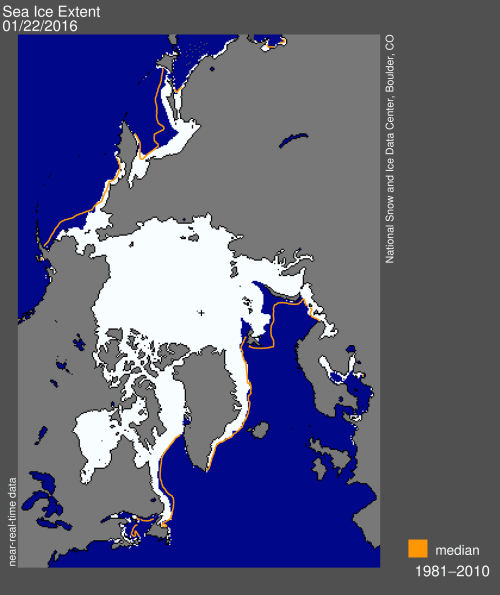
Using sea ice maps issued by the National Sea Ice Data Center (NSIDC), it’s interesting to compare these two years with respect to polar bear health and survival (keeping in mind that no polar bears live in what I like to call the armpits of the Arctic – the Sea of Okhotsk, the Baltic Sea or in the Gulf of St. Lawrence)1:

22 January 2016

Sea ice extent 2016 Jan 22 NSIDC

Continue reading

Survey Results: Svalbard polar bear numbers increased 42% over last 11 years

Results of this fall’s Barents Sea population survey have been released by the Norwegian Polar Institute and they are phenomenal: despite several years with poor ice conditions, there are more bears now (~975) than there were in 2004 (~685) around Svalbard (a 42 30% increase) and the bears were in good condition.

Svalbard polar bear fall 2015_Aars

Oddly, in a September report right after the count, biologist Jon Aars reported them in “excellent” condition, with some of them “as fat as pigs.” I guess “good” is the same as “excellent.”

Bears in the Russian portion of the Barents Sea were not counted this year because the Russians would not allow it; the previous total count, from 2004, was 2,650 (range ~1900-3600) for the entire region.

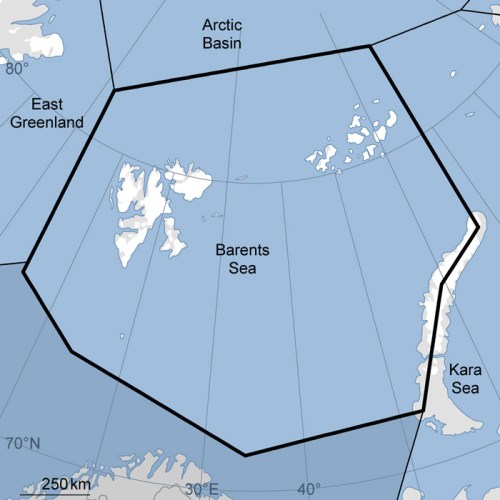
map-BarentsSea

In the map above (courtesy the IUCN Polar Bear Specialist Group), the Svalbard archipelago is on the left (Norwegian territory) and the archipelagos of Franz Josef Land and Novaya Zemlya on the right (Russian territory).

Oddly, the comments made by lead researcher Jon Aars to a Norwegian newspaper (in English), which picked this up yesterday (“Polar bears make a comeback” ), were far more positive than those in the press release (which is likely all that western media will see).

UPDATE 24 December 2015: The new population survey number for Svalbard is actually a 42% increase over the 2004 number. Thanks to Arvid Oen, a WUWT reader, for alerting Anthony Watts to the error, and to Anthony for passing it along. Title and text fixed accordingly, apologies to any others who have picked this up. Cheers and Merry Christmas.

Continue reading

Barents Sea polar bears adapt to changing sea ice conditions

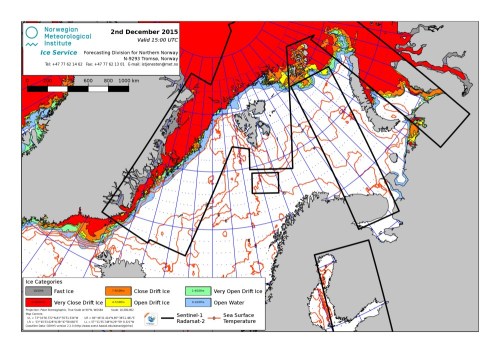
Sea ice development in eastern Svalbard this fall is lagging well behind the rest of the Arctic. Several polar bear researchers (e.g., Andrew Derocher here and here) have recently been raising the alarm that this might be devastating for Barents Sea females looking for suitable denning sites.

Barents Sea ice 2015 Dec 2_NIS_sm

The implication is that pregnant polar bear females are inflexible – so fixated on one location to give birth that they are unable or unwilling to choose an alternative if conditions preclude using their preferred location this year. However, the available facts do not support such a pessimistic attitude.
Continue reading

Barents Sea polar bears in excellent condition say Norwegian biologists

Conditions this year (2015) in the Barents Sea were excellent according to the polar bear researchers who work there (“Polar bears were as fat as pigs”).

Barents Sea bear 2015 August Cobbing_NPI
A new survey just completed for a population count showed the bears were are in excellent condition – except the injured ones, of course, which some news organizations are promoting as evidence of harm from global warming-induced sea ice changes because an activist photographer  – not scientists – said so.

Continue reading

Last year’s dead Svalbard polar bear used for this year’s propaganda

Via Mashable yesterday: “Global warming may have led to the death of this polar bear, researcher says”  Note this is about a death that occurred last year (2014), but Mashable author Andrew Freedman implies it happened this year.

Stirlings other pb that died of climate change_Sept 8 2015

The polar bear death occurred last year in Svalbard in the Barents Sea after a fall (2013) and winter (2014) of poor ice conditions due to well-known cyclical sea ice and weather patterns (not global warming). There is no doubt that 2014 was an unusually bad year for sea ice around Svalbard during the fall and winter. This year, however, conditions improved markedly: Norwegian researchers earlier this year reported a good crop of females with cubs this spring, many more than last year (see previous post Many polar bears cubs seen in Svalbard this year, says Norwegian biologist).

The photo above was taken by National Geographic photographer Paul Nicklan, who sent the instagram on 6 September 2015, with a photo and comments about a trip he’d taken to Svalbard in 2014.

Yet the Mashable article says the photo was taken “in recent days” and includes some quotes from Ian Stirling suggesting that the death relates to low summer sea ice and makes no mention of the fact that condition this year were excellent from fall 2014 through at least early July 2015 (see sea ice map below).

I guess if sea ice won’t cooperate and cause polar bears to die this year, it’s OK to use last years’ deaths instead and imply this year was just as bad. Oh, and none of them mention that starvation is the leading cause of death for all polar bears and always has been.

UPDATE 9 September 2015:Mashable’s Andrew Freedman has amended his article:

UPDATED 9:10 a.m. ET: This story was updated to indicate that Micklen’s photo was taken in 2014, not 2015. As Ian Stirling told Mashable, 2015 was also a year that featured extensive sea ice loss in parts of the Svalbard archipelago.”

Freedman’s update, especially the second sentence, is clearly a response to this post. The implication is that any amount of late summer sea ice that’s below average around Svalbard is a threat to polar bear survival. However, there is no published scientific evidence to support that. The evidence that links sea ice levels with polar bear body condition for Svalbard area bears is for spring and early summer ice, and for denning success, fall ice arrival dates. Many Barents Sea bears never come to land, they travel with the sea ice as it expands and contracts, and females den on the ice.

As I tweeted last month, with two maps (3 August 2015)

“Svalbard #polarbears den in the EAST, critical #seaice levels in fall, vary by yr; lots of hunting habitat N & E”

Low ice levels in western Svalbard in late summer are of little consequence for the polar bear population there. Sea ice in the Barents Sea varies with the state of the Atlantic Multidecadal Oscillation (AMO) — even the US National Snow and Ice Data Center says so.  Those changes are not evidence of global warming. And I reiterate: starvation is the leading cause of death for polar bears.

Continue reading

Barents Sea polar bear research in the good old days – 1968/69 – with video

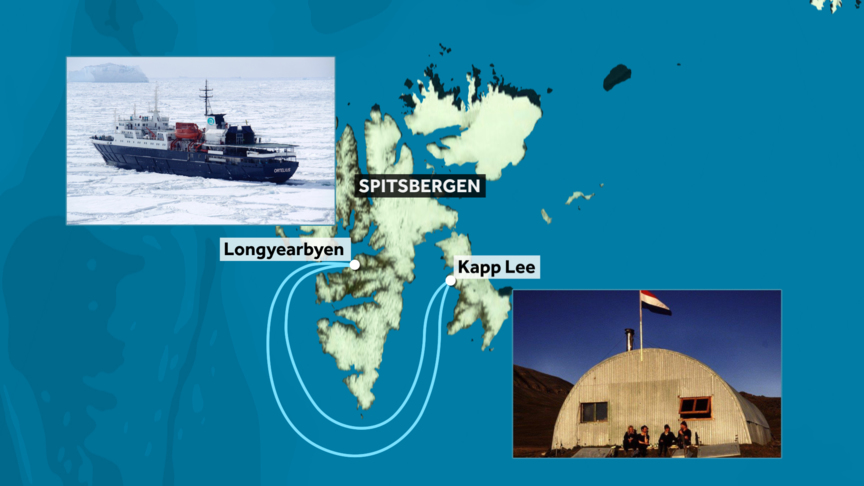
Here is some old footage shot in 1968-1969 of four Dutch researchers – none of whom had any experience with large carnivores – sent to study polar bears at Kapp Lee on Edgeøya (eastern Svalbard). It’s in Dutch so I don’t know what they’re saying but given the choice of music (Beatles, “All You Need is Love”) I can guess the message.

Still, the images are kind of cool, it’s interesting to see how research was conducted at the time by inexperienced personnel. FYI, I began my university studies in 1968, I was not much younger than these students at the time.

Overwintering Spitsbergen 1968-1969 [Uploaded to youtube 21 October 2012; length 45:55]

Description: In the winter of 1968-1969 stayed four Dutch students on the island Edgeøya east of Spitsbergen to do research as to polar bears. During that expedition, this film made by Paul van de Bosch and Hans Sweet and exhibited by the NOS on Dutch television in 1969. 

[Barents Sea polar bear subpopulation background here and here]

I found some additional background that I’ve included below, which shows how naive these young men were, although clearly they had enthusiasm. Dutch researcher Piet Oosterveld was one of the original four on the 1968 expedition and according to a recent news report (see below), will accompany a new expedition to study the effects of global warming. Map below is from the Dutch News story cited below. Spoiler alert: in 1987, Oosterveld was attacked by a polar bear and seriously injured, blamed in part on the rapid increase in polar bear numbers due to their protected status.

Dutch expedition route map
Continue reading