Posted onDecember 7, 2019|Comments Off on No joke: Russian scientists marked problem Kara Sea polar bear with T-34
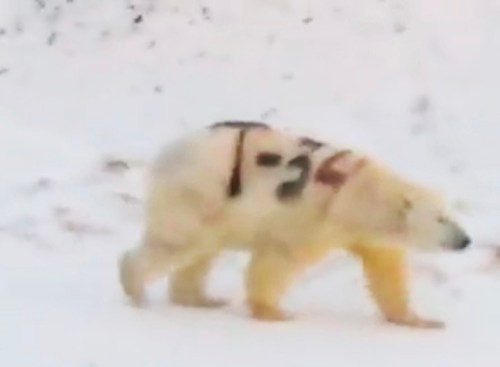
The media are so gullible. So eager are they for a sympathetic polar bear victim that news outlets everywhere carried a story earlier this week about a Russian polar bear that had ‘T-34’ spray-painted on its side. They took the word of Russian polar bear/walrus consultant to WWF and Netflix, Anatoly Kochnev, that this was some kind of cruel joke that meant an untimely death for the bear. Turns out it was nothing of the kind.
Posted onApril 9, 2016|Comments Off on Tracking polar bears in the Beaufort Sea – new crop of tagged bears for 2016
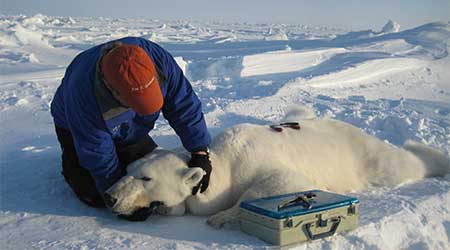
Five more bears were tagged near the Southern Beaufort Sea coast last month, all in the western portion of the coast where Chukchi Sea bears are often encountered. They join the one female who seems to have made a den way out over the continental shelf, where she’s been all winter.
“In collaboration with the U.S. Fish and Wildlife Service we are also experimenting with glue-on and ear tag satellite transmitters, which can be deployed on adult male bears and younger, still-growing bears.”
Posted onAugust 16, 2015|Comments Off on Barents Sea polar bear research in the good old days – 1968/69 – with video
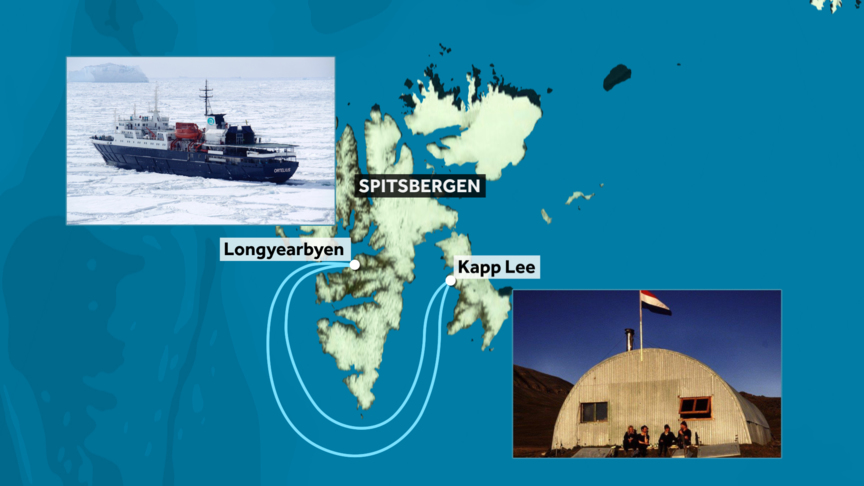
Here is some old footage shot in 1968-1969 of four Dutch researchers – none of whom had any experience with large carnivores – sent to study polar bears at Kapp Lee on Edgeøya (eastern Svalbard). It’s in Dutch so I don’t know what they’re saying but given the choice of music (Beatles, “All You Need is Love”) I can guess the message.
Still, the images are kind of cool, it’s interesting to see how research was conducted at the time by inexperienced personnel. FYI, I began my university studies in 1968, I was not much younger than these students at the time.
Overwintering Spitsbergen 1968-1969 [Uploaded to youtube 21 October 2012; length 45:55]
Description:In the winter of 1968-1969 stayed four Dutch students on the island Edgeøya east of Spitsbergen to do research as to polar bears. During that expedition, this film made by Paul van de Bosch and Hans Sweet and exhibited by the NOS on Dutch television in 1969.
[Barents Sea polar bear subpopulation background here and here]
I found some additional background that I’ve included below, which shows how naive these young men were, although clearly they had enthusiasm. Dutch researcher Piet Oosterveld was one of the original four on the 1968 expedition and according to a recent news report (see below), will accompany a new expedition to study the effects of global warming. Map below is from the Dutch News story cited below. Spoiler alert: in 1987, Oosterveld was attacked by a polar bear and seriously injured, blamed in part on the rapid increase in polar bear numbers due to their protected status.
Posted onSeptember 10, 2014|Comments Off on M’Clintock polar bear survey’s first year plagued by fog in an area thick with heavy ice
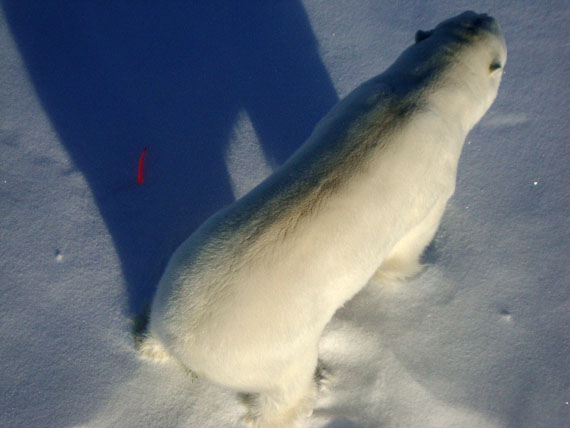
“Blizzards, we had fog — we had to sleep in the helicopter, on the sea ice one night, because we couldn’t fly anywhere,” Markus Dyck, senior polar bear biologist with the GN, told Nunatsiaq News Sept. 5.”
Fog was the theme of polar bear research this summer in Queen Maud Gulf, otherwise known as the M’Clintock Channel polar bear subpopulation region.
Watch polar bear habitat reform in the Canadian Arctic: “last 10 days” Canadian Ice Service animation (works anytime) HERE.
See Quote archive for details.







 polarbearscience
You must be logged in to post a comment.