Tag Archives: withholding data

Churchill seemingly unworried about polar bears, fails to post problem bear reports on social media

We know transparency’s gone out the window for many public officials, but still: Since early August, I’ve been checking daily for Problem Polar Bear Reports issued by the Churchill Polar Bear Alert Program managed by Manitoba Conservation. This morning (12 September), five reports were posted at once on the Town of Churchill website, dating back to first of the season for the week of August 5-11, see image below.
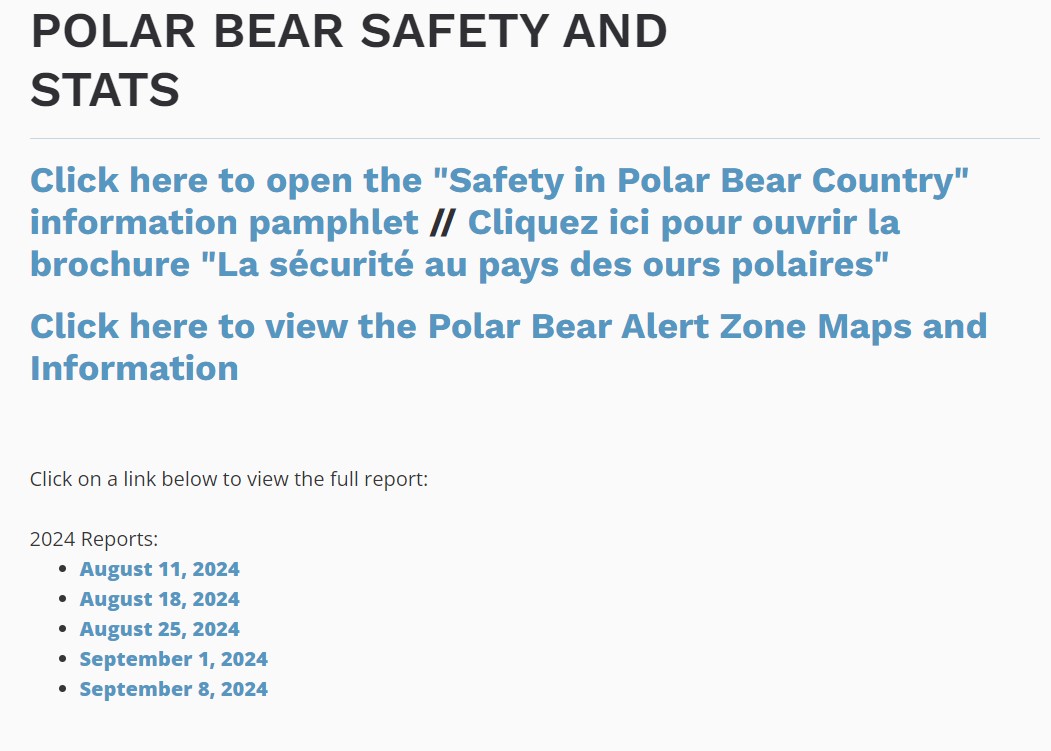
It’s apparent that the intent of these reports is in part public safety: to raise awareness of the potential threat of wandering polar bears around the town of Churchill because of the language that appears on virtually every report: “stay vigilant”, “be bear smart,” “be bear aware,” etc.

However, the X account for Town of Churchill seems to have been abandoned (last post 19 April 2024), which suggests the town is confident no residents or tourists would benefit from Alerts on X that polar bears are ashore:

The town’s Facebook account seems to be their only method of public communication yet even there, there have been no Polar Bear Alert reports posted this summer.

Oddly, even though it is now apparent from the just-released reports that one bear got so close to town that it had to captured and put in the ‘polar bear jail’ the week of 5-11 August — for the public’s safety — the only safety announcement the town issued that week was a ‘heat warning’ on 12 August:

I guess we are to assume that whoever is running this account – or the town council, or the mayor – believes that a day or two of hot weather (which Churchill gets regularly most years) is more dangerous to public safety than a massive predator wandering around town.

I can only conclude that keeping residents and tourists in the dark about potential threats from local polar bears is one way that Churchill is now adapting to climate change (from CBC News, 10 September 2024):

Bears Onshore and Effective Sea Ice Breakup dates

It is apparent from the wording of the Churchill reports that even by the last week of August this year, all bears were not yet off the ice, since they say only that “most bears” were on shore the week of 26 August to 1 September (see next section).

That suggests the last bears came ashore this year at least a week later than they did in 2020 (at 21 August), which at the time polar bear specialist Andrew Derocher presented as an anomaly (see tweet below). Compare to the situation last year here.

The last report I’ve seen from Derocher (via X) for 2024 on the status of his teams’ tagged females is that many of them (11/29 or 38%) were still on the ice as of 8 August (posted 11 Aug):

Derocher referring to this an “amazing” year that’s “similar” to the 1980s probably doesn’t tell the half of it, since he hasn’t posted any maps since then (as of noon, 12 September).

This effectively keeps secret the date when the last of these females bears actually came ashore, which is in any case a biased microcosm of the entire subpopulation. In other words, we can expect that if 40% of tagged female were still on bits of remnant ice at 8 August, there will have been many more bears, especially males, out there as well – which of course he never mentions.

He also never mentions that satellites under-report the amount of ice at this time of year by as much as 20% because of the effects of melt-water sitting on ice, but we’ve come to expect that.

Oddly, a recent study tried to explain the importance to survival of the recent phenomenon (since about 2015 or so) of bears staying out on melting bits of remnant ice rather than heading immediately to shore when the ice coverage over Western Hudson Bay drops below 50%. They suggested this behaviour was largely confined to male bears because they had to make up for feeding missed during the breeding season (McGeachy et al. 2024).

Females, alternatively, appear to respond to break-up in WH by coming onshore approximately 3 weeks after the mean ice concentration in WH reached 50%, … However, suitable habitat was still present elsewhere in the Bay and appeared to be used by a portion of WH prime age males. [McGeachy et al. 2024: 494, where “prime age males” are aged 5-19 years.]

However, these authors never mention the data reported by Derocher every year showing fairly significant numbers of tagged females lingering on tiny chunks of ice well into August, even though Derocher is a co-author. Funny, that.

Problem Bear Reports 2024, Weeks 1-5

Week 1, 5-11 August

Week 2, 12-18 August

Week 3, 19-25 August

Week 4, 26 August-September 1

Week 5, 2-8 September

References

McGeachy, D., Lunn, N.J., Richards, E.S. and Derocher, A.E. (2024). Sea ice influence on male polar bear survival in Hudson Bay. Arctic Science 10, 483-498. https://doi.org/10.1139/as-2023-004 Open access.
Recent S. Beaufort polar bear count was a cherry-picked result – new evidence

New evidence has come to light that mark-recapture field work used to calculate a new population estimate for Southern Beaufort polar bears did not conclude in 2010 as implied in a widely-publicized paper last month but continued until 2013.

Amstrup w triplet_Prudhoe Bay 2005_USGS_sm

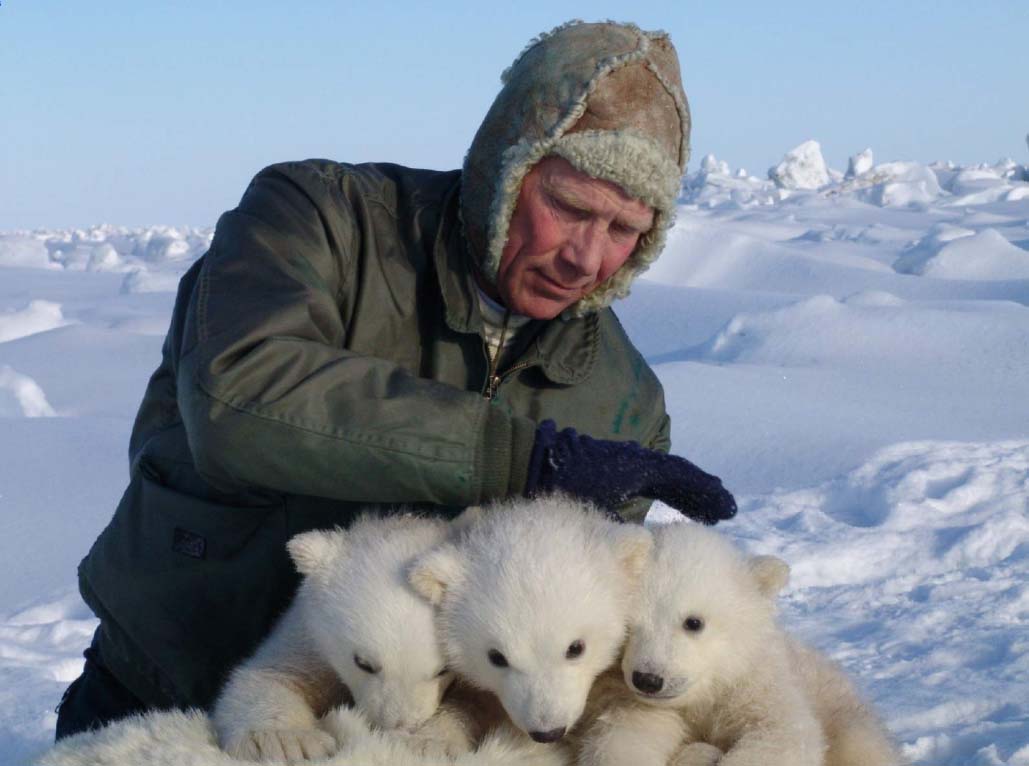
Steve Amstrup in S. Beaufort, 2005 (USGS photo), co-author of Rode et al. paper.

As I discussed previously, last month’s widely-hyped paper (Bromaghin et al. 2015 in press) – which reported a decline of ~40% between 2004 and 2010 (based on spring mark-recapture work) – was contradicted by fall survey counts that suggested strongly a population rebound would have been apparent if the mark-recapture work had continued another two years.

A new paper by Karyn Rode and colleagues (which includes Bromaghin and others (e.g. Amstrup) from the previous paper), summarized in a USGS press release issued on Monday and published online Tuesday, utilized comprehensive data collected during mark-recapture work carried out in spring from 1982 to 2013 in the Southern Beaufort Sea.

This new paper used the same kind of comprehensive data as Bromaghin and colleagues – from the same season, in the same region – to assess potentially negative effects of the mark-recapture research method itself, up to 2012 and beyond.

More on the Rode et al. conclusions later1 – for the moment, what is important is that the work described in the paper confirms that spring mark-recapture work on polar bears in the Southern Beaufort continued beyond 2010. Bromaghin and colleagues didn’t end their mark-recapture work prematurely — they actually left data collected in 2011 and 2012 out of their population estimate analysis when they had to have known the population had not finished rebounding from the 2004-2006 decline.
Continue reading

W Hudson Bay polar bear mark-recapture study report 2013 – at last

I have finally secured a copy of the 2013 Western Hudson Bay mark-recapture study produced by Environment Canada.

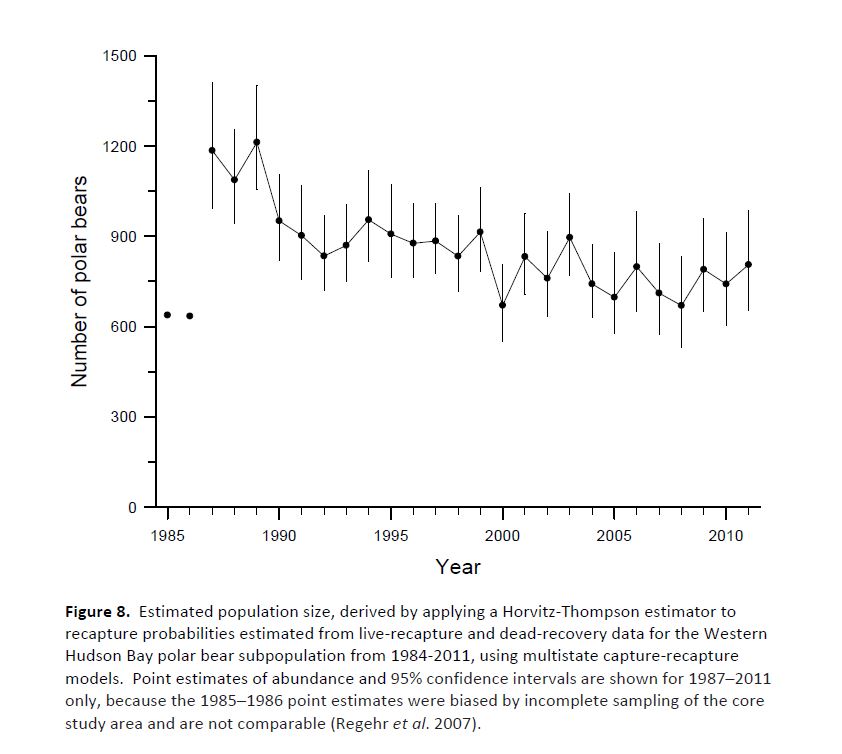
The pertinent figure is below: as you can see, there was no declining trend in Western Hudson Bay polar bears between 2000 and 2011. Click to enlarge.

WH EC Polar Bear Demography report Lunn 26 Nov 2013 Final _Fig 8

I have relatives visiting so I don’t have time to do an in-depth summary but the report’s opening “Summary” is copied below and a pdf provided. More later when I have had time to look at it more closely. Background on the issue here.

Continue reading

Public misled about W Hudson Bay bears since November 2013

Leading polar bear biologists knew by November 2013 that mark-recapture studies showed the Western Hudson Bay subpopulation had not changed appreciably since 2004 but none said so. This includes Steven Amstrup and Ian Stirling at Polar Bears International, Andrew Derocher (University of Alberta), and Nick Lunn (Canadian Wildlife Service), all of whom are (or have been) extensively involved in Western Hudson Bay polar bear research and have made recent statements to the media on this topic.

Polar_Bear_2004-11-15_Wapusk Nat Park_Wikipedia

More details have emerged about the status of Western Hudson Bay (WHB) polar bears (reported a few days ago here), reported this morning in NunatsiaqOnline, excerpts below.

The story reveals that there are two Canadian Wildlife Service (Environment Canada) reports containing population estimates of Western Hudson Bay polar bears – one produced in 2011 and another in November 2013 (reversing the 2011 conclusion) – that have not been made public.

[In contrast, Nunavut Government reports on their 2011 population estimate, based on aerial surveys, were made public in both draft and final report formats (and have since been peer-reviewed and published)]

The conclusion of the 2013 report, quoted in this mornings article, suggests that some of our most vocal polar bear specialists have been misleading the public about the status of the Western Hudson Bay population for the last year.
Continue reading

Polar bear researchers knew S Beaufort population continued to increase up to 2012

Why did the Southern Beaufort polar bear population survey stop in 2010? It’s clear that the recently-published and widely-hyped new study stopped before the population rebound from a known decline was complete.

USFWS 2013-2014 PB News_cover_PolarBearScience

The researchers of the recently-published paper knew before starting their mark-recapture study in 2007 that the population decline had taken place. They also knew why the numbers dropped and that previous declines, caused by similar conditions, had been followed by a full recovery.

Did they really think a full recovery in population numbers was possible in only three four years, when cubs born in 2007 would not yet have been old enough to reproduce?

In fact, a US Fish and Wildlife Service (USFWS) fall survey of Southern Beaufort polar bears in 2012 found numbers were higher than they had been in a decade.
Continue reading