Yearly Archives: 2014

My interview with Benny Peiser about polar bears, evolution and Arctic controversies

While I was in London, ahead of my House of Lords lecture on June 11, 2014 (“Healthy Polar Bears, Less Than Healthy Science)*, I had a chat with Benny Peiser of the Global Warming Policy Foundation.

Healthy Polar Bears Less Than Healthy Science GWPF interview screencap June 11 2014

Have a listen here: An Interview with Dr Susan Crockford on polar bears, evolution and Arctic controversies.

I’ve been traveling for a month but I am finally home — tired and jet-lagged after a journey that took me two-thirds of the way around the world and back. More on my experiences as my energy for blogging returns.

*I shouldn’t have to point this out but I will: I was not paid for this lecture, nor for the airfare to London (I was passing through town anyway). As the timing of the lecture required an overnight stay, GWPF did pick up the tab for a hotel room and dinner, as hosting organizations for such events do as a matter of course.

Tracking polar bears in the Beaufort Sea – May 2014 map and USGS video footage

Here is the May 2014 follow-up to my post on the July 2013 track map for female polar bears being followed by satellite in the Beaufort Sea by the US Geological Survey (USGS) – “Ten out of ten polar bears being tracked this summer in the Beaufort Sea are on the ice.”

See that post for methods and other background on this topic, and some track maps from 2012 (also available at the USGS website here).

The USGS track map May 2014 is copied below (Fig. 1).

Compare this to April’s map (Fig. 2) – the 24 bears from April are down to 20 and the bears are spreading out a bit from the area on the central Alaskan coast where they were originally tagged. Fifteen of these bears have satellite collar transmitters [and therefore are females] and 5 of these bears have glue-on satellite transmitters [either males or subadult animals].

Some comments on the polar bear video cam footage released June 6 by USGS and stories on it run by the media follow.

Continue reading

Activists pressure tactics to force Canada to list polar bears as ‘threatened’ have failed

The Center for Biological Diversity has failed in its bid to use NAFTA (North American Free Trade Agreement) to pressure Canada to list polar bears as a species ‘threatened’ with extinction — wrapping up a story I wrote about twice last year (here and here).

Chukchi male 1240 lbs labeled Durner 2008

Continue reading

Barents Sea polar bear cubs – new data for 2014 made to sound ominous

Last week, Damian Carrington (May 28, 2014) at The Guardian offered a scary-sounding polar bear story, based on the work of Jon Aars and colleagues from the Norwegian Polar Institute (Fewer polar bear cubs are being born in the Arctic islands, survey finds). As often is the case however, once you see the scientific data, you will sleep better.

[Dr Aars also gave a radio interview with CBC Canada (May 29): Is climate change the cause of lower polar bear birth rates in Norway?”; audio available]

[Update June 24, 2014 — see below]

Female polar bear with cubs. (U.S. Fish & Wildlife Service/AP)

Female polar bear with cubs. (U.S. Fish & Wildlife Service)

Continue reading

IUCN Polar Bear Specialist Group says its global population estimate was “a qualified guess”

Last week (May 22), I received an unsolicited email from Dr. Dag Vongraven, the current chairman of the IUCN Polar Bear Specialist Group (PBSG).

pbsg logo

The email from Vongraven began this way:

Dr. Crockford

Below you’ll find a footnote that will accompany a total polar bear population size range in the circumpolar polar bear action plan that we are currently drafting together with the Parties to the 1973 Agreement. This might keep you blogging for a day or two.” [my bold]

It appears the PBSG have come to the realization that public outrage (or just confusion) is brewing over their global population estimates and some damage control is perhaps called for. Their solution — bury a statement of clarification within their next official missive (which I have commented upon here).

Instead of issuing a press release to clarify matters to the public immediately, Vongraven decided he would let me take care of informing the public that this global estimate may not be what it seems.

OK, I’ll oblige (I am traveling in Russia on business and finding it very hard to do even short posts – more on that later). The footnote Vongraven sent is below, with some comments from me. You can decide for yourself if the PBSG have been straight-forward about the nature of their global population estimates and transparent about the purpose for issuing it.
Continue reading

Tracking polar bears in the Beaufort Sea – more bears added to the April 2014 map

Polar bears were tagged in 2013 and 2014 on the spring-time sea ice of the southern Beaufort Sea. Seventeen of these bears have satellite collar transmitters and 7 of these bears have glue-on satellite transmitters” say the folks at the USGS Alaska Science Center.

I guess that’s why the April map was late getting posted.

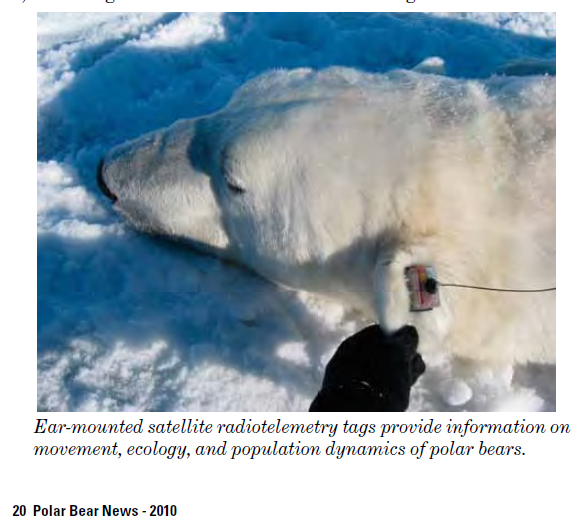
Polar bear ear tag_USFWS_PolarBearNews2010

Continue reading

Climate bullying echoes the expulsion of Mitch Taylor from Polar Bear Specialist Group

A lone polar bear walking on ice [Kathy Crane (NOAA) photo].  We'll call this a metaphor for the expulsion of Mitch Taylor from the PBSG after the Group switched from emphasizing unregulated over-hunting as the primary threat to polar bear conservation to global warming.

Kathy Crane (NOAA) photo

Swedish meteorologist Lennart Bengtsson today declared his resignation from the Academic Advisory Board of the Global Warming Policy Foundation (GWPF), which he joined only three weeks ago, because of bullying by his colleagues. His email letter reads, in part:

“I had not expecting such an enormous world-wide pressure put at me from a community that I have been close to all my active life. Colleagues are withdrawing their support, other colleagues are withdrawing from joint authorship etc. I see no limit and end to what will happen. It is a situation that reminds me about the time of McCarthy. I would never have expecting anything similar in such an original peaceful community as meteorology.”

See WUWT for the email in its entirety, GWPF response, and other reactions (and more here).

Absolutely shameful. Alas, the reprehensible behaviour displayed by Bengtsson’s colleagues also goes on within the polar bear research community: those that refuse to parrot the “consensus” are quickly punished.

Remember Mitch Taylor and his expulsion in 2009 from the IUCN Polar Bear Specialist Group? His “crime” was objecting to the PBSG using weak evidence about future threats of global warming to have the conservation status of polar bears changed to ‘threatened’ even though populations were currently healthy. Details below for those who don’t know the story, or have forgotten.

Continue reading

My upcoming lecture at House of Lords, London: how to get invited

Benny Peiser of the Global Warming Policy Foundation (GWPF) has arranged for me to give a lecture at the House of Lords (London) on June 11.

Healthy Polar Bears, Less Than Healthy Science
A lecture by Dr. Susan J. Crockford

When: 11 June 2014, 6pm

Where: House of Lords, Committee Room 3, London

Crockford 08_21_2011_0056b

This lecture focuses on recent research results that have shown that polar bear populations are not responding as predicted to recent declines in Arctic sea ice. Despite the fatalistic attitude of many polar bear field biologists, real-world evidence indicates that polar bears are well equipped to survive substantial variations in their Arctic sea ice habitat and have not been harmed by recent low ice coverage. Such resilience over the short term is hardly surprising, since polar bears are now known to have survived a multitude of past climate shifts of almost inconceivable magnitude.

As the venue has limited space, interested readers in the UK may contact the GWPF at info@thegwpf.org for an invitation. They will let you know if places are still available.

Hope to meet some of you there.

Susan

PS. I will be staying near Bristol later that week with relatives (June 13-15) and could take an afternoon or evening for a pub chat about polar bears and other issues, if anyone is interested. Send me a note via the contact page above.

Evolution by geneticists again: yet another date for when polar bears arose

The latest addition to the never-ending story of when-and-why polar bear evolution took place according to geneticists (Liu et al. 2014 — the 8th such paper in less than 4 years, if you can believe it) is getting way, way more media attention than it deserves.

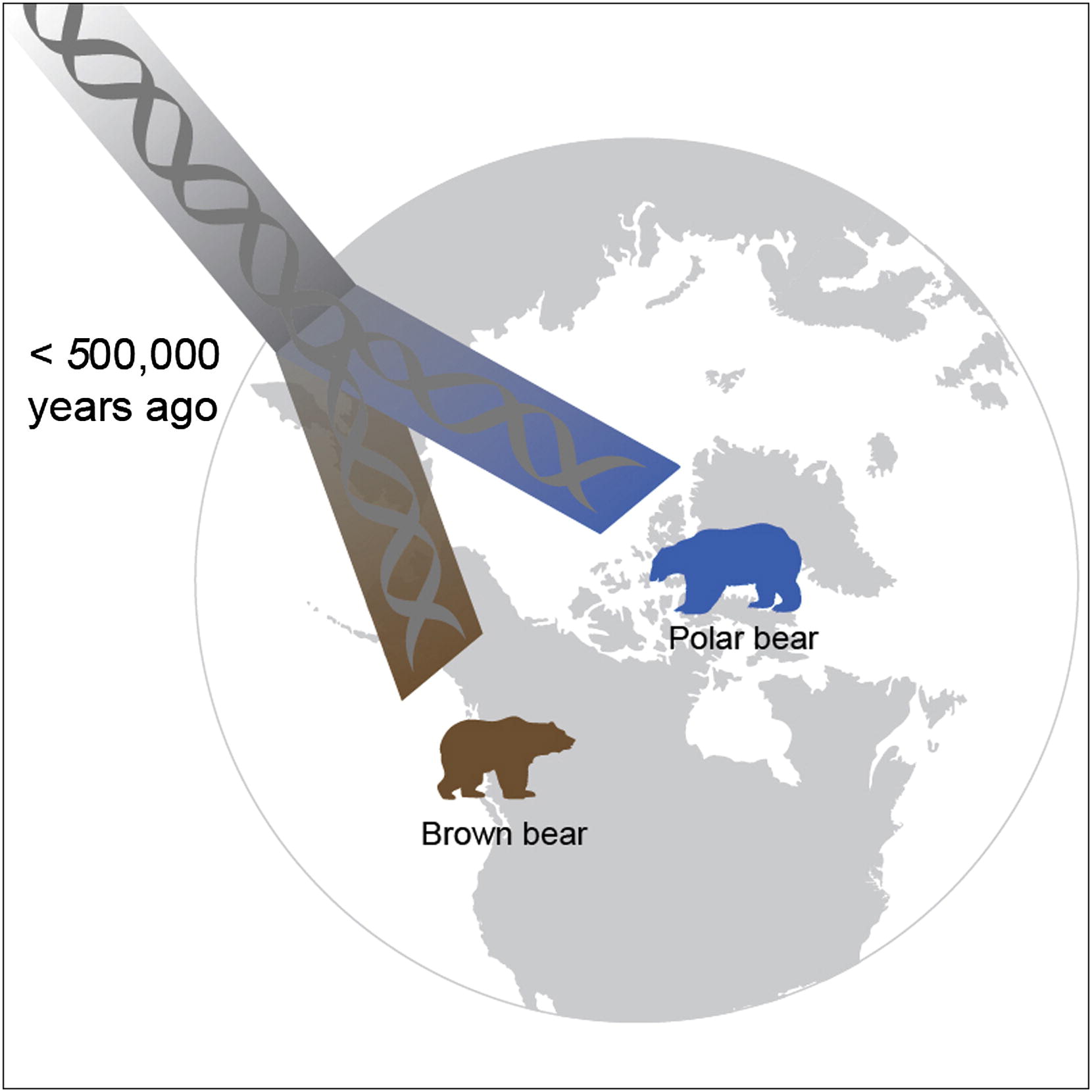
Lui et al. 2014 figure provided in the abstract.

Liu et al. 2014 figure provided in the abstract.

This multi-member research team used a new data set (mostly Scandinavian brown bears and Greenland polar bears, for a change) to add not much of anything new on the evolutionary insight front except yet another estimate of when polar bears came to be.1

However, the real focus of the paper is the description of their finding of a few genetic differences between brown bears and polar bears that they identified. They found a few genes in polar bears were different than brown bears and made a boat load of assumptions about what these might mean.

Their discovery was not accompanied by any attempt to demonstrate that the changes in gene architecture they found also involved a change in the function of the genes or were associated with different effects on bear physiology. If a changed gene cannot be shown to act differently or to have a demonstrated new physiological effect on the animal in question, the changes themselves mean next to nothing – especially for evolution!

That’s my take – see what you think. It looks long but a lot of it is quotes.
Continue reading

Ancestor of the polar bear by any name: grizzly vs. brown bear monikers explained

Apparently, all media outlets (except Fox News) so confused the distinction between the two common names used for the ancestor of polar bears, Ursus arctos, that they got the point of a recent news story totally wrong. An Alaskan journalist explains.

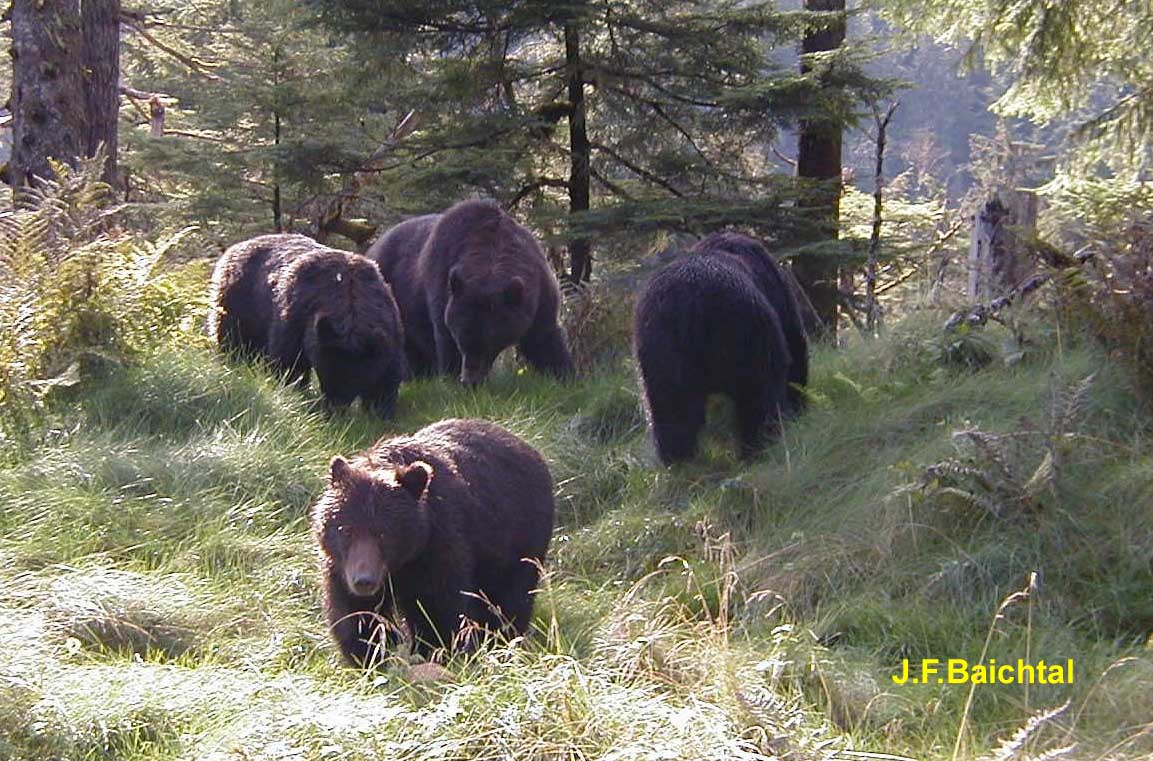
Coastal brown bears from Admiralty Island, southeast Alaska. See previous post here.

Coastal brown bears from Admiralty Island, southeast Alaska (courtesy Jim Baichtal, US Forest Service, Alaska). See previous post here.

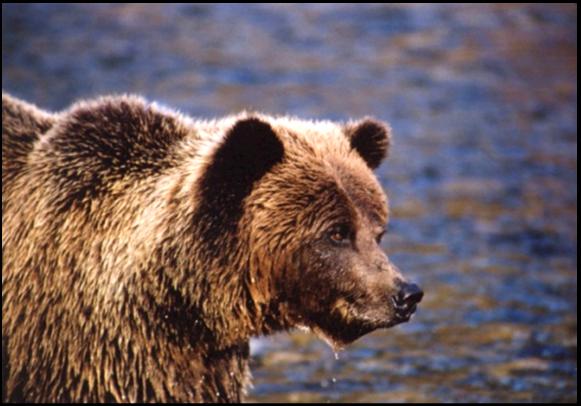
Tundra grizzly from the Yukon (courtesy Government of Yukon Territory). These bears also occur across the north slope of Alaska and are the bears that occasionally hybridize with polar bears, as explained here.

Tundra grizzly bear from the Yukon (courtesy Government of Yukon Territory). These bears also occur across the north slope of Alaska and are the bears that occasionally hybridize with polar bears this time of year, as explained here.

Continue reading