Author Archives: susanjcrockford

Western Hudson Bay polar bears are not like the others – Part 1

A review paper, purporting to list the “effects of climate warming on polar bears” (Stirling and Derocher 2012:2697), has this to say about the state of research in western Hudson Bay:

“The most comprehensive long-term research on polar bear demography, body condition, subpopulation size, abundance, and reproductive success has been conducted on the Western Hudson Bay subpopulation.”

This means that compared to all of the 19 subpopulations of polar bears (see fig. 1), the very best information we have is for Western Hudson Bay (WHB) bears (fig. 2).

But are western Hudson Bay polar bears biologically typical of all polar bears? In this post, I’ll begin to examine that question.

Continue reading

The slaughter of polar bears that rarely gets mentioned (ca. 1890-1930)

Chock this post up as another example of mind-blowing information you sometimes find while looking for something else.

In their dendrochronology paper on trees associated with polar bear dens in western Hudson Bay, Scott and Stirling (2002:157) reference an MA thesis in Geography by James Honderich (1991), in regards to a discussion of denning frequency during the period 1850-1899, “when polar bear hides were more or less traded consistently.”

It turns out the James Honderich’s thesis is actually a summary of polar bear harvests in Canada from about 4,000 years ago to 1935. The number of polar bears taken by Arctic explorers (1594 to mid-1900s), Hudson’s Bay Company fur traders (from 1670 to 1935) and Arctic whalers (1820s-1935) were calculated from a variety of historical sources. This post is a summary of the results for the period 1800-1935. It is likely you have never seen this astonishing information before and the implications for polar bear biology are substantial. Continue reading

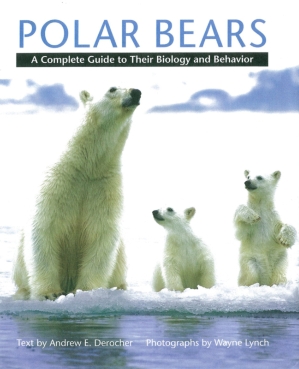
Another polar bear advocate writes a book: Derocher and Lynch 2012

Polar Bears: A Complete Guide to their Biology and Behavior (2012) Text by Andrew E. Derocher, Photographs by Wayne Lynch, in association with Polar Bears International. Johns Hopkins University Press 264 pp. 153 color photos, 4 maps. 978-1-4214-0305-2    $39.95 hardcover

Here is the promotional description of this book:

“Derocher and Lynch have spent decades following polar bears, and this book offers the most comprehensive and readable review of their biology, ecology, behavior, and conservation.” From the JHUPress catalogue

This statement suggested to me that I would find Andrew Derocher’s new book upbeat and primarily concerned with explaining the biology, behavior and life history of polar bears, as the title suggests. I’d buy a book like that, I thought.

I was also eager to see how Derocher’s effort compared with Ian Stirling’s book that came out last year (2011), which I reviewed in July. The title of Stirling’s book – Polar Bears: The Natural History of a Threatened Species – did at least hint at the advocacy found within.

Would Derocher’s book be substantially different, despite his strident advocacy on display just last month in the press “Bleak future for polar bears, U of A scientists say” and in his most recent co-authored scientific paper (Stirling and Derocher 2012, now in print), that I discussed briefly in my first post? Continue reading

First month for Polar Bear Science – Aug, 2012

First posts went up July 26.

Total views @ Aug. 31 – 2454

Total views:
July 2012 –    567
Aug. 2012 – 1887

Over the last three weeks, views have been >600/week, an average of 91/day.

Largest spikes in readership were generated not by new posts (surprise!) but by media coverage:
1) television, newspaper and radio interviews associated with my lecture at the University of Toronto Aug. 14, “Polar Bears: Outstanding Survivors of Climate Change”;
2) one of my posts was featured at Climate Depote on Aug. 31.

I am happy to report that so far, all of the comments I have received via the “comments/tips” page have been positive.

No one has yet asked for references. So, just to be clear, I am happy to send pdfs of any references I cite in my posts (if I have them – not always available, e.g. book chapters). Simply use the “Requests” contact page. Just because you don’t have access to a university library should not mean you can’t get to the science. Don’t take my word for anything – if you have doubts about what the research papers say, go to the source. Just ask!

I felt one comment by a reader was worth posting, so with their permission, I added it to the post as an update. Another commenter sent me photos, which I happily added, noted as an update.

I’ve got some interesting posts lined up, including another book review – stay tuned.

Enjoy the rest of your long weeekend.

PS. Huge thanks to Tom Nelson for highlighting my posts and Hilary Ostrov for technical advice to this novice blogger.

Record low sea ice extent and what it means for polar bears…

On Aug. 27, 2012 sea ice extent dipped below the yearly minimum extent reached in 2007.

The sea ice at this point, a five-day average, was 4.1 million km squared and the lowest point reached since satellite records began in 1979. The National Snow and Ice Data Center (NSIDC) thought it was important enough to issue a press release.

There are sure to be more than a few media-hungry folks who will be moaning about the fate of the poor polar bears because of this report. Before people get too hysterical, a bit of rational perspective might be helpful.

Keep in mind that 4.1 m sq. km (Fig. 5) is about the size of Greenland (2.166 m km2) plus Mexico (1.972 m km2), or about the size of India (3.287 m km2) plus Pakistan (0.809 m km2), figures from Wikipedia.

It may be a ‘record’ low, but it’s still a lot of ice: 4.1 m km2 is not anywhere close to an ‘ice-free’ Arctic!

Arctic sea ice melts – or gets pushed out of the Arctic and then melts – every year, leaving various amounts behind. The ice lingering at mid-September adds to next year’s ‘multiyear’ ice.

The maximum extent is usually reached mid-to-late March. Have a look at how this ‘low extent’ developed from the March maximum this year. Even if you’ve looked at some of these maps, you may not have looked at them one after the other. I’ll compare these to the fall maps for 2007, after the Sept. minimum and discuss these in relation to polar bear habitat. Contineu reading

Is there insufficient ice for polar bears to den offshore?

In an earlier post (July 26), I had some critical things to say about an article in the Edmonton Journal (July 17, 2012) by veteran Arctic science writer and photographer Ed Struzik called “Bleak future for polar bears, U of A scientists say“, which was picked up by news outlets across Canada.

The Struzik article publicized a summary academic paper written by polar bear biologists Ian Stirling and Andrew Derocher (a former Ph.D. student of Stirling) that appeared “in press” behind the paywall at the journal Global Change Biology on July 9.

The academic paper is a summary of Stirling and Derocher’s dire predictions on the future fate of polar bears as a result of melting of Arctic sea ice over the next few decades, one of the prophesied catastrophes of anthropogenic global warming. These views mirror to a large degree the chapter on “climate warming” in Ian Stirling’s book on polar bears released in 2011, which I reviewed recently here.

Let’s look at one of the statements made in the Struzik article:

In Alaska, many bears are denning on land because there is insufficient ice for them to give birth offshore.

Update added Aug. 28, 3:35 PM  below the post
Continue reading

Is it plausible that polar bears are 4-5 million years old? Part 3, sea ice

Last in a three-part series of my critique of Miller et al.’s (2012)
paper on the newest genetic evidence for the origin of polar bears. Part 1 here, Part 2 here.

Here is my final (I hope) comments on the claims made in that paper, suggesting why we might want to take them with a grain of salt.

These are the points regarding this paper that I think deserve a critical look. In this post, I’ll elaborate on Claims #3 and #4. [I’ve added one more to the original three listed].

Claim #1 Polar bears and brown bears (aka grizzlies) arose 4-5 million years old. [I countered with fossil evidence]

Claim #2 Hybridization in both directions occurred repeatedly throughout the evolutionary history of polar bears and brown bears. [I countered with full details on known hybrids]

Claim #3 Svalbard may have been an important refugium for polar bears during warm interglacial periods – and related sea ice issues related to the origin of polar bears as a species.

Claim #4 Polar bear population numbers (population size estimates) over the last one million years track changes in climate (warmer/colder periods).

Claim #3 Svalbard may have been an important refugium for polar bears during warm interglacial periods (and related sea ice issues related to the origin of polar bears as a species) [Which I’ll counter with evidence on paleo sea ice]

Continue reading

Is it plausible that polar bears are 4-5 million years old? Part 2, Hybridization

These are some of the points regarding this new paper by Miller et al. (2012, in press), on genetic evidence for the origin of polar bears, that I think deserve a critical look. See part 1, for my comments on Claim #1 (the fossil evidence)(see Doug Hoffman summary of the paper here).

In this post, I’ll elaborate on Claim #2. I’ve added one more to the original three listed.

Claim #1 Polar bears and brown bears (aka grizzlies) arose 4-5 million years old. [I countered with the fossil evidence]

Claim #2 Hybridization in both directions occurred repeatedly throughout the evolutionary history of polar bears and brown bears.

Claim #3 Svalbard may have been an important refugium for polar bears during warm interglacial periods.

Claim #4 Polar bear population numbers (population size estimates) over the last one million years tracked changes in climate (warmer/colder periods).

Claim #2 Hybridization in both directions occurred repeatedly throughout the evolutionary history of polar bears and brown bears [a claim also made in two other recent papers on polar bear evolution (Edwards et al. 2011; Hailer et al. 2012)].

Continue reading

Is it plausible that Polar bears are 4-5 million years old? Part 1

A new genetic study (Miller et al. 2012, now in print) suggests that Polar bears arose between 4-5 million years ago and thus survived the more than 50 glacial/interglacial cycles of the 2.5 million year Pleistocene epoch. Here I’ll begin to explore some of the claims of that paper on the emergence of Arctic bears, suggesting why we might want to take them with a grain of salt.

See my introduction to this topic, which contains information on the so-called ‘ABC’ bears of Southeast Alaska (as well as some notes on my adventures in ABC bear territory a few years ago). It’s worth taking a look at Doug Hoffman’s excellent Aug. 5 summary of the original paper here. The NIPCC also has a summary here.

Here are some of the points regarding this new paper by Miller and colleagues that I think deserve a critical look. In this post, I’ll elaborate on Claim #1.
Continue reading

ABC bears and polar bear evolution – and an adventure

A new genetic study (Miller et al. 2012, in press) suggests that polar bears arose between 4-5 million years ago and thus survived the more than 50 glacial/interglacial cycles of the 2.5 million year Pleistocene epoch. I will explore some of the claims of that paper later, suggesting why we might want to take them with a grain of salt.

But first, a bit of background and my personal caving adventure in ABC brown bear country.

Update: see new ABC bear photos added, courtesy Jim Baichtal, US Forest Service, Alaska (“real” ABC bears, he says)

continue reading