Category Archives: Polar bear attacks

Heads up Newfoundland & Labrador: polar bear season has begun

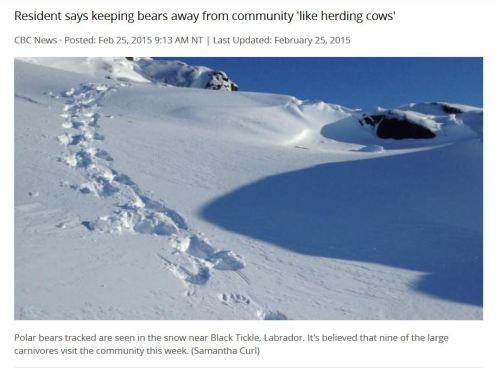
There is now enough sea ice off southern Labrador and the northern tip of Newfoundland for Davis Strait polar bears to come ashore looking for food. Baby seals won’t be available for months yet. And since winter is the lean season for these bears, some may seek food sources onshore. The bears come down from the area of Hudson Strait and southern Baffin Island: as the sea ice expands south, so do the bears.

Polar bear tracks_25 Feb Labrador 2015 CBC

Continue reading

May a polar bear not be something you are faced with in 2019

A polar bear can be too close: fat or thin, it can be deadly.

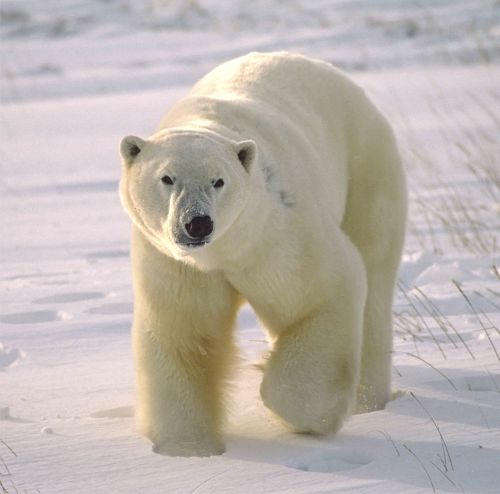
Walking bear_129029633_web size

Happy New Year.

And condolences to those whose lives were torn apart by a polar bear encounter in 2018.

Derocher admits Western Hudson Bay polar bear population may not be declining

Earlier this year, I challenged a journalist to ask to see the data used by Andrew Derocher and his colleagues to support their repeated claims that Western Hudson Bay polar bears are having trouble surviving. It almost happened.
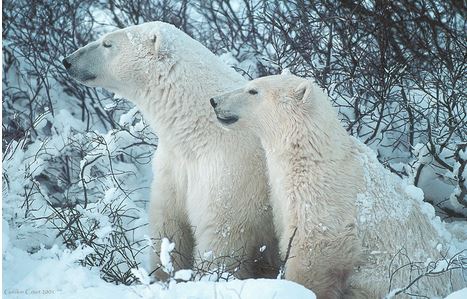
Polar bears_Gordon Court_Committee on the status of endangered wildlife in Canada Dec 2018

David Rose, writing for The Mail on Sunday, has produced an excellent feature on the conflict between Nunavut Inuit and biologists about polar bear management, got Andrew Derocher to tell the truth about current polar bear health and survival.

Or, to be more precise, to waffle a bit on his standard message of doom:

“Even Prof Derocher, who is convinced the bears’ long-term future is bleak, accepts that ‘the wheels are not coming off yet’, while ‘some bear populations are doing fine’. In West Hudson Bay, there has been ‘a recent period of stability’, he says, and though ‘we were seeing starving bears, starving cubs on land, that seems to have slowed down’. Then again, the computer models ‘are not great on the 5 – 10 year time-frame’, and it was possible that although the Arviat bears might look healthy now, they may be about to ‘fall off a cliff’.” [my bold]

This concession by Derocher suggests that Western Hudson Bay bears indeed are thriving, because he’s the guy who holds all the data. But he couldn’t help adding that disaster might be just around the corner.

But did he actually produce the data that show what’s been happening with cub survival or the body condition of females since 2004? Apparently not — but his admission that conditions are not as bleak as he continually portrays them suggests he is covering for data that says the same: polar bears in Western Hudson Bay are doing just fine and Inuit are right to be worried.

This may be as good as it gets unless the people of Nunavut can force Derocher to show his data.

Read the whole story here: “Why all you’ve been told about these polar bears could be WRONG: Animals driven to the edge of their natural habitat by shrinking ice have become one of the defining images of climate change, but Inuits who know the predators have a very different story.” (The Mail on Sunday, David Rose, 30 December 2018).

Continue reading

Biologists escalate conflict over Inuit management of polar bear populations

Yesterday, two polar bear specialists and an inept freelance journalist poured gasoline on the already-volatile issue of polar bear management in Nunavut.

Quote of the day: “I think there’s a reasonable chance that the last polar bear in Canada will be shot by an Inuk hunter.” [Andrew Derocher, University of Alberta]

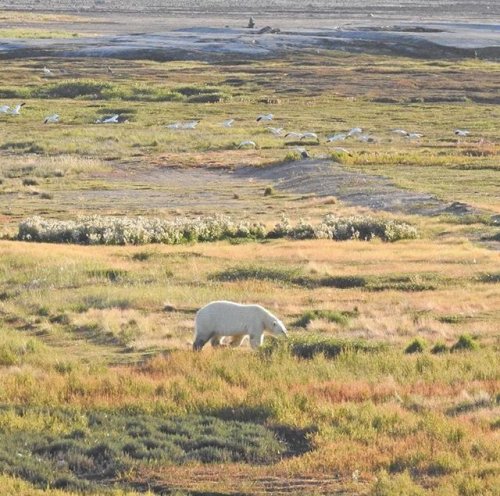
Polar bear Aug 2017 near area where June 19 2018 bear was spotted Gordy Kidlapik

You have to read it to believe how bad the Yale Environment 360 article by Gloria Dickie (19 December 2018) really is: “As polar bear attacks increase in the Arctic, a search for solutions.” [reprinted 26 December at PBS] The title suggests a balanced treatment of the issue but the reality is far from that: gross inaccuracies in the descriptions of the two fatal attacks that took place this summer that can only be explained by sloppy research and what struck me as unbelievably nasty and racist commentary by polar bear specialist Andrew Derocher. But decide for yourself.

Continue reading

Inuit and Western science are far apart on polar bear issues in Nunavut

Interesting summary and informed perspective from Nunavut News that’s worth a read on the issue of polar bear management in Nunavut (29 November 2018: “Inuit, Western science far apart on polar bear issues”).

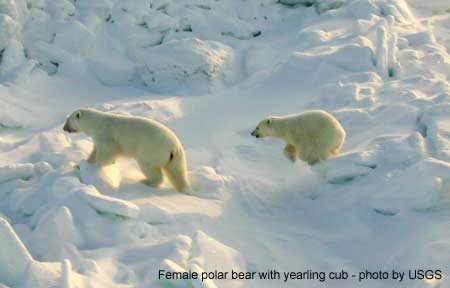
sow_yearling_USGS

“Nirlungayuk said the predictions made by Western science for the polar bear populations in western Hudson Bay and Baffin Bay were, in a word, wrong.

He said they need to look closely at those predictions and determine how they got them wrong.

“From a scientific perspective, I would challenge the scientific community to take another look at both western Hudson Bay and Baffin Bay to explain why the predictions that were being made back in the early 2000s up to 2018 were so wrong.

“A statement that came from Environment Canada was that the bears will keep on declining because of climate change even without hunting and that hasn’t happened.”

 Read the rest here.

Nunavut government has a draft plan to deal with unsafe numbers of polar bears

In the news today: “Nunavut Draft Plan Says There Are Actually Too Many Polar Bears In Territory” (CTV News via The Canadian Press, Bob Weber, 12 November 2018).

Polar Bear seaweed_Lorraine Brandson Churchill_taken Nov 2012

Polar bear eating seaweed near Churchill, Manitoba (November 2012). Lorraine Brandson photo.

From the Canadian Press story:

“There are too many polar bears in parts of Nunavut and climate change hasn’t yet affected any of them, says a draft management plan from the territorial government that contradicts much of conventional scientific thinking.

The proposed plan — which is to go to public hearings in Iqaluit on Tuesday — says that growing bear numbers are increasingly jeopardizing public safety and it’s time Inuit knowledge drove management policy.

“Inuit believe there are now so many bears that public safety has become a major concern,” says the document, the result of four years of study and public consultation.”

I’ve noted previously that there were two fatal polar bear attacks in Hudson Bay this summer. Both of them happened outside local communities and both happened early during the ice-free period (when bears would have been onshore for only a few weeks). Neither incident can be reasonably blamed on lack of sea ice, an extended ice-free period, or lack of management of problem polar bears within or near communities. The bears involved in the August attack were described as being in good condition.

Update 13 November 2018: See The Guardian‘s take on this story, by a different writer. Despite potential to talk to other polar bear specialists about this issue, only Derocher is quoted. Is no one else talking? “Polar bear numbers in Canadian Arctic pose threat to Inuit, controversial report says” (The Guardian, 13 November 2018).

Update 14 November 2018: See a new CBC story on Inuit perspectives on this issue. “Nunavut community says Inuit lives need to be protected over polar bear population” (CBC News, 14 November 2018).

Continue reading

Polar bears waiting for ice on Russian coast of Chukchi Sea threaten village residents

Ryrkaypiy on the Chukotka coast of Russia is similar to Churchill, Manitoba: both human settlements are of similar size and are close to where polar bears wait for sea ice to form in the fall and where some pregnant females make their maternity dens in preparation for the birth of cubs over the winter (Durner et al. 2018:xxii). Sea ice advances from the west along the Chukotka shore and bears cannot move offshore to resume hunting until the sea ice reaches the village of Ryrkaypiy. According to the Siberian Times, the village is again having problems with local polar bears, as they have for the last several years (including 2013).

Mother with cubs Russia_shutterstock_71694292_web size

“At least twelve polar bears are inside the village, with some of them paying daily visits.

The rest are within three kilometres away.

‘We have to constantly scare the bears away with signal rockets, so far thanks to efforts of the Bear Patrol we manage well’, said acting head of Ryrkaypiy Yevgenia Malakhova.

The large group of bears started to form a month ago when they came close to Cape Kozhevnikov.

‘Now the bears moved close to the village, they also walk back and forth all along the shore line. The animals are irritated because they are ready to leave the area and start hunting in the deep sea, but ice is too thin’, said Malakhova.

All 760 locals are aware of the dangerous situation and take extreme care when moving around the place.”

More below, including map and ice chart.

Continue reading

Churchill’s polar bear problems took time and money to resolve

Churchill, Manitoba is proud of its management of problem polar bears and rightly so. But it took time and money to implement the solutions that allowed Churchill to function as it does today, and that should be a lesson for other Arctic communities that have only really started to have problems with polar bears in recent years.

Churchill polar bear_mother_with_cub 2009 Wikipedia

For those who want to understand the problems facing other communities, including Arviat (formerly “Eskimo Point”), a town 260 km north of Churchill. Arviat has a population more than three times the size of Churchill and has been having significant problems with bears since about 2007. I’ve made an excerpt of an excellent paper written by Ian Stirling and colleagues that was published back in 1977 (Stirling et al. 1977).

It describes in detail the problems Churchill had with polar bears in the 1960s and 70s when bear numbers were on the rise — and the various steps that were taken to try and resolve them (even by the time the paper was written, not all of them had been adequately resolved, see Kearney 1989).  It’s a fascinating read — see it here.

Continue reading

Inuit hunters frustrated by polar bear conservation rules that put their lives at risk

‘The rules are taking over Inuit tradition and the bears are taking over Inuit. We’re just watching in the distance, afraid of these bears because they’re free to do whatever they want.’ says Brian Aglukark, after two fatal polar bear attacks this summer (CBC,  24 September 2018).

Walking bear_129029633_web size

Here’s an excerpt (my bold): continue reading

Polar bears that killed Foxe Basin hunter in August were in good condition, say officials

Just in from NunatsiaqNews (6 September 2018): The polar bears that killed Foxe Basin resident Darryl Kaunak were in good condition, as were the bears who approached the group of hunters after the fact. And the bear that mauled Arviat resident Aaron Gibbons in early July was an adult male in “fair” condition, according to necropsy results.

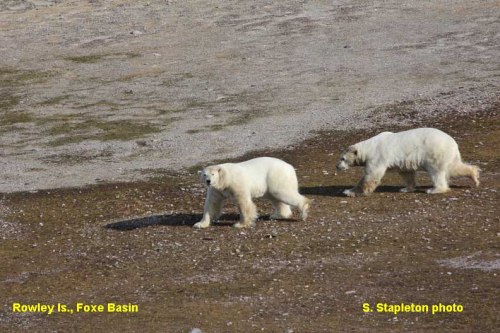
Foxe Basin polar_bears_rowley_island_Stapleton 2012 press photo labeled sm

In all, no evidence that lack of sea ice was to blame. Quotes below.

Continue reading