Category Archives: Polar bear attacks

White Lie: Polar bear starvation is virtually never caused by sea ice loss

Starvation due to natural causes is the leading cause of death for polar bears and loss of body condition (getting thinner) is therefore the first symptom of impending death for virtually all polar bears that die naturally. However, polar bear specialist Andrew Derocher claims that loss of body condition is also the first symptom of climate change for polar bears.
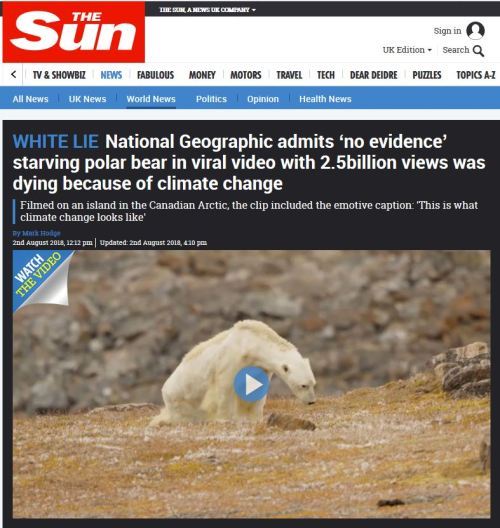
white-lie_the-sun-on-ng-apology-2-aug-2018-headline.jpg

But how do you tell the difference between polar bears made thin by man-made climate change and those who are thin due to natural causes?

You can’t. Even a necropsy will not be conclusive because there are so many natural reasons for a bear to lose weight — and even starve to death — that’s it’s virtually impossible to say that any thin bear is skinny due to a lack of sea ice.

Emaciated polar bears like the one above from Somerset Island in the Canadian Arctic,1 captured on camera in August 2017, are being used to promote the idea that polar bears are already dying of starvation due to climate change. That’s a big white lie, as the headline above suggests: seven months later, National Geographic has admitted as much. Here I show why it could not have been true in the first place (with references from the scientific literature).

UPDATE: 29 August 2018: See my op-ed in the National Post (29 August 2018) and the GWPF video below on this issue:
Continue reading

Breaking news: One hunter killed, two injured in polar bear attack in Foxe Basin

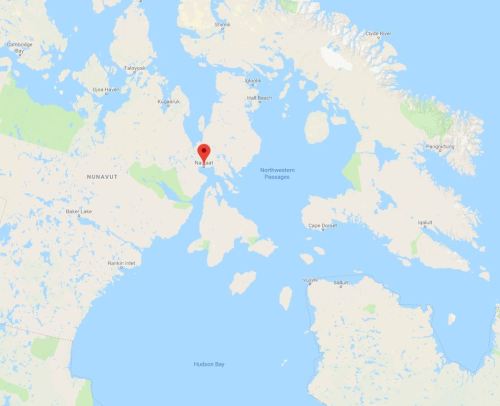
A man from Naujaat, Nunavut (formerly Repulse Bay) has been killed by a polar bear and her cub, and his two hunting companions injured. The party was found today by a search and rescue team on White Island, southeast of Naujaat after they were reported overdue home on Sunday. A total of five bears were destroyed at the scene: the female and her cub responsible for the attack, plus three other bears attracted to the site and still present when rescuers arrived. This is the second fatal polar bear attack in Nunavut this summer (see previous post here). A very sad day indeed.

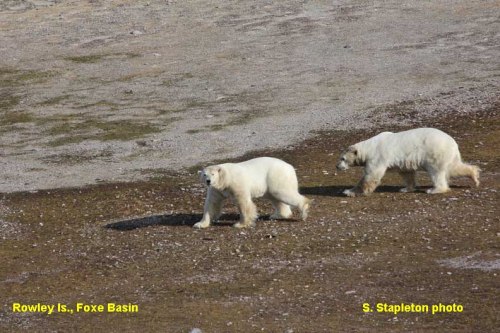
Foxe Basin polar_bears_rowley_island_Stapleton 2012 press photo labeled sm

Excerpts from news reports below and more details to follow on this incident as they become available. Map below shows location of Naujaat, with White Island about 100 km southeast (off Southampton Island):

Naujaat location_Foxe Basin_Google maps

UPDATE 6 September 2018: According to examination of the bodies, all of the bears involved (apparently only 4, not 5) were in good condition. See post here and news announcement here.

According to the CBC (28 August 2018), five polar bears were destroyed following the attack [my bold]:

Continue reading

Busy week for Churchill Polar Bear Alert Program in week 6, more problems than 2017

The Churchill Polar Bear Alert program has been busy in week 6 (Aug.13-19), with 67 occurrences to date: slower than last year but not quite as brisk as 2016. Some bears have already been released from the holding cells of “polar bear jail,” transported outside of Churchill and marked with a green dot to identify them as problem bears to residents of communities further north.

churchill-pb-reports_week-6_-aug-13-19-2018.jpg

Compare the above to other years below, as welll as weeks 4 and 5. Previous weeks here and here.

Continue reading

Brace yourself: more starving polar bear news stories in the pipeline from Svalbard

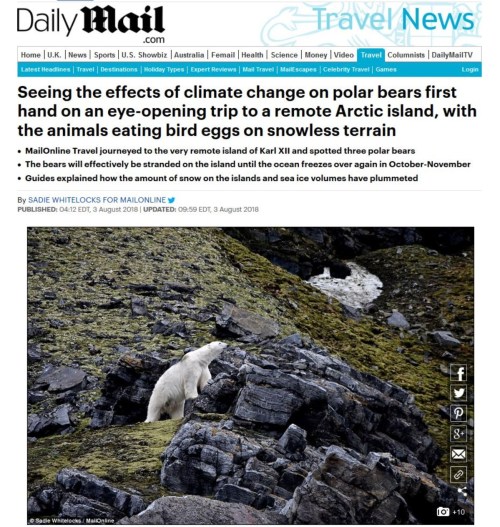
A few polar bears have become stranded on small islands north of Svalbard since the local sea ice retreated — of which the bear that mauled a cruise ship guard last month was but one — and if return of the ice is as late as last year, those handful of bears are likely doomed to die of starvation. This is not due to climate change but rather bad judgment on the part of these few bears. They were not forced ashore: if they’d stayed on the ice like the rest of the population, they’d have likely been just fine.

Daily Mail stranded bear headline_3 Aug 2018 all

Similar to the bear in northwestern Hudson Bay that fatally mauled a young father in early July, these bears were likely lured ashore by the prospect of masses of bird eggs present on island rookeries. But they overstayed their window of opportunity and the ice retreated without them.

Fledgling birds and bird eggs are not replacements for seals in a bear’s diet but when the season of easy seal kills winds down, as it does in late spring, easy-picking sea bird eggs may be enticing enough to lure a few bears ashore when they’d be better off on the ice.

That is not the fault of climate change.

Unlike bears in Hudson Bay and many other regions — including the Lancaster Sound area of Canada where the National Geographic “starving” bear was filmed last summer — these bears were not forced ashore by retreating ice: they chose to do so.
Continue reading

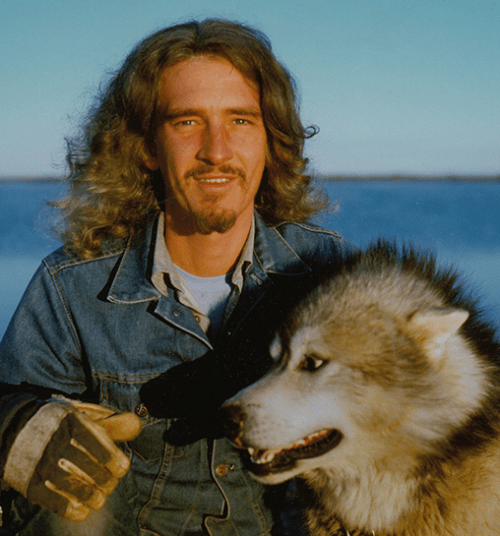
Brian Ladoon, saviour of Canadian Eskimo Dogs, has died in Churchill

Early on Sunday 5 August 2018, Brian Ladoon died at the age of 65 in Churchill, Manitoba — and so far, the media have said nothing. Brian dedicated his life to the preservation of the Canadian Eskimo Dog — which often attracted polar bears to his property — but he was also an accomplished artist.

Ladoon and husky_Norbert Rosing obituary 6 Aug 2018

In the early days, (Norbert Rosing photo.

As a lover of Arctic dogs, I remember hearing of Brian’s work decades ago but only that “someone” was working hard to save the breed. I never dreamed I’d come to know so much more about his work through my research on polar bear ecology and evolution.

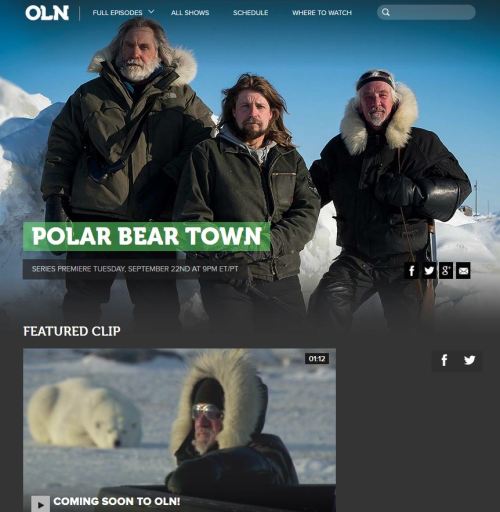
I never met the man. But he has clearly been an icon of Churchill for decades and because of that, the place will not be the same without him. He is on the right in the photo below, for the TV series “Polar Bear Town” that ran in 2015 (some episodes below).

Polar Bear Town premiere Sept 22 2015

UPDATE 9 May 2019: A reader asked what happened to Brian’s dogs and because I wondered myself, I asked around. Kelsey Eliasson responded:

“Penny his ex-partner is taking care of them with a small team of helpers… they are trying to formalize a board/non-profit for long-term needs”

Continue reading

Polar bears do not outnumber people in Svalbard and the backlash against ecotourism over a justified defensive kill

It is often said that there are more polar bears than people in Svalbard, Norway (see BBC, “Polar bear shot dead after attacking cruise ship guard29 July 2018). But that isn’t true now and probably hasn’t been for a very long time. This pseudo-fact (a misunderstanding made by tourism promoters) continues to be quoted as the story about the Svalbard polar bear shot by a cruise ship bear guard last week evolves in the online and print media. The media continue to focus on social media backlash against ecotourism, which is nothing like the pushback about the starving polar video from last year.

Svalbard dead bear_Gustav Busch Arntsen_Governor of Svalbard_NTB Scanpix via AP 28 July 2018

Continue reading

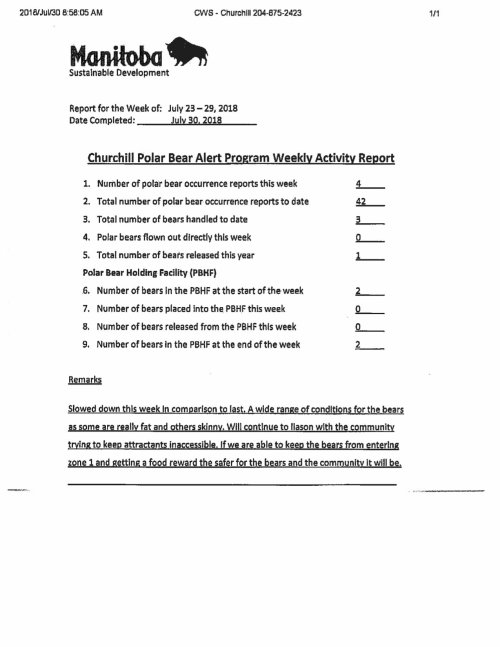
Churchill problem polar bear report for week 3, July 23-29 2018

Polar bears that have come off the sea ice of Hudson Bay near Churchill, Manitoba in Western Hudson Bay are apparently in a wide variety of conditions, from very fat to skinny.  So, not all skinny despite the relatively early breakup of ice in the northwest.

Churchill PB reports_week 3_ July 23-29_July 2018

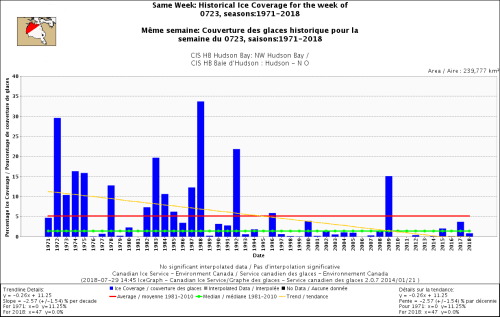
Most of the ice was gone from the NW of Hudson Bay for the week of 23 July 2018 and the graph below shows that this is a new pattern that began in 1997, with only 2009 being an outlier:

Hudson Bay NW same week_ ice coverage 23 July 1971-2018 with trend

Continue reading

Cruise ship bear guard survives being mauled by polar bear in Svalbard

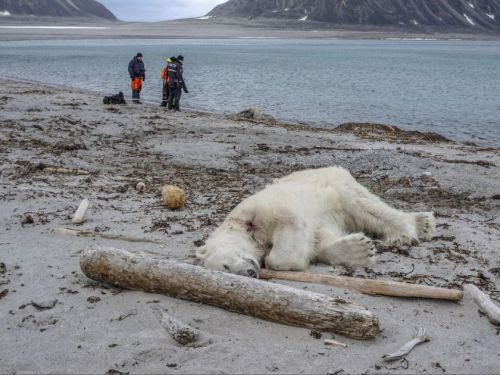
Less than a month after a fatal polar bear attack near Arviat, Western Hudson Bay, European media reported this morning that one of two German polar bear guards escorting a group of tourists on a shore visit in northern Svalbard was mauled on 28 July by a polar bear before the second guard could kill it.

Svalbard dead bear_Gustav Busch Arntsen_Governor of Svalbard_NTB Scanpix via AP 28 July 2018

The man was air-lifted to hospital in Longyearbyen with non-life-threatening head injuries. Whether the bear was fat or thin was not mentioned but a necropsy will be performed.

More details are likely to be available within the next few days. The guards and tourists were from the German cruise ship MS Bremen, which apparently is operating a live web cam. The group landed on the Sjuøyane Islands, the northernmost group of islands in the Svalbard archipelago (see the top of the black box on the map below).

UPDATE 28 July 2018 11:00 pm PT: The photo of the dead bear (above, provided by the Governor of Svalbard), shows the animal was in poor condition. See my comments below regarding sea ice coverage for the area: the bear had likely been on the islands since early May and if he was not in good condition when he left the ice, he would have been desperate by now. However, we still do not know if he was sick or injured, young or old. That information will come with time.

UPDATE 29 July 2018: The cruise ship line has released a statement on Facebook that includes further details about the attack, see below.

Continue reading

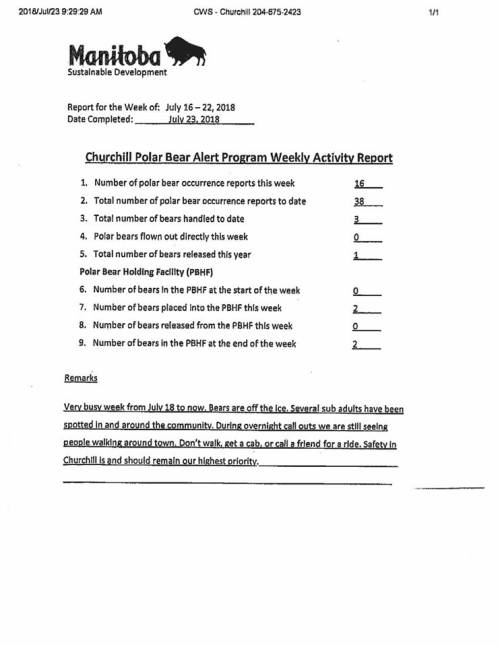
Churchill area polar bears off the ice as of third week in July say problem bear reports

Second week of Polar Bear Alert Activity reports (16-22 July) for 2018 and already two bears are in jail, making it the busiest 3rd week in July since 2015:

churchill-pb-reports_week-2_-july-16-22_july-2018-e1532401430601.jpg

Continue reading

New information on the fatal polar bear attack at Arviat, Western Hudson Bay

Additional information is available regarding the fatal mauling of a young Arviat father two weeks ago that may answer the question of why the bear left the Hudson Bay sea ice well before it was necessary. Was it lack of sea ice (blamed on global warming), as biologist Ian Stirling recently insisted — or did natural food attractants lure the bear ashore prematurely?

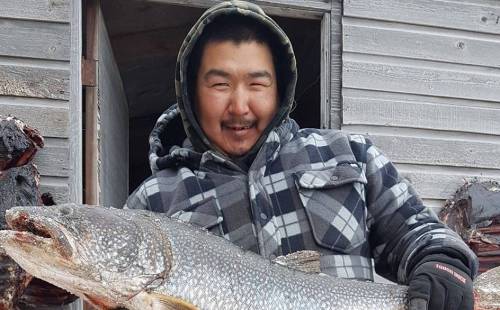
Aaron Gibbons_fishing_Gibbons family photo

I would also like to appeal to readers to consider a donation to the Go Fund Me campaign set up to support the widow and children of Aaron Gibbons, who was only 31 years old. So far, there has not been an overwhelming response (less than 1/2 of the modest goal of $5,000 met after two weeks) and that saddens me deeply.

I have contributed myself but each individual can only do so much. Imagine losing your spouse in this most vicious manner (the children witnessed the attack and were the ones that called for help) and think of the challenges of healing your family and keeping it afloat financially. Please see the GO FUND ME page and contribute if you can.

What I’ve learned over the last week is that the polar bear that killed Aaron Gibbons was a big male in poor condition but he was not the only bear onshore at the time. In addition, the Arctic tern nesting colony on Sentry Island was undoubtedly an enticing natural attractant that seems to have encouraged these bears to leave the ice far north of where they might otherwise have come ashore.

UPDATE 20 July 2018: I’ve added the most recent (19 July) map of collared WH polar bear locations on Hudson Bay to the “Condition of the Sea Ice” discussion below. Also, I am pleased to see that the GO FUND ME campaign has now gone above the half-way mark (~$2800.00 as of 2:00 PM Pacific time). My personal thanks to every one who was able to contribute. I hope to see the goal reached within the next few days.

UPDATE 6 September 2018: A news announcement today revealed that the necropsy done on the bear that attacked Aaron Gibbons was an adult male in “fair” condition (thin but not skinny). See my report here and the news story here. And I’m pleased to report that the GoFundMe goal of $5000 for Aaron’s family has been reached: thanks to all PolarBearScience readers for their support.
Continue reading