Category Archives: Population

Both sides now: New paper critiques Canadian polar bear population status

Demographic and traditional knowledge perspectives on the current status of Canadian polar bear subpopulations. 2016 (in press). Jordan York, Martha Dowsley, Adam Cornwell, Miroslaw Kuc and Mitchell Taylor. Ecology and Evolution 6(9):2897-2924. DOI: 10.1002/ece3.2030

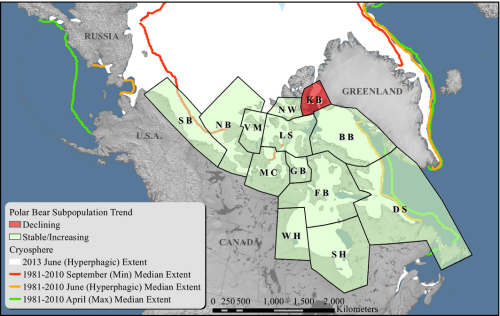
York et al 2016 fig 1_numbers 2013

Take home quote:

“We see reason for concern, but find no reliable evidence to support the contention that polar bears are currently experiencing a climate crisis. We suggest that the qualitative projections for dramatic reductions in population numbers and range are overly pessimistic given the response of polar bears, climate, and sea ice to the present.”

Continue reading

Polar bears onshore in winter – will more bears mean more deadly attacks?

Incidents of polar bears causing problems onshore this winter (January & February) – including one that killed a horse in Greenland and another that threatened a resident in western Hudson Bay (only weeks after several incidents in southern Labrador) may be the tip of a very scary iceberg. I’ve taken a look at what records exist of this phenomenon, which in the past often involved deadly attacks. The large number of reports this winter appears to be a real increase, which is a rather terrifying prospect indeed.

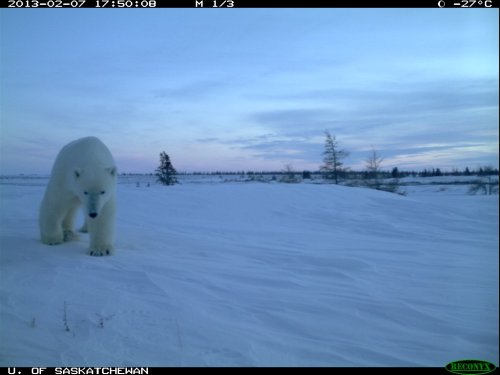
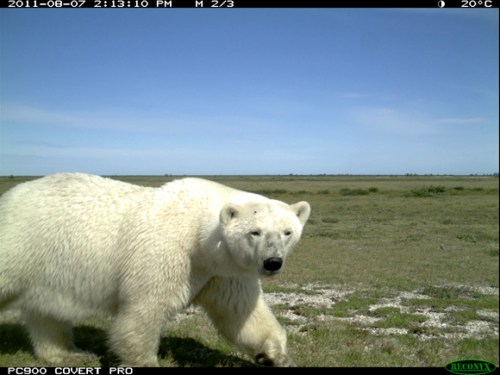
Doug Clark photo polar bears onshore in Feb 2013 Wapusk NP

In winter, all polar bears except females in dens nursing newborn cubs are presumed by biologists to be on the sea ice hunting but it turns out that is not quite true. Although relatively rare over the last twenty years or so, it appears that in some areas, bears are now coming ashore in winter.

The photo above shows a polar bear photographed by a remote camera installed at Broad River Camp, Wapusk National Park, western Hudson Bay on 7 February 2013. It was visible to the camera for 40 minutes but apparently caused no trouble (camera installed and maintained by associate professor Doug Clark from the University of Saskatchewan and colleagues).

Given the fact that there are now many more polar bears than there were in the 1970s as well as more people living in many coastal Arctic communities, problems with bears in winter are likely to increase, as this winter’s events show. More bears out on the ice in winter (January-March) will almost certainly create more competition for the little bit of food that’s available (seals are hard to catch in winter), which means some bears might increasingly be looking for alternate sources of food onshore.

Continue reading

Challenging Alaska polar bear research sound bites and bewildering ESA status

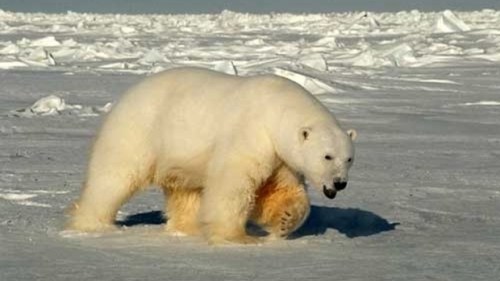
Beaufort Sea male polar bear USGS_2005 Amstrup photo

It’s easy to take polar bear research papers at face value but it’s not very scientific. The snappy sound bites provided for the benefit of the media – whether they’re embedded in press releases or in published abstracts – don’t cut it with trained scientists. Trained scientists read the whole report, critically examine the evidence it contains and assess that evidence within the context of previous knowledge. That’s what they are trained to do.

I challenge the superficial summary on the status of Alaskan polar bear populations provided by FactCheck.org journalist Vanessa Schipani.  Schipani disputed a comment made by Alaska Senator Lisa Murkowski that, according to the latest research Alaskan polar bear population numbers are strong and healthy. I’m not especially interested in the political context of the statement, only Schipani’s bald claim that Murkowski’s declaration is false.

I’ve read all the relevant papers in full and I contend that the evidence supports Murkowski’s statement. Schipani is confusing the issue by regurgitating ‘facts’ that don’t tell the truth of the matter. By the sum of accounts, Alaskan polar bear populations are indeed healthy and strong – whether or not this status will continue is an entirely different question. Continue reading

A new count planned for Southern Beaufort polar bears

I know I was not the only one that thought the last polar bear count conducted by the US Geological Survey (USGS) in the Southern Beaufort generated an untenable result but it appears that some of those challengers are in a position to demand a recount.

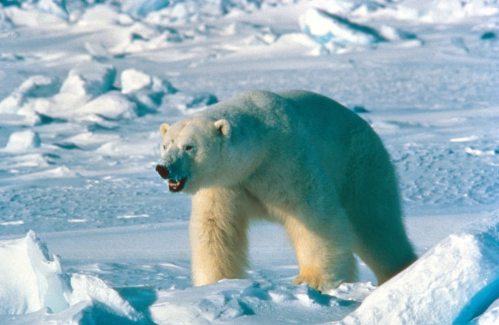
polar_bear_usfws_no date_sm

CBC News ran a story late last week announcing a plan is in the works to do an aerial survey of Southern Beaufort Sea polar bears across their entire range over two years starting in 2017 (11 March 2016, “Joint U.S.-Canada Beaufort Sea polar bear survey planned“).

With luck, this period will not include another bout of the same thick spring ice conditions that decimated the population in the mid-2000s (which many reporters concluded was due to reduced summer sea ice because that’s what leading biologists implied). Even if it does, lucky timing will not negate the fact that this population is routinely subjected to devastating population declines caused by natural changes to spring sea ice conditions from which they have recovered on numerous occasions. Continue reading

Biggest threat to polar bears reconsidered

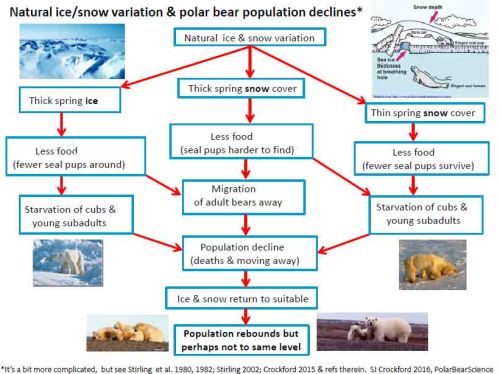
What presents a bigger risk to current polar bear populations: natural hazards that have already proven deadly or potential, yet-to-be-realized threats prophesied to occur due to human activities? That’s a perfect question for International Polar Bear Day.

Natural ice_snow variation and polar bears_model_PolarBearScienceFeb 20 2016

Dag Vongraven, chair of the IUCN Polar Bear Specialist Group, remarked last year that “until 2001, everything was fine.

Polar bear researchers thus assume that 2001 was the year climate change became the new over-hunting – but is it true? What are the relative harms presented by proven natural causes, potential human-caused threats, and predicted threats due to sea ice declines blamed on global warming? Considered objectively, is climate change really the single biggest threat to polar bear health and survival right now?
Continue reading

W. Hudson Bay polar bear numbers declined then stabilized, says new paper

Polarbear_Parks Canada Wapusk in August

Western Hudson Bay bear, Wakusp National Park, August 2011.

In the just-published version of their Western Hudson Bay (WHB) population survey conducted in 2011, Nick Lunn and colleagues highlighted in the abstract:

“Our analysis suggested a long-term decline in the number of bears from 1,185 (993-1411) in 1987 to 806 (653-984) in 2011…” 

But they didn’t mention that the 806 estimate for 2011 was based on only a portion of the WHB region (Fig. 1) and has not been accepted by their peers as a valid estimate of the population size. They also failed to mention that the decline occurred due to thick spring ice and/or unsuitable snow conditions for ringed seals between 1989 and 1992 (Fig. 2), which resulted in reduced availability of polar bear prey (as I discussed in detail in Crockford 2015).

They know the “long-term” population decline is what the media will grab onto and run with – rather than the next sentence, which says “In the last 10 years of the study, the number of bears appeared stable due to temporary stability in sea ice conditions.

In other words, their study shows there has been no decline in the population since 2004, which had been predicted to occur (see previous post, Prediction #1), and there has been no trend in either breakup or freeze-up dates between 2001 and 2010 (or since). See previous post on the government report on which this paper is based here.

The bottom line is this: no one is buying this population estimate of 806 bears for the Western Hudson Bay population – both the IUCN Polar Bear Specialist Group and Environment Canada are using Seth Stapleton and colleagues (2014) estimate from their aerial survey done the same year and that official population size number is 1030 bears. Continue reading

Polar bear capital of the world stuck between fear-mongering and science

CBS News published a predictably one-sided “Cover Story” this morning (14 February 2016) about Churchill, Manitoba – the self-proclaimed Polar Bear Capital of the World. 

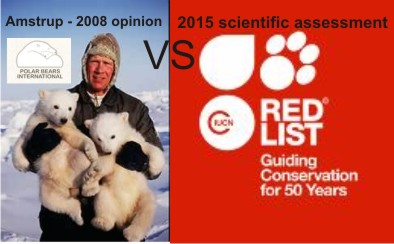
This is the online version of a Sunday morning TV special that’s not available where I live. It’s yet another example of how the media feeds the politics of polar bears and prevents the advancement of science. Here’s my take on this CBS effort.

Amstrup vs IUCN science_Feb 14 2016_PolarBearScience

Continue reading

Zoos use polar bears to spur action on climate change – not to save them

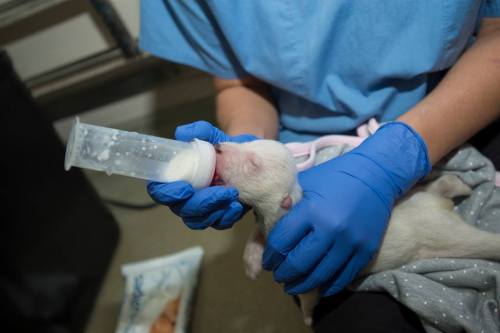
Media outlets have recently been having collective orgasms over photos and videos of a three month old polar bear cub born at the Columbus Zoo in Ohio, which has again raised the issue of why it is now acceptable for polar bears to be held and bred in captivity.

Zoo bear at Columbus_after birth in November 2015

Newborn polar bear cub ‘Nora’ Columbus Zoo handout

The myth being propagated by zoos and their supporters is that it’s necessary to save polar bears from extinction.

Actually, nothing could be further from the truth – this is all about pressuring people to care about climate change. Polar bears are merely  a marketing tool to spur action on climate change.  That’s not my opinion but the plan put in place in 2012 by the Association of Zoos and Aquariums and Polar Bears International.

Oddly, few animal rights activists are objecting (or at least, not objecting very strenuously) to zoo displays of captive polar bear cubs – obvious money-making draws for zoos – which were so vehemently condemned in the 1970s that most zoos gave them up.

Now, the practice is defended and everyone seems to feel this is the greatest thing since the invention of the telephone. [Update 19 February 2016: courtesy the BBC, we can add Highland Wildlife Park in Scotland to the list of zoos using “we’re saving the polar bears” justification for breeding the bears in captivity]

The surprise is that disgraced climate scientist Michael Mann, promoter of the infamous hockey stick of global temperatures, is involved in all this.

Continue reading

Polar bears roaming Labrador in winter due to climate change, says minister

This is a follow-up to a post on my book blog that I wrote this morning because it’s relevant to the scenario I describe in my novel, set in the year 2025 in northern Newfoundland. I’m cross posting it for the benefit of regular readers here.

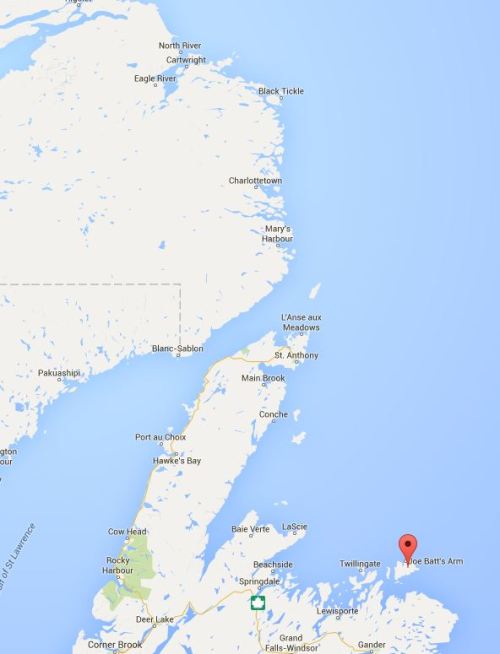
It appears that most of the blame for this phenomenon of multiple sightings of hungry bears onshore in the dead of winter (creating havoc and roaming among houses in the coastal Labrador communities of Black Tickle and Charlottetown) has been placed squarely on…climate change. By a government minister. You have to hear this man’s words to believe it.

Labrador south and Fogo Nfld marked

Continue reading

Polar bear myths perpetuate from the mouth of stuck-in-the-past Ian Stirling

In my last post, I complained about “vague and misleading statements” made by polar bear specialists and conservation advocates. Here’s a recent example of that phenomena, from veteran polar bear biologist Ian Stirling.


stirling_UA faculty page photo accessed July 22 2012

The magazine of Canada’s North, UpHere, published an interview with Ian Stirling this month. The piece begins:

“No fear-mongering. No exaggeration. For Ian Stirling, it’s purely about the science.”

Yeah, well – judge for yourself. Here’s a sample:

“We have lost on average about half the sea ice that we had in 1979, which is the first year that satellite coverage of the Arctic was taken [he’s talking about September ice here]. Places like Hudson Bay are breaking up three weeks earlier than they used to and freezing up a couple weeks later. We’re going to have even more significant effects over a much wider area in the Arctic. We’re likely to lose another 30 or 40 percent, or even half of the bears that we have today in the middle of the century, and unchecked, we will likely have very few bears left at the turn of the next century. In 2100, we’ll probably just have a few small remaining pockets in the northern Canadian Arctic islands and northern Greenland.”

Read the rest here.

Stirling’s opinion about polar bears and climate change hasn’t changed since at least 2004 despite the following scientific developments: Continue reading