Derocher admits Western Hudson Bay polar bear population may not be declining

Earlier this year, I challenged a journalist to ask to see the data used by Andrew Derocher and his colleagues to support their repeated claims that Western Hudson Bay polar bears are having trouble surviving. It almost happened.
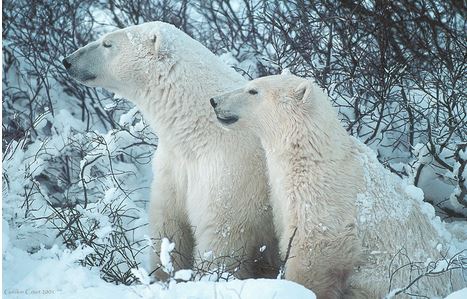
Polar bears_Gordon Court_Committee on the status of endangered wildlife in Canada Dec 2018

David Rose, writing for The Mail on Sunday, has produced an excellent feature on the conflict between Nunavut Inuit and biologists about polar bear management, got Andrew Derocher to tell the truth about current polar bear health and survival.

Or, to be more precise, to waffle a bit on his standard message of doom:

“Even Prof Derocher, who is convinced the bears’ long-term future is bleak, accepts that ‘the wheels are not coming off yet’, while ‘some bear populations are doing fine’. In West Hudson Bay, there has been ‘a recent period of stability’, he says, and though ‘we were seeing starving bears, starving cubs on land, that seems to have slowed down’. Then again, the computer models ‘are not great on the 5 – 10 year time-frame’, and it was possible that although the Arviat bears might look healthy now, they may be about to ‘fall off a cliff’.” [my bold]

This concession by Derocher suggests that Western Hudson Bay bears indeed are thriving, because he’s the guy who holds all the data. But he couldn’t help adding that disaster might be just around the corner.

But did he actually produce the data that show what’s been happening with cub survival or the body condition of females since 2004? Apparently not — but his admission that conditions are not as bleak as he continually portrays them suggests he is covering for data that says the same: polar bears in Western Hudson Bay are doing just fine and Inuit are right to be worried.

This may be as good as it gets unless the people of Nunavut can force Derocher to show his data.

Read the whole story here: “Why all you’ve been told about these polar bears could be WRONG: Animals driven to the edge of their natural habitat by shrinking ice have become one of the defining images of climate change, but Inuits who know the predators have a very different story.” (The Mail on Sunday, David Rose, 30 December 2018).
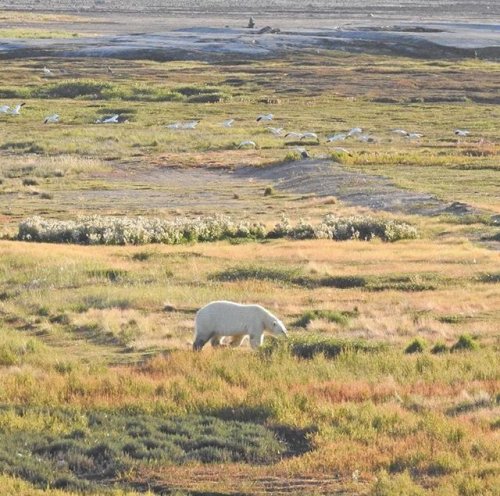
Continue reading

Biologists escalate conflict over Inuit management of polar bear populations

Yesterday, two polar bear specialists and an inept freelance journalist poured gasoline on the already-volatile issue of polar bear management in Nunavut.

Quote of the day: “I think there’s a reasonable chance that the last polar bear in Canada will be shot by an Inuk hunter.” [Andrew Derocher, University of Alberta]

Polar bear Aug 2017 near area where June 19 2018 bear was spotted Gordy Kidlapik

You have to read it to believe how bad the Yale Environment 360 article by Gloria Dickie (19 December 2018) really is: “As polar bear attacks increase in the Arctic, a search for solutions.” [reprinted 26 December at PBS] The title suggests a balanced treatment of the issue but the reality is far from that: gross inaccuracies in the descriptions of the two fatal attacks that took place this summer that can only be explained by sloppy research and what struck me as unbelievably nasty and racist commentary by polar bear specialist Andrew Derocher. But decide for yourself.

Continue reading

CBC hypes “bleak” Churchill polar bear fate with unsupported claims & falsehoods

Over the weekend in Canada, the CBC ran a polar bear news feature that is now available online (“Polar bears in peril: the bleak future of Churchill bears,” The National, CBC, 3 December 2018). It gave polar bear biologist Nick Lunn of Environment Canada free rein to spread unsubstantiated claims and outright falsehoods about the status of Western Hudson Bay polar bears and sea ice. Apparently, he and the CBC learned nothing from National Geographic‘s fiasco over their starving’ polar bear video last year: they still think the public will be swayed to “act” on human-caused global warming if a persuasive expert tells them that polar bears are on their way to extinction. I expect many were convinced otherwise, since the facts are available for all to see.

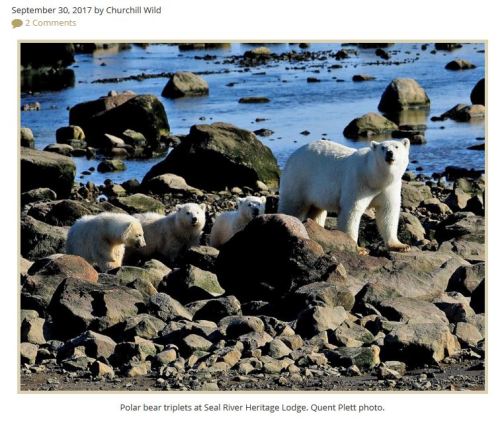
No triplet litters born since 1996? Nonsense, as the photo below (from 2017) shows.

Triplet litter at Seal River Lodge 2017 Quent Plett photo

The CBC video is described this way:

“They are a majestic icon of Canada’s North, but polar bears have also come to symbolize climate change. And scientists say the future for one particular population of polar bears in northern Manitoba is dire.

Continue reading

Unfounded concern for polar bears from onshore oil exploration in Alaska

Canadian biologist Andrew Derocher was called upon to promote his particularly pessimistic viewpoint on polar bear survival in a story published in the New York Times yesterday (2 December 2018: “Drilling in the Arctic: Questions for a Polar Bear Expert”). However, decades of evidence suggests that onshore oil exploration in the Arctic National Wildlife Refuge is unlikely to harm the few female bears that come ashore in Alaska to make maternity dens.

polar bear investigates an oil platform_USFWS photo used Dec 2018

Here is my rebuttal to Derocher’s claims, all of which I’ve dealt with previously.

Continue reading

Canadian polar bears still not threatened with extinction says conservation committee

At recent meeting of the Committee on the Status of Endangered Wildlife in Canada (COSEWIC), biologists decided to continue to list the polar bear as a species of ‘Special Concern.’ About 2/3 of the world’s polar bears live in Canada and the balance of all evidence (including Inuit knowledge) indicate the bears are not threatened with extinction. The bears have held this status since 1991.

Polar bears_Gordon Court_Committee on the status of endangered wildlife in Canada Dec 2018

Details from the 3 December 2018 press release below.

Continue reading

Inuit and Western science are far apart on polar bear issues in Nunavut

Interesting summary and informed perspective from Nunavut News that’s worth a read on the issue of polar bear management in Nunavut (29 November 2018: “Inuit, Western science far apart on polar bear issues”).

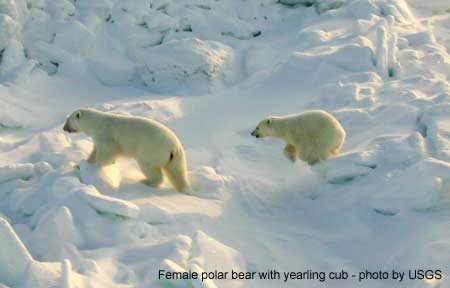
sow_yearling_USGS

“Nirlungayuk said the predictions made by Western science for the polar bear populations in western Hudson Bay and Baffin Bay were, in a word, wrong.

He said they need to look closely at those predictions and determine how they got them wrong.

“From a scientific perspective, I would challenge the scientific community to take another look at both western Hudson Bay and Baffin Bay to explain why the predictions that were being made back in the early 2000s up to 2018 were so wrong.

“A statement that came from Environment Canada was that the bears will keep on declining because of climate change even without hunting and that hasn’t happened.”

 Read the rest here.

No extirpation looms for Svalbard polar bears: no pending catastrophe in Norway

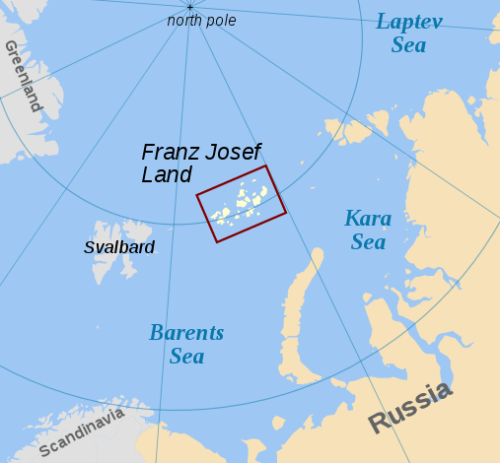
Despite a wild claim that a “slow Arctic freeze” this year increases the risk that polar bears will become extinct, sea ice charts show ice returning earlier than it has for decades everywhere except the Svalbard area of the Barents Sea. That’s good news for pregnant polar bears. Although Svalbard is without ice, that’s been true for so many years that pregnant Svalbard females long ago abandoned the use of islands they used in good ice years and now make their dens in the Franz Josef Land archipelago to the east (which is still within the Barents Sea subpopulation region).

Svalbard polar bear fall 2015_Aars

Polar bears give birth around 25 December each year, so pregnant females prefer to be snug in a safe den by around the end of November at the latest. That’s been possible for all regions of the Arctic this year, including the Barents Sea — because sea ice returned to Franz Josef Land weeks ago, even though Svalbard is still ice-free.

Franz_Josef_Land_location_wikipedia

Major denning areas in Russia, including Wrangel Island, have been surrounded by ice since the middle of the month, allowing pregnant females that did not remain on shore over the summer to return to make maternity dens. Elsewhere, bears that have been confined to shore over the ice-free season (such as along Hudson Bay and Baffin Island in eastern Canada) returned to the ice to hunt seals weeks ago after the earliest freeze-up in more than two decades.

Continue reading

Hudson Bay polar bear habitat is highest in more than two decades for this time of year

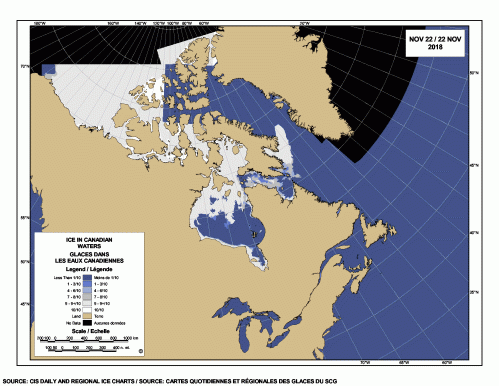
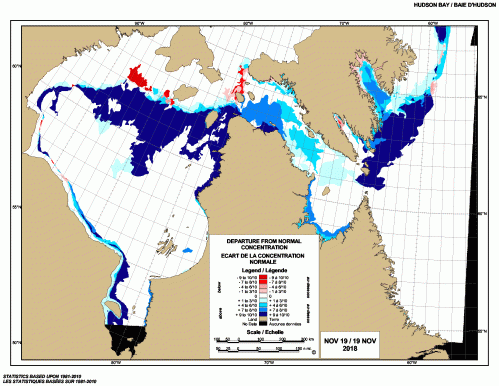
More ice in Hudson Bay and adjacent regions than we’ve seen at this time of year for more than two decades: not since 1993 has there been as much polar bear habitat in the 2nd-last week of November.

Sea ice Canada 2018 Nov 22

The anomaly chart for this week is almost all blue:

Hudson Bay weekly departure from normal 2018 Nov 19

Other years back to 1994 had much less ice for the 2nd-last week in November, as the charts below show. Colour charts are only available from 2004.

Continue reading

My fabulous polar bear science book for kids now also available in Norwegian

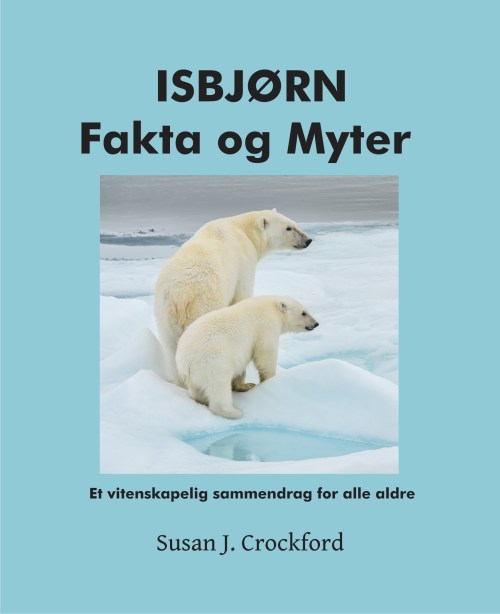
Polar Bear Facts and Myths (for children aged 7 and up) is now avaiblable in Norwegian!

The same day as a glowing review of the Dutch translation of my popular children’s science book appeared in de Telegraaf (front page and all of page 5, 19 November 2018, pdf here), I am thrilled to announce that this important book is now available in Norwegian via Amazon worldwide, including European outlets.

Crockford FM front cover Norwegian FINAL 18 Nov 2018 3 inch

The translation was done by native Norwegian speakers Arve Tunstad and Morten Jødal. In Norwegian the book is called ISBJØRN Fakta og Myter.

Please pass along to your friends, relatives, and colleagues in North America and abroad (calling all Sons of Norway). The English version is still available in paperback and ebook formats. Other translations in French and German are already available: five languages in all, including Dutch.

shutterstock_473571037 (2) purchased 3 November_smaller

Details below on the Norwegian version. Continue reading

Chukchi Sea polar bears number almost 3000 according to new survey results: update

The Chukchi Sea finally has a polar bear population estimate! According to survey results from 2016 only recently made public, about 2937 bears (1522-5944) currently inhabit the region, making this the largest subpopulation in the Arctic. This is exciting news — and a huge accomplishment — but the US Fish and Wildlife Service responsible for the work has been oddly mum on the topic.

beaufort-bears_-suzanne-miller-usfws-3-af-2c-on-spit-1.jpg

Not only that, but an extrapolation of that estimate calculated by USFWS researchers for Chukchi plus Alaska (the US portion of the Southern Beaufort Sea subpopulation) was estimated at 4437 (2283-9527), although with “significant uncertainty.” Nevertheless, it means the 2016 estimate for Alaska could be roughly three times what it was in 2010: a whopping 1500 or so, up from about 450 (or about 225-650) for the same area estimated during the last survey (Bromaghin et al. 2015: Fig. 5a).

Even if the real number for Alaska is only twice as large (~1000), that’s still a huge improvement. It would eliminate the Southern Beaufort as the only polar bear subpopulation in the Arctic to have shown a significant decline blamed on human-caused global warming (Crockford 2018). If the recovery is real, it means the 2004-2006 decline was a temporary fluctuation after all, just like previous declines in the region. I expect, however, that it will take a dedicated SB population survey for officials to concede that point.

There is not yet now a detailed report to cite (Regehr et al. 2018 in prep, see update below), but the numbers were announced at the 10th meeting of the Russian-American Commission on Polar Bears held at the end of July this year (AC SWG 2018) by Eric Regehr (formerly of the US Fish & Wildlife Service, as of 2017 at the University of Washington). [h/t to G.H.] This was the same report that raised the quota for subsistence hunting in the Chukchi from 58 to 85, based on these new figures, as I discussed last week.

Wrangel Island polar bear with cubs 2015 news story

From “Military bases to open on Wrangel Island and Chukotka” 22 October 2015.

Regehr was quoted as saying:

“Chukchi bears remain larger and fatter and have not seen downward trends in cub production and survival, according to new preliminary information on the health and numbers of bears.”

UPDATE 15 November 2018: The scientific paper describing the entirely new method (yes, yet another one: see Bromaghin et al. 2015) used to estimate the size of the Chukchi Sea population is now available (University of Washington press release here), in an open-access paper: Regher et al. 2018. News reports (see one here) spin the positive outcome as something that researchers expected all along but that’s simply not true. They expected Chukchi Sea bears and Southern Beaufort Sea bears to respond similarly to reduced amounts of summer sea ice, as explained here and in Crockford 2017).
Continue reading