Ten dire polar bear predictions that have failed as global population hits 22-31k

Grim predictions of the imminent demise of polar bears – their “harsh prophetic reality” as it’s been called – have been touted since at least 2001. But such depressing prophesies have so widely missed the mark they can now be said to have failed.
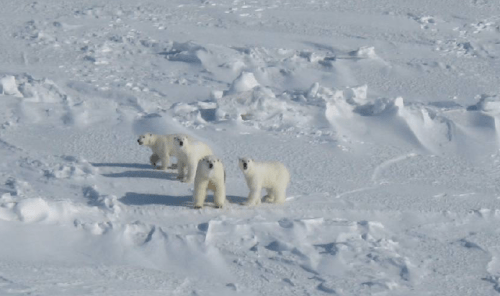
Rode and Regehr 2010_Chukchi_report2010_triplets redone PNG


While polar bears may be negatively affected by declines in sea ice sometime in the future, so far there is no convincing evidence that any unnatural harm has come to them. Indeed, global population size (described by officials as a “tentative guess“) appears to have grown slightly over this time, as the maximum estimated number was 28,370 in 1993 (Wiig and colleagues 1995; range 21,470-28,370) but rose to 31,000 in 2015 (Wiig and colleagues 2015, [pdf here] aka 2015 IUCN Red List assessment; range 22,000-31,000).

These ominous prophesies have been promoted primarily by Ian Stirling, Steven Amstrup, Andrew Derocher and a few other IUCN Polar Bear Specialist Group (PBSG) members but ironically, it’s data collected by their colleagues that’s refuted their message of doom.

Here are the predictions (in no particular order, references at the end):
Continue reading
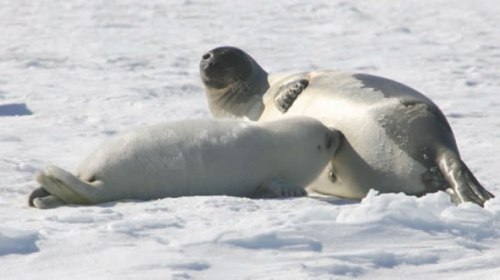
Harp seal: most abundant Arctic seal is an undervalued polar bear prey species

The harp seal is the most abundant seal species in the northern hemisphere (estimated to number more than 9 million animals – that’s more harps than ringed seals) but are found only in the North Atlantic. Partly because they give birth on mobile pack ice, harps have their pups earlier in the season than all other Arctic seals, which means that in some regions, they are a critical food source for polar bears that have eaten little over the winter months.

Harp seal pup_DFO Newfoundland

Although young ringed seals are considered the primary prey of polar bears throughout the Arctic, young harp seals undoubtedly represent an increasingly important resource for populations of Davis Strait, East Greenland and Kara Sea bears.

Most of the harp seals in the NW Atlantic/Atlantic Canada (about 80% of them) have their pups off Newfoundland and Labrador, an area known as the “Front” (the location of my polar bear attack novel, EATEN: special deals all this week). Harps seals at the Front now provide a huge prey base for polar bears of the large (and possibly still growing) Davis Strait subpopulation (photo below courtesy DFO Canada).

There are an estimated 7.4 million harps in Atlantic Canada today (range 6.5-8.3m), an exponential increase over the early 1980s, when perhaps only half a million so remained.  Pagophilus groenlandicus was assigned a conservation status of ‘Least Concern’ by the IUCN Red List in June last year (Kovacs 2015), when it was estimated that the global population size of the harp seal was greater than 9 million animals and probably growing1, 2 due to reduced human hunting:

“…harp seals have been harvested for thousands of years but currently the population is large and the number of animals harvested is declining.” [my bold]

Photographers and animial rights activists love cute, fluffy harp seal pups and rarely mention the carnage that goes on in spring as polar bears devour the naive youngsters. See the video below (from 2008), for an example of the cuteness factor.

Continue reading

Cannibalism video shot in 2015 did not involve a starving polar bear

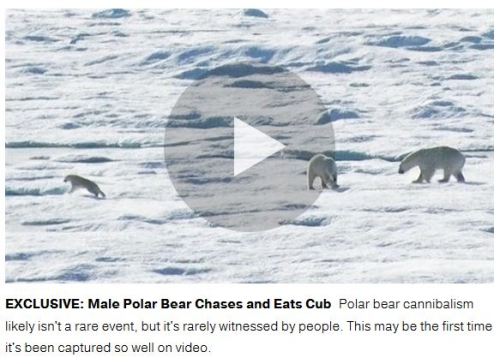
National Geographic has just posted an exclusive video shot mid-summer of 2015 of a male polar bear killing and eating a young cub.

National Geographic 2015 cruise Cannibalism video screencap_Feb 23 2016

It’s worth watching (23 February 2016; Polar bear cannialzies cub) [update: Youtube version posted below]. It was filmed in 2015 in Baffin Bay at mid-summer (during either their July 28-Aug 9 or Aug 7- 19 cruise; pdf of itinerary, dates and prices – oh my god, the prices! here). [Summer is 1 July-30 September]

You’ll soon realize the male bear was not thin or starving (as was true of a much-publicized 2011 event captured on film off Svalbard).

It is also obvious based on the dates listed above that this incident debunks the explanation that cannibalism by adult males is driven primarily by their desire to mate with the mother of the consumed cub: this incident occurred sometime between August 7 and August 19 (as I was informed via email, by a reader on one of those two cruises), which is well past the breeding season for polar bears. A male bear would not still have viable sperm by August and a female could not be forced into estrus. [added 26 February 2016]

National Geographic is already hyping this incident as more evidence of climate change harming polar bears, as the article accompanying the video suggests. However, this is just the typical oversell that accompanies much to do with polar bear these days.

The bear was not “driven to desperation” : he simply took advantage of a rare chance to eat during the summer:

“Without the ability to hunt seals, polar bears may be driven to ever more extreme cannibalism, if they’re not already.”

It’s clear to me that this was an opportunistic kill made at a time of year when few seals are available, as even Stirling admits. It reiterates the point I’ve made many times before, that polar bears on the sea ice in summer have few feeding opportunities.

Incidents of cannibalism cannot be said to be increasing because there is no scientific baseline for which recent occurrences can be compared. Scattered anecdotal reports of any behaviour cannot be touted as evidence for a trend even though they may be of interest and worth recording.

UPDATE 23 February 2016: Video now posted on Youtube, see it copied below:

Spring sea ice prediction by CIS for Atlantic Canada 2016 vs. observations

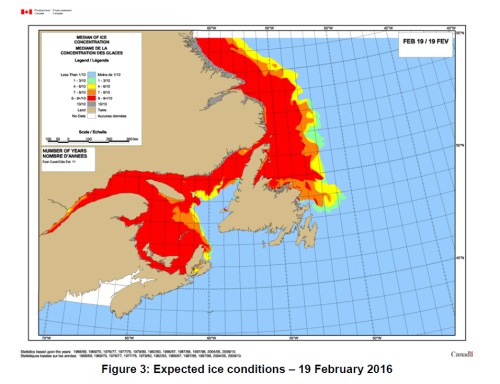
The Canadian Ice Service prediction for spring ice coverage for Atlantic Canada in 2016, released 1 December 2015, would be as extensive as 2014 and 2015 or greater.

Their expected ice coverage for 19 February 2016 is copied below (CIS fig. 3):

2016 Newfoundland Ice outlook for 19 Feb 2016_at Dec 1 2015

In my December 2015 post that reported this prediction, I compared it to past ice coverage at 19 February. But that date is now past: how does the predicted ice coverage compare to reality (i.e., observations)? Have a look below.
Continue reading

February polar bear focus: daily posts plus special deals on my new novel

I’ve got two special deals running on my polar bear attack novel for the rest of the month: you can enter to win an autographed copy of the paperback and/or enjoy 60% off most ebook formats.

I’ll also be publishing daily PolarBearScience articles and thought-provoking essays for the rest of this month – up to, and including, International Polar Bear Day on the 27th. Stay tuned.

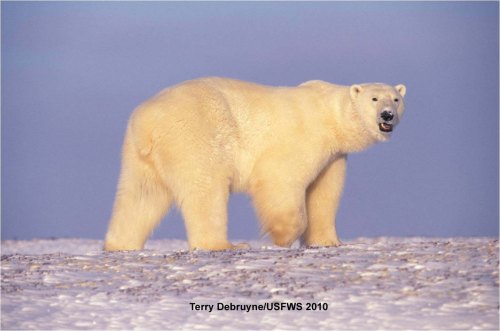
Polar_Bear_in fall Terry Debruyne_USFWS Nov 10 2010_w label_sm

Continue reading

Horse killed by a polar bear in southern Greenland this week

“Until Wednesday, Malik Frederiksen owned nine horses at his property in southern Greenland. After an attack by a polar bear, he now owns eight.”

Nanortalik Greenland_in context Google maps

So begins an article published in The Arctic Journal yesterday (18 February) about more problem bears onshore in mid-winter. But this time, the location is the south-west tip of Greenland and this time, the polar bear killed something before it was shot. It could just as easily have been a person.

In addition, according to this report, this is the second time in two days that a polar bear has been shot onshore in Greenland because it got too close for comfort.

It’s also the second report in as many weeks of multiple polar bears onshore causing problems in the middle of winter – the other reports were from southern Labrador in late January/early February.  This is a new pattern: it’s different and it means something. Continue reading

Only the gullible still buying ‘polar bear died of climate change’ nonsense

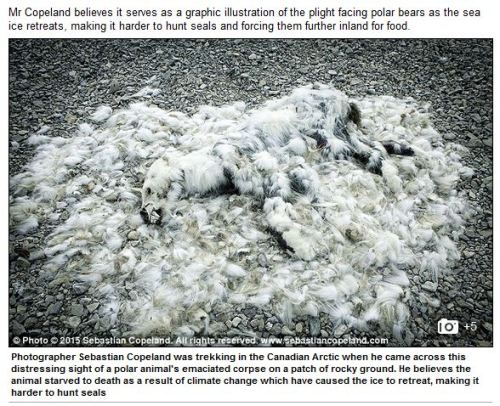
The media promote this ‘polar bear who died of climate change’ rubbish because it’s good for business but there is no evidence to support it. The Daily Mail today is running a piece that encourages the self-serving, sensationalist claim made by a photographer trying to sell his book. 

Daily Mail screencap_polar bear that died of climate change_Feb 18 2016

Read the whole thing here but remember this: the leading cause of death for all polar bears is starvation, in part because they have no natural enemies. Polar bears die of starvation every year, with or without ‘climate change.’

This bear might have died of starvation but that does not mean global warming is to blame. It’s bad enough when it’s a leading polar bear biologist making such a ridiculous claim but there is no reason at all to take the scientifically baseless word of Sebastian Copeland on this matter.

Previous posts where I have addressed similar claims:

Last year’s dead Svalbard polar bear used for this year’s propaganda

Polar bear behaviour gets the animal tragedy porn treatment – two new papers

Cannibalism in polar bears: spin and misrepresentation of fact galore posted

Ian Stirling’s howler update: contradicted by scientific data


Polar bear habitat mid-winter update

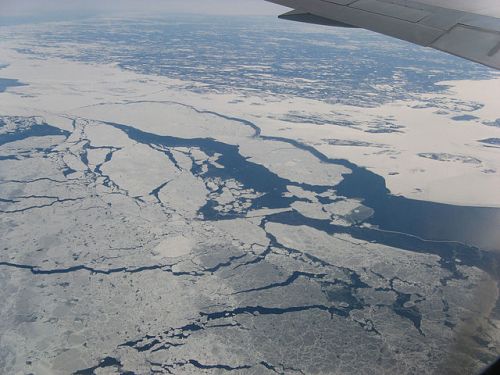
Sea ice extent in the Arctic is a bit below average this year at mid-winter but there are no data to suggest this situation will have a negative impact on polar bears.

Sea_ice_near_coast_of_Labrador_-b_wikimedia_sm_26 March 2007

[Photo above is sea ice off the coast of Labrador, Canada on 26 March 2007 (from Wikimedia): polar bears in the southern portion of the Davis Strait subpopulation have been particularly successful in recent years because in late March through May/June they hunt abundant numbers of young harp and hooded seals in this habitat]

Polar bear researchers presume that most animals eat little to nothing over the winter, because it explains why even non-pregnant bears are at their lowest weight at the beginning of spring.

Sea ice charts and maps below. Continue reading

Polar bear capital of the world stuck between fear-mongering and science

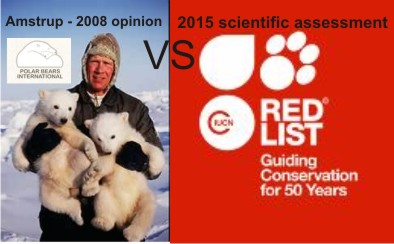
CBS News published a predictably one-sided “Cover Story” this morning (14 February 2016) about Churchill, Manitoba – the self-proclaimed Polar Bear Capital of the World. 

This is the online version of a Sunday morning TV special that’s not available where I live. It’s yet another example of how the media feeds the politics of polar bears and prevents the advancement of science. Here’s my take on this CBS effort.

Amstrup vs IUCN science_Feb 14 2016_PolarBearScience

Continue reading

Give your love a polar bear attack thriller for Valentine’s Day

The New York Times has a “Love and Death” theme for their books section this Valentine’s Day weekend – wouldn’t my new novel fit right in?

Valentines Day book cover2_EATEN

In fact, I gave a polar bear lecture to a men’s club a few days ago and two of the guys bought copies of EATEN as Valentine’s gifts for their wives.

One man said, “That’s not wrong, is it?”  Truly, absolutely not!

Most women love a good book. EATEN has several strong female characters that women (and men) will admire. There’s a thread of potential romance that runs through the riveting terror of multiple polar bear attacks – enough to peak a woman’s interest but not so much to put a man off.

The book has been selling well and getting excellent reviews. Soon, EATEN will be on bookshelves across Newfoundland and Labrador – I’ve made a deal with a major Atlantic book distributor who thinks the book will be a good seller. That’s rare for a self-published novel, I can tell you.

So, go ahead – buy EATEN for the one you love and help support the work I do here at PolarBearScience. At Amazon USA here; Barnes and Noble here or the Book Depository (which has free delivery worldwide); Amazon UK here. Other ebook options here.