Posted onJuly 11, 2019|Comments Off on Polar bears are thriving despite global warming: this short essay explains why
This essay explains in simple terms why so many people still believe that polar bears are in peril when nothing could be further from the truth: it is an essential lesson that shatters the basis of the shameful indoctrination of young school children and undermines the baseless claims of activist protestors. It was written and translated into French for a special climate change feature issue (July) of the monthly French magazine Valeurs Actuelles (reviewed here) and reprinted by the French hunting magazine Chasses Internationales. It has also been translated into German for a dedicated climate change issue (11 July) of the Swiss weekly magazine Die Weltwoche.
I have added a couple of figures to illustrate this English version of the essay.
Posted onApril 23, 2019|Comments Off on Even with Inuit lives at stake, polar bear specialists make unsupported claims
The standoff between Inuit and polar bear specialists regarding the status of polar bears in Canada is not going to end until someone in authority demands to see the data scientists insist contradict Inuit knowledge.
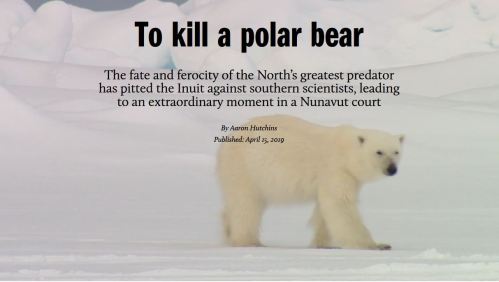
An article in Maclean’s Magazine (15 April 2019), entitled “To Kill a Polar Bear”, explores some of the feelings and opinions of folks involved but fails to ask whether the data support the rhetoric advanced by scientists. Author Aaron Hutchins takes the scientists at their word, that seeing more bears than 20 years ago is all because of lack of sea ice. However, from what I’ve seen, he might as well trust a fox in a hen house.
Ian Stirling is quoted by Hutchins insisting that polar bears in Western Hudson Bay continue to suffer from the effects of declining sea ice, without mentioning that ice cover has been essentially static on Hudson Bay since at least 2001 (Castro de la Guardia et al. 2017; Lunn et al. 2016) and fall freeze up dates for the last two years were earlier than most years in the 1980s:
“This year saw the seventh-lowest Arctic sea ice levels since the National Snow and Ice Data Center first started gathering satellite data 40 years ago, with the long-term trend clearly downwards. And the negative effects on polar bears can be clearly seen in the science, says Stirling, pointing to the closely studied subpopulation along western Hudson Bay: “They’re losing body condition. Reproductive rates have dropped. Survival rates of young have plummeted. Every indication you would expect from a declining population is there.”
However, as I’ve pointed out previously (last year and in 2012), there are no recent data published that support these claims: the only information that exists is at least 25 years old. And the fact that no such data have been published suggests strongly that it either does not exist or does not show what Stirling claims it shows.
Yet, the government of Canada is willing to bet the lives of Inuit on their belief that polar bear specialists would never stretch the truth to qualify for government grants.
Posted onDecember 3, 2018|Comments Off on Canadian polar bears still not threatened with extinction says conservation committee
At recent meeting of the Committee on the Status of Endangered Wildlife in Canada (COSEWIC), biologists decided to continue to list the polar bear as a species of ‘Special Concern.’ About 2/3 of the world’s polar bears live in Canada and the balance of all evidence (including Inuit knowledge) indicate the bears are not threatened with extinction. The bears have held this statussince 1991.
Details from the 3 December 2018 press release below.
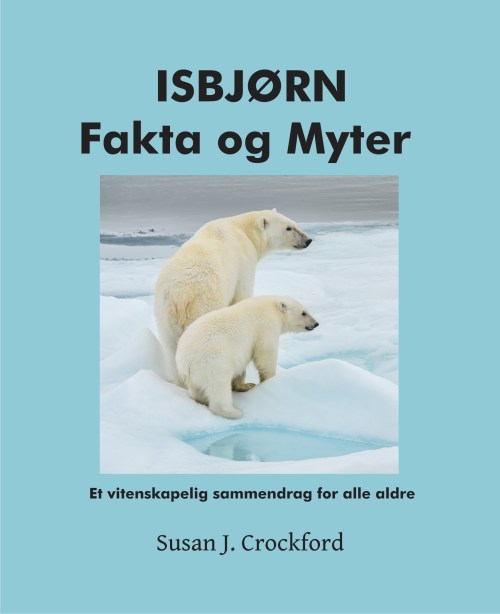
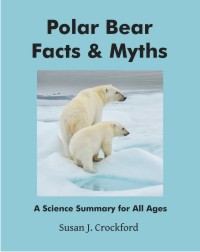
The same day as a glowing review of the Dutch translation of my popular children’s science book appeared in de Telegraaf (front page and all of page 5, 19 November 2018, pdf here), I am thrilled to announce that this important book is now available in Norwegian via Amazon worldwide, including European outlets.
The translation was done by native Norwegian speakers Arve Tunstad and Morten Jødal. In Norwegian the book is called ISBJØRN Fakta og Myter.
Please pass along to your friends, relatives, and colleagues in North America and abroad (calling all Sons of Norway). The English version is still available in paperback and ebook formats. Other translations in French and German are already available: five languages in all, including Dutch.
Posted onSeptember 24, 2018|Comments Off on Inuit hunters frustrated by polar bear conservation rules that put their lives at risk
‘The rules are taking over Inuit tradition and the bears are taking over Inuit. We’re just watching in the distance, afraid of these bears because they’re free to do whatever they want.’ says Brian Aglukark, after two fatal polar bear attacks this summer (CBC, 24 September 2018).
Posted onFebruary 23, 2018|Comments Off on Coffee house discussion about polar bear science & conservation in Toronto on Tuesday
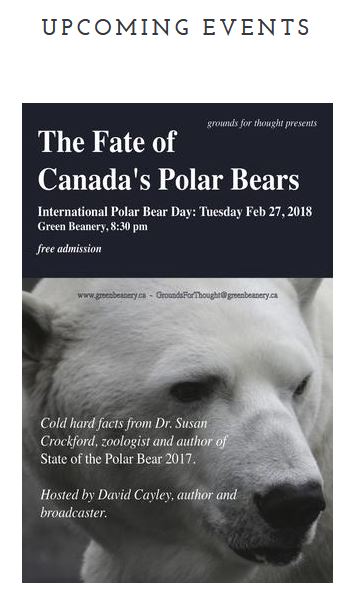
In conjunction with the launch of my State of the Polar Bear Report in Toronto next week, Benny Peiser (from the Global Warming Policy Foundation) and I will be participating in a coffee house discussion about polar bear conservation and survival issues on the evening of Tuesday, 27 February 2018 at 8:30 pm.
If you’re in town, come and celebrate International Polar Bear Day with a frank discussion about polar bear science.
I am very much looking forward to meeting the public at this evening discussion and to chat with media representatives and colleagues at the press luncheon in the early afternoon. Journalist/opinion writer Terry Corcoran recently billed the luncheon as part of a Polar Bear Battle since conservation organization Polar Bears International (where biologist Steven Amstrup, co-author of the Harvey et al. Biosciencepaper and developer of the failed 2007 polar bear survival model, is employed as chief scientist) is holding a gala fundraiser dinner the same night, just a block away.
In addition to Benny Peiser from GWPF, a number of familiar names will be at the State of the Polar Bear launch and press luncheon, including Terry Corcoran,Larry Soloman, Joe Oliver and Conrad Black (all journalist/opinion writers at the Financial Post and/or National Post), journalist/writer Donna Laframboise who blogs at No Frakking Consensus, as well as science colleagues Chris Essex, Ross McKitrick, and Steve McIntyre of Climate Audit fame. Details below.
Posted onFebruary 9, 2018|Comments Off on New Scientist prints a more reasoned polar bear article but myths persist
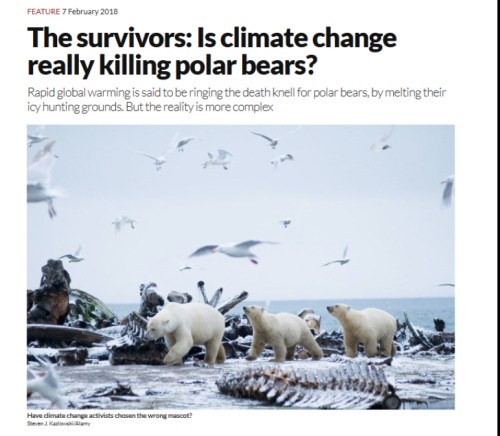
New Scientist has an article coming out next week takes a fairly reasoned approach to the polar bear conservation issue. It acknowledges that polar bear numbers have not declined in recent years even though summer sea ice dropped dramatically but goes on to perpetuate a number of myths that might not have happened if the author had done his homework or quizzed his other experts as thoroughly as he did me.
The survivors: is climate change really killing polar bears? Rapid global warming is said to be ringing the death knell for polar bears, by melthing their icy hunting grounds. But the reality is more complex. Fred Pearce, New Scientist 10 February 2018. Online now.
Posted onJanuary 15, 2018|Comments Off on Science, optimism, and the resilience of polar bears in an ever-changing Arctic
Optimism in conservation science — which the Smithsonian says we desperately need (Earth Optimism Summit21-23 April 2017, apparently a huge success) — means it’s time to acknowledge and celebrate real conservation success stories. The Smithsonian folks probably won’t say it but I will — one of those successes is the recovery of polar bears.
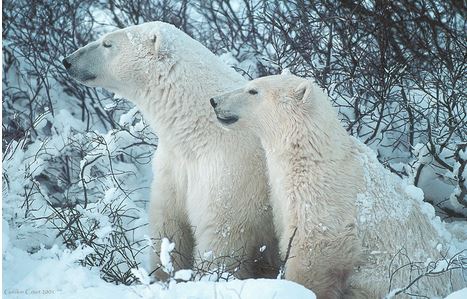
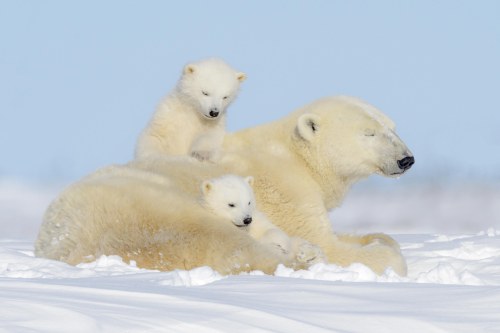
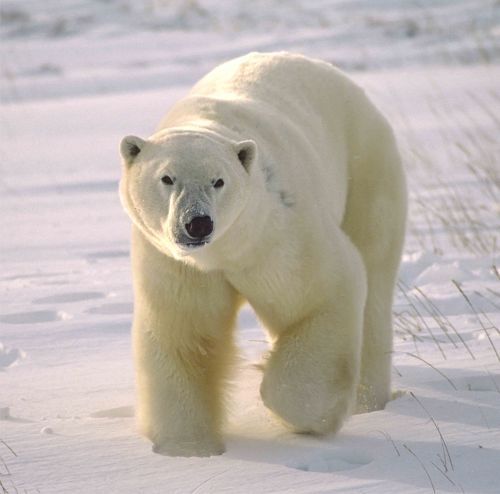
It’s time to abandon the focus on prophesies of impending loss and accept that recovery of polar bears from the over-hunting of last century has continued despite a decade of low summer sea ice (Aars et al. 2017; Crockford 2017; Dyck et al. 2017; SWG 2016; York et al. 2016). Why not focus on the numerous images of fat, healthy bearsrather than the anomalous starving ones?
It’s time to let go of imagined future catastrophes based on pessimistic failures of adaptation (Amstrup et al. 2007, 2008; Atwood et al. 2016; Stirling and Derocher 2012) and acknowledge that polar bears and Arctic seals, just like Pacific walrus (MacCracken et al. 2017; US Fish & Wildlife Service 2017), are resilient species with adaptive capabilities we are only just beginning to comprehend (Crawford and Quakenbush 2013; Crawford et al. 2015; Escajeda et al. 2018; Rode et al. 2014; Stirling and Lunn 1997; Stirling et al. 1975a; Vibe 1965). Continue reading →
Comments Off on Science, optimism, and the resilience of polar bears in an ever-changing Arctic
Posted onNovember 27, 2017|Comments Off on Published essay: the conservation fiasco that is the ESA listing of polar bears
In early October, the US Fish & Wildlife Service reversed its 2011 decision to list Pacific walrus as ‘threatened with extinction’, saying they could not “determine with certainty that walruses are likely to become endangered “in the foreseeable future.” [details below]
I have arguedthat the 2008 decision by the USFWS to list polar bears as ‘threatened’ is similarly lacking in certainty (Crockford 2017) and as for walrus, the previous determination of ‘threatened’ for polar bears was premature and should be reversed.
A prominent biology colleague and I recently put it this way in a newly published essay:
“Is it ethical or fair to the many citizens impacted directly and indirectly by the 2008 polar bear ruling for the FWS to allow polar bears to remain on the Endangered Species List?”
Read our piece in the winter 2018 issue of RANGE Magazine (open access), authored by myself and Dr. Valerius Geist, professor emeritus of environmental science at the University of Calgary, Alberta.
Crockford, S.J. and Geist, V. 2018. Conservation Fiasco. Range Magazine, Winter 2017/2018, pg. 26-27. Pdf here.
PS. You’ll find an excellent piece on wildfires by biologist Jim Steele in the same issue.
See also Crockford, S.J. 2017. Testing the hypothesis that routine sea ice coverage of 3-5 mkm2 results in a greater than 30% decline in population size of polar bears (Ursus maritimus). PeerJ Preprints 2 March 2017. Doi: 10.7287/peerj.preprints.2737v3 Open access. https://doi.org/10.7287/peerj.preprints.2737v3
Details on the USFWS decision on the walrus is below. Note that like the walrus, if ESA protection on the polar bear was reversed, the bears would still be strongly protected under the Marine Mammal Protection Act (as they have been since 1972), and like the walrus, polar bears have shown an ability to adapt that was not foreseen in 2007 (as evidenced by theirfailure to die off droves in response to recent sea ice declines).
Posted onNovember 6, 2017|Comments Off on Twenty reasons not to worry about polar bears, the 2017 update
Just in timefor Polar Bears International’s self-proclaimed fall Polar Bear Week (5-11 November 2017), here’s a new resource for cooling the polar bear spin. I’ve updated my 2015 summary of reasons not to worry about polar bears, which is now more than two years old. In this new version, you will find links to supporting information, including published papers and fully referenced blog posts of mine that provide background, maps and bibliographies, although some of the most important graphs and maps have been reproduced here. I hope you find it a useful resource for refuting the pessimism and prophecies of catastrophe about the future of polar bears. Please feel free to share it.
As global leaders meet in Bonn for COP23 (6-17 November 2017), it’s time to celebrate the proven resilience of polar bears to their ever-changing Arctic environment.
Twenty Reasons: the bullet points
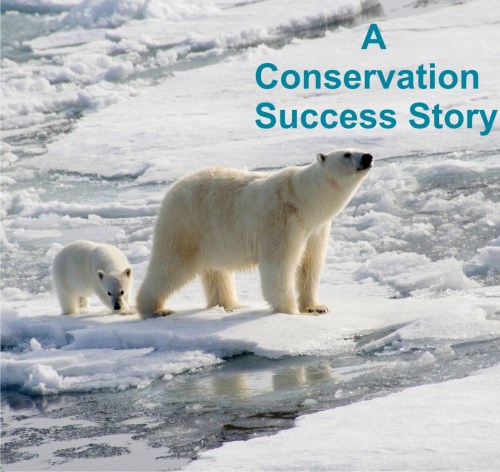
Polar bears are still a conservation success story: there are more polar bears now than there were 40 years ago.
Fewer populations are in decline than in 2010 (only one, officially) and only six are data deficient (down from nine).
Abrupt summer sea ice decline has not affected polar bear numbers as predicted: even though sea ice levels dropped to mid-century levels in 2007, the expected decimation of polar bears failed to occur.
The Chukchi Sea population is thriving despite a pronounced lengthening of the ice-free season since 2007.
Less sea ice in the summer in the Chukchi Sea has meant a healthy prey base for polar bears because ringed seals feed primarily in the ice-free season.
Polar bears have shown themselves to be adaptable to changing ice conditions in several regions.
Southern Beaufort numbers have rebounded since the last survey count.
Barents Sea numbers have probably increased since 2005 and have definitely not declined despite much less sea ice cover.
There is no evidence that record-low summer sea ice in 2012 had a harmful effect on Southern Beaufort bear numbers.
Other species are being negatively impacted by high polar bear numbers, especially nesting sea birds and ducks.
Western Hudson Bay population numbers have been stable since 2004, despite what scientists are telling the media.
Hudson Bay sea ice has not changed since about 1999: breakup dates and freeze-up dates are highly variable but the ice-free period was not any longer in 2015 than it was in 2004. However, this fall freeze-up is shaping up to be the earliest in decades.
Problem bears in Churchill are not lean or starving.
Churchill Manitoba had the most problem bears in 1983 and 2016, which were late freeze-up years, but many of the incidents in 2016 can be attributed to increased vigilance on the part of patrol officers after an attack in 2013.
There have been only marginal sea ice declines during the feeding period in spring, when polar bears need sea ice the most.
The is no evidence that subsistence hunting is affecting bear populations.
Stressful research methods have been curtailed in much of Canada.
There have been no reports of polar bear cannibalism since 2011.
Polar bears appear unaffected by pollution: studies suggest only that harm is theoretically possible, not that it has happened.
Polar bears have survived past warm periods, which is evidence they have the ability to survive future warm periods.
Conclusion
Polar bears are thriving: they are not currently threatened with extinction.
Tens of thousands of polar bears did not die as a result of more than a decade of low summer sea ice, as was predicted.
Polar bears don’t need sea ice in late summer/early fall as long as they are well-fed in the spring.
[full text below, pdf with footnotes and references here]
Watch polar bear habitat reform in the Canadian Arctic: “last 10 days” Canadian Ice Service animation (works anytime) HERE.
See Quote archive for details.


 It’s time to abandon the focus on prophesies of impending loss and accept that recovery of polar bears from the over-hunting of last century has continued despite a decade of low summer sea ice (Aars et al. 2017; Crockford 2017; Dyck et al. 2017; SWG 2016; York et al. 2016). Why not focus on the numerous images of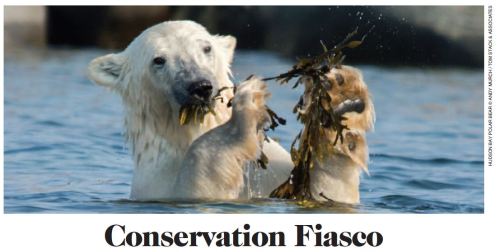





 polarbearscience
You must be logged in to post a comment.