Tag Archives: extinction

Recent studies show Sept ice of 3-5 mkm2 did not kill polar bears off as predicted

The annual Arctic sea ice minimum for 2016 is imminent and the hand-wringing about polar bear survival has already begun. While this year is shaping up to be another very low sea ice minimum in the Arctic – not as low as 2012 but lower than as low as 2007 (previously the 2nd lowest since 1979) – contrary to predictions, several recent studies show that such low sea ice coverage in summer has had no (or very limited) negative effects on polar bear health and survival. In fact, for polar bears in some areas low summer sea ice has been quite beneficial (although these are not the populations that polar bear specialists predicted would do better).
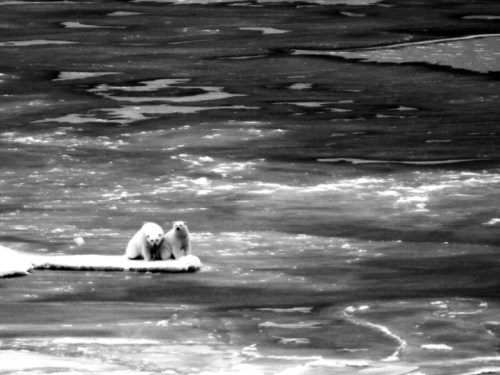
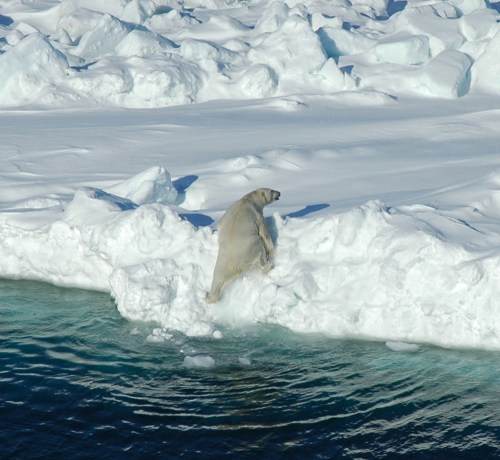
polar_thin_ice Jessica Robertson_USGS

Since low summer extents of recent magnitude (3.0 – 5.0 mkm2) are clearly not any sort of threat to polar bears, it seems improbable that even an ice-free (≤ 1.0 mkm2) summer (e.g. Wang and Overland 2015) would be devastating to the species [don’t forget Cronin and Cronin 2016: they’ve survived such conditions before] – as long as conditions in spring allow for the necessary concentrated feeding on young seals.
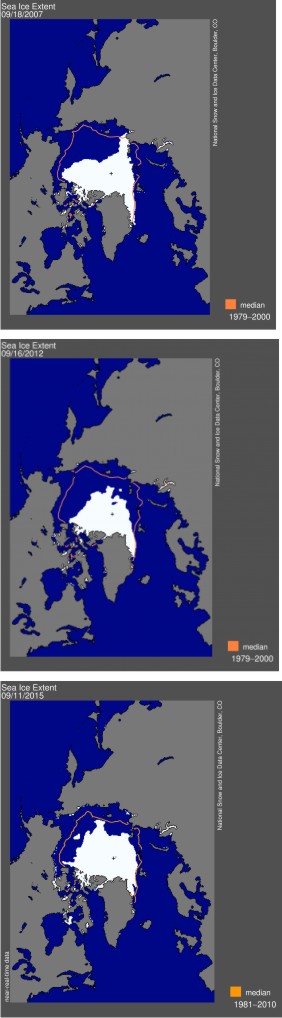
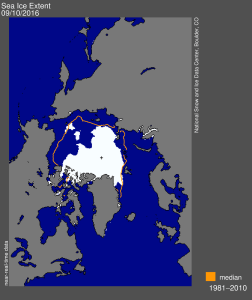
sea-ice-mins_2007_2012_2015_polarbearscienceAbove: Top, minimum at 2012 (16 Sept, 3.41 mkm2, lowest since 1979); Center, 2007 (18 Sept, 4.17 mkm2); Bottom, 2015 (9 Sept, 4.50 mkm2), from NSIDC. Below: sea ice at 10 Sept 2016, 4.137 mkm2 – minimum not yet called).
sea-ice-extent-2016-sept-10_nsidc

Recall that in 2006, the IUCN Polar Bear Specialist Group based their conservation status of ‘vulnerable’ (likely to become threatened within the next 45 years due to reduced habitat) on the predictions of sea ice specialists (see 2008 update here).

Sea ice experts in 2005 predicted such low summer sea ice extents as polar bears have endured since 2007 (3.0 – 5.0 mkm2) would not happen until 2040-2070, at which time PBSG biologists said that >30% of the world’s bears would be gone.

Evidence to the contrary comes from polar bear specialists working in the Chukchi, Beaufort, and Barents Seas – and in Southern Hudson Bay – since 2007. Overall, the latest IUCN Red Book assessment (2015) put the global population size at 22,000-31,000 (or about 26,500).

All of this means that those polar bear experts were wrong: polar bears are more resilient to low summer sea ice conditions than they assumed.

UPDATE 2 January 2017: I’ve added some quotes from the original USGS reports that explicitly state their dire predictions for 2050 that differ from the predictions made by the IUCN Polar Bear Specialist Group.
Continue reading
Columnist admits video on polar bears and global warming contained a serious error

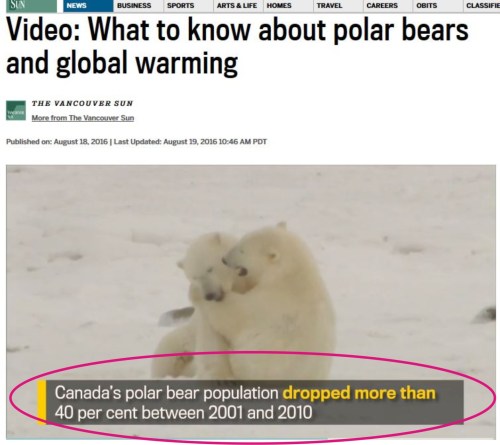
Since mid-August,  Vancouver Sun columnist Daphne Bramham has been filing a series of articles from an expedition cruise through the Northwest Passage for a feature called “Above the Arctic Circle”. One of these appeared on August 18, along with a video called “What to know about polar bears and global warming” and it contained an egregious error that should have stood out to any educated person as being wrong by several orders of magnitude:

What to know about pbs GW_Video_screencap 2_SUN_18 Aug 2016 marked

We are not talking about a difference of opinion or interpretation but a simple fact that was outrageously wrong by a wide margin. You see it, don’t you? Continue reading

Terrestrial food fight amongst polar bear researchers reflects political differences

With a few big guns on one side and some fringe folk on the other, a dichotomy of opinion has developed amongst polar bear researchers regarding whether or not consumption of land-based foods is making a difference to polar bear survival (or is likely to in the future).

Polar bears eating terrest foods WHB_Rockwell press release

It’s been going on for a while now. Last year, two US Geological Survey members of the IUCN Polar Bear Specialist Group (PBSG) apparently got fed up with the scatter-shot of papers promoting terrestrial foods as a possible salvation for polar bears (e.g. Iles et al. 2013;  Iverson et al. 2014; Rockwell and Gormezano 2013a, 2013b). In April, they published a canon volley of a paper meant to blow all that ‘polar-bears-might-survive’ talk out of the water once and for all (Rode et al. 2015).

Note that although the PBSG didn’t bother to update their website with the IUCN Red List assessment when it came out last November, they had a link up to the USGS terrestrial feeding paper within 16 days (with an editorial summary in the “NEWS” section as well as a listing of the paper in the “RECOMMENDED READING” section). As I suggest below, this difference in treatment may not be a coincidence.

However, another group of non-PBSG researchers  haven’t given up just yet, as shown by the title chosen for the most recent news report (Alaska Dispatch News, 16 June 2016) on the just-finished International Bear Conference:

Want to know how a changing climate is affecting polar bears? Look at what they’re eating.

Apparently, Jeff Welker, a University of Alaska Anchorage researcher who is co-author on two recent papers on the subject of polar bear consumption of terrestrial foods (Tartu et al. 2016 and Rogers et al. 2015), gave a presentation at the conference that raised this topic yet again. His talk came on the heels of an earlier presentation by Todd Atwood, who suggested Southern Beaufort polar bears might benefit from staying onshore to eat left-over whale scraps instead of staying on the sea ice during the summer (even though he had no data to support that opinion – as I discussed in this post).

Here’s the question: is this dispute really about what polar bears eat or don’t eat when they’re on land – or is it symptomatic of the underlying politics of polar bears? [CBC documentary video by that name here]
Continue reading

Silence of the IUCN Polar Bear Specialist Group on the 2015 IUCN Red List assessment

It’s been six months and still the IUCN Polar Bear Specialist Group has not updated its website with a link to the 2015 IUCN Red List assessment for polar bears, which was made public with some fanfare in November 2015. They are not the only group still ignoring the Red List decision but their silence is the most damning – the IUCN is the parent body of their organization.

On May 7th, I wrote to the IUCN Red List folks (redlist@iucn.org) about this situation (excerpt below) but as yet have received no reply.

PBSG website banner May 10 2016

Continue reading

Late winter surge in sea ice habitat and the resilience of Svalbard polar bears

The Barents Sea – and Svalbard in particular – has had very little sea ice this winter but recent evidence suggests pregnant females adapted by moving east to Franz Josef Land to have their cubs. The surge in ice that’s come over the last few weeks will, however, be welcome habitat for the critical hunt of fat newborn seals that takes place primarily in April and May.

Svalbard polar bear_NP015991-isbjorn-JA

It was only last fall that Norwegian biologist Jon Aars (photo above taken by him in August 2015) was touting the fat condition of Svalbard-area polar bears he and his team saw in August and admitted the population had increased by a whopping 42% since 2004 – despite dire predictions of a drastic decline. In fact, 2014/2015 was a great year for the area’s polar bears.

However, in the fall of 2015 sea ice was so late forming around Svalbard that it seemed impossible that any females would get to traditional denning grounds on the east coast in time to give birth. There was no sea ice to speak of until late December, so it seemed virtually certain that all females had gone to Franz Josef Land further east (in Russia) – as they are known to do – to utilized its alternative denning sites.

It’s called resilience – the ability to shift behaviour in response to changing conditions. In this case, all indications are that shifting den locations to Franz Josef Land is a long-standing response of Svalbard area polar bears to low ice conditions. This shift does not even require a movement outside their subpopulation boundaries, let alone a movement outside the ill-defined “sea ice ecoregions” originally defined by Steven Amstrup and colleagues (2008) to support their prediction that polar bears will likely be extinct by 2100, taken up later by others since.

Some polar bear specialists appear to believe that if Barents Sea conditions are not precisely what they were in the 1980s (examples here and here), polar bears cannot possibly survive. But the bears are showing them otherwise – and demonstrating how they likely survived previous warm periods like the Holocene Optimum ~9,000 years ago and the Eemian Interglacial ~115,000-130,000 years ago (CERQA 2014:66) without population numbers getting anywhere near extinction levels.
Continue reading

Biggest threat to polar bears reconsidered

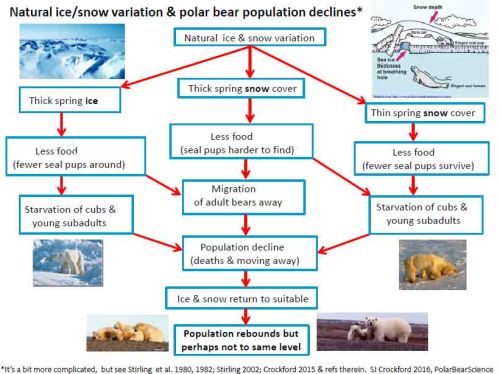
What presents a bigger risk to current polar bear populations: natural hazards that have already proven deadly or potential, yet-to-be-realized threats prophesied to occur due to human activities? That’s a perfect question for International Polar Bear Day.

Natural ice_snow variation and polar bears_model_PolarBearScienceFeb 20 2016

Dag Vongraven, chair of the IUCN Polar Bear Specialist Group, remarked last year that “until 2001, everything was fine.

Polar bear researchers thus assume that 2001 was the year climate change became the new over-hunting – but is it true? What are the relative harms presented by proven natural causes, potential human-caused threats, and predicted threats due to sea ice declines blamed on global warming? Considered objectively, is climate change really the single biggest threat to polar bear health and survival right now?
Continue reading

Ten dire polar bear predictions that have failed as global population hits 22-31k

Grim predictions of the imminent demise of polar bears – their “harsh prophetic reality” as it’s been called – have been touted since at least 2001. But such depressing prophesies have so widely missed the mark they can now be said to have failed.

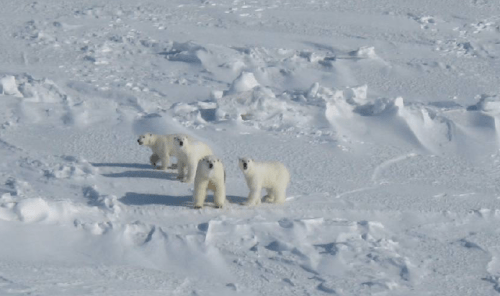
Rode and Regehr 2010_Chukchi_report2010_triplets redone PNG


While polar bears may be negatively affected by declines in sea ice sometime in the future, so far there is no convincing evidence that any unnatural harm has come to them. Indeed, global population size (described by officials as a “tentative guess“) appears to have grown slightly over this time, as the maximum estimated number was 28,370 in 1993 (Wiig and colleagues 1995; range 21,470-28,370) but rose to 31,000 in 2015 (Wiig and colleagues 2015, [pdf here] aka 2015 IUCN Red List assessment; range 22,000-31,000).

These ominous prophesies have been promoted primarily by Ian Stirling, Steven Amstrup, Andrew Derocher and a few other IUCN Polar Bear Specialist Group (PBSG) members but ironically, it’s data collected by their colleagues that’s refuted their message of doom.

Here are the predictions (in no particular order, references at the end):
Continue reading

Many otherwise intelligent people believe only a few hundred polar bears remain

The other day, I got a call from an international journalist who admitted he’d done no research into the polar bear issue but believed, based on media reports he’d heard, that there must only be about 100-200 bears remaining in the Arctic. I know he’s not alone.

polar-bears-3-large_USGS

This journalist was utterly astonished to learn that the IUCN Red List assessment in 2015 put the polar bear population total at 22,000-31,000 bears and demanded proof that this was true.

Here is a summary of the Red List report, with references and links to the report:

The 2015 IUCN Red List assessment update for polar bears (published 18 November 2015) states that the global polar bear population is 22,000 – 31,000 (26,000), that the current trend is ‘unknown’ and that there is only a 70% chance that polar bear numbers will decline by 30% in 35 years (with virtually zero chance that the numbers will decline by 80% or more by 2050) – in other words, zero chance of extinction. [Detailed in a document called 22823 Ursus maritimus]. It classifies the polar bear as ‘vulnerable’ to extinction based on predictions of future sea ice decline due to global warming [similar to ‘threatened’ by other organizations] Pdf here.

Below is a list of what truly worrying species declines look like: that is, animals whose numbers have actually declined, no prophesies involved (Adler 2008).
Continue reading

The old ‘website revision’ excuse for not updating polar bear status changes

Apparently, the IUCN Polar Bear Specialist Group (PBSG) thinks that it’s OK to mislead the public on the conservation status of polar bears for half a year because its website is being revamped. This conservation organization is of the opinion that people landing on their website while searching for official polar bear status information don’t need to know right away that a new IUCN Red List document was published in November 2015. We know this because the message below appeared on the PBSG homepage 14 January 2016 (text in bold was there previously: the new message is in CAPS), screencap of entire page at 16 Jan 2016 pdf here:

PBSG website notice_2016 Jan 14 update

It appears that the PBSG feels that the public can wait to be told about 2015 Red List decision until the PBSG are ready for them to be told, which could be anywhere from March to the end of June 2016, depending on what definition of “spring” they use. Anyone (like moi) suggesting this tactic is paramount to withholding unpleasant information is just being “impatient.”

Decide for yourself but to me, this PBSG message speaks volumes: it says the 2015 IUCN Red List assessment is bad news for polar bear predictions of gloom and doom. Polar bear specialists don’t want to talk about it because it is a slap-down of all previous attempts at predicting a grim future for the bears (see the summary at the end of this post).
Continue reading

Genetic similarity of polar bears does not make them vulnerable to global warming

A new genetics paper suggests that global warming will “fragment” polar bear habitat to such an extent that it will further reduce the already-low genetic variability documented in the bears, with disastrous effects on survival.

Beaufort Sea male polar bear USGS_2005 Amstrup photo

However, that argument only works if you disregard a rather large body of literature on other mammals as well as the history of polar bears themselves. I’ve addressed this issue before (“Low genetic diversity will not make polar bears more vulnerable to extinction”) and what I said then needs to be repeated now:

“…there is lots of evidence to support my contention that polar bears are not more vulnerable to extinction just because they have low genetic diversity.

I continued:

Many populations that were reduced to very low numbers (i.e., gone through a ‘bottleneck’ ), ending up with low genetic variation, have subsequently recovered dramatically without adverse affects.

In other words, they not only recouped their population size after a population bottleneck but did so while dealing with subsequent environmental fluctuations and other natural threats to their survival (Lehman 1998:R723-724).

In some cases, genetic diversity increased after a population bottleneck, via mechanisms biologists are only just beginning to understand.

In fact, there is good evidence to suggest that ice age cooling is what previously fragmented polar bear populations: past warm interglacial periods brought bears closer together, confined more or less to the area within the Arctic Circle – even in winter.

Go back and read the entire genetic diversity post. I concluded it by recounting several examples of abundant and successful mammal populations with low genetic diversity (with references), including Northern elephant seals, Guadalupe fur seal, Sand Nicolas Island fox, Mouflon sheep, and North Atlantic right whale. The details are worth reviewing. If you can’t access a paper you want to read, contact me via the contact page above and I’ll send it along.

Regarding this new paper (Kutschera et al. 2016), what I said before needs repeating:

“To suggest that polar bears cannot endure a bit of Arctic warming in the future (whether natural or due to human influences on climate, or a bit of both) is absurd: climatic extremes have defined the evolutionary history of polar bears, which means that climatic extremes have fine-tuned their biological adaptability.”

In fact, the paleoclimate/genetics paper by Cronin and Cronin (2015) which I summarized a few days ago, documents those climatic extremes. See below for details on the polar bear genetic diversity paper.
Continue reading