Tag Archives: extinction

Organizations fail to acknowledge 2015 Red List polar bear assessment info

You have to know that the 2015 IUCN Red List assessment for polar bears contains good news because no one is talking about it – and none of the online information sources I’ve checked have updated their polar bear profiles to reflect it.

For all its flaws (including the deceptive focus on summer sea ice), this Red List update is the most statistically robust, in-depth study of the conservation status of polar bears – why is it being ignored, especially by the conservation organizations people turn to for information online?

UPDATE: see 18 January 2016 post here.

Continue reading

Ian Stirling uses lifetime award to repeat flawed predictions for polar bears

It has been less than a month since the 2015 IUCN Red List assessment for polar bears was announced, which emphasized that the population trend for polar bears is unknown and that there is only a 70% chance that polar bear numbers could decline by 30% over the next 35 years.

ian-stirling_full

Yet, in a press release announcing the Weston Family Prize for lifetime achievement in northern research (along with $50,000) to Ian Stirling for his work on polar bears (Newswire, December 9, 2015), Stirling is quoted repeating an out-of-date prediction:

“Dr. Stirling estimates that about half of the polar bear population around the circumpolar Arctic could disappear by 2050 to 2060, if climate warming continues as is currently projected…”

I’d have thought that if Stirling did not agree with the IUCN assessment prepared by his colleagues, he would have said so last month when the report was released to international fanfare. Instead, he seems to be deliberately ignoring the 2015 IUCN Red List assessment and pretending that the flawed predictions he had a hand in making are still plausible.  Continue reading

IUCN Red Book officials forced scientific standards on polar bear predictive models

As I reported Thursday, the IUCN announcement of a new Red List assessment for polar bear got the usual overwrought attention from international media outlets. However, not one of these contained a quote from a polar bear biologist.

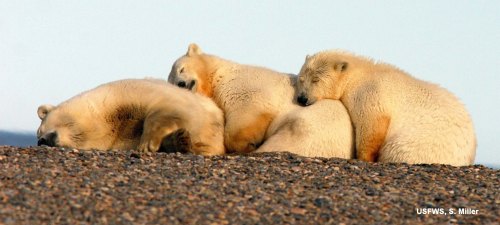
polarbears-arcticnatlwildliferefuge-suzannemiller-usfws_labeled_sm

Steven Amstrup, science spokesperson for activist conservation organization Polar Bears International, has so far had nothing to say to the media. Yet, Amstrup was a co-author of the IUCN Red List report. Not until late in the day following the release of the report did his his organization’s website post a short, bland news report (“Climate Change Still Primary Threat to Polar Bears”).

Similarly, Ian Stirling, Andrew Derocher, Nicholas Lunn (also a co-author of the IUCN Red List report), and former WWF employee Geoff York – who are usual go-to guys for polar-bears-are-all-going-to-die media frenzies – have so far been silent and invisible on this issue.

In addition, while the IUCN press release [backup here: 2015 IUCN Red List press release_Nov 19 2015] included a quote from IUCN Polar Bear Specialist Group (PBSG) chairman Dag Vongraven, as of this morning (21 November, PST), the website of the PBSG contains no mention of this decision – no item in the “News” category  and, more importantly, no update of the status table  or global estimates to reflect the changes contained in the report  (even though they obviously knew it was coming months ago: the report was submitted to the IUCN Red List 27 August 2015).

In my opinion, this silence says it all: polar bear specialists know this assessment is a severe de facto critique of their 2008 assessment (as well as Amstrup’s predictive models) and it’s a big step backwards for their conservation activism. I expect they are silent because they are royally pissed off.

However, this assessment is good news because finally, some standards of scientific rigor have been applied to polar bear predictive models – even though the PBSG were still been allowed to pretend that summer sea ice coverage is critical to polar bear health and survival (Crockford 2015).  Continue reading

Only a 70% chance that polar bear numbers will decline by 30% by 2050

Despite the stupendously unwarranted hype being generated out of the recent release of the 2015 update to the IUCN Red List status assessment for polar bears, in fact the prognosis is better than it has been for years.

That’s because polar bear experts have been forced by the IUCN standards committee to acknowledge the great deal of uncertainty in their predictive models. They now admit there is only a 70% chance that number will decline by 30% over the next 35 years: only slightly higher than a 50:50 chance.

That means there is a 30% chance that the numbers WILL NOT decline by 30% over the next 35 years. See my detailed analysis, where you will find copies of the report and links to the online IUCN Red List assessment.

That has not stopped all major news outlets from treating this report as a new pronouncement of gloom:

CBC, Canada: (“Polar bear numbers to fall as Arctic ice shrinks: study
Population will decline by more than 30% over next 35 to 40 years, experts say”). Except the first sentence admits this is merely “likely”, not “will”:

“Polar bear populations are likely to fall by more than 30 per cent by around mid-century as global warming thaws Arctic sea ice, experts said on Thursday in the most detailed review of the predators to date.”

Mirror UK: “Polar bears facing extinction as numbers ‘to fall by a third over next 40 years’: There is now a high probability numbers of the species will decline by more than 30%, experts claim”

Express UK: “Nearly 8,000 polar bears to ‘DIE OUT’ as vulnerable giants hurtle towards ‘obliteration’: POLAR bears face a “decimation” in the next couple of decades with more than 30 per cent in population set for complete wipe-out in the most terrifying warning yet.”

The Guardian UK: ” Climate change is ‘single biggest threat’ to polar bear survival: ‘High probability’ of a 30% decline in polar bear numbers by 2050 due to retreating sea ice, IUCN study finds”

[Except, as I noted in my previous post, the IUCN report did not evaluate extinction risk].

 

Polar bear doom and gloom from USGS vs. biologist Mitch Taylor’s reasoned thoughts

A few days ago polar bear biologist Mitch Taylor and Nunavut’s Gabriel Niryungaluk talked to Toronto radio host Roy Green about the recent USGS dire model predictions for the future of polar bears.

Taylor interview_5 July 2015 Polar bear numbers_radio

There’s an audio podcast and, courtesy of the valuable efforts of fellow blogger Alex Cull, a transcript. Links below, plus some excerpts of Mitch Taylor’s commentary.
Continue reading

USGS promotes another flawed polar bear model: GHG emissions still “primary threat”

It’s still based on the same flawed ecological premise as all previous models – it assumes that sea ice was a naturally stable habitat until human-caused global warming came along. It also uses slight-of-hand maneuvers to correlate declining summer sea ice and declining polar bear population numbers.

PolarBearCV1_USGS_2009

Just because they keep repeating the same hype doesn’t make it true.
Continue reading

Polar bear biologists try – again – to blame S. Beaufort thick spring ice on global warming

The trouble is, sea ice researchers and atmospheric scientists have not drawn that conclusion, despite what a new paper by Pilfold and colleagues imply. It shows just what lengths desperate IUCN Polar Bear Specialist Group  (PBSG) biologists will go to in order to link the recent decline of Southern Beaufort bear numbers to global warming while ignoring similar past declines.

Beaufort Sea pressure ridges_Spring 1949 wikipedia sm

Continue reading

Polar bear gene flow blamed on melting ice is another model result that doesn’t make sense

Polar bear researchers just published a study that suggests polar bears have moved around the Arctic in direct response to recent sea ice changes — a conclusion I suggest you take with a grain of salt and a raised eyebrow.

That’s because they have also proposed, among other things, that the Svalbard Archipelago was a sea ice refugium during warm interglacial periods, and could be again if the Arctic warms as predicted. That they would accept and promote such a model-based conclusion, which has no relationship with reality, calls their scientific judgment into question.

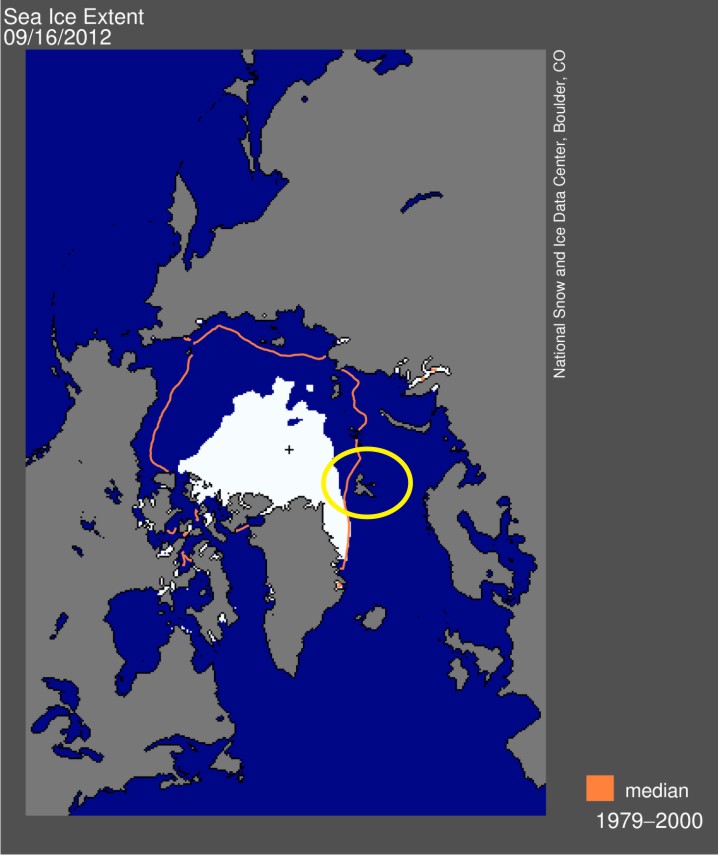
Svalbard as a potential warm refugium_Jan 8 2015_PolarBearScience

Based on genetic model results, the Svalbard Archipelago (circled) has been proposed as a sea ice refugium for polar bears during previous warm Interglacial periods and during predicted sea ice declines in the future. Yet most years since 1979 (2014 was one exception), this region has been ice free during the summer, making Svalbard a decidedly poor candidate for retaining sea ice when it’s much warmer than today.

Continue reading

IUCN Polar Bear Specialist Group out-lived its usefulness 20 years ago

The IUCN Polar Bear Specialist Group (PBSG) should have been disbanded in 1996, the year polar bears were down-graded from a status of ‘vulnerable to extinction’ to ‘lower risk – conservation dependent’ (now called ‘least concern’) on the IUCN Red List.

Bumpersticker from Cambridge Bay, Nunavut, courtesy Joe Prins.

Bumpersticker from Cambridge Bay, Nunavut, courtesy Joe Prins.

Polar bears had recovered from previous decades of wanton over-hunting — by all measures used by the International Union for the Conservation of Nature, they were a conservation success story.

Why did the IUCN and Arctic governments not break up the PBSG back in 1996? Leaving the group intact once polar bears were down-graded to ‘least concern’ simply made its members desperate to justify their existence. That’s precisely what we’ve seen over the last 20 years — PBSG members working tirelessly to ensure the organization didn’t go extinct.

pbsg logo

In fact, polar bears are in no more danger of extinction now than they were in 1996, despite dedicated efforts of the PBSG to convince the world otherwise. Take a look at the history and see if you come to a different conclusion.
Continue reading

Amstrup knows his polar bear predictions are flawed – but continues to promote them

The largest conservation organization in the world says that predictive models developed by polar bear biologist Steven Amstrup are utterly unsuitable for scientifically estimating future populations. Earlier this year, mathematical modeling experts  at the International Union for the Conservation of Nature, who maintain the Red List of Threatened Species, made it clear that Amstrup’s models (used in 2008 to convince the US Fish and Wildlife Service to list polar bears as ‘threatened’ due to predicted global warming) do not meet IUCN standards.

I’d say this makes Amstrup’s polar bear projections (Amstrup et al. 2008, 2010) no more scientifically useful than a crystal ball prophesy, but you wouldn’t know it by his recent actions — or the silence of his fellows.

crystal ball_3c

Continue reading