Posted onFebruary 26, 2025|Comments Off on No News is Good News on Polar Bear Day: Celebrate With 35% Off Polar Bear Evolution
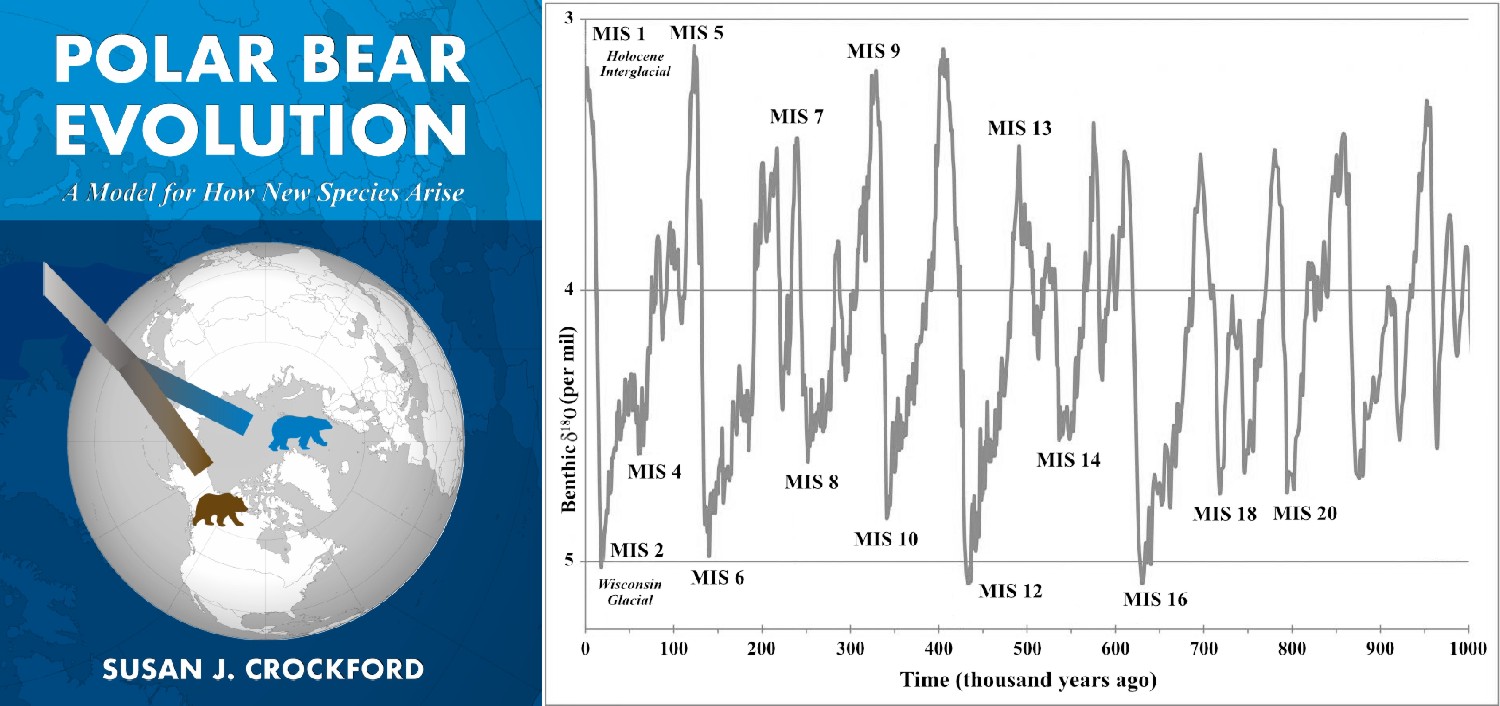
In honour of International Polar Bear Day coming up on Thursday February 27, I’ve discounted the price of my Polar Bear Evolution book by 40% for the next month in order to encourage evolutionary thinking about polar bears (in all markets: see links at the end of this post). UPDATE: Sale extended until June.
Instead of asking whether polar bears will survive a bit of warming over the next few decades, ask yourself how they survived more than 100,000 years of unimaginable changes in Arctic climate (both much warmer and colder) before now?
The fact that recently-deceased Ian Stirling was a prominent co-author should come as no surprise: his irrational promotion of the idea that future “climate warming” could doom polar bears to near-extinction – even after recording and publishing evidence to the contrary – will go down in history as an appalling violation of scientific principles.
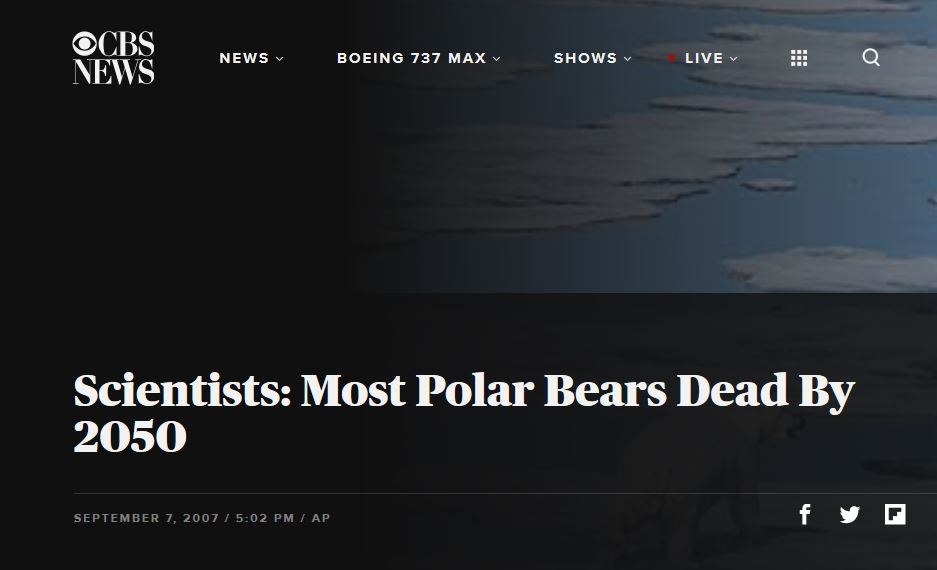
Adding to the dubious validity of the paper: lead author Julienne Stroeve’s 2007 paper predicting summer sea ice decline by 2050 was proven wrong by actual data by the time it was published (Stroeve et al. 2007, 2014) and a more recent update failed to foresee the recent 17-year stall in decline. And co-author Steve Ferguson, a seal biologists, rashly stated in 2016 that Hudson Bay could be ice-free in winter as early as 2021 [which, needless to say, never came close to fruition].
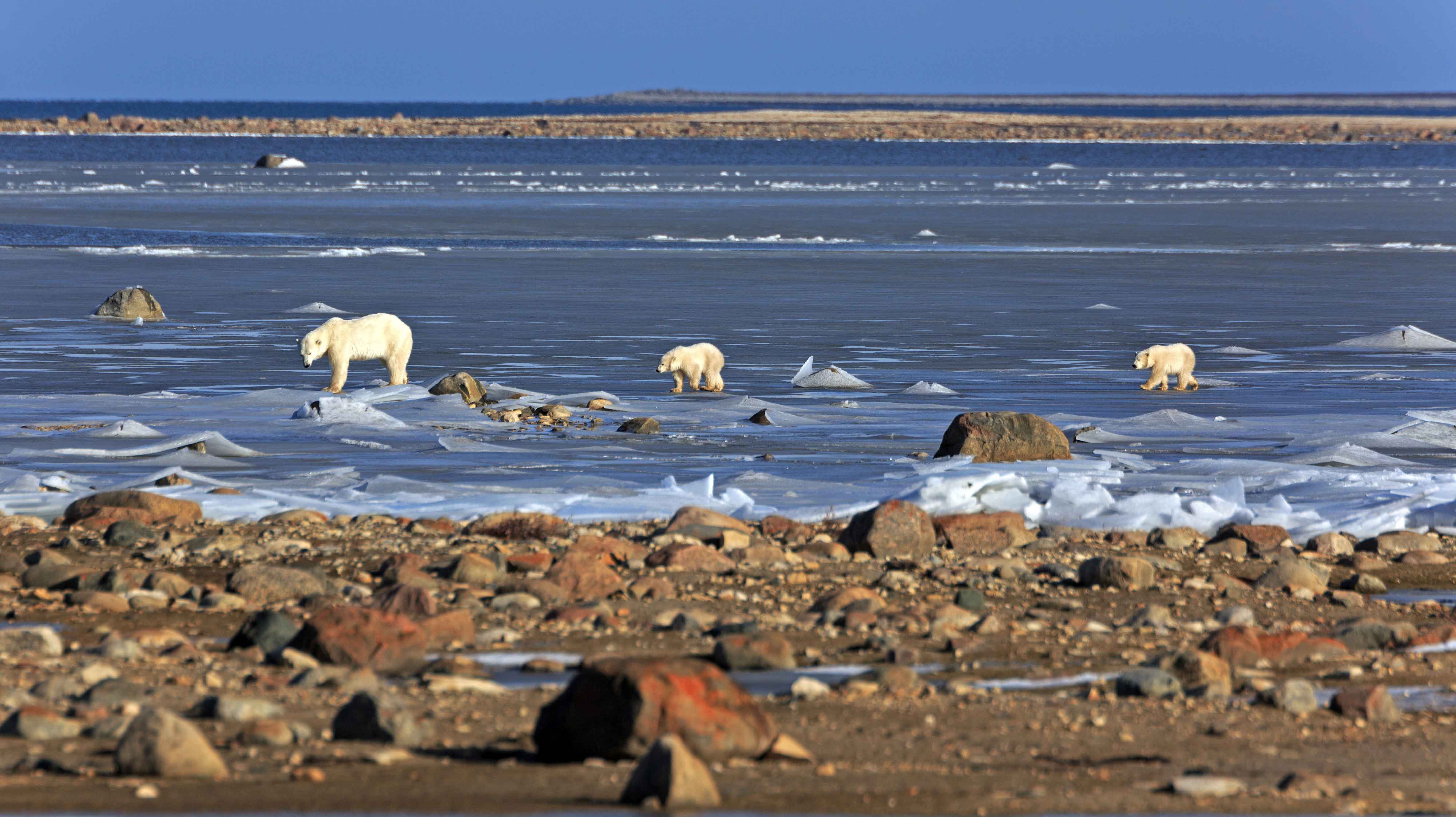
I’d say if Southern Hudson Bay polar bears might be extirpated as soon as 2030, as the paper’s co-author Alex Crawford suggests, the global temperature and ice melt had better get a move on: a survey showed the SH population was thriving in 2021 and Hudson Bay sea ice hasn’t hit any kind of death spiral in the three years since.
Posted onFebruary 13, 2024|Comments Off on When polar bears die, they die of starvation: new Nature paper is propaganda, not news
Is it a coincidence that a paper reporting the results of a no-news study on polar bears, but which predicts future starvation due to climate change, was published two weeks to the day ahead of a climate change marketing event made up by the activist organization Polar Bears International? I doubt it.
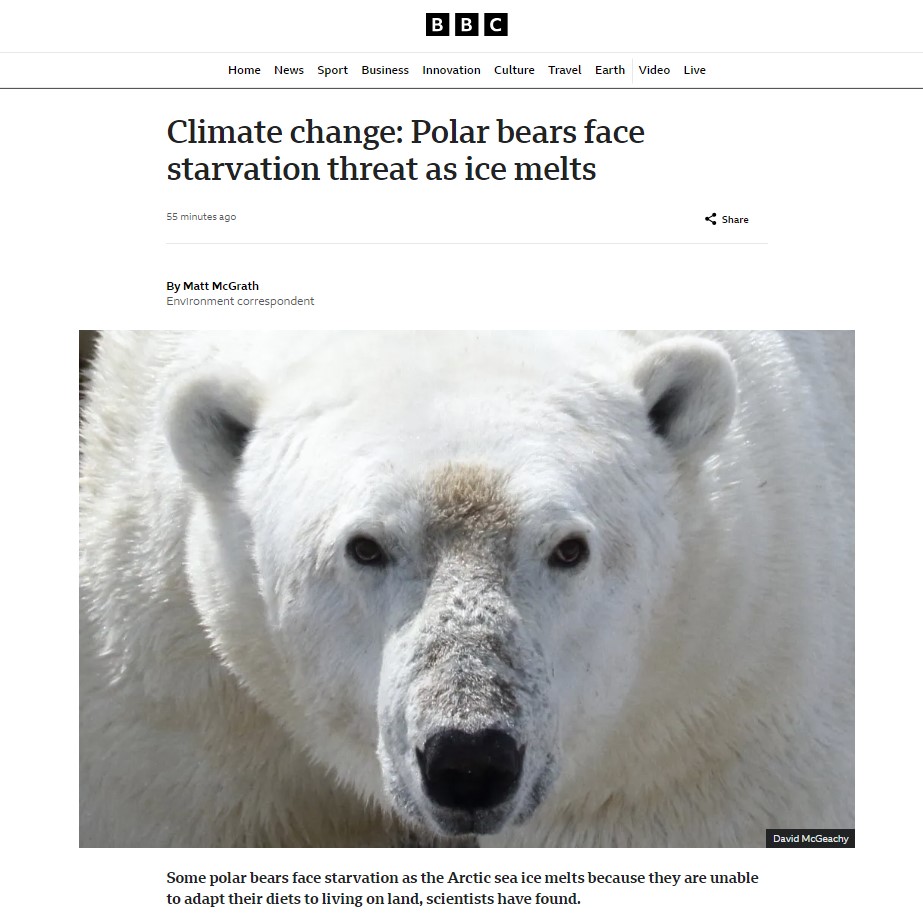
And do I think the high-profile journal Nature Communications would not only agree to publish such a useless bit of propaganda but also rig the timing to advance the climate change emergency narrative? Silly question. And the media worldwide are of course lapping it up, happy for an excuse to promote the perils of climate change, see here, here, and here using images of fat polar bears. Image above is from the BBC headline, 13 February 2024.
They believe this strategy is effective because they think the public is stupid, but they are deluding themselves. Most people are now laughing at their obvious acts of desperation.
Posted onSeptember 22, 2023|Comments Off on 17 years of near-zero trend in September sea ice demolishes claim that more CO2 means less sea ice
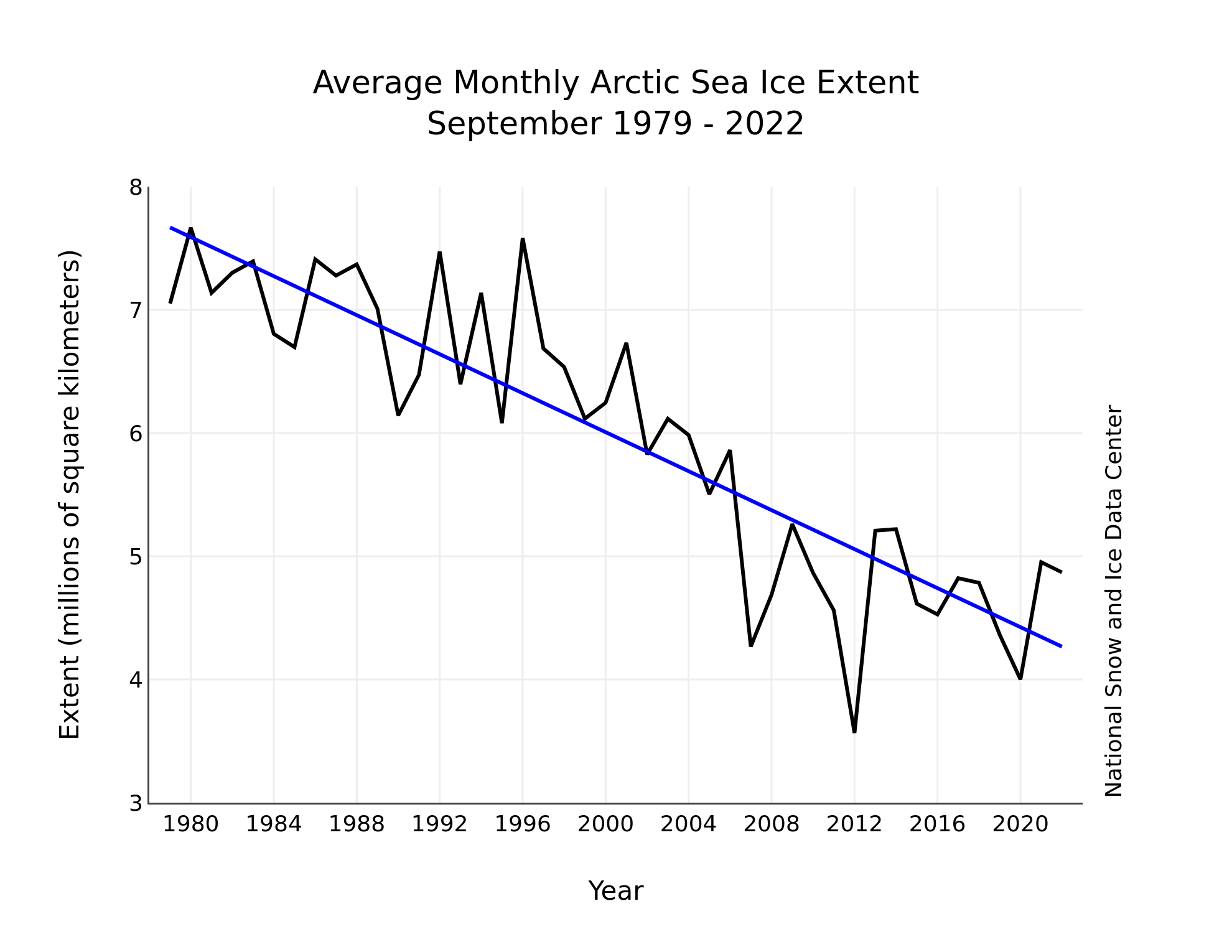
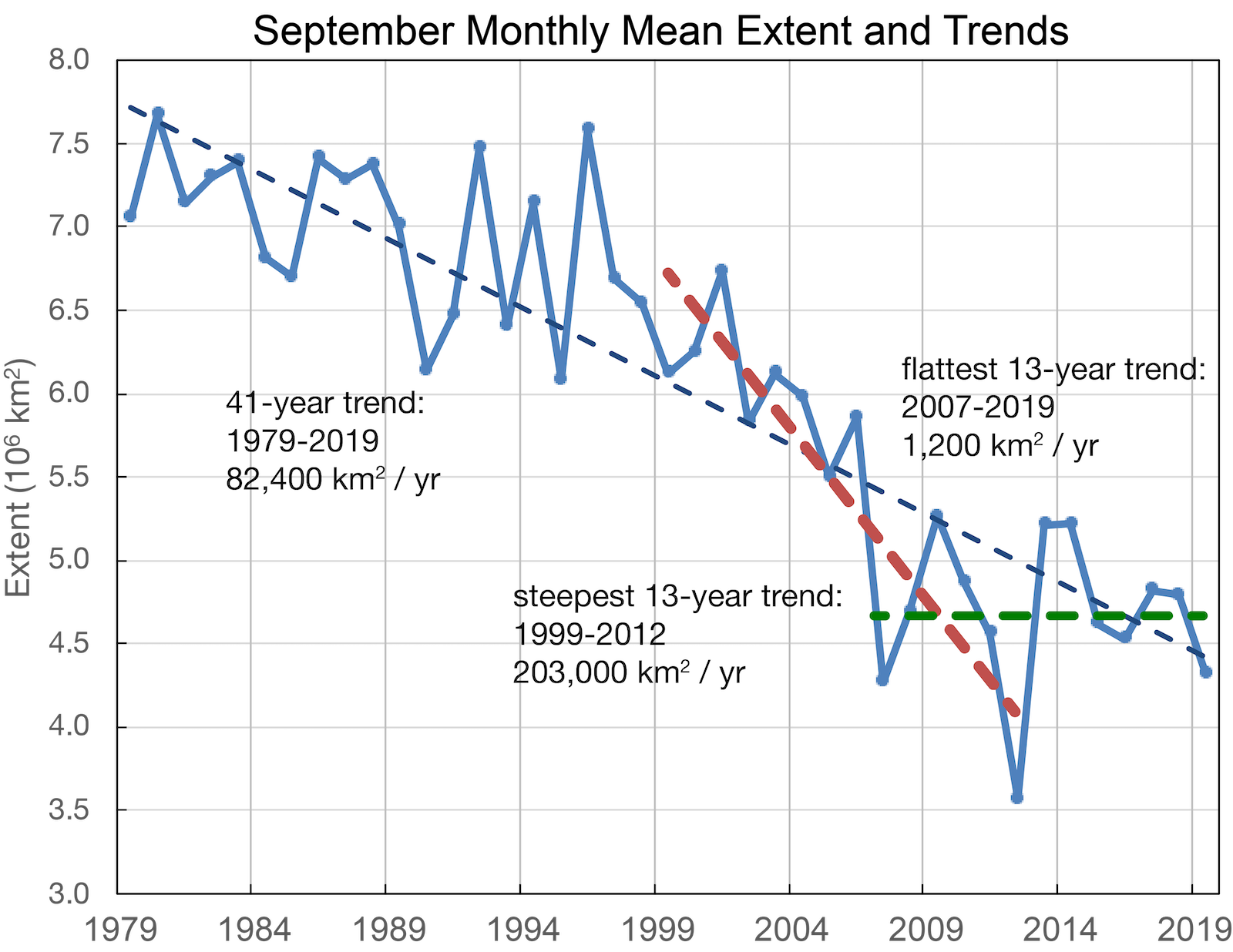
If the hottest year ever can’t precipitate ‘ice-free’ conditions in September, what’s it going to take? Arctic sea ice failed to nose-dive again this year, undoubtedly disappointing expects who have been anticipating a ‘death-spiral’ decline for ages. Arctic sea ice hit its seasonal low sometime around mid-September this year and although the precise value hasn’t been published, the average September ice coverage will likely be about 4.2 mkm2 once it gets announced in early October.
This means we have now had 17 years of a near-zero trend for September sea ice, extending the nearly-flat trend NSIDC sea ice experts acknowledged four years ago. This surely busts a huge hole in the prevailing concept that more atmospheric CO2 causes less summer sea ice. Note that CO2 levels measured in August 2023 were 419.7 parts per million (ppm), compared to 382.2 in August 2007, a rise of 37.5ppm with no corresponding decline in summer sea ice (and vs. 314.2 ppm in 1960). Measured in metric tons, CO2 emissions due to fossil fuels rose from 31.1 billion in 2007 to 37.1 billion in 2021 (last year of data), again with no corresponding decline in summer sea ice.
Posted onJuly 17, 2023|Comments Off on More Barents Sea polar bear habitat at mid-July 2023 than in 2012 despite more atmospheric CO2
Despite more CO2 in the atmosphere (424 vs. 392, for June), there was more sea ice cover in the Barents Sea at mid-July this year than there was in 2012.
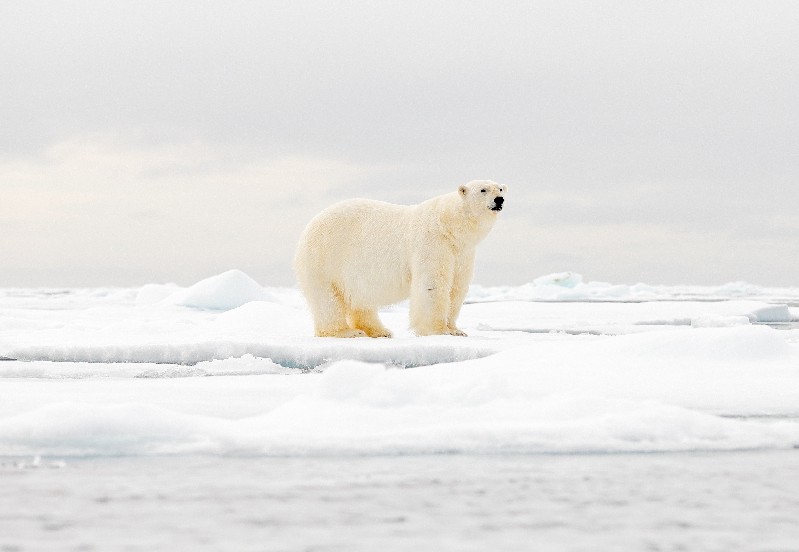
Yet contrary to predictions, which insisted that protracted poor ice conditions in summer would inevitably result in catastrophic rates of starvation and death (Amstrup et al. 2007; Crockford 2017, 2019), polar bears in the Svalbard region have so far not had any documented any harm to their health or population size. In fact, field data show bears in Svalbard are in better condition than they were in the late 1990s (Lippold et al. 2019), almost certainly due to the documented increase in primary productivity that has resulted from longer ice-free summers since 2003 (Frey et al. 2022; Crockford 2023).
Posted onMay 18, 2023|Comments Off on How is widespread use of helicopters to study polar bears defensible in a warming world?
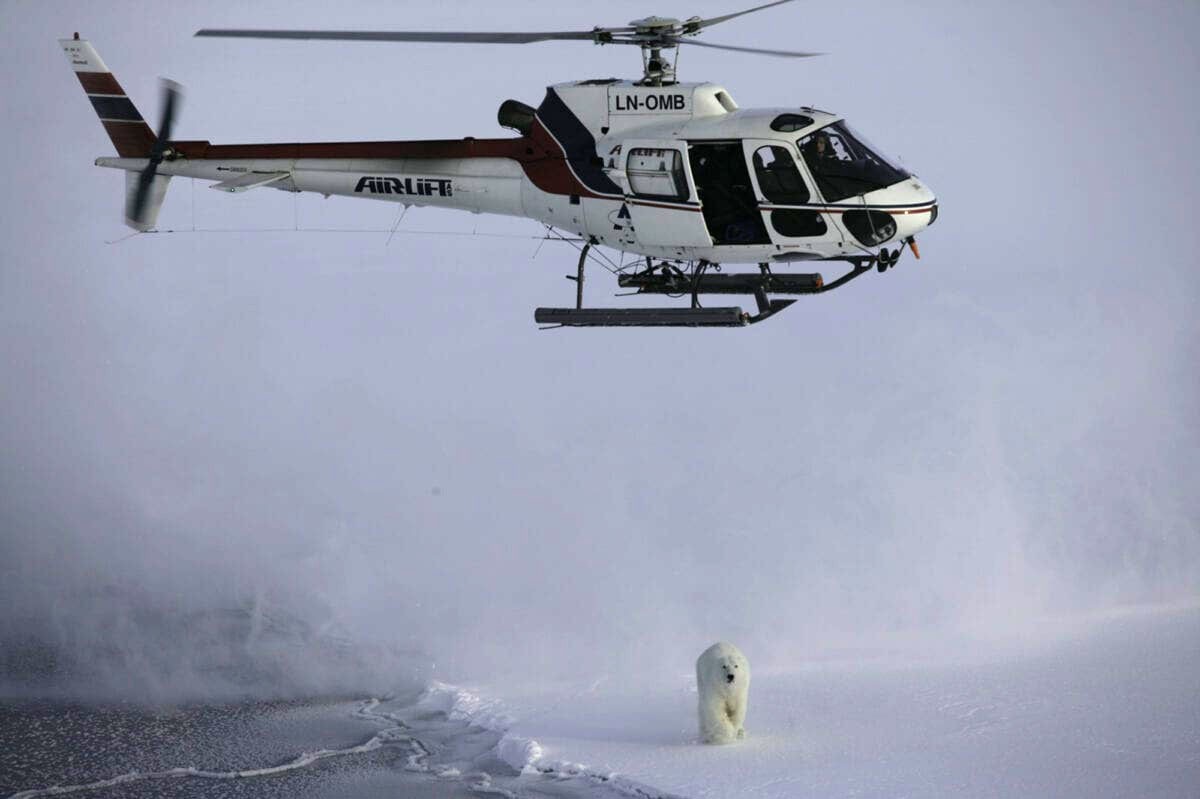
If all of us should be doing “everything possible” to stop climate change, why is it still OK–15 years after polar bears were declared threatened with extinction because of predicted climate change effects–for researchers across the Arctic to use helicopters to study polar bears? Aircraft that consume massive amounts of aviation fuel and engine oils, otherwise known as ‘fossil fuels.’
Money quote: “…the lifeblood of most polar bear research is jet fuel needed by helicopters.” (Derocher 2012:107).
From Hudson Bay and the High Arctic in Canada, the Beaufort Sea off Alaska, to Svalbard in Norway (above, from 2015), polar bear research is impossible without helicopters powered by fossil fuels. This has been true since the 1980s (e.g. Ramsy and Stirling 1988). And this doesn’t even take into account the fossil fuel-powered fixed wing aircraft needed in some locations, commercial airline flights that transport personnel and equipment to distant locations, or the Tundra buggies used in Churchill (Western Hudson Bay) to get up close to bears and educateindoctrinate the tourists.
Posted onMay 8, 2023|Comments Off on Attenborough expects King Charles to continue his activism
Now that Charles is King, it seems the new euphemisms for WEF-style totalitarian climate change activism is a defence of “environmental issues,” “protecting the natural world,” and “backing conservation.”
In a pre-coronation interview with the BBC, Sir David Attenborough said on Friday he believes that Charles will continue his activism while he is King, despite the constitutional demand that a British monarch remains apolitical. Today is Attenborough’s 97th birthday and it seems fitting to say I believe him. Why wouldn’t he tell the truth?
Money quote from Attenborough: “…now everybody realises that the future of humanity is dependent upon a healthy natural world.The way ahead demands that leaders of the state should actually give their full backing and I’m quite sure that as King he will lead this country in a very important way.”
In true 1984 style, it seems the ruling elite are redefining terms to fit their ideology: recasting the King’s former activism and promotion of World Economic Forum agendas as entirely a defence of the environment and conservation issues. No doubt this tactic is meant to convince the naive public that there was never any politics involved in what Charles did before and so it cannot be considered political now that Charles is King.
But those who have been paying attention know better.
It also suggests that what those wealty powerbrokers have planned for us cannot work without the King’s considerable power and influence. This may sound awfully cynical but my eyes have been opened by Attenborough’s behaviour over the falling walrus issue and the alliances he’s made with the WWF and Netflix over the last few years. You may agree when you read what has been circulating in the news over the weekend, summarized below.
Posted onApril 15, 2023|Comments Off on Russian walrus and polar bears continue to thrive US researchers tell the Washington Post
Interviews with US researchers for a piece in the Washington Post earlier today contain revelations that walrus and polar bear populations in the Russian Far East continue to thrive, despite insisting that polar bears face a dire future without human interference.
This article on collateral damage of Russia’s war with Ukraine comes with this stunning sub-headline:
The invasion [of Ukraine] is first and foremost a human tragedy, but it is also dire for wildlife, stalling scientific work on polar bears and other wildlife threatened with extinction.
The article prominently features a researcher working on Chukchi sea polar bears, which are currently thriving but still tagged with a status of “threatened” based entirely on computer models that predict a dire outcome 30 years from now. The writer also interviewed a scientist working on Pacific walrus, which likely number more than 200,000 animals and are not considered “threatened,” a point oddly not mentioned by the author or the researcher interviewed (Crockford 2023; MacCracken et al. 2017; Fischbach et al. 2022; USFWS 2017a,b).
Posted onMarch 20, 2023|Comments Off on 15 years after ESA listing as ‘threatened’ due to sea ice loss polar bears are abundant & thriving
Experts who used the American Endangered Species Act (ESA) to list polar bears as ‘threatened’ in May 2008 were mistaken: sea ice authorities got their predictions wrong about future ice extent and polar bear specialists erroneously declared that two-thirds of polar bears would disappear if summer sea ice declines continued unabated.
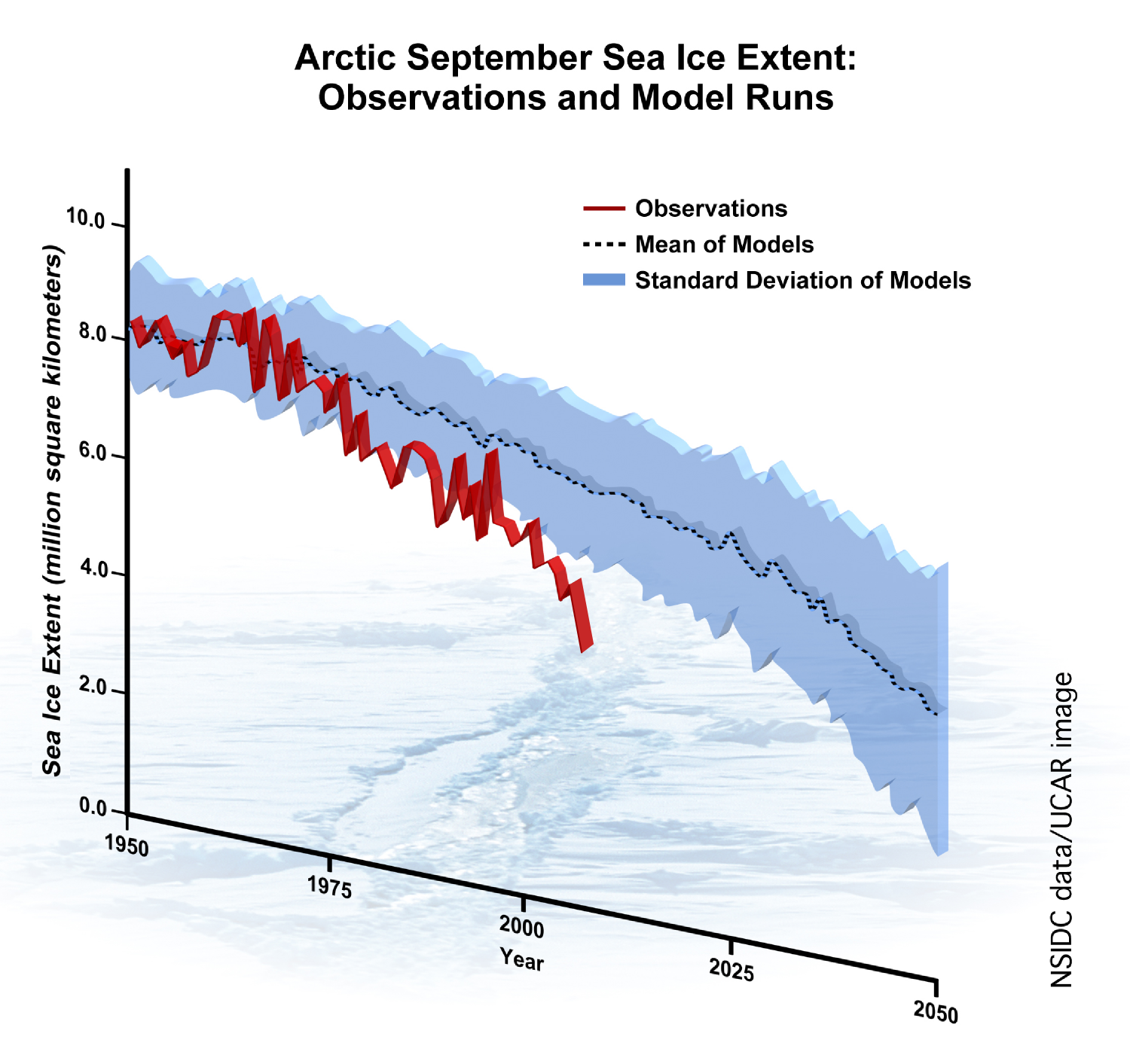
By 2007, there was even less summer sea ice than computer models of the day had predicted (Stroeve et al. 2007, see red line on graph below) and in 2012, it dropped to just above 3 mkm2.
Simplified Arctic sea ice predictions vs. observations up to 2007 by Stroeve et al. 2007 (courtesy Wikimedia). Sea ice hit an even lower extent in 2012 and all years since then have been below these predicted levels.
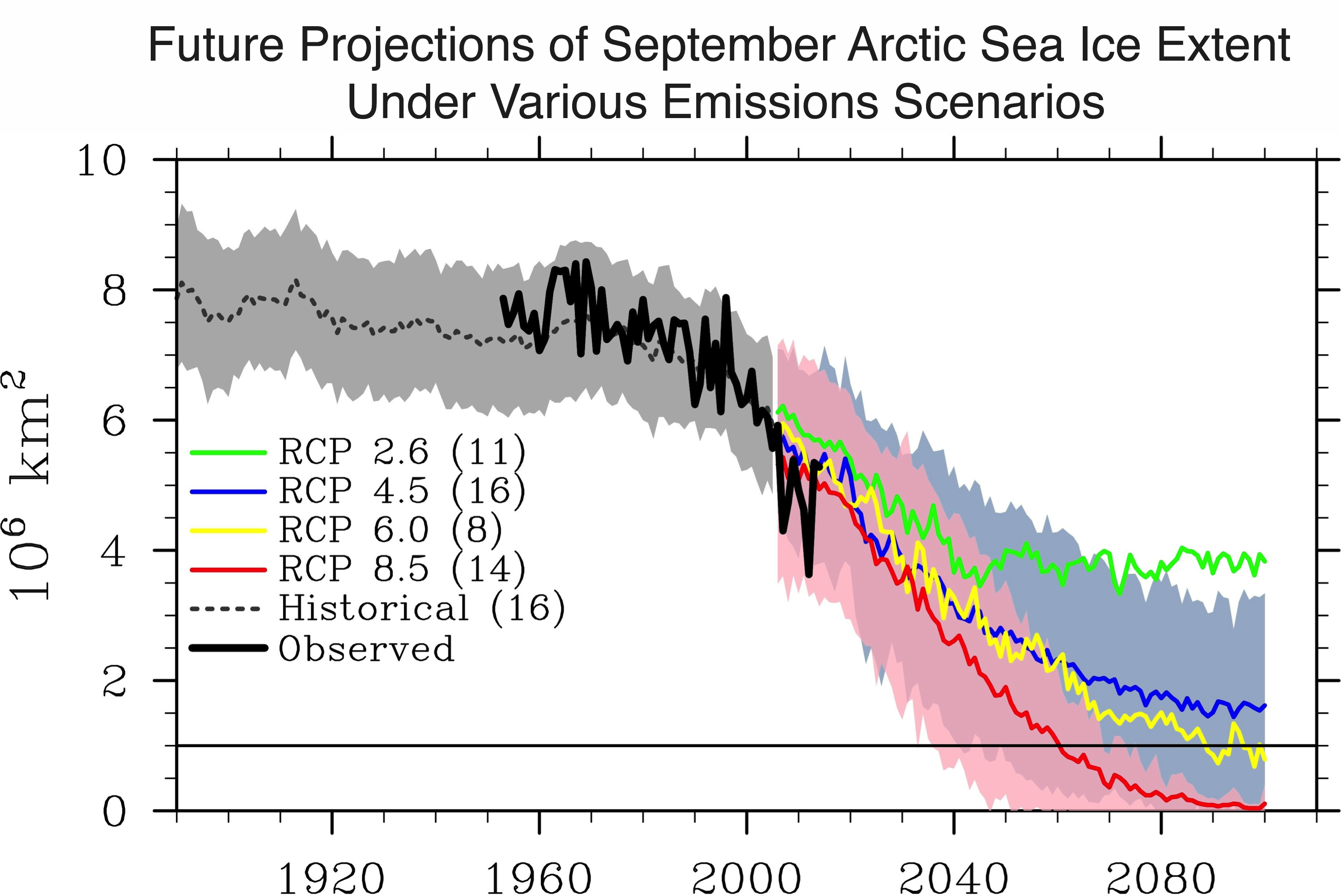
Updated sea ice predictions published in 2014 by the Stroeve team (see below) went to the other extreme, using totally implausible RCP 8.5 scenarios to predict a virtually ice-free Arctic (< 1 mkm2 ice extent) before 2040, which seem just as likely to be just as wrong as their 2007 attempt (Hausfather and Peters 2020; Pielke and Ritchie 2021; Stroeve et al. 2007, 2014; Swart et al. 2015).
In fact, for 12 years out of the last 15, summer ice extent has been below 5.0 mkm2 (often well below), which polar bear experts had not anticipated would happen until at least 2050 (Amstrup et al. 2006).
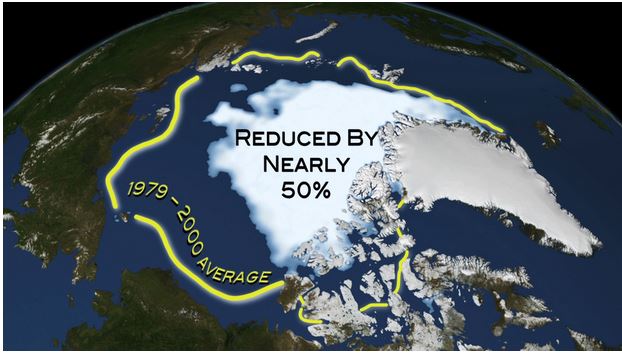
In 2012, NOAA sea ice experts summarized this sea ice loss as “reduced by nearly 50%” since 1979:
Despite this dramatic decline in sea ice, polar bears are still abundant and thriving because polar bear specialists got it wrong about the bears’ need for this habitat in summer (Crockford 2017, 2019; Crockford and Geist 2018). Polar bear turned out to be more flexible and resilient than predicted and many subpopulations are better off than before. Davis Strait and Chukchi Sea bears are doing very well: Barents Sea bears in particular are thriving despite by far the most sea ice loss of any Arctic region (e.g. Conn et al. 2021; Frey et al. 2022; Haavik 2022; Lippold et al. 2019; Peacock et al. 2013; Regehr et al. 2018; Rode et al. 2014, 2018, 2021, 2022).
Conclusion: Despite the Arctic warming four times as fast as the rest of the world with rising CO2 levels and almost 50% less summer ice than there was in 1979, polar bears are no closer to extinction than they were 15 years ago, according to the results of field studies. There is no existential emergency for polar bears or any other Arctic sea mammals due to declining summer sea ice, despite continued messages of doom from remorseless experts.
References
Amstrup, S.C., Marcot, B.G. & Douglas, D.C. 2007. Forecasting the rangewide status of polar bears at selected times in the 21st century. US Geological Survey. Reston, VA. Pdf here
Conn, P.B., Chernook, V.I., Moreland, E.E., et al. 2021. Aerial survey estimates of polar bears and their tracks in the Chukchi Sea. PLoS ONE 16(5): e0251130. https://doi.org/10.1371/journal.pone.0251130
Crockford, S.J. 2017. Testing the hypothesis that routine sea ice coverage of 3-5 mkm2 results in a greater than 30% decline in population size of polar bears (Ursus maritimus). PeerJ Preprints 19 January 2017. Doi: 10.7287/peerj.preprints.2737v1 Open access. https://peerj.com/preprints/2737/
Crockford, S.J. 2019. The Polar Bear Catastrophe That Never Happened. Global Warming Policy Foundation, London. Available in paperback and ebook formats.
Crockford, S.J. and Geist, V. 2018. Conservation Fiasco. Range Magazine, Winter 2017/2018, pg. 26-27. Pdf here.
Frey, K.E., Comiso, J.C., Cooper, L.W., et al. 2022. Arctic Ocean primary productivity: the response of marine algae to climate warming and sea ice decline. 2022 NOAA Arctic Report Card, https://doi.org/10.25923/0je1-te61
Haavik, E. 2022. ‘Svalbard’s polar bears persist as sea ice melts — but not forever. The World, 21 July.
Hausfather, Z. and Peters, G.P. 2020. Emissions – the ‘business as usual’ story is misleading [“Stop using the worst-case scenario for climate warming as the most likely outcome — more-realistic baselines make for better policy”]. Nature 577: 618-620. https://www.nature.com/articles/d41586-020-00177-3
Lippold, A., Bourgeon, S., Aars, J., et al. 2019. Temporal trends of persistent organic pollutants in Barents Sea polar bears (Ursus maritimus) in relation to changes in feeding habits and body condition. Environmental Science and Technology 53(2):984-995.
Regehr, E.V., Laidre, K.L, Akçakaya, H.R., Amstrup, S.C., Atwood, T.C., Lunn, N.J., Obbard, M., Stern, H., Thiemann, G.W., & Wiig, Ø. 2016. Conservation status of polar bears (Ursus maritimus) in relation to projected sea-ice declines. Biology Letters 12: 20160556. http://rsbl.royalsocietypublishing.org/content/12/12/20160556 Supplementary data here.
Rode, K.D., Regehr, E.V., Douglas, D., et al. 2014. Variation in the response of an Arctic top predator experiencing habitat loss: feeding and reproductive ecology of two polar bear populations. Global Change Biology 20(1):76-88. http://onlinelibrary.wiley.com/doi/10.1111/gcb.12339/abstract
Rode, K.D., Olson, J., Eggett, D., et al. 2018. Den phenology and reproductive success of polar bears in a changing climate. Journal of Mammalogy 99(1):16-26. here.
Rode, K. D., Regehr, E.V., Bromaghin, J. F., et al. 2021. Seal body condition and atmospheric circulation patterns influence polar bear body condition, recruitment, and feeding ecology in the Chukchi Sea. Global Change Biology 27:2684–2701. https://doi.org/10.1111/gcb.15572
Rode, K.D., Douglas, D.C., Atwood, T.C., et al. 2022. Observed and forecasted changes in land use by polar bears in the Beaufort and Chukchi Seas, 1985-2040. Global Ecology and Conservation 40: e02319. https://doi.org/10.1016/j.gecco.2022.e02319
UPDATE 12 November 2022. One of the independents on the ground near Churchill had this to say about the bears and freeze-up conditions this year:
“Bears started leaving on November 10; conservation emptied the jail on the 10th as well.”
[the 10th was the day this post was originally published; ‘the jail’ is the Churchill Polar Bear Alert Program’s ‘holding facility’, see report below]. This information suggests the average date for bears leaving shore will likely turn out to be 12-14 November, again earlier than the average for the 1980s (16 Nov +/- 5 days). There may still be a few bears on the shore of Wapusk National Park that seem to be in no hurry to leave, but a few stragglers doesn’t mean there isn’t ice available for hunting.
Watch polar bear habitat reform in the Canadian Arctic: “last 10 days” Canadian Ice Service animation (works anytime) HERE.
See Quote archive for details.







 polarbearscience
You must be logged in to post a comment.