Tag Archives: Polar Bears International

PBI Facebook posts on Stirling’s polar bear that “died of climate change” have disappeared

It seems the two PBI Facebook posts about polar bear expert Ian Stirling’s bear that supposedly “died of climate change” last summer, which included some scathing comments and links to this blog, were removed sometime between late August 2013 and yesterday, when I happened to look for them.

See the screen-caps below. The first one, posted August 6, linked to the original Guardian article on the Svalbard bear and added some activist spin for good measure!
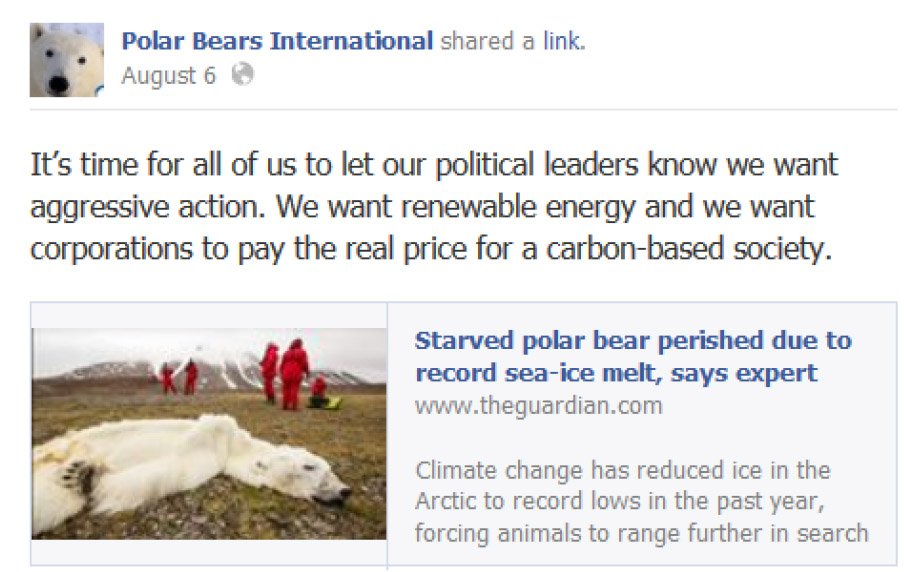
Polar Bears International Facebook_Aug 6

The second one, posted August 8, linked to an PBI news item that introduced a PBI blog post written by Stirling, in which he attempted some damage control.1
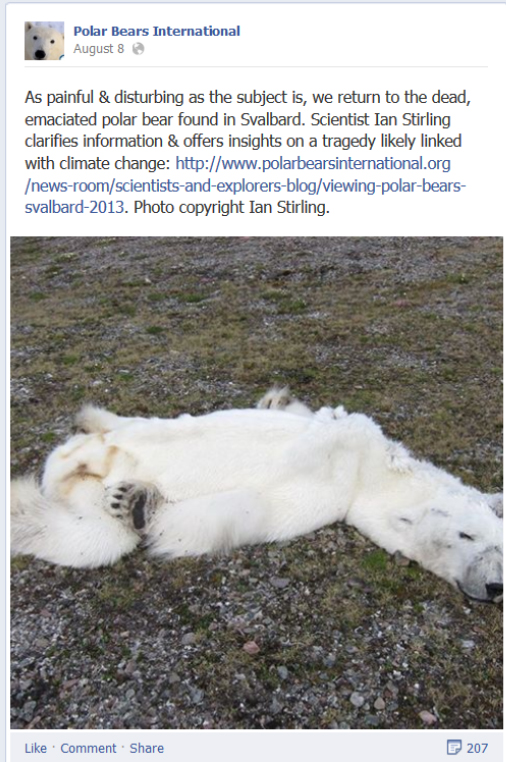
PBI link to Stirlings blog post on the bear that died of climate change_with activist spin_Aug 8 2013

[Reprise: Stirling speculated that a 16 year old bear found emaciated and dead in Svalbard, three months after it had been captured by researchers in good condition, had died of starvation due to lack of sea ice caused by global warming. Guardian writers transformed this into a bear that “died of climate change.” No mention from in the original story that 16 years is near the maximum life expectancy for male bears in the wild, that death by starvation is the usual cause of death for very old bears, or that other bears in the area were doing just fine (based on the fact that the Norwegian team working that area had just posted their data online). See my original post here, followup here, Featured Quote #44, here and footnote below]

Stirling himself (a “scientific advisor” to Polar Bears International, PBI), and the-polar-bears-are-dying message generally, took a big hit over that incident. But attempting to rewrite history? See the screen-cap below, taken yesterday (pdf here):

PBI_Fan Photo Day Aug 6 to Aug 13 gap_Svalbard bear story gone_April 29 2014

The deletion of these two entire entries suggests that PBI and Ian Stirling would rather their faithful Facebook followers and donors not have a chance to revisit the scathing comments and links to this blog. I assume it is the comments and links that were the offending parts, since Stirling’s blog post at PBI is still there, and of course, the news stories carried elsewhere are still out there. So instead of deleting comments, they removed the entire posts.

Good thing I saved screen caps of many of the more critical comments, from at least two PBI Facebook followers I’ve never heard of — have a look. [August 6th post was also captured by the cache machine]
Continue reading
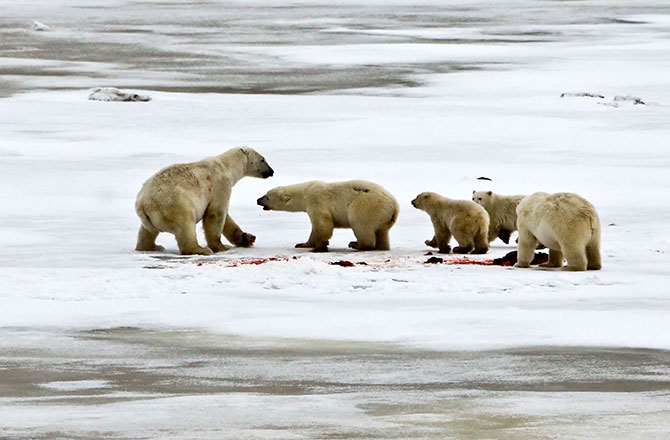
Polar bear female with cubs fights off adult male – photos from W Hudson Bay

Discovery News ran a photo feature yesterday (January 28, 2014), courtesy Mike Lockhart from Polar Bears International, of an interesting incident Lockhart witnessed while was working with a government (Manitoba Conservation) research team surveying bears of Western Hudson Bay in the fall of 2013.

Figure 1. Female with 2 cubs turns on an adult male (far right) that she had been happily feeding with moments before. Mike Lockhart photo, Polar Bears International and Discovery News.

Figure 1. Female with 2 cubs turns on an adult male (far left) that she had been happily feeding with moments before. This is the 3rd photo in the sequence; see description and photo 4 below. Mike Lockhart photo, Polar Bears International, Discovery News story.

Continue reading

Amstrup’s comment on his starving polar bear article and my response

Steve Amstrup has left a comment below his January 20, 2014 “starving polar bears’ article at The Conversation, which I discussed in my last post.

I’ve copied his comment below and the response to his comment that I left this morning, which is copied below his. See the entire comment sequence here.
Continue reading

Amstrup repeats starving polar bear nonsense, features “Ursus bogus”

As if on cue just before an important polar bear announcement, Steven Amstrup, full time employee of Polar Bears International (PBI), is crying “starving polar bears” yet again, with a laughable twist.

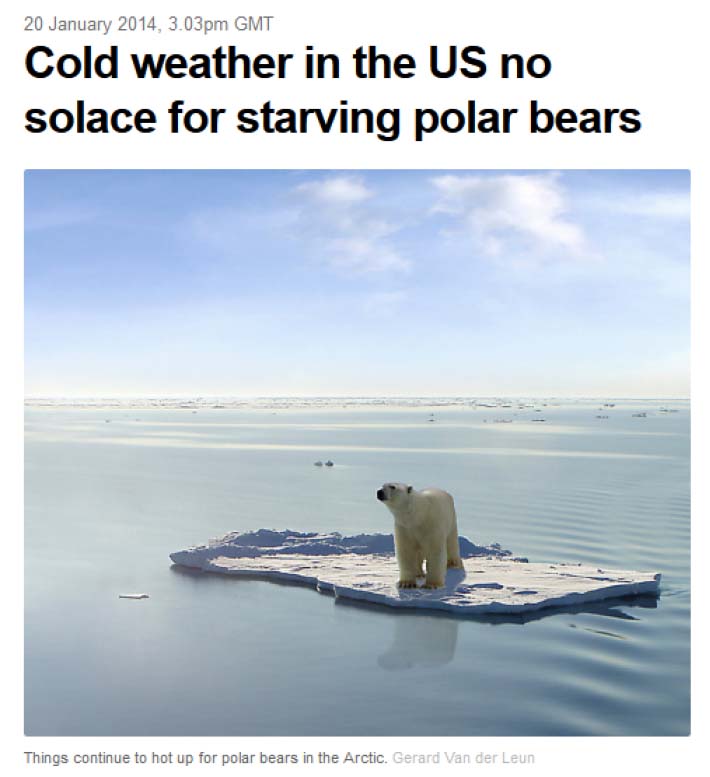
Over at “The Conversation” (a university supported forum for academics), in a piece titled “Cold weather in the US no solace for starving polar bears,” Amstrup uses his adjunct affiliation at University of Wyoming to unleash a bit of unpaid advertising for PBI’s alarmist message (I put it this way because while Amstrup  does disclose his affiliation at PBI, he is more than just an affiliated member, he is their paid spokesperson).

Ironically, the headline photo (Fig. 1) is the notorious “Ursus bogus,” the photoshopped image used by the journal Science back in May 2010 to feature an article on the integrity of science, It was quickly exposed by Tim Blair at The Telegraph (also covered at WUWT), and the journal was obliged to acknowledge the error, replace the image and issue a correction.

In this case, commenter Brad Keyes at The Conversation defends the use of the “Ursus bogus” image with this astonishing statement [UPDATE Jan. 25/14: it has since transpired that this was almost certainly meant to be satire]:

The problem is, only sensational exaggeration makes the kind of story that will get politicians’—and readers’—attention. So, yes, climate scientists might exaggerate, but in today’s world, this is the only way to assure any political action and thus more federal financing to reduce the scientific uncertainty.

Figure 1. The headline photo from Steven Amstrup’s article at The Conversation. This infamous “Ursus bogus” image (for sale at IStock photos, listed under “Global warming images”), says “This image is a photoshop design. Polarbear, ice floe, ocean and sky are real, they were just not together in the way they are now.”

Figure 1. The headline photo from Steven Amstrup’s article at The Conversation. This infamous “Ursus bogus” image (for sale at IStock photos, listed under “Global warming images), says “This image is a photoshop design. Polarbear, ice floe, ocean and sky are real, they were just not together in the way they are now.”

However, we now know that Amstrup is crying wolf — summer sea ice has been declining despite a hiatus in global warming and unusual numbers of polar bears are not starving. He seems to think that if he keeps repeating his Chicken Little message (with nary a recent photo of an actual starving polar bear) he will convince more people to believe him and donate to PBI. It’s his job to do so of course, so he’s not likely to stop. [pardon my mixed metaphor – Amstrup, if you recall, prefers a Titanic metaphor]
Continue reading

WWF and cohorts barred from Moscow polar bear forum

Despite the fact that the World Wildlife Fund (WWF) apparently provided a significant portion of the funding for the recently concluded International Forum on Conservation of Polar Bears (December 3-6, Moscow), it appears in the end they and their NGO cohorts were prevented from having an undue amount of influence at the meeting. For that we can thank the delegates of the five Arctic nations: three cheers for common sense!

This news did not emerge until late yesterday (Friday, Dec. 6), after the meeting had concluded: no mention was made of NGOs being excluded in the press releases and stories written before then. For example, see IUCN story, Dec. 5; WWF story, Dec. 4; Times of India report, Dec. 5 and this Arctic Journal story Dec. 6. There was nothing in any of them about NGOs and journalists being barred from parts of the meeting they thought they would be allowed to attend.

Note that biologist Mitch Taylor, booted-out of the Polar Bear Specialist Group because he did not agree with the group’s position on global warming, attended as part of the Canadian contingent (see list at the end of this post), which was a bit of a surprise. However, the exclusion from the meeting of WWF and their buddies is the big news as far as I’m concerned.

[The media seems more interested in the fallout from a twitter message sent on the final day of the meeting by Canada’s Environment Minister Leona Aglukkaq — more on that in my next post].

Continue reading

Hudson Bay freeze-up has not been a day later each year since 1981

[Update Nov. 23, 2013: I’ve added a few comments, noted, in the text]

This is a follow-up to an earlier post, Polar bear problems in N Hudson Bay not due to late freeze-up, to counter some misinformation that’s being circulated about the history of Hudson Bay freeze-up dates.

Polar bear biologists working in Western Hudson Bay published new definitions of breakup and freeze-up earlier this year. The new method better reflects how polar bears interact with seasonal changes in sea ice on the bay.

Formerly, 50% ice coverage levels were used to assign the date when major ice change phenomena were reached each year (breakup in summer, freeze-up in fall (e.g. Gagnon and Gough 2005). The new method (Cherry et al. 2013, see discussion here) defines breakup at 30% ice coverage and freeze-up at 10%.

Cherry and colleagues had a fairly complicated method of defining 30% coverage for breakup in Western Hudson Bay. However, freeze-up in the fall is much simpler because ice always forms first along the western shore, starting in the north.

This means that the weekly graphs of ice development provided by the Canadian Ice Service for Hudson Bay, which are expressed as a percentage (just like the Cherry et al. study), can be used to compare freeze-up dates historically.

These graphs refute the absurd claim that freeze-up on Hudson Bay has been “one day later each year” over the last 30 years – an assertion repeated just the other day at PBI. Let’s take a closer look, shall we?
Continue reading

Amstrup compares climate change to a Titanic for polar bears

Steven Amstrup, spokesperson for Polar Bears International, has ramped up his “save the polar bear” rhetoric over last week’s nonsense.

Last night (November 13), the NBC News online story (here) that accompanied their evening news clip (h/t DB) included this appalling analogy:

“…Amstrup said greenhouse gases created by humans threaten future generations of bears by threatening their ice. He said he likes to compare climate change’s effect on polar bears to the infamous Titanic ocean liner.

“[It] didn’t matter how many people were on the Titanic or how well they were doing,” he said. “When the Titanic slipped beneath the waves and they lost their habitat, that was it. So polar bears will also go away because of their dependence on sea ice.” [my bold]

Amstrup really wants people to believe that all the polar bears in the world will die some day, all at once, in some mega ice-loss catastrophe!
Continue reading

Hudson Bay freeze-up average this year – not late

Freeze-up in Western Hudson Bay is finally underway. It’s no later this year than average, similar to last year.

This rather contradicts the hysterical hue and cry from the tag-team of Polar Bears International (PBI) spokesperson Steven Amstrup and Guardian reporter Suzanne Goldenberg last week during PBI’s “Polar Bear Week” propaganda blitz (see previous posts here, here, and here), 

So much for the trend towards later freeze-up dates that PBI says is endangering polar bears in Western Hudson Bay.

On-the-ground observers confirm polar bears are preparing to move out and sea ice maps show the ice is forming very rapidly — see maps and quotes below.

Continue reading

Eemian excuses: the warm was different then, polar bears were fine

Today I’ll discuss the response by Polar Bears International representative Steven Amstrup to a comment submitted during their recent “webchat” at The Guardian (Wednesday, November 6), which had to do with the fact that polar bears survived warm periods in the geological past, particularly interglacials.

[Here’s a pdf file of all the questions that were answered by PBI staff: PBI webchat Q&A, also available here]

This is the comment (the first portion of #4 on my list), submitted by MarkBLR:

There was a paper in Science magazine last year (link …) indicating that polar bears became a distinct species about 600kya (+/- 300k years).

This means that they have survived at least two (and possibly eight) previous inter-glacials, in particular the Eemian (130kya to 110kya), when temperatures in the Arctic were 5 to 8 degrees Celcius warmer than current temperatures for several thousand years.

Note that their numbers apparently decreased significantly during the Eemian, and slowly increased as temperatures cooled, but “climate change” was not enough on its own to make them extinct. [my bold]

[We can perhaps forgive Mark for not being able to spell “Celsius” correctly, but Amstrup (see below) has no excuse. The paper in Science Mark refers to is Hailer et al. 2012, discussed in a previous post here. Note that the actual question Mark asked is not included here because Amstrup responded to this portion of his comment only]

Amstrup tries to convince Mark and other readers that polar bear resilience through Eemian warming is irrelevant to the issue of future survival, which I’ll demonstrate is not the case at all.

Here is what Amstrup had to say:
Continue reading

Challenging “save the polar bear” propaganda

[Updates: Note correction to point 6 and links added at the end of the post]

Polar Bears International has mustered the UK newspaper, The Guardian, to provide free publicity for a “save the polar bear” propaganda event coming up tomorrow, November 6.

From The Guardian Environment Blog:

“On Wednesday, 6 November at 10am EST and 3pm GMT you will have a chance to ask a scientist [Steven Amstrup] and a conservationist [Krista Wright] about the latest research on the state of polar bears – and the efforts to protect them.”

The “participants” of this webchat are Polar Bears International (PBI) employees. PBI is a lobbyist organization that uses its influence to pressure politicians and supposedly impartial scientific organizations, like the IUCN Polar Bear Specialist Group (PBSG), to make decisions that fit their agenda. The PBI rallying cry is “Save Our Sea Ice.They are committed to promoting legislation to curtail supposed effects of anthropogenic global warming and are using polar bears as a tool to do so.

Dr. Steve Amstrup is now a full-time, professional activist and spokesperson for PBI (Chief Scientist and Vice President”), a job he took on after a long career as a polar bear biologist. Arranging “webchats” like this is part of the job he is now paid to do.

Krista Wright has a Bachelors degree in Outdoor Education and has worked for NGOs for more than 20 years. She joined PBI in 2009 and is now the Executive Director (i.e., an administrator). She is described as “a passionate conservationist who is deeply concerned about the effects of global warming on polar bears, the Arctic, and the planet.She brings emotion to this event, not science.

Below I dissect some of the fear-mongering background presented at The Guardian, one point at a time; Guardian quotes are in italics, numbered; my responses are below, with links to pertinent previous posts that are fully referenced:

[Links to video and the webchat Q & A have been added at the end of this post as updates]

Continue reading