Tag Archives: ringed seal

Snow depth over spring sea ice affects polar bear feeding success and ringed seal survival

Snow depth over sea ice in spring affects the hunting success of polar bears on ringed seal (Phoca hispida) pups, but the relationship is more complicated than you might think and there is less data on this phenomenon than you would believe.
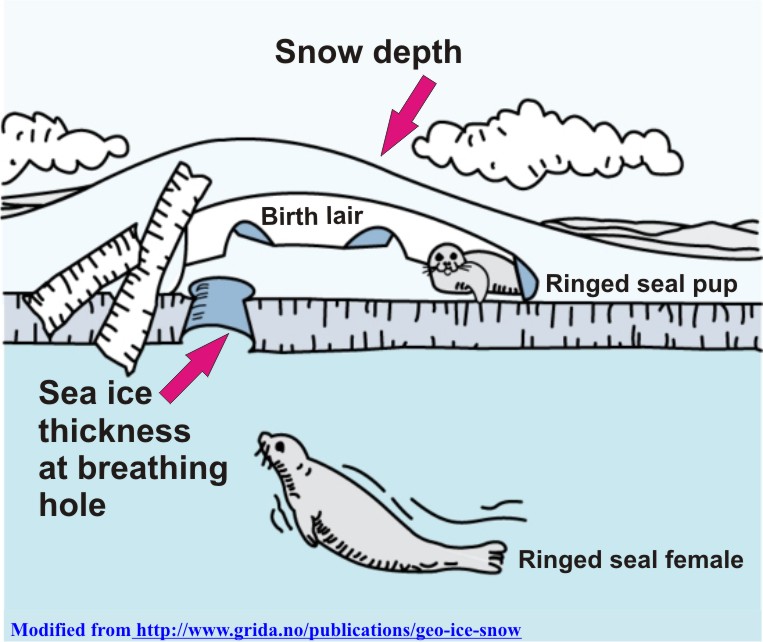
Ringed seal lair_snow and ice thickness_PolarBearScience_sm

Regional snow depth in spring (April-May) varies naturally from year to year due to weather patterns driven in part by long-term climate cycles (like the Atlantic Multidecadal Oscillation, Pacific Decadal Oscillation, and the Arctic Oscillation).

This year, it was very cold in Eastern North America, with record-breaking snow fall in some areas. Snow depth was apparently greater than average over Hudson Bay sea ice this spring but was it deep enough to have impaired polar bear hunting success?

Continue reading

Polar bears barely survived the sea ice habitat changes of the last Ice Age, evidence suggests

While the polar bear is an Ice Age species, genetic and fossil evidence suggests it barely survived the profound sea ice changes associated with the Last Glacial Maximum, one of the most severe glacial periods of the Pleistocene.

polar_bear_usfws_no date_sm

A map of sea ice extent at the climax of the Last Glacial Maximum (both perennial and seasonal ice), prepared with the help of a colleague, makes it possible to discuss what genetic and fossil evidence can tell us about the probable effects of glacial conditions on polar bears and ringed seals.

Continue reading

‘Threatened’ status for Arctic ringed seals under ESA makes no sense

Recent research (Crawford and Quakenbush 203; Rode et al. 2014) has shown that sea ice declines in the Chukchi and Beaufort Seas have made life better for ringed seals, not worse (as predicted) – ringed seals are in better condition and reproducing better than they were in the 1970s. Why? Ringed seals do most of their feeding in the open-water period (Young and Ferguson 2013), so a longer open-water season means fatter, healthier seals and more fat pups for polar bears to hunt the following spring.

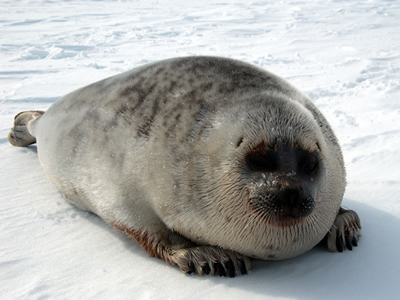
Ringed_seal_2_NOAA

However, Arctic ringed seals (as well as bearded seals) were designated as ‘threatened’ by the USA in 2012 under the Endangered Species Act, based on predicted ice and snow declines due to prophesied global warming. These listings are all about future threats, with no pretense of on-going harm.

Virtually no other Arctic nation has taken this step for Arctic seals — see previous discussion here. There are lots of ringed seals — an estimated 3-4 million world-wide and about 1.7 million within the critical habitat proposed by NOAA (see below).

As weak as the case for listing polar bears as ‘threatened’ has proven to be, the case for listing ringed and bearded seals is even more feeble (a judge has already sent the bearded seal listing back to the drawing board).
Continue reading

‘Threatened’ Arctic species comparison shows USA most assertive about global warming

A cross-Arctic comparison shows that the US has been the most aggressive in designating polar bears and their main prey species as ‘threatened with extinction’ due to the predicted effects of human-caused (“anthropogenic”) global warming (AGW), even though the US has the least amount of sea ice habit of all circumpolar nations.

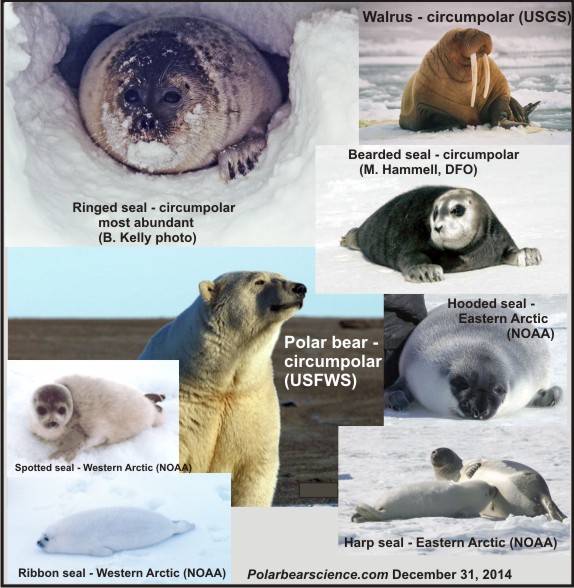
Arctic marine mammals_Dec 31 2014_Polarbearscience

I’ve made a chart listing the conservation status of these species across all Arctic nations (Canada, Russia, Norway, Denmark (for Greenland) and the USA), as well as the one international body that considers the conservation status of all species (International Union for Conservation of Nature, IUCN).

Oddly, the IUCN considers the polar bear vulnerable due to future threats from predicted sea ice losses but not ringed seals or bearded seals. This situation highlights the capricious nature of the use of “future threats” (almost exclusively based on predictions of AGW) as a valid criteria for evaluating the conservation status of Arctic marine mammals. It also suggests why the IUCN has tightened considerably its rules regarding this practice.

Continue reading

Sea ice, beluga whales, and polar bear densities in the Gulf of Boothia

As I discussed in my last post, the Gulf of Boothia subpopulation in the central Canadian Arctic has the highest density of polar bears anywhere in the world. The question is, why?

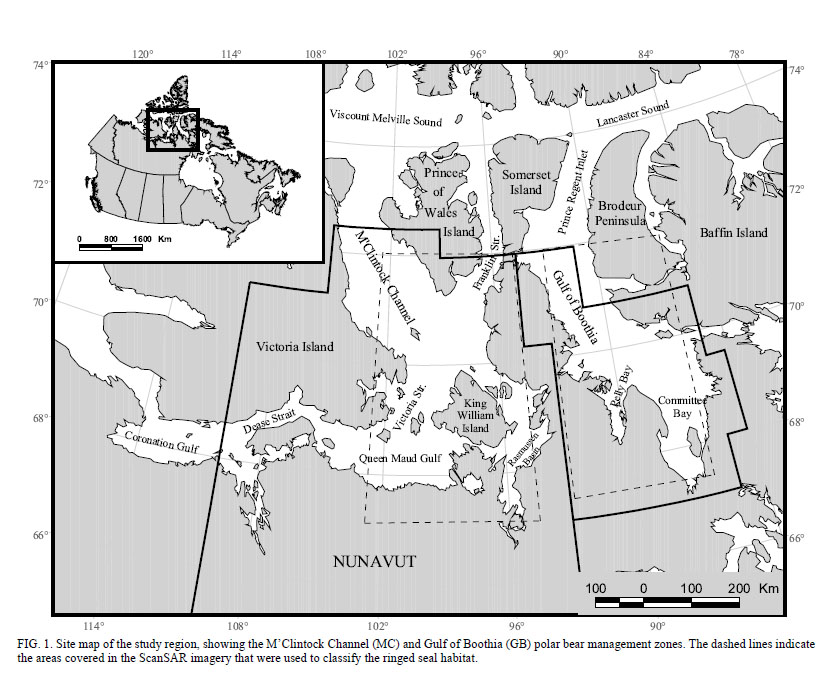
For example, is the sea ice in the Gulf of Boothia region so markedly different from its nearest subpopulation-neighbor, M’Clintock Channel (Fig. 1), that it accounts for the wide disparity in polar bear densities between the two? The differences, remember, are dramatic: Gulf of Boothia, 18.3 bears per 1000 km2 vs. M’Clintock Channel, 1.9. And while M’Clintock Channel may be low in part due to recent over-harvests (see footnote 1), even the density before over-harvests occurred in M’Clintock Channel were only 4.7, compared to 10.4 bears per 1000 km2 in Gulf of Boothia (see Table 1 in previous post).

Today, I’ll take a look at sea ice and ringed seal habitat in the Gulf of Boothia and M’Clintock Channel, as well as information from a study on polar bear diets, which together shine some light on why the Gulf of Boothia is such a great place for polar bears.

Figure 1. Map showing the side-by-side relationship of M’Clintock Channel and the Gulf of Boothia. From Barber and Iacozza (2004: Fig. 1).

Figure 1. Map showing the side-by-side relationship of M’Clintock Channel and the Gulf of Boothia. From Barber and Iacozza (2004: Fig. 1).

Continue reading