Tag Archives: science

Consensus polar bear experts dealt with criticism differently in 2007

Frustration with criticism over the fate of polar bears decades into the future has plagued consensus experts since they first brought their concerns to the attention of conservation organizations in the mid-2000s. But now that catastrophe has not materialized, these researchers have shifted their defensive style from logical reasoning to relentless insult.

Dealing with criticism 2007 vs 2017

A decade ago, doubts about the veracity of the proposed ESA conservation status of “threatened” with extinction due to predicted effect of global warming came primarily through the media, who were seen to give critics a platform.

In a revealing article published 10 years ago in the fall of 2007 (before the ESA decision had been made) by polar bear biologists Ian Stirling and Andrew Derocher (“Melting Under Pressure: The real scoop on climate warming and polar bears”) in The Wildlife Professional, some of the same concerns were being raised as in 2017 by Harvey and colleagues (that including Stirling and fellow polar bear biologist Steven Amstrup) in BioScience (“Internet blogs, polar bears, and climate-change denial by proxy”), but the approach and the language is startlingly different.
Continue reading

Harvey et al. attack article mum on real selection process for polar bear papers used in their analysis

The Harvey et al. Bioscience article that attacks this blog and others that link to it — a veritable tantrum paper that took 14 people to write — included a sciency-looking analysis of peer-reviewed articles said to have been retrieved by the database “Web of Science” using the search terms “polar bear” and “sea ice.”

Temper-Tantrum graphic

“Consensus science pounds the floor and chews the carpet in angry frustration.” [mpainter, 25 December 2017]

Other critics have pointed out that the Harvey paper used 92 such references:

“Of the 92 papers included in the study, 6 are labeled ‘controversial.’ Of the remaining 86, 60 are authored or co-authored by Stirling or Amstrup, or Derocher. That is, close to 70% (69.76%) of the so-called ‘majority-view’ papers are from just three people, 2 of whom wrote the attack paper themselves.” [Shub Niggurath, crossposted at Climate Scepticism, 14 December 2017]

The bias of co-author papers used to represent the “expert consensus” on polar bear biology is only one problem with this particular attempt at making the Harvey paper look like science: in fact, the short list of papers used for analysis is a far cry from the original number returned by Web of Science for the search terms the authors say they used in the supplementary information.

How that large original number (almost 500) was whittled down to less than 100 is not explained by the authors. As a consequence, I can only conclude that the “methodology” for paper selection was likely defined after the fact. While the method of paper selection sounds simple and reasonable, apparently not one of the Harvey et al. paper’s co-authors checked to see if it was plausible (or didn’t care if it was not).

Continue reading

2017 in review: polar bear prophesies of doom more at odds with current reality

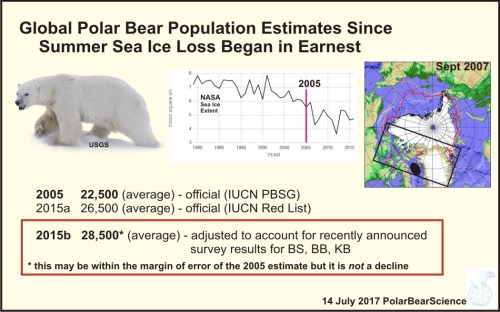
Tales of doom and gloom about polar bears reflect what some people think might happen in the future, not what is happening right now.  Currently, polar bears are doing just fine despite the low summer sea ice coverage they’ve experienced since 2007 (Crockford 2017a; York et al. 2016). In other words, there has been no global population decline as predicted: officially, the numbers were 22,000-31,000 (or 26,500 average) in 2015 (Wiig et al. 2015) but about 28,500 when estimates published since then are included (Aars et al. 2017; Dyck et al. 2017; Matishov et al. 2014; SWG 2016), up from about 22,500 in 2005).

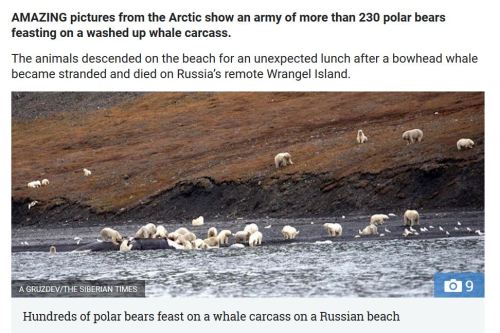
Wrangel Island bears on whale_29 Sept 2017 SUNThis increase might not be statistically significant but it is most assuredly not the decrease in abundance that was predicted by ‘experts’ such as Steve Amstrup and colleagues (Amstrup et al. 2007), making it hard to take subsequent predictions of impending catastrophe seriously (e.g. Atwood et al. 2016; Regehr et al. 2016; Wiig et al. 2015).

The doomsayers can’t stand to have someone provide the public with unbiased evidence of this failure so they attack my scientific integrity with an academically weak and aggressively vindictive ‘peer-reviewed’ paper (Harvey et al. 2017, in press) that you’ll hear more about in the new year.

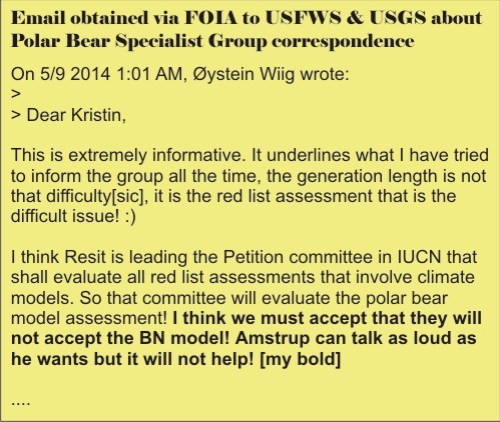
Wiig to Laidre_9 May 2014 follow up to Lunches with Resit_first part_redacted highlighted

Bottom line: 2017 saw abundant good news stories about polar bears, which I’ve summarized below. See also Crockford 2017b: Twenty reasons not to worry about polar bears, the 2017 update and my 2017 block-buster video, Polar Bear Scare Unmasked: The Saga of a Toppled Global Warming Icon:


Continue reading

Amazon Black Friday deals and author bonus on polar bear books

As you plan your Amazon Black Friday/Cyber Monday gift shopping (see the deals in the US here, in Canada here, in the UK here), don’t forget to add a few polar bear books to your order to give to relatives, friends, and local libraries. Although price cuts don’t appear to extend to my books, there are other good book offers and free shipping deals, and I’ve put together a special bonus to brighten your gift package.

Book mark and note_adultsSpecial bonus: I’ve designed two polar bear bookmarks and a postcard-sized personal note signed by me to include with your gifts. Find the bookmark for kids here and the bookmark for adults here (both three per page); the person note is here (four per page), all as downloadable pdfs to print out on heavy photo paper or card stock. Spread the word.

Book mark and note_kids

My thriller (EATEN: A novel) couldn’t be more relevant this year: remember that while 2016 had the second lowest coverage of summer sea ice since 1979, the East Coast of Canada had much thicker spring ice than average this year. As a result, Newfoundland and Labrador in particular experienced heavy ice conditions and were inundated with polar bears.

And as described in my novel under similar circumstances, Newfoundland in 2017 had the most sightings ever recorded — it was a wakup call that polar bears really could become the kind of wildlife problem that EATEN describes. This food-for-thought thriller is a great gift for teenagers and adults alike.

Don’t forget the basic science! Polar bear science got a recent boost with my books for kids and adults that relays facts without fearmongering. Expand the minds of those around you and give them something to think about. Both are perfect library donations.

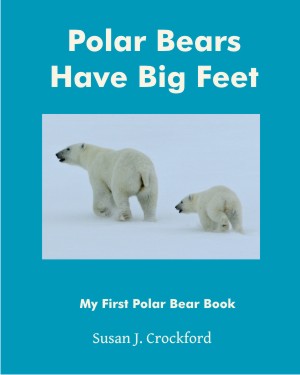
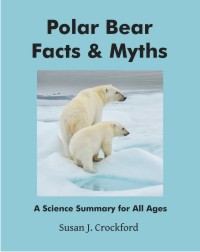
There’s even a preschooler picture book version (Polar Bears Have Big Feet) so they don’t feel left out if older siblings or parents have their age-appropriate books (Polar Bear Facts & Myths for ages 7 and up — the first ever for this age group, which is also available in French and German — and Polar Bears: Outstanding Survivors of Climate Change for adults and teens).


I don’t ask for donations to support my work here; buying my books for your friends, neighbours, and family benefits everyone. Spread the polar bear science, support a science writer.

Fabulous polar bear science book for kids now available in French and German

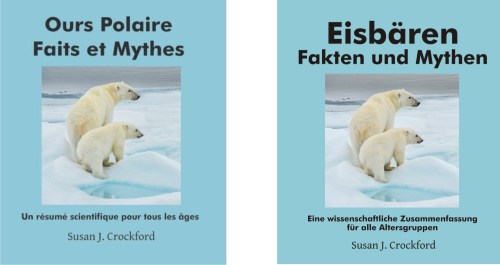
Announcing the French and German translations of my popular science book, Polar Bear Facts and Myths (suitable for children aged seven and up), are now available through Amazon worldwide in paperback. Please pass along to your friends, relatives, and colleagues in North America and abroad. The English version still available in paperback and ebook formats.

FRENCH
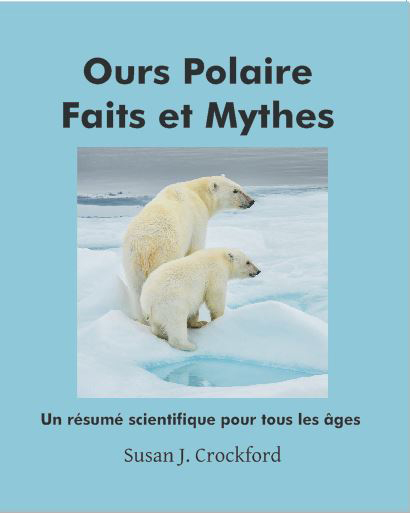
Crockford Ours Polaire_French front cover_web size_10 Sept 2017

Titre: Ours Polaire Faits et Mythes: Un résumé scientifique pour tous âges
L’autheur: Susan J. Crockford
Traduit par: Reynald Duberger
Date de publication: 10 September 2017
ISBN: 1976158362
Nombre de pages: 44
Le price: USD $12.99  €10.87  £9.94 [soon to be £10.03 to qualify for free shipping]  CAD $20.22 [with free shipping]

Acheter-le ici: Amazon.com [USA]; Amazon.ca [Canada, also in the French Immersion Store]; Amazon.fr [France]; Amazon.uk [UK]; Amazon.de [Germany]

On a fait croire aux enfants qu’il ne reste que quelques centaines d’ours polaires,  mais l’implacable message sur les ours polaires condamnés (par la faute de l’homme) est heureusement faux. Il est temps qu’on révèle la vérité aux jeunes.

Voici donc les bonnes nouvelles qu’on doit apprendre aux enfants: les ours polaires n’ont jamais été menacés d’extinction à cause d’un réchauffement global anthropique. Il y a effectivement davantage d’ours polaires qu’il y en avait il y a 50 ans, et la population globale est d’un taille respectable, en dépit du fait que la banquise d’été ait atteint des niveaux ayant dû, selon les prévisions, mener à la catastrophe depuis 2007.

Les ours polaires se sont adaptés admirablement bien à ces niveaux, et contre toute attente, leur nombre a augmenté et non pas diminué au cours des années.

L’ours polaire: Faits et Mythes est un livre scientifique inspirant sur la survie dans l’Arctique qui plaira aussi bien aux parents qu’aux enfants.

À propos de l’auteur: Susan Crockford est une zoologiste professionnelle. Depuis plus de 20 ans elle étudie l’écologie et l’évolution de l’ours polaire. Elle possède un PhD et maintient un blog sur le passé et le présent des ours polaires appelé http://www.polarbearscience.com.

Depuis longtemps, les lecteurs réclamaient un livre clair et simple sur la science de l’ours polaire s’adressant aux enfants comme aux adultes, offrant la même approche rationnelle que celle de ses publications scientifiques pour adultes. Susan leur livre enfin cet ouvrage.

Un livre d’accompagnement (en anglais) est aussi disponible (Polar Bears: Outstanding Survivors of Climate Change) présentant des détails bien référencés sur les questions et enjeux récents concernant la conservation de l’ours polaire. Pour les amateurs de fiction, elle propose aussi un thriller sur les attaques d’ours polaires (EATEN: A Novel), également en anglais.

GERMAN
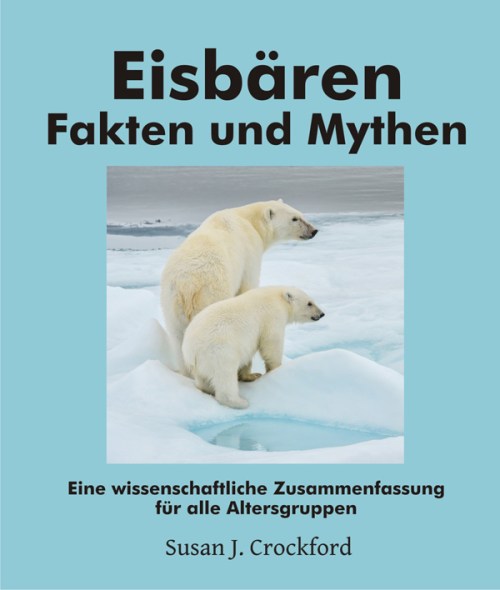
Crockford FM FRONT cover only_German 10 Sept 2017 web size

Der Titel: Eisbären Fakten und Mythen: Eine wissenschaftliche Zusammenfassung für alle Altersgruppen
Der Autor: Susan J. Crockford
Übersetzt von: Marie McMillan
Datum der Veröffentlichung: 10 September 2017
ISBN: 1976305748

Seitenzahl: USD $12.99  €10.87  £9.94 [soon to be £10.03 to qualify for free shipping] CAD $20.22 [with free shipping]

Kauf es hier: Amazon.com [USA]; Amazon.de [Germany]; Amazon. ca [Canada]; Amazon.uk [UK]; Amazon.fr [France]

Beschreibung auf Deutsch

Vielen Kindern weltweit wurde erzählt, dass es nur noch ein paar hundert Eisbären auf der ganzen Welt gibt. Zum Glück ist die Nachricht, dass der Polarbär dem Untergang geweiht sei (und dass das allein die Schuld der Menschen sei) falsch. Es wird Zeit, dass die Kinder dies erfahren.

Die gute Nachricht, die Kinder hören müssen, ist diese: Eisbären sind nicht vom Aussterben bedroht aufgrund des Klimawandels. Tatsächlich gibt es heute viel mehr Polarbären als vor 50 Jahren und die Population weltweit hat eine gesunde Größe. Und das obwohl das Meereseis seit 2007 ein Niveau erreicht hat, von dem es hieß, dass es katastrophale Folgen haben würde. Eisbären kommen ganz gut mit weniger Meereseis im Sommer klar; entgegen allen Erwartungen ist ihre Zahl über die Jahre gestiegen, sie sind nicht weniger geworden.

Eisbär Fakten und Mythen ist ein ermutigendes wissenschaftliches Buch über das Überleben in der Arktis, welches Kindern und Eltern gleichermaßen gefällt.

Über die Autorin: Susan Crockford ist eine professionelle Zoologin, die seit mehr als 20 Jahren Polarbär-Ökologie und Evolution studiert. Sie hat einen Doktortitel und schreibt einen Blog über die historische und gegenwärtige Situation der Polarbären: http://www.polarbearscience.com. Seit Jahren fragten Leser sie nach einem wissenschaftlichen Buch dass sich auch an Kinder richtet und in gleichsam rationaler und umfassender Perspektive gehalten ist wie ihre wissenschaftlichen Texte für Erwachsene. Dieses Buch ist Dr. Crockfords Antwort.

English version of above descriptions copied below:

Continue reading

Video: Death of a Climate Icon, the polar bear’s demise as a useful poster child

Last week I asked: “What’s causing the death of the polar bear as a climate change icon?”

I was echoing the conclusion of a commentator at the Arctic Institute (22 August 2017) who lamented: “The polar bear is dead, long live the polar bear” and climate scientist Michael Mann, who told a lecture audience a few months ago that polar bears are no longer useful for generating “action” on climate change.

Crockford 2017_Slide 15 screencap

This is slide 15 from my presentation at ICCC-12 in Washington, D.C. in March 2017.

Now here’s the video. Watch “The Death of a Climate Icon” (31 August 2017):

The video was made possible with the assistance of the Global Warming Policy Foundation.

Kind of makes you wonder: is Al Gore’s recent climate change movie, An Inconvenient Sequel: Truth to Power, tanking at the box office because he couldn’t include polar bears as an example of the effects of human-caused global warming as he did in his award-winning 2007 effort? Did too many polar bears doom Gore’s 2017 movie?

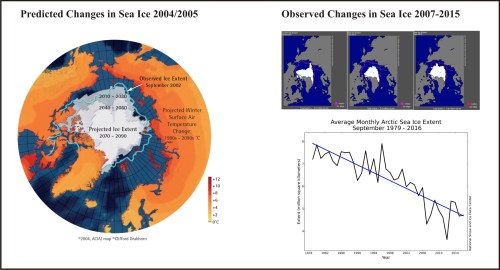
Conclusions in the video about the predictions of polar bear decline vs. the current status of polar bears and sea ice are documented in my 2017 published paper:

Crockford, S.J. 2017. Testing the hypothesis that routine sea ice coverage of 3-5 mkm2 results in a greater than 30% decline in population size of polar bears (Ursus maritimus). PeerJ Preprints 19 January 2017. Doi: 10.7287/peerj.preprints.2737v1 Open access. https://peerj.com/preprints/2737/

Crockford 2017 sea ice graphic

Polar Bear Facts & Myths translations in French and German coming soon

Translations of my popular polar bear science book Polar Bear Facts & Myths — suitable for readers aged seven and up — are almost complete. Versions in French and German will be available soon through Amazon.

FM French and German covers_10 Sept 2017


These translations have been done by native French and German speakers. They are particularly suitable for Canadian French immersion science classes and home school science lessons worldwide. But most importantly, they offer the chance for young children whose first language is French or German to read a sensible book about polar bears loaded with fabulous colour images.

Ours Polaire Faits et Mythes — Bientôt disponible!

Eisbären Fakten und Mythen — Bald erhältlich!

These translated versions of Polar Bear Facts & Myths will delight children of all ages as well as adults: they have the same question and answer format and are based on the most up-to-date science.

Please pass this notice along to teachers and parents you think might be interested.

Abrupt summer sea ice decline has not affected polar bear numbers as predicted

Yes, Arctic sea ice has declined since satellite records began in 1979 but polar bears have adjusted well to this change, especially to the abrupt decline to low summer sea ice levels that have been the norm since 2007.

Global pb population size sea ice 2017 July PolarBearScience

Some polar bear subpopulations have indeed spent more time on land in summer than in previous decades but this had little negative impact on health or survival and while polar bear attacks on humans appear to have increased in recent years (Wilder et al. 2017), the reasons for this are not clear: reduced summer sea ice is almost certainly not the causal factor (see previous post here).

Ultimately, there is little reason to accept as plausible the computer models (e.g. Atwood et al. 2016; Regehr et al. 2016) that suggest polar bear numbers will decline by 30% or more within a few decades: even the IUCN Red List assessment (Wiig et al. 2015) determined the probability of that happening was only 70%.

Arctic sea ice has never been a stable living platform (Crockford 2015): it shifts from season to season, year to year, and millennia to millennia. Without the ability to adapt to changing conditions, Arctic species like polar bears and their prey species (seals, walrus, beluga, narwhal) would not have survived the unimaginably extreme changes in ice extent and thickness that have occurred over the last 30,000 years, let alone the extremes of sea ice they endured in the last 200,000 years or so.

Some biologists continue to hawk doomsday scenarios for polar bears due to summer sea ice loss but the truth is that their previous predictions based on sea ice declines failed so miserably (e.g. Amstrup et al. 2007) that it’s impossible to take the new ones seriously — especially since the basic assumptions that caused the first predictions to fail have not been corrected, as I’ve stated in print (Crockford 2017:27):

In summary, recent research has shown that most bears are capable of surviving a summer fast of five months or so as long as they have fed sufficiently from late winter through spring, which appears to have taken place since 2007 despite marked declines in summer sea ice extent.

The assumption that summer sea ice is critical feeding habitat for polar bears is not supported.

Recent research shows that changes in summer ice extent generally matter much less than assumed in predictive polar bear survival models of the early 2000s as well as in recent models devised to replace them (Amstrup et al. 2010; Atwood et al. 2016a; Regehr et al. 2015; Regeher et al. 2016; Wiig et al. 2015), while variations in spring ice conditions matter more.

As a consequence, the evidence to date suggests that even if an ‘ice-free’ summer occurs sometime in the future ­ defined as sea ice extent of 1 million km2 or less (Jahn et al. 2016) ­ it is unlikely to have a devastating impact on polar bears or their prey. [my bold]

The abrupt drop in summer sea ice that occurred in 2007 was not predicted by experts to occur until mid-century yet the predicted decimation of polar bears worldwide expected under those conditions (a loss of 2/3 of the global total, to only about 6660-8325 bears) not only did not happen, it did not come even close to happening (Crockford 2017; see also my recent books, Polar Bear Facts & Myths, and Polar Bears: Outstanding Survivors of Climate Change, sidebar).

Instead, the global population grew from about 22,550 bears in 2005 to about 28,500 bears in 2015. And while this might not be a statistically significant increase (due to the very wide margins of error for polar bear estimates), it is absolutely not a decline.

The present reality is that low summer sea ice cover since 2007 has not caused polar bear numbers to decline and therefore, polar bears are not a species in trouble. This suggests that even if the Arctic should become briefly ice-free in summer in the future, polar bears are likely to be only minimally affected and not become threatened with extinction. Polar bears are outstanding survivors of climate change: recent research and their evolutionary history confirm this to be true.

Continue reading

Stock up on polar bear gift books and summer reading about the Arctic

Here are some suggestions, by myself and others. See the sidebar for my offerings, not forgetting “Polar Bears Have Big Feet” for the toddlers in your life, so they don’t feel left out when older kids get polar bear books to read over the summer: Facts & Myths for middle school ages, and Outstanding Survivors and/or EATEN (the polar bear attack thriller) for teens and adults. PBs have Big Feet Front small

Titles from other authors that have a few mentions of polar bears amid great descriptions of life in the Arctic or Arctic exploration that would make good summer reading as well. Continue reading

IUCN Specialist Group now rejects polar bear numbers it used for 2015 IUCN Red List review

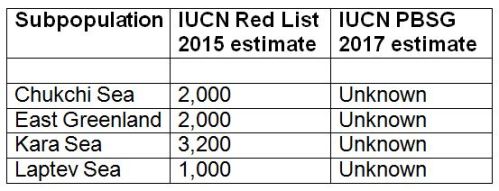
Is there a mutiny in the works between the IUCN Red List and the IUCN Polar Bear Specialist Group (PBSG) over polar bear population estimates or has there simply been a breach of ethics? What else explains the fact that some of the subpopulation estimates used by the PBSG to support the status of ‘vulnerable’ for the IUCN Red List in 2015 are unacceptable to them in 2017? And why are the PBSG refusing to embrace the Red List global estimate of 22,000-31,000?

2015 IUCN Red List estimates vs IUCN PBSG 2017

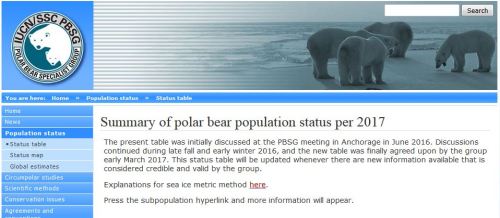
The latest version of the IUCN PBSG status table was posted online 30 March 2017 without fanfare or even a note on their home page. It seems the result came from much discussion at their official meeting last summer (June 2016) that they say continued into early March 2017.

2017 population status update early March headline

PBGS members voted to reject four subpopulation estimates used in the 2015 Red List polar bear status review  — even though the inclusion of those numbers was required in order for the Red List status of ‘vulnerable’ to be upheld. The group has also chosen not to update their global population page with the Red List estimate of 22,000-31,000.

And surprise, surprise — now that only one subpopulation out of nineteen worldwide has shown a recent decline, the PBSG have removed the “trend” columns from their summary table for subpopulations.

Welcome to conservation ‘science’ practiced by IUCN polar bear specialists.
Continue reading