Posted onFebruary 3, 2026|Comments Off on Biologists allowed David Attenborough to tell BBC viewers that Barents Sea bears were dying of starvation in his 2011 Frozen Planet episode when they knew it wasn’t true
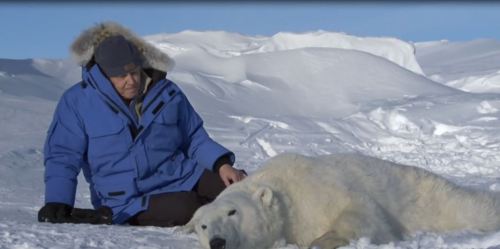
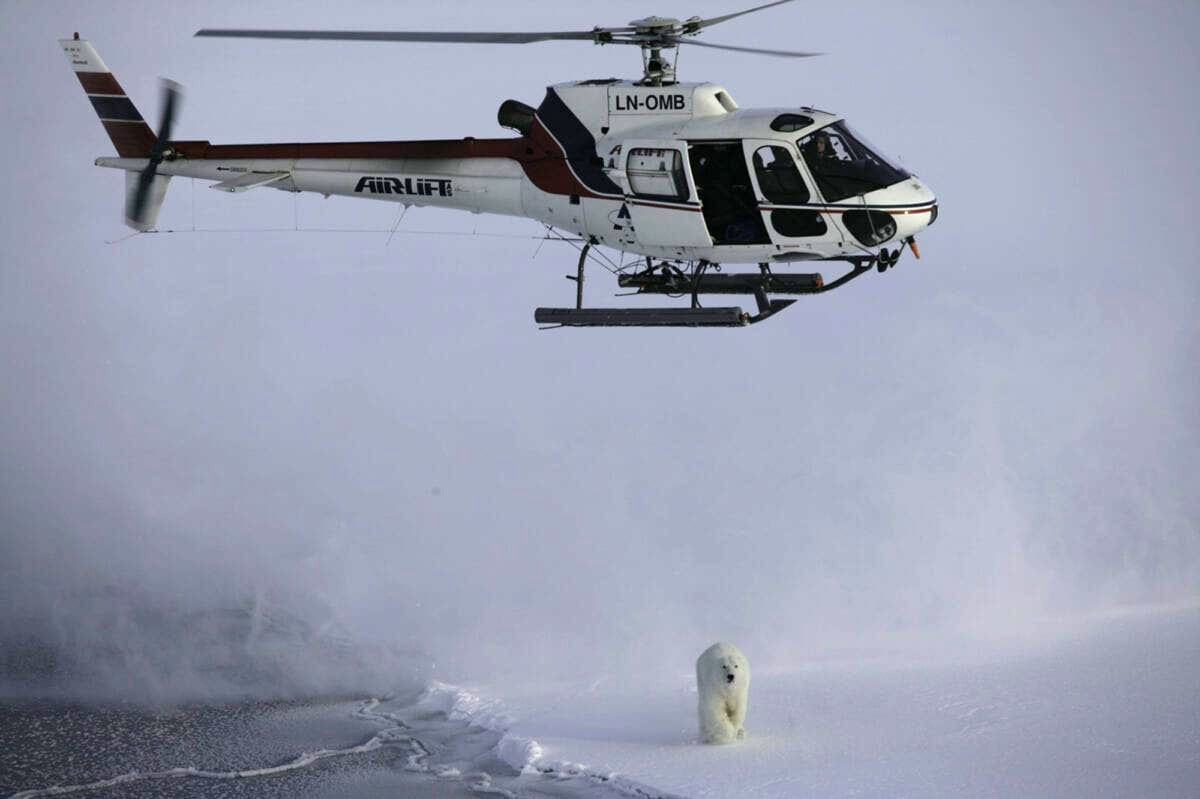
In the climate change episode of his 2011 BBC Frozen Planet series ‘On Thin Ice’, Sir David Attenborough told viewers that polar bear mothers and cubs across the Arctic were starving because climate change was melting the sea ice, even as he sat beside a fat, healthy Barents Sea female (below).
I wonder how Sir David Attenborough feels now? Has anyone bothered to tell him that Norwegian biologists have finally admitted that Barents Sea polar bears were actually fat and healthy in 2010 when they assisted in the filming of his BBC documentary? Or, did Attenborough know even then that this population of polar bears was thriving despite the large loss of sea ice – but let his viewers think otherwise?
Comments Off on Biologists allowed David Attenborough to tell BBC viewers that Barents Sea bears were dying of starvation in his 2011 Frozen Planet episode when they knew it wasn’t true
Posted onDecember 17, 2025|Comments Off on Sea ice conditions continued to favour Arctic marine life in 2025
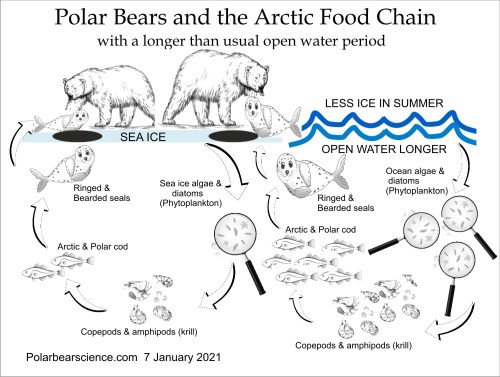
Increased primary productivity in the Arctic generated by reduced summer sea ice has continued into 2025, according to NOAA’s annual Arctic Report Card published yesterday, which means Arctic seals and whales, walrus, and polar bears will continue to flourish.
September sea ice extent has continued to stall, rather than plummet as predicted (Table 1: eleventh lowest average September extent since 1979; 4.75 mkm2), although they don’t come out and say so. NSIDC has stopped producing monthly sea ice reports due to budget cuts in late September 2025.
From the Report Card highlights [my bold]:
From 2003 to 2025, phytoplankton productivity spiked by 80% in the Eurasian Arctic, 34% in the Barents Sea, and 27% in Hudson Bay.
Plankton productivity in 2025 was higher than the 2003-22 average in eight of nine regions assessed across the Arctic.
And from the report on primary productivity itself:
All regions, except for the Amerasian Arctic (the combined Chukchi Sea, Beaufort Sea, and Canadian Archipelago), continue to exhibit positive trends in ocean primary productivity during 2003-25, with the largest percent changes in the Eurasian Arctic (+80.2%), Barents Sea (+33.8%), and Hudson Bay (+27.1%).
I’ve explained previously how and why this works: less summer ice = more plankton, which means more food for all marine life.
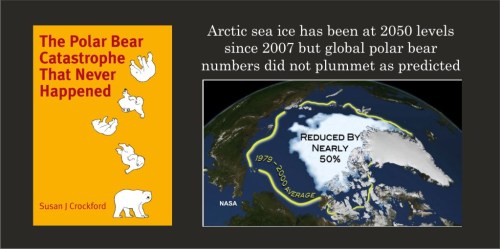
This explains why the catastrophic decline in polar bear numbers predicted in 2007 never happened.
PS. If you haven’t already, check out my new wolf attack thriller, DON’T RUN. There’s probably still time to order and get a before-Christmas delivery.
Comments Off on Sea ice conditions continued to favour Arctic marine life in 2025
Posted onSeptember 12, 2024|Comments Off on Churchill seemingly unworried about polar bears, fails to post problem bear reports on social media
We know transparency’s gone out the window for many public officials, but still: Since early August, I’ve been checking daily for Problem Polar Bear Reports issued by the Churchill Polar Bear Alert Program managed by Manitoba Conservation. This morning (12 September), five reports were posted at once on the Town of Churchill website, dating back to first of the season for the week of August 5-11, see image below.
It’s apparent that the intent of these reports is in part public safety: to raise awareness of the potential threat of wandering polar bears around the town of Churchill because of the language that appears on virtually every report: “stay vigilant”, “be bear smart,” “be bear aware,” etc.
However, the X account for Town of Churchill seems to have been abandoned (last post 19 April 2024), which suggests the town is confident no residents or tourists would benefit from Alerts on X that polar bears are ashore:
The town’s Facebook account seems to be their only method of public communication yet even there, there have been no Polar Bear Alert reports posted this summer.
Oddly, even though it is now apparent from the just-released reports that one bear got so close to town that it had to captured and put in the ‘polar bear jail’ the week of 5-11 August — for the public’s safety — the only safety announcement the town issued that week was a ‘heat warning’ on 12 August:
I guess we are to assume that whoever is running this account – or the town council, or the mayor – believes that a day or two of hot weather (which Churchill gets regularly most years) is more dangerous to public safety than a massive predator wandering around town.
I can only conclude that keeping residents and tourists in the dark about potential threats from local polar bears is one way that Churchill is now adapting to climate change (from CBC News, 10 September 2024):
Bears Onshore and Effective Sea Ice Breakup dates
It is apparent from the wording of the Churchill reports that even by the last week of August this year, all bears were not yet off the ice, since they say only that “most bears” were on shore the week of 26 August to 1 September (see next section).
That suggests the last bears came ashore this year at least a week later than they did in 2020 (at 21 August), which at the time polar bear specialist Andrew Derocher presented as an anomaly (see tweet below). Compare to the situation last year here.
The last report I’ve seen from Derocher (via X) for 2024 on the status of his teams’ tagged females is that many of them (11/29 or 38%) were still on the ice as of 8 August (posted 11 Aug):
Derocher referring to this an “amazing” year that’s “similar” to the 1980s probably doesn’t tell the half of it, since he hasn’t posted any maps since then (as of noon, 12 September).
This effectively keeps secret the date when the last of these females bears actually came ashore, which is in any case a biased microcosm of the entire subpopulation. In other words, we can expect that if 40% of tagged female were still on bits of remnant ice at 8 August, there will have been many more bears, especially males, out there as well – which of course he never mentions.
He also never mentions that satellites under-report the amount of ice at this time of year by as much as 20% because of the effects of melt-water sitting on ice, but we’ve come to expect that.
Oddly, a recent study tried to explain the importance to survival of the recent phenomenon (since about 2015 or so) of bears staying out on melting bits of remnant ice rather than heading immediately to shore when the ice coverage over Western Hudson Bay drops below 50%. They suggested this behaviour was largely confined to male bears because they had to make up for feeding missed during the breeding season (McGeachy et al. 2024).
Females, alternatively, appear to respond to break-up in WH by coming onshore approximately 3 weeks after the mean ice concentration in WH reached 50%, … However, suitable habitat was still present elsewhere in the Bay and appeared to be used by a portion of WH prime age males. [McGeachy et al. 2024: 494, where “prime age males” are aged 5-19 years.]
However, these authors never mention the data reported by Derocher every year showing fairly significant numbers of tagged females lingering on tiny chunks of ice well into August, even though Derocher is a co-author. Funny, that.
Problem Bear Reports 2024, Weeks 1-5
Week 1, 5-11 August
Week 2, 12-18 August
Week 3, 19-25 August
Week 4, 26 August-September 1
Week 5, 2-8 September
References
McGeachy, D., Lunn, N.J., Richards, E.S. and Derocher, A.E. (2024). Sea ice influence on male polar bear survival in Hudson Bay. Arctic Science 10, 483-498. https://doi.org/10.1139/as-2023-004 Open access.
Comments Off on Churchill seemingly unworried about polar bears, fails to post problem bear reports on social media
Posted onAugust 1, 2024|Comments Off on Polar bear “boom” reported in East & Southwest Greenland comes with the usual problems
Reports over the last week of an unexpected abundance of polar bears onshore in East and Southwest Greenland have locals and tourists concerned. The former Prime Minister of Greenland claims the unusual number of bear sightings and problems with bears near communities (including an attack involving serious injury to a German researcher) are due to abundant sea ice offshore. This explanation is contrary to what polar bear specialists predict: i.e., that problems with bears occur when there is less ice than usual. None of the bears sighted have been described as thin or starving.
The Polar Bear Specialist Group has previously estimated that there are only about 650 bears in East Greenland, while a recent study estimated that an additional 234 bears lived in SE Greenland.
Polar bears don’t often show up in Southern or Western Greenland any more, but this year has been an exception. Only yesterday, two appeared near Nuuk, Greenland’s capital. And according to Aleqa Hammond, Greenland’s former Prime Minister, that’s just been the tip of the, well, iceberg.
“There are bears everywhere in West Greenland this year,” she told ExplorersWeb. “Quite a few have been way too close to towns in South Greenland this summer, too. Several polar bears have been shot in Qaqortoq, as the bears were literally in town.”
Another polar bear has been observed – and shot as an emergency – in Ittoqqortoormiit on Thursday morning. This is confirmed by the head of duty at the Greenland Police, Jørgen Madsen, to Sermitsiaq.
It is the second time a polar bear has been shot in emergency situations in Ittoqqortoormiit this week. On Tuesday evening around 19:30, the police received a report about a polar bear that had been shot in an emergency.
Here, the police could say that the polar bear came close to a dog crate, and then headed directly for a soccer field where children are playing.
Last week, a polar bear attacked a German researcher in East Greenland. The researcher, part of a team on Traill Island, encountered the bear on Friday morning.
Posted onJuly 18, 2024|Comments Off on W. Hudson Bay sea ice not going away anytime soon as polar bears sit tight offshore
A broad band of sea ice is jammed up against the western shore of Hudson Bay, hanging on despite warm mid-July temperatures. Its unusual thickness suggests it won’t be gone anytime soon, which means most Western Hudson Bay polar bears will likely remain offshore for at least a few more weeks.
The dark blue in the “departure from normal” chart below shows just how unusual this phenomenon is for the northern reaches of Hudson Bay:
Posted onJune 25, 2024|Comments Off on Arctic sea ice at the summer solstice: more polar bear habitat than 2022 after hottest year on record
We are just into the 2024 sea ice melt season in the Arctic with no signs of any big, dramatic changes despite claims that 2023 was the warmest year on record (since 1850). There is still abundant sea ice habitat for polar bears ahead of the summer months (July-September) when Arctic ice melts back considerably.
Polar bears in Western Hudson Bay are still on the ice despite vast open water levels normally signaling “breakup” has happened: the wind-driven ice is packed tight against the western shore and the bears are still on it.
The fact that recently-deceased Ian Stirling was a prominent co-author should come as no surprise: his irrational promotion of the idea that future “climate warming” could doom polar bears to near-extinction – even after recording and publishing evidence to the contrary – will go down in history as an appalling violation of scientific principles.
Adding to the dubious validity of the paper: lead author Julienne Stroeve’s 2007 paper predicting summer sea ice decline by 2050 was proven wrong by actual data by the time it was published (Stroeve et al. 2007, 2014) and a more recent update failed to foresee the recent 17-year stall in decline. And co-author Steve Ferguson, a seal biologists, rashly stated in 2016 that Hudson Bay could be ice-free in winter as early as 2021 [which, needless to say, never came close to fruition].
I’d say if Southern Hudson Bay polar bears might be extirpated as soon as 2030, as the paper’s co-author Alex Crawford suggests, the global temperature and ice melt had better get a move on: a survey showed the SH population was thriving in 2021 and Hudson Bay sea ice hasn’t hit any kind of death spiral in the three years since.
Posted onJune 9, 2024|Comments Off on Huge area of open water on Hudson Bay created by wind, not ice melt, NSIDC experts confirm
Sea ice experts at the US National Snow and Ice Data Center just confirmed my suspicion that the huge area of open water in eastern Hudson Bay during May this year was caused by winds, not ice melt. In other words, it’s a rare occurrence but not a sign of extra-early sea ice melt caused by global warming.
Money quote: “Unusual strong and persistent winds from the east caused the low extent.”
Posted onJune 4, 2024|Comments Off on New data show Svalbard polar bears are fatter than they were in 1993 despite continued low sea ice
Researchers at the Norwegian Polar Institute have finally updated their spring data, which show male polar bears in 2024 were even fatter than they were in 1993 and litter sizes of new cubs were just as high, despite continued low sea ice in the region over the summer months especially.
Posted onApril 28, 2024|Comments Off on Polar bears are going extinct? Actually, they’re not! A new video worth watching and sharing
Great Barrier Reef specialist Peter Ridd has just published an excellent video about my work and the way I’ve been treated by the scientific community just for pointing out that polar bear populations have failed to respond as predicted to the recent decline in Arctic sea ice.
The report Peter refers to in the video is this one, which was published in February 2024:
Crockford, S.J. 2024. State of the Polar Bear 2023. Briefing Paper 67. Global Warming Policy Foundation, London. Download pdf here.
In other words, the polar bear catastrophe we were promised never happened. In case you missed it, I wrote a book about that. Polar bears across the Arctic are thriving: not just because their numbers have increased overall but because the field data collected from bears in regions that have had the most dramatic declines in summer sea ice, including the Barents Sea and the Chukchi Sea, show the bears are healthy and reproducing well.
Comments Off on Polar bears are going extinct? Actually, they’re not! A new video worth watching and sharing
Watch polar bear habitat reform in the Canadian Arctic: “last 10 days” Canadian Ice Service animation (works anytime) HERE.
See Quote archive for details.









 polarbearscience
You must be logged in to post a comment.