Tag Archives: sea ice

My Polar Bear Facts & Myths book for kids is being translated into Dutch & Norwegian

In celebration of International Polar Bear Day on Tuesday 27 February, I’m pleased to announce the up-coming publication of Dutch and Norwegian translations of my popular childrens’ science book Polar Bear Facts & Myths.

Lying bear shutterstock_244419640_Cropped_web size

Ijsberen Feiten en Mythen

Isbjørn Fakta og Myter

This means my powerful little book that provides the straight goods for kids on polar bear science will soon be available in five languages: English, French, German, Dutch and Norwegian.

Watch for them!

Russia confirms Chukchi Sea polar bears not at risk from climate change or poaching

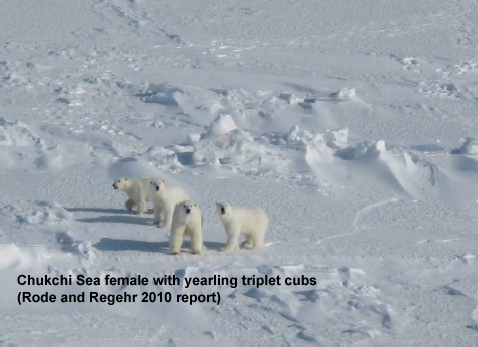
A statement yesterday from Yegor Vereshchagin, wildlife conservation manager from Chukotka, Russia  (Polar Bears Adjust to Climate Change, 20 February 2018) confirms that Chukchi Sea polar bears are currently doing extremely well.

Rode and Regehr 2010_Chukchi_report2010_Fig1_triplets_labelled

Contrary to previous reports and predictions (e.g. Amstrup 2011; Amstrup et al. 2007, 2008; Durner et al. 2009), there appears to be no threats due to recent declines in summer sea ice (Rode and Regehr 2010; Rode et al. 2013, 2014, 2018) or from poaching.
Continue reading

New Scientist prints a more reasoned polar bear article but myths persist

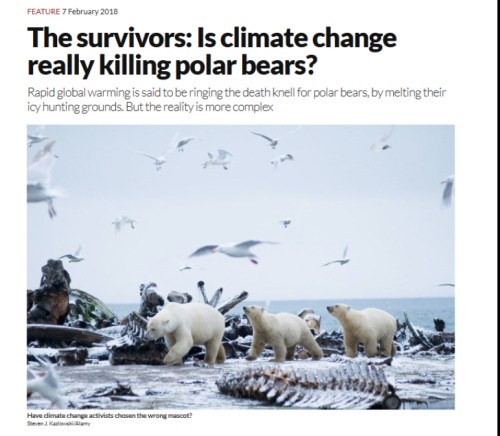
New Scientist has an article coming out next week takes a fairly reasoned approach to the polar bear conservation issue. It acknowledges that polar bear numbers have not declined in recent years even though summer sea ice dropped dramatically but goes on to perpetuate a number of myths that might not have happened if the author had done his homework or quizzed his other experts as thoroughly as he did me.

New Scientist headline_10 Feb 2018 issue 3164 photo

The survivors: is climate change really killing polar bears? Rapid global warming is said to be ringing the death knell for polar bears, by melthing their icy hunting grounds. But the reality is more complex. Fred Pearce, New Scientist 10 February 2018. Online now.

Continue reading

Polar bear specialists double-down on message of future starving bears

The really significant content of a new paper being heavily-hyped by the media1 is what wasn’t said rather than what the authors discovered about metabolic rates and weight maintenance of a small sample of nine Southern Beaufort Sea bears in 2014 to 2016 (Pagano et al. 2018; Whiteman 2018).

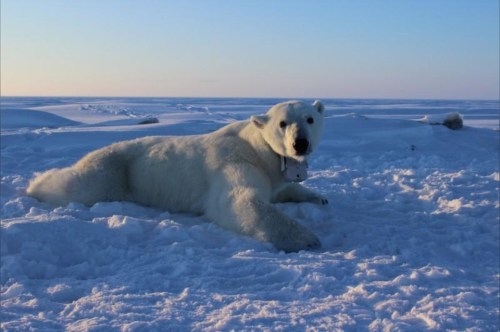
Pagano et al. 2018 photo released to press 2

This paper does not document starving or dying bears but merely found some (5/9) that lost weight when they should have been gaining, given that early April is the start of the ringed seal pupping season (Smith 1987) and the intensive spring feeding period for polar bears (Stirling et al. 1981).

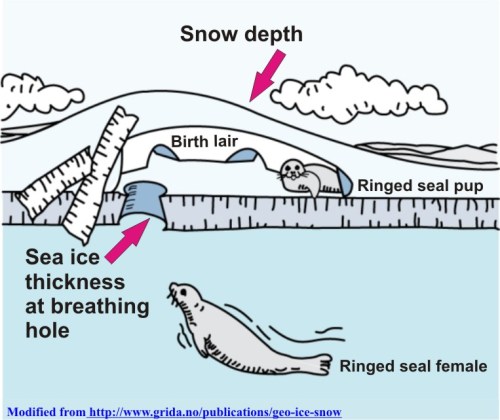
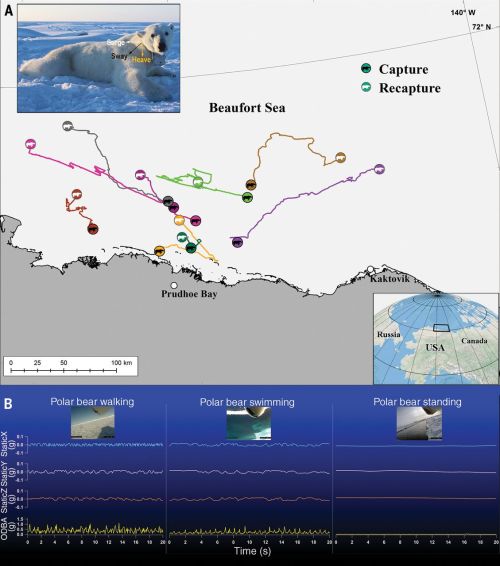
The question is, why were Southern Beaufort Sea polar bears off Prudhoe Bay (see map of the study area below), still hunting and capturing only adult and subadult ringed seals from sea ice leads when newborn ringed seal pups and their mothers should have been plentiful and relatively easily available in their birth lairs on the sea ice (see below)?

Ringed seal lair_snow and ice thickness_PolarBearScience_sm

“Using video collar data, we documented bears’ hunting behavior and foraging success. Bears used sit-and-wait tactics to hunt seals 90% of the time, and stalking comprised the remaining 10% of hunts (movies S1 to S4) (19). Bears that successfully killed and ate adult or subadult ringed seals either gained or maintained body mass, whereas bears that only scavenged or showed no evidence of eating lost mass.”

There was no discussion in the paper of ringed seal birth lairs, or sea ice conditions at the time of the study, but several mentions about what might happen in the future to sea ice and potential consequences for polar bears. The press release did the same.

However, as you’ll see by the sea ice thickness maps below, there may be good reason for the lack of ringed seal lairs, and a general lack of seals except at the nearshore lead that forms because of tidal action: the ice just a bit further offshore ice looks too thick for a good crop of ringed seals in all three years of the study. This is reminiscent of conditions that occurred with devastating results in the mid-1970s and mid-2000s (Burns et al. 1975; Cherry et al. 2009; Harwood et al. 2012, 2015; Pilfold et al. 2012; Stirling 2002, Stirling et al. 1987). Those events affected primarily bears in the eastern half of the Southern Beaufort and were almost certainly responsible for the recorded decline in SB bear numbers in the 2001-2010 survey (Bromaghin et al. 2015; Crockford 2017; Crockford and Geist 2018).

It seems very odd to me that Pagano and colleagues suggested no reasons for the unexpectedly poor showing of polar bear hunting success during their study except a bit of hand-waving about higher-than-we-thought metabolic rates in the bears. For years, I’ve worried that the inevitable next episodes of thick Southern Beaufort spring ice would cause problems for polar bears and seals but we wouldn’t know it because whatever effects were documented would be blamed on reduced summer ice: I suspect that time may have come.

Pagano et al. 2018 polar bear fat and energy fig 1

Figure 1 from Pagano et al. 2018 cropped to show only the study area off Alaska.

Continue reading

Early Holocene polar bear skeleton from Norway vs. other ancient remains

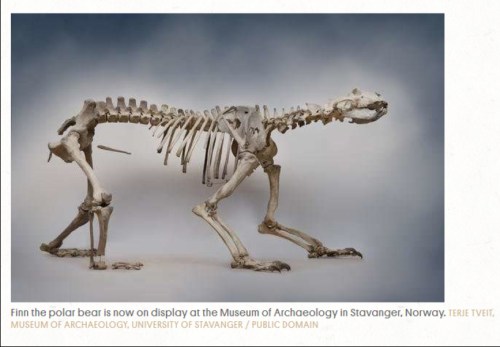
A press release issued yesterday (23 January 2018) by the University of Stavanger tells the story of decades of work on the most complete ancient polar bear skeleton in the world, found in 1976 in southern Norway, that culminated in an articulated museum display. This specimen was described in my research paper, Annotated Map of Ancient Polar Bear Remains of the World (Crockford 2012), which shows how many very early Holocene remains have been found outside current polar bear range.

Finn the ice age polar bear skeleton_U Stavanger_photo 2

Continue reading

Polar bear numbers not declining despite media headlines suggesting otherwise

In scanning comments generated by the recent flurry of internet interest in polar bears and blogs I noticed that a good many people, fed alarming media stories, are still convinced that polar bear numbers are declining rapidly when nothing could be further from the truth.

Crockford 2017_Slide 12 screencap

Continue reading

Science, optimism, and the resilience of polar bears in an ever-changing Arctic

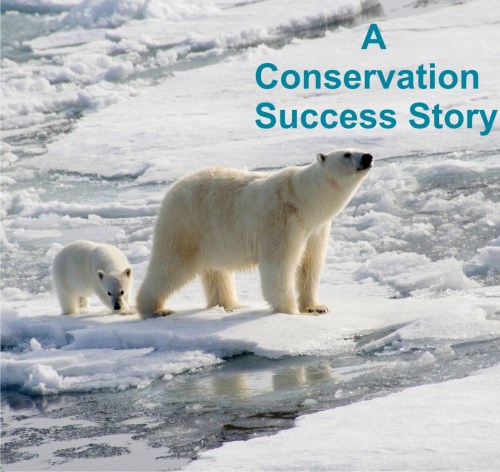
Optimism in conservation science — which the Smithsonian says we desperately need (Earth Optimism Summit 21-23 April 2017, apparently a huge success) — means it’s time to acknowledge and celebrate real conservation success stories. The Smithsonian folks probably won’t say it but I will — one of those successes is the recovery of polar bears.

Female with cub_Shutterstock_PolarBearScienceIt’s time to abandon the focus on prophesies of impending loss and accept that recovery of polar bears from the over-hunting of last century has continued despite a decade of low summer sea ice (Aars et al. 2017; Crockford 2017; Dyck et al. 2017; SWG 2016; York et al. 2016). Why not focus on the numerous images of fat, healthy bears rather than the anomalous starving ones?

It’s time to let go of imagined future catastrophes based on pessimistic failures of adaptation (Amstrup et al. 2007, 2008; Atwood et al. 2016; Stirling and Derocher 2012) and acknowledge that polar bears and Arctic seals, just like Pacific walrus (MacCracken et al. 2017; US Fish & Wildlife Service 2017), are resilient species with adaptive capabilities we are only just beginning to comprehend (Crawford and Quakenbush 2013; Crawford et al. 2015; Escajeda et al. 2018; Rode et al. 2014; Stirling and Lunn 1997; Stirling et al. 1975a; Vibe 1965). Continue reading

Franz Josef Land is a sea ice refugium for most pregnant Barents Sea polar bears

Consensus polar bear expert Andrew Derocher has been busy over the last few weeks, expounding a story of doom regarding Svalbard area polar bears (e.g. here and here), ridiculing the suggestion that Franz Josef Land is viable alternate habitat for Barents Sea bears, especially pregnant females looking for a place to den and give birth. But the facts say otherwise.

Svalbard polar bear_Aars August 2015-NP058930_press release

Below are the long answers, with references and ice maps, to the questions Derocher asked in his 21 December 2017 tweet (above), a refreshing change from the ‘take my word for it, I’m the official expert’ answer one gets from him, along with derogatory slurs directed at those who don’t share his pessimism.

UPDATED 1 February 2019. Two references added.

Continue reading

2017 in review: polar bear prophesies of doom more at odds with current reality

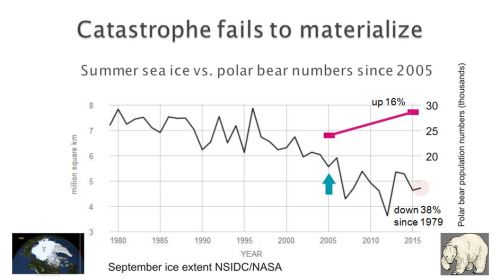
Tales of doom and gloom about polar bears reflect what some people think might happen in the future, not what is happening right now.  Currently, polar bears are doing just fine despite the low summer sea ice coverage they’ve experienced since 2007 (Crockford 2017a; York et al. 2016). In other words, there has been no global population decline as predicted: officially, the numbers were 22,000-31,000 (or 26,500 average) in 2015 (Wiig et al. 2015) but about 28,500 when estimates published since then are included (Aars et al. 2017; Dyck et al. 2017; Matishov et al. 2014; SWG 2016), up from about 22,500 in 2005).

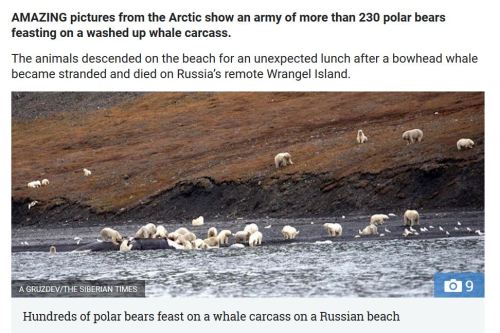
Wrangel Island bears on whale_29 Sept 2017 SUNThis increase might not be statistically significant but it is most assuredly not the decrease in abundance that was predicted by ‘experts’ such as Steve Amstrup and colleagues (Amstrup et al. 2007), making it hard to take subsequent predictions of impending catastrophe seriously (e.g. Atwood et al. 2016; Regehr et al. 2016; Wiig et al. 2015).

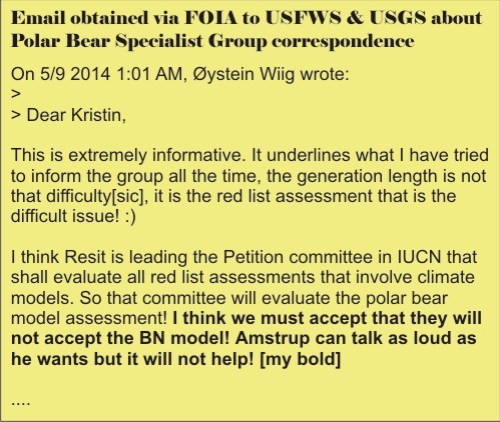
The doomsayers can’t stand to have someone provide the public with unbiased evidence of this failure so they attack my scientific integrity with an academically weak and aggressively vindictive ‘peer-reviewed’ paper (Harvey et al. 2017, in press) that you’ll hear more about in the new year.

Wiig to Laidre_9 May 2014 follow up to Lunches with Resit_first part_redacted highlighted

Bottom line: 2017 saw abundant good news stories about polar bears, which I’ve summarized below. See also Crockford 2017b: Twenty reasons not to worry about polar bears, the 2017 update and my 2017 block-buster video, Polar Bear Scare Unmasked: The Saga of a Toppled Global Warming Icon:


Continue reading

W Hudson Bay polar bear season wrap-up: problem bear stats & sea ice vs. 2016

This year, due to an early freeze-up of the sea ice, many polar bears left the Western Hudson Bay area (including Churchill) the week of November 6-12. However, the folks who produce Churchill’s problem polar bear statistics did not generate a report for that week, so we are left with assessing the final freeze-up situation based on the previous report (see it here) and the one they have just released for the week of 13-19 November (below), the 18th week of the season (which began July 10):
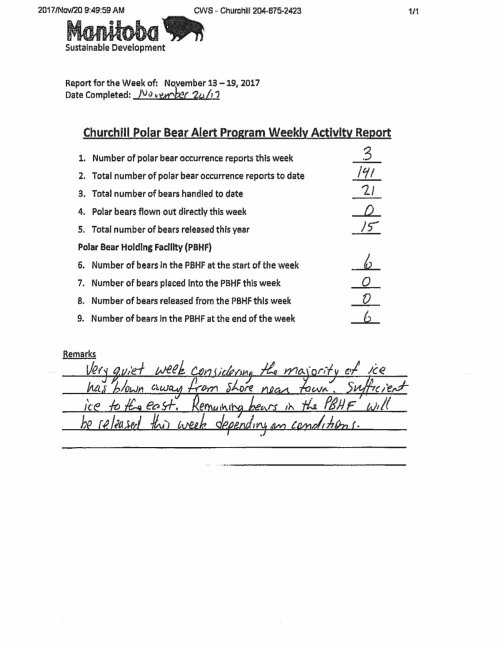
Churchill Polar bear alert report Nov 13-19_Nov 20 released

The “quiet” week was almost certainly due to the fact that very few bears were still around, having left the previous week.

While it is apparently true that a south wind briefly blew ice away from the area around the town of Churchill, most bears had left by that point and there was plenty of ice to the north and southeast for bears that had congregated outside the town to wait for the ice to form.

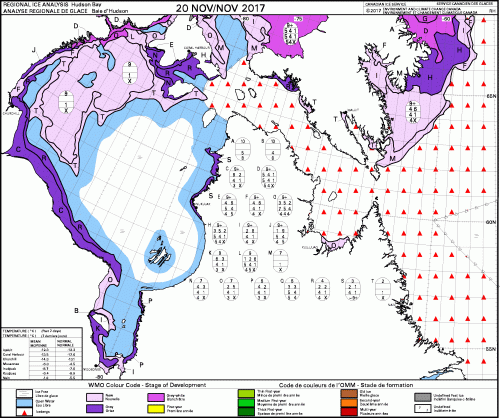
Churchill sits on a point of land (see map below) that makes new ice vulnerable to winds from the south but this year impact was small: the north winds returned within a few days and so did the ice.
Hudson Bay weekly ice stage of development 2017 Nov 20

By this week there were still a few stragglers that hadn’t left shore but most of these were mothers with cubs, as well as young bears living on their own, who often hold back to avoid dangerous encounters with adult males at the ice edge.

A few adult males that were still in excellent condition after 4 months ashore without food seemed in no particular hurry to resume hunting. In part, this may have been due to the rather foul weather prevalent since the first week of November (with howling winds, low temperatures and blowing snow much of the time).

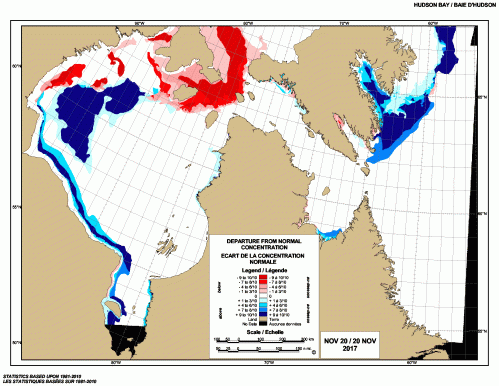
You can see in the chart below just how much more ice there was for the week of 20 November compared to average — all those dark and light blue areas along the west coast of Hudson Bay (and east of Baffin Bay) indicate more ice than usual. Even Southern Hudson Bay has enough shore ice for bears to resume hunting. Foxe Basin (to the north of Hudson Bay) has less ice than usual (red and pink) but there is still enough ice for polar bears there to begin their fall hunting, as the chart above makes very clear.
Hudson Bay weekly departure from normal 2017 Nov 20

Freeze-up and bear movement offshore were about three weeks earlier this year in Western Hudson Bay compared to 2016, which made a huge difference to the number of problem bears in Churchill, see below.

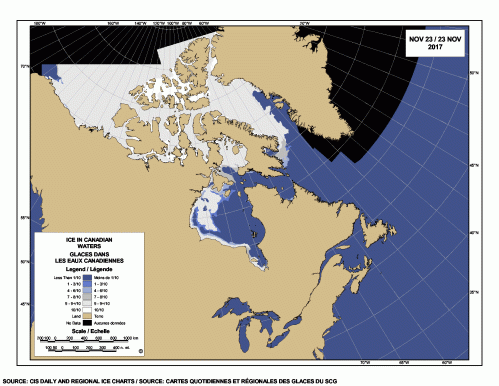
UPDATE 23 November 2017: CIS ice chart for today showing the ice forming in the northwest sector of Hudson Bay
Sea ice Canada 2017 Nov 23

UPDATE 27 November 2017: Final problem polar bear report copied below, issued by the town of Churchill. As noted above, the fact that some bears remained onshore into last week was a very local anomaly not experienced over the rest of the region.

churchill-pb-reports_week-19_20-26-nov-2017_last-of-the-season.jpg

Continue reading