Posted onJuly 22, 2021|Comments Off on Western Hudson Bay polar bears: still some out on the sea ice, some causing trouble
As of Monday (19 July), more polar bears had come ashore near Churchill and on the shores of Wakusp National Park but some are still out on the bay. The pattern of ice breakup this year means most bears will come ashore well south of Churchill and make their way north over the summer and fall. There have been two Churchill ‘problem’ bear reports so far but not one for this week, so I’ll go ahead and post without it.
Posted onJuly 9, 2021|Comments Off on Polar bears have begun to come ashore on Western Hudson Bay
So far, the first evidence I’ve seen of a bear ashore in Western Hudson Bay was one photographed near Churchill Manitoba on 28 June (below).
28 June 2021 near Churchill
However, by 5 July, the first of six collared females from Andrew Derocher’s WH study (below) had also come ashore, as did others along the shore of Wapusk National Park. This is not ‘early’ – just earlier than the last few years. Like last year, however, there is still a fair amount of sea ice left on the bay and some bears seem to be choosing to stay out longer on what ‘experts’ describe as unsuitable habitat. As you can see on his bear tracker map, Derocher uses a filter that shows only ice >50% concentration because he and his buddies have decided that bears so dislike anything less that they immediately head to shore as soon as ice levels fall below this threshold.
Posted onJune 23, 2021|Comments Off on Polar bears of western Hudson Bay still on the ice at third week June
According to the tracker map provided by Andrew Derocher (University of Alberta), all of the western Hudson Bay polar bear females that still have operational satellite collars (deployed in 2019) are still out on the ice of Hudson Bay. The Explore.org live video cam that sits on the shore of Wapusk National Park just south of Churchill has been capturing images of caribou and birds but so far, no polar bears. Last year, the first bear seen onshore by the cameras (shown in the video) was on 13 July.
It wasn’t until a month later that more bears were seen: the fat mother and cub in the screencap below were spotted on 18 July 2020 and the last of the collared bears didn’t come ashore until late August:
This year at 21 June, only 6 collars still operating but only one of them is anywhere close to shore yet (courtesy Andrew Derocher via twitter, below):
That ice in the middle of the bay is still primarily very thick first year ice, as the chart for this third week of June shows (below):
Posted onDecember 17, 2020|Comments Off on The conundrum of Hudson Bay bears that left shore late in 1983 with video from CBC archives
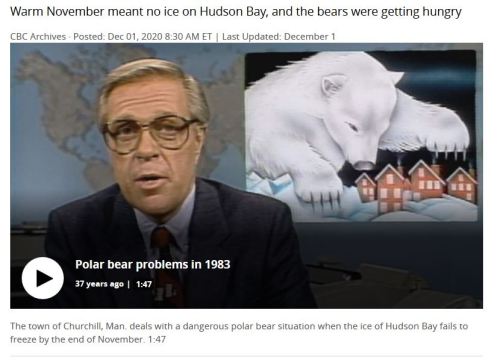
In 1983, it was claimed that freeze-up of Hudson Bay was so late that polar bears didn’t leave the shore until the 4th of December – several weeks later than had been usual at that time. However, the fact that sea ice charts show significant ice offshore weeks before that time suggests something else was probably going on.
About three weeks ago, CBC News republished an article (with video) from their 1983 archives for 1 December, about the plight of the people of Churchill who had already suffered one death and one serious mauling by polar bears. That was thirty-seven years ago, long before lack of sea ice was blamed for everything bad that happened to Western Hudson Bay polar bears. In fact, rather than a really late freeze-up, it appears the problem had more to do with the fact the bears had had an especially tough spring that year and arrived onshore in only ‘OK’ condition – and as a consequence, the town dump became such a strong attractant for many bears that they were reluctant to leave when the sea ice formed offshore.
Posted onSeptember 1, 2020|Comments Off on First polar bear alert report for Churchill an astonishing seven weeks later than last year
The first report of the Polar Bear Alert Program in Churchill, Manitoba was released today(1 September), a full seven weeks later than last year due to many bears remaining on the Western Hudson Bay ice much later than they have done in the past.
As I mentioned previously, as long as I’ve been collecting these published reports (2015), there has not been a first report of the season issued later than the second week in July, so this year is really unusual and I suspect similar to the 1980s.
I thought it possible that this was a Covid-related delay getting conservation officers to Churchill but as you’ll see above, that appears not to be the case: there simply have been not enough serious problems with bears in Churchill to warrant sending officers out before last week. No information on the general condition of bears was included this year, as it has been in other years (see below). Activity this last week in August 2020 was similar to the first week in July 2018.
Posted onAugust 27, 2020|Comments Off on Amid crying over low Arctic ice, W Hudson Bay polar bears leave ice as late as 2009
This year, the last collared Western Hudson Bay polar bear to leave the ice left as late, or later, than the last collared bear did in 2009 (which was an unusually late breakup year) and so far, all bears spotted have been in good physical condition despite inhabiting one of the most southern regions of the Arctic. All the while, sea ice experts have been hand-wringing about low Arctic sea ice –– in general and as polar bear habitat.
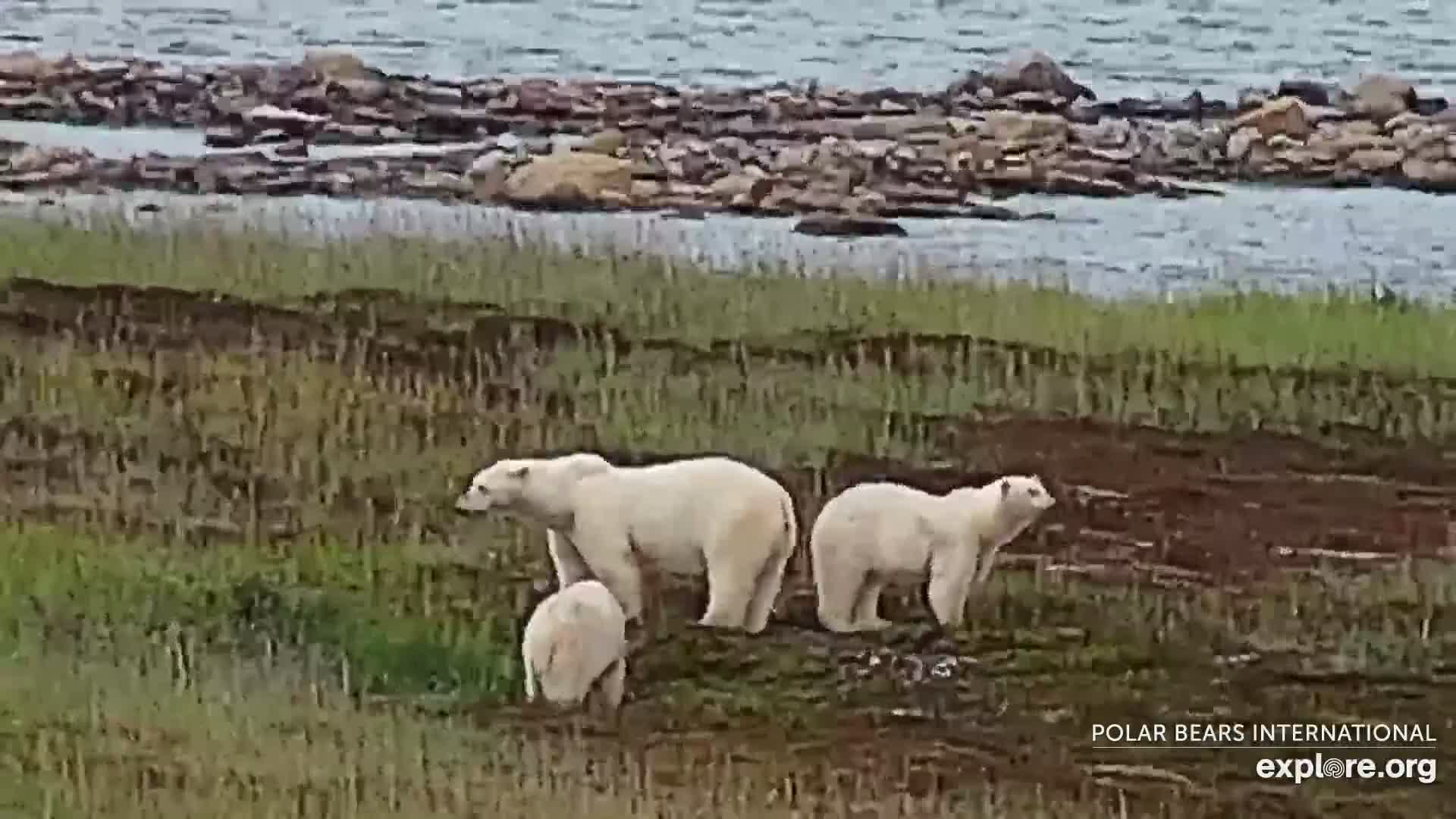
A female with two yearling cubs on the shore of Wakusp National Park, Western Hudson Bay on 24 August 2020. Taken via livecam from almost a mile away.
Posted onAugust 15, 2020|Comments Off on Few bears on the ice off Western Hudson Bay at 14 August but will be onshore soon
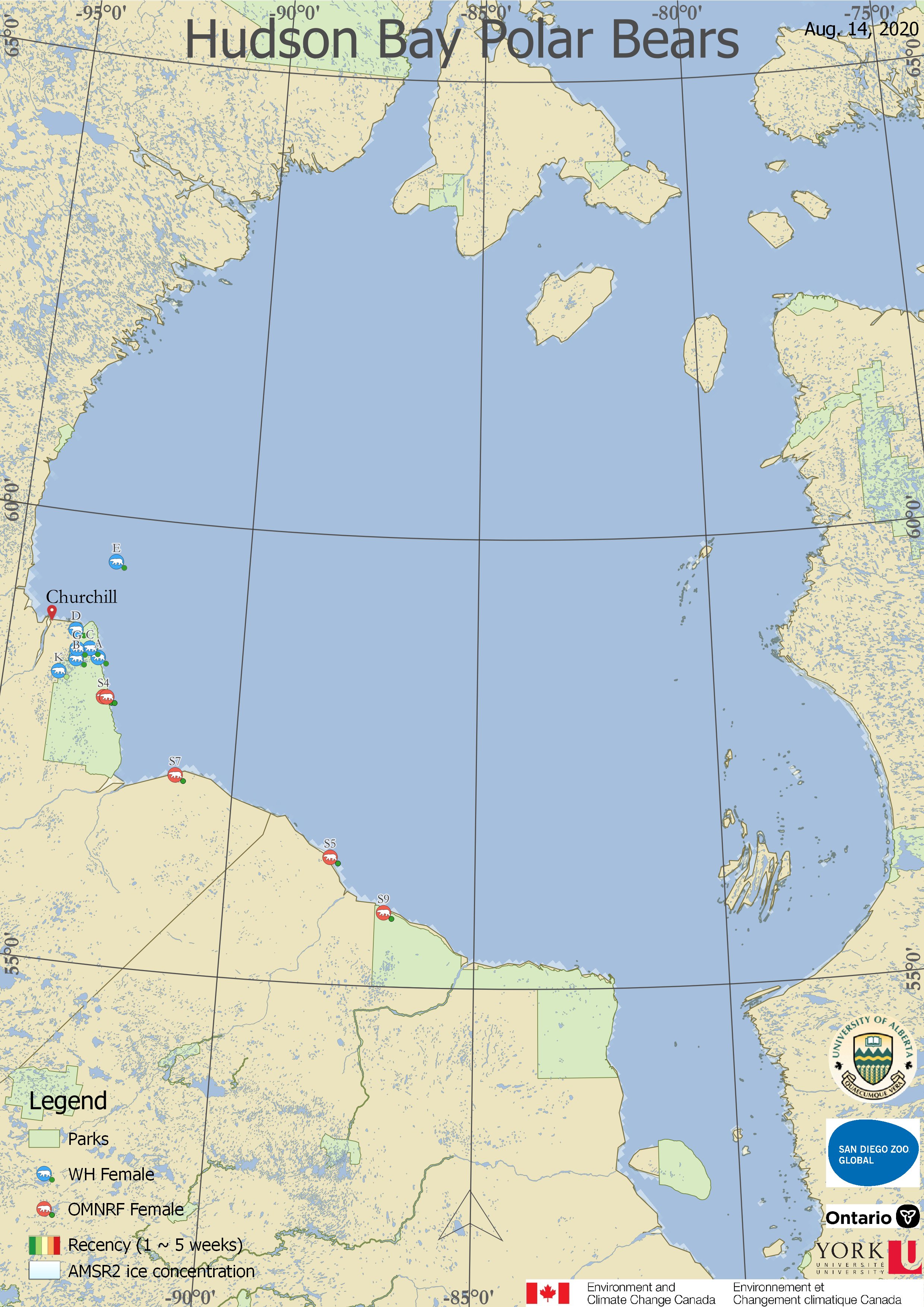
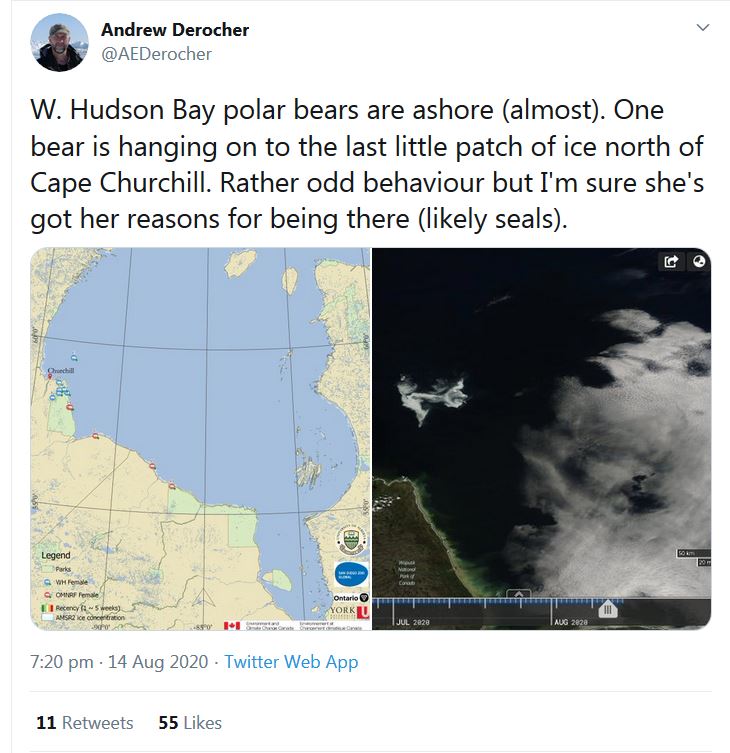
Polar bear biologist Andrew Derocher published a tracking map of his collared polar bear females that shows one bear (out of 11) still on the rapidly diminishing ice north of Churchill in Western Hudson Bay – and where there is a collared female, there is almost certainly other bears doing the exact same thing:
Without evidence to support such a claim, Derocher (below) assumes this collared female is probably hunting seals. In fact, last year he admitted that most bears on Hudson Bay from at least July onward are unlikely to be successfully hunting seals:
Posted onAugust 9, 2020|Comments Off on Many W Hudson Bay polar bears still offshore at 7 August despite apparent low ice levels
Contrary to all expert expectations, five female polar bears (45%) out of eleven that had tracking collars attached last year were still out on the sea ice that’s lingering along the western shore of Hudson Bay as of 7 August. And if five collared bears are out there, then there are almost certainly many more without collars doing the same thing. This pattern of bears staying out on the ice long after the so-called ‘critical threshold’ of 50% concentration has passed has been going on since at least 2015 and many bears on tracking maps in July and August appear to be on ice that doesn’t exist.
There are two explanations for this pattern and both are likely true: 1) much more ice actually exists on Hudson Bay than satellites can detect and 2) polar bear experts are wrong that Western Hudson Bay polar bears head to land soon after sea ice concentration drops below 50%. Models that predict a catastrophic future for Western Hudson Bay polar bears (Castro de la Guardia et al. 2013; Molnar et al. 2020) assume that ice coverage of less than 50% in summer greatly reduces polar bear survival. However, if polar bears do not always head to land when sea ice drops below 50% then the models cannot possibly describe their future accurately. In other words, depending on the discredited ‘worst case’ RCP8.5 climate scenario for the most recent polar bear survival model that extrapolates from Western Hudson Bay bear data to many other subpopulations, as I discussed previously, may not be its only fault.
Posted onJuly 27, 2020|Comments Off on Six good years in a row for the polar bear subpopulation used to predict species demise
In something resembling a new pattern for Western Hudson Bay polar bears, most of the animals are still out on the ice in late July this year, just like they were in the 1980s. The same thing happened last year but was brushed off as a happy anomaly. However, after last fall’s 1980s-like early freeze-up, this makes the sixth year in a row of good to very good sea ice conditions for Western Hudson Bay polar bears. No wonder polar bear experts haven’t published these data: good sea ice conditions along with polar bears coming ashore fat and healthy are not just inconvenient – they threaten to destroy the extinction panic narrative that depends on Western Hudson Bay bears showing evidence of harm from reduced sea ice.
Fat mother and cub onshore at Wakusp National Park, Western Hudson Bay 18 July 2020, one of the first of the season.
Posted onJuly 20, 2020|Comments Off on New model of predicted polar bear extinction is not scientifically plausible
Apparently, a prediction that polar bears could be nearly extinct by 2100 (which was first suggested back in 2007) is news today because there is a new model. As for all previous models, this prediction of future polar bear devastation depends on using the so-called ‘business as usual’ RCP8.5 climate scenario, which has been roundly criticized in recent years as totally implausible, which even the BBC has mentioned. This new model, published today as a pay-walled paper in Nature Climate Change, also did something I warned against in my last post: it uses polar bear data collected up to 2009 only from Western Hudson Bay – which is an outlier in many respects – to predict the response of bears worldwide. The lead author, Peter Molnar, is a former student of vocal polar bear catastrophist Andrew Derocher – who himself learned his trade from the king of polar bear calamity forecasts,Ian Stirling. Steven Amstrup, another co-author of this paper, provided the ‘expert opinion’ for the failed USGS polar bear extinction model featured in my book, The Polar Bear Catastrophe That Never Happened.
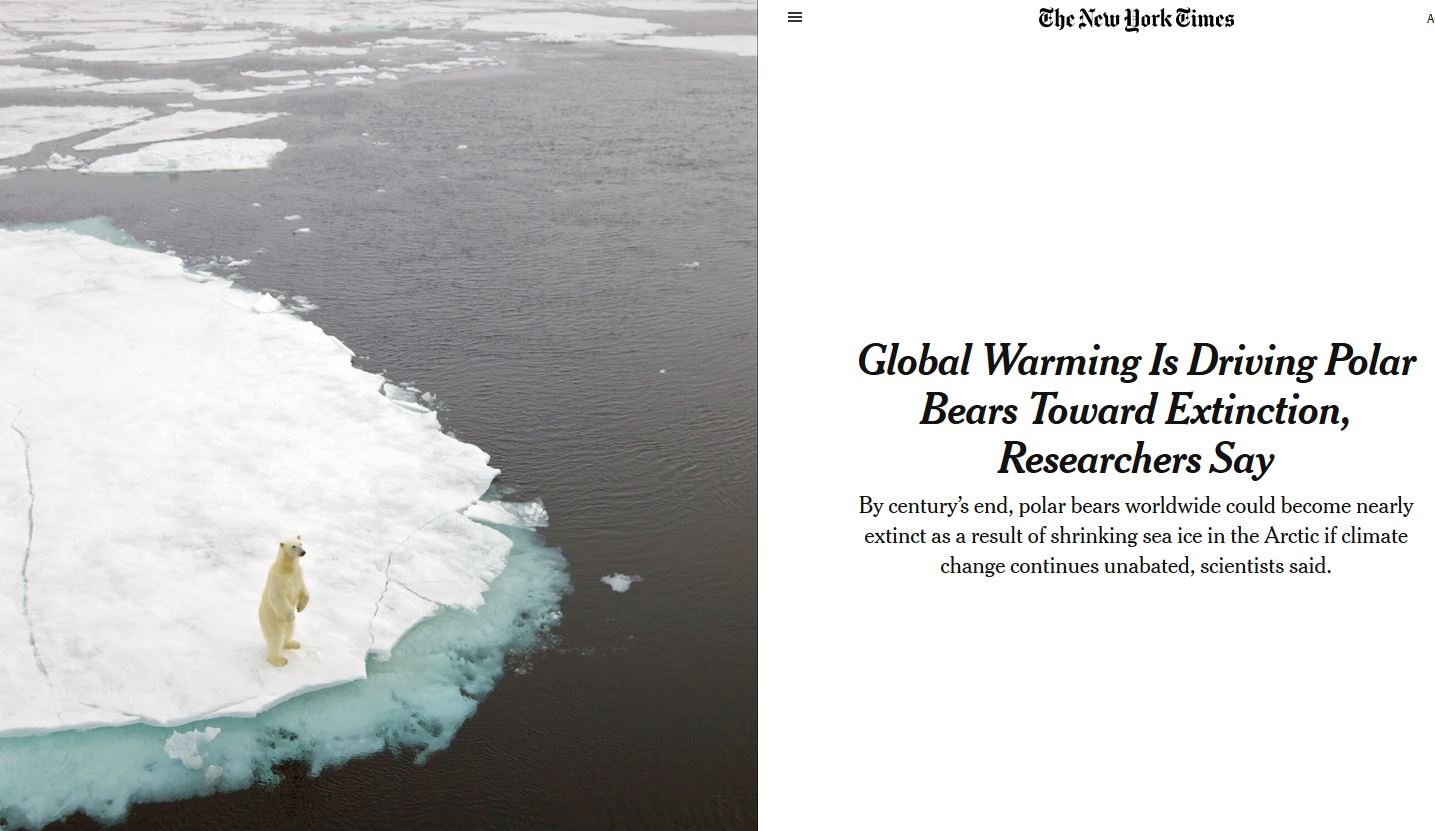
Well, these authors and their supporters got the headlines they crave, including coverage by outlets like the BBC and New York Times (see below) but I have to say that the combination of using out-of-date Western Hudson Bay information on when polar bears come ashore in summer and leave for the ice in fall (only to 2009) to make vague projections (‘possible’, ‘likely’, ‘very likely’) about all other subpopulations in addition to depending on the most extreme and now discredited RCP8.5 climate scenario (Hausfather and Peters 2020) for this newest polar bear survival model is all that’s needed to dismiss it as exaggerated-fear-mongering-by-proxy. Why would anyone believe that the output of this new model describes a plausible future for polar bears?
Watch polar bear habitat reform in the Canadian Arctic: “last 10 days” Canadian Ice Service animation (works anytime) HERE.
See Quote archive for details.











 polarbearscience
You must be logged in to post a comment.