Category Archives: Advocacy

Winnipeg zoo unashamedly frightens children about polar bear extinction, for a price

The Assiniboine Park Zoo in Winnipeg is selling Polar Bears International-style1 “save our sea ice” global warming propaganda to children, which it calls “messaging.”

“The centre is deliberately targeting children, fully aware that there is a magical connection between the cuddly, entertaining orphan cubs and young visitors.”

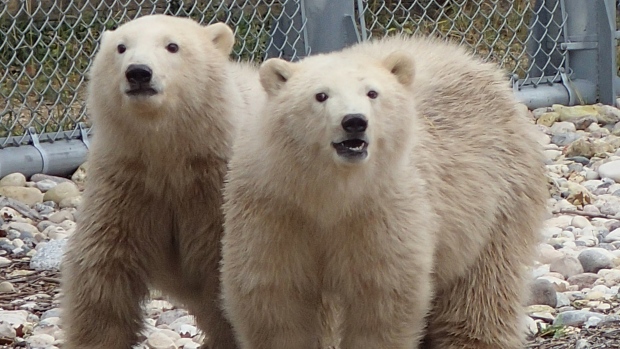
Orphaned cubs from Churchill now on display in Winnipeg

Orphaned cubs from Churchill now on display in Winnipeg

That’s the money quote, in more ways than one, from an article at The Globe and Mail earlier this week (23 November 2014), “Innovative Winnipeg zoo experiment shares the plight of polar bears” in which the author promotes the new “Journey to Churchill” exhibit at the Assiniboine Park Zoo in Winnipeg as “an ambitious experiment.”
Continue reading

Polar bear researchers knew S Beaufort population continued to increase up to 2012

Why did the Southern Beaufort polar bear population survey stop in 2010? It’s clear that the recently-published and widely-hyped new study stopped before the population rebound from a known decline was complete.

USFWS 2013-2014 PB News_cover_PolarBearScience

The researchers of the recently-published paper knew before starting their mark-recapture study in 2007 that the population decline had taken place. They also knew why the numbers dropped and that previous declines, caused by similar conditions, had been followed by a full recovery.

Did they really think a full recovery in population numbers was possible in only three four years, when cubs born in 2007 would not yet have been old enough to reproduce?

In fact, a US Fish and Wildlife Service (USFWS) fall survey of Southern Beaufort polar bears in 2012 found numbers were higher than they had been in a decade.
Continue reading

“Meltdown: Terror at the Top of the World” — new book exploits polar bear attack to sell fear of sea ice decline

The polar bear attack that was all over the news last summer is now an ebook about global warming. The Maine lawyer who was mauled by a bear while on a hiking trip to Labrador (and lived to tell the tale) has allowed his story to be co-opted by an activist journalist to promote fears of sea ice decline, polar bear extinction, and man-made global warming.

Melt-down_Terror at the Top of the World_Nov 12 2014 press release book cover

The press release issued yesterday by the news group that published the book and employs author Sabrina Shankman (InsideClimateNews), described it this way:

“A riveting new e-book about the battle between man, beast and Nature in a warming world. Called Meltdown: Terror at the Top of the World, the e-book tells the story of the hikers’ harrowing encounter with a polar bear; of the plight of the polar bear in general, facing starvation and extinction as the sea ice melts and its habitat disappears; and of the Arctic meltdown, the leading edge of man-made climate change.”

I have little doubt the man mauled by the bear was indeed terrified and that his companions were as well. However, that horror is exploited shamelessly in this book as a means to promote anxiety over the future survival of polar bears and instill panic over a prophesied Arctic “meltdown.”
Continue reading

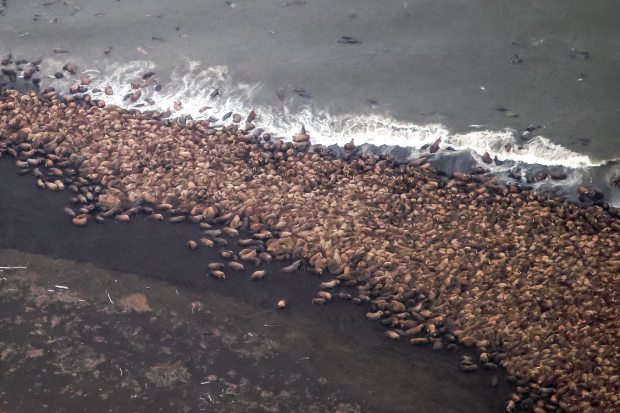
No proof walrus are “struggling from the loss of sea ice” as new Earthjustice lawsuit claims

A new day, a new lawsuit by environmentalists: this time, the species-on-a-pedestal is the same population of Chukchi Sea walrus that generated a news frenzy last month, which apparently still has legs.

Walrus puss_USGS_IMG_4763
Continue reading

BBC provides a forum for desperate biologists: “Will polar bears become extinct?”

Yesterday, the BBC published a story that gave the two most alarmist polar bear researchers on the planet a forum to market their ‘polar bears are doomed’ message. This time the desperation shows: watch how these biologists move the goal-posts, make claims so misleading they border on lies, and pretend they don’t have big, big trouble with their predictive models.

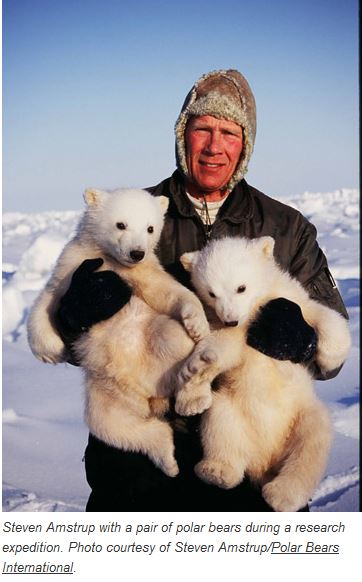
Amstrup_only solution_with 2 cubs_Oct 8 2014

Amstrup photo that accompanied an interview last month.

Continue reading

Polar bear specialist says there are 800 polar bears in W Hudson Bay, gov’t says ~1,000-1,500

Activist polar bear biologist Andrew Derocher (University of Alberta) may have gone too far this time. In an interview with Yahoo News, Derocher is quoted as saying:

“When I first started here about 30 years ago the population was about 1,200 bears and now we’re down to about 800,” team member Andrew Derocher, a biology professor at the University of Alberta, said in a phone interview from the tundra outside Churchill.”  [my bold]

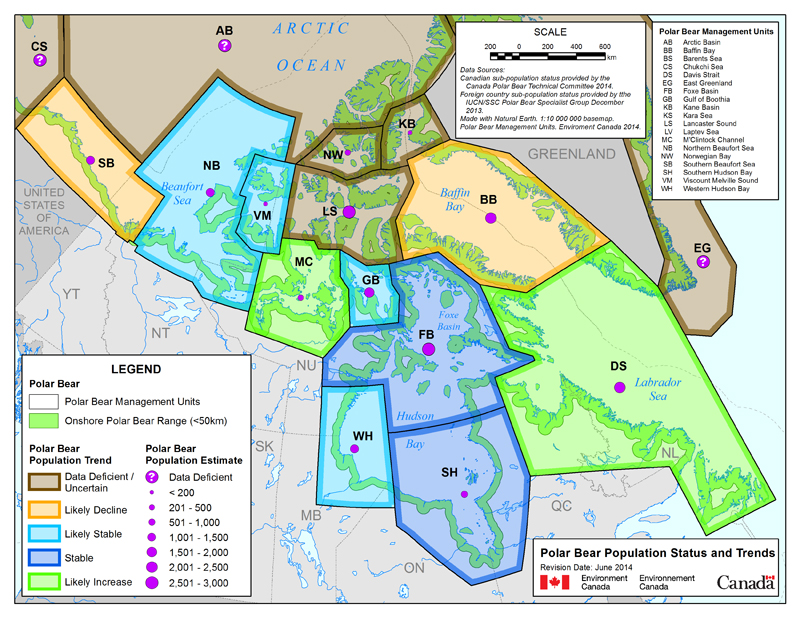
Figure 4. Environment Canada's "Map 3: 2014 Canadian Polar Bear Subpopulation and Status Map," original here.

Environment Canada’s “Map 3: 2014 Canadian Polar Bear Subpopulation and Status Map,” original here. Click to enlarge.

However, the Polar Bear Technical Committee of Environment Canada says differently: it estimates there are ~1000-1,500 bears in Western Hudson Bay (WH) and that the population is probably stable, as their new status map (dated June 2014, copied above) shows. A recent (2014) peer-reviewed paper by Stapleton and colleagues (discussed here) provides the data for that estimate.
Continue reading

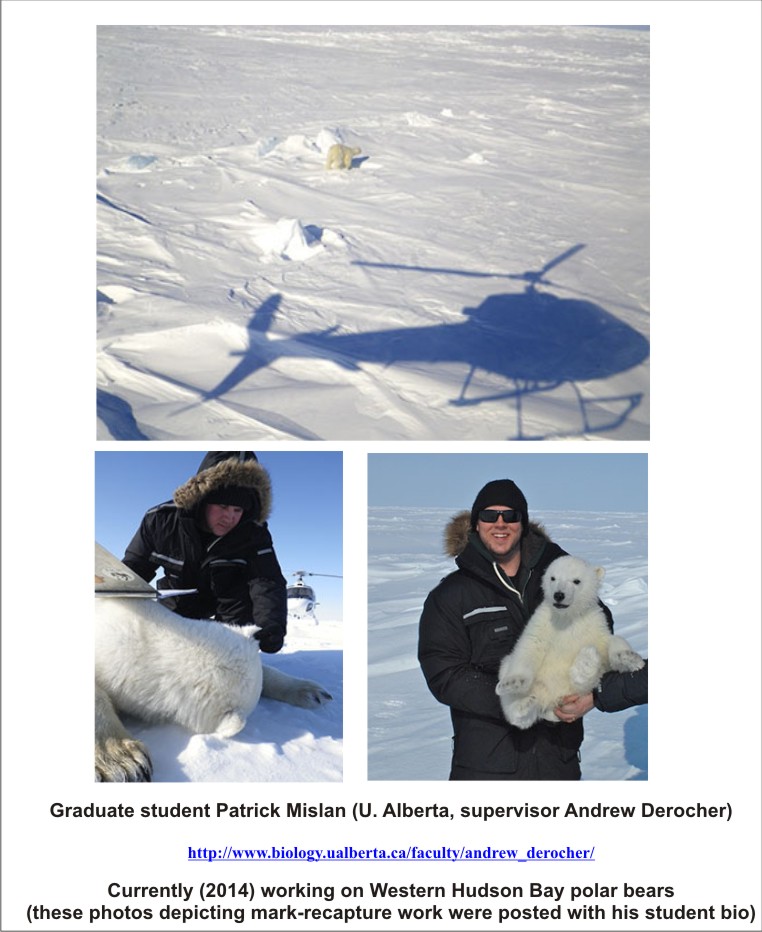
Polar bear biologists doing mark-recapture work in Hudson Bay may have misled the world

What exactly are Western Hudson Bay (WHB) polar bear researchers hiding? Since 2004, research on the body condition and cub production of Western Hudson Bay (WHB) polar bears has been carried out but none of the results of these mark-recapture studies have been made public.

U Alberta student Mislan bio photos_PolarBearScience

The researchers all claim that WHB polar bears are struggling to survive because of recent sea ice changes but won’t release the 10 years worth of updated information they possess on the bears or the sea ice.

Continue reading

W Hudson Bay polar bear population no longer “declining” – where are the headlines?

Why are the #saveourseaice folks at Polar Bears International, who have being working in Western Hudson Bay for decades, not dancing in the streets of Churchill? Environment Canada’s Polar Bear Technical Committee upgraded the status of Western Hudson Bay polar bears from “declining” to “likely stable” four months ago (details here). Why has this fabulous news not made major headlines around the world?

Figure 4. Environment Canada's "Map 3: 2014 Canadian Polar Bear Subpopulation and Status Map," original here.

Figure 1. Environment Canada’s “Map 3: 2014 Canadian Polar Bear Subpopulation and Status Map,” original here. Western Hudson Bay is “WH.”

After years of being told by polar bear specialists and activists organizations like Polar Bears International and the World Wildlife Fund that the Western Hudson Bay (WHB) population is already suffering mightily because of global warming, it now appears that is far from the truth.

Continue reading

Walrus and sea ice, a summary

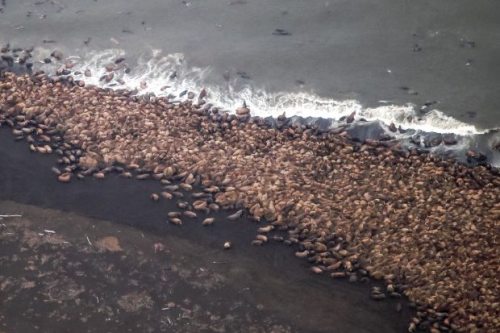
I’ve written a briefing paper for the GWPF refuting claims that huge herds of Pacific walruses hauled out on land are a sign of global warming.
Here’s the GWPF press release:

London, 20 October: A briefing paper published today by the Global Warming Policy Foundation refutes claims that Arctic walruses are in distress and danger due to global warming.

The paper, written by Canadian zoologist Dr Susan Crockford, assesses the recent mass haulouts of walrus females and calves on the beaches of Alaska and Russia bordering the Chukchi Sea. The events have been blamed by US government biologists and WWF activists on lack of summer sea ice, amplified into alarming scare stories by news media around the world.

Such claims ignore previous haulouts that suggest a different cause. Scientific reports about large walrus haulouts that have occurred repeatedly over the last 45 years show that they are not new phenomena for this region.

At least two documented incidents of similar magnitude have occurred in the recent past: one in 1978, on eastern St. Lawrence Island and the other in 1972, on the western end of Wrangel Island. The 1978 event involved an estimated total of almost 150,000 walrus hauled out within in a small geographic area.

Moreover, sea ice maps for the months when known mass haulouts occurred, compared to years when they did not, suggest no strong correlation with low sea ice levels.

“The WWF and American walrus biologists have categorically linked the Point Lay mass haulout event to global warming, but available evidence suggests that’s alarmist nonsense,” Dr Crockford said.

“Blaming lack of sea ice for recent events ignores the documented factor – large population size – that drove walruses onto beaches en masse in the past, when plenty of ice was available. Conservation measures have almost certainly led to a spectacular recovery of walrus numbers over the last few years. This suggests that recent mass haulouts are more an indicator that Chukchi walrus are nearing maximum capacity than a sign of impending global warming catastrophe,” Dr Crockford added.

Here’s the paper. [Link fixed, h/t HO]

Save

Churchill problem bears and early breakup dates in WHB: The 1983 & 2004 anomalies

In this part of my critique of Stirling and Parkinson (2006), regarding breakup dates in Western Hudson Bay (see Part I here), I will show that these authors also left out critical data.

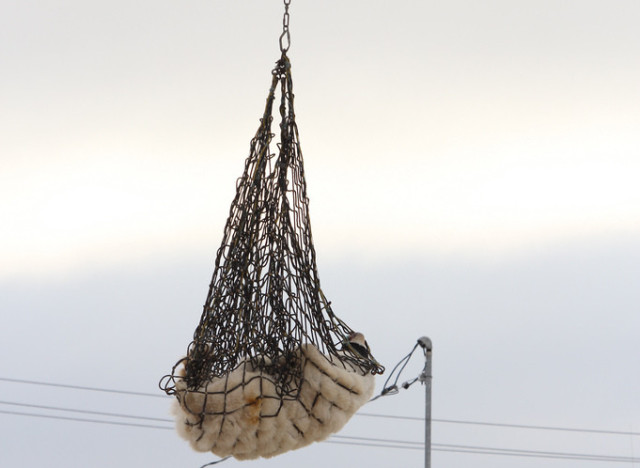
Figure 1. A bear is transported to Churchill’s polar bear holding facility, from a 2011 Huffington Post article “Polar Bear Prison.”

Figure 1. A bear is transported to Churchill’s polar bear holding facility, from a 2011 Huffington Post article “Polar Bear Prison.”

Their correlation between number of problem bears in Churchill and breakup dates for WHB worked because some very inconvenient data were simply left out: problem bear data for 1983 and 2004.

Inclusion of that information would have shown 1983 and 2004 were two of the worst years for polar bear problems in recent history despite being late breakup years (1983 also had the last human fatality from a polar bear attack). They could have explained why they did not use the data but they did not — they simply left it out.

Amazingly, this work is being touted as “evidence” that global warming is harming Western Hudson Bay polar bears.
Continue reading