Category Archives: Life History

First anniversary for The Polar Bear Catastrophe That Never Happened

On this first anniversary of the publication of The Polar Bear Catastrophe That Never Happened, it’s a day of celebration for me. The book has informed thousands about how and why the scary stories about the imminent demise of polar bears due to human-caused global warming failed so miserably.  It is a story of the triumph of facts over assumptions and a perfect example of why scientific observations trump model predictions. It is also a study of science at its worst: how a close-knit community of scientists groomed by a few senior researchers was able to cast out an insider who refused to tow the line on their climate change agenda – and mobilized mobs to attack outsiders who questioned their authority.
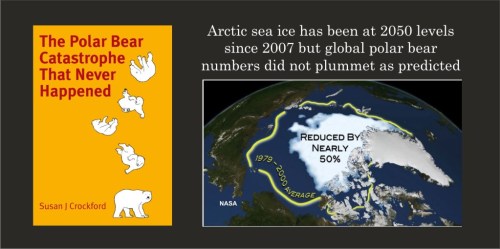
Book graphics for promotion updated March 2020

If you haven’t read it, now may be the perfect time. Many of you will be forced or encouraged to stay at home because of Covid-19 concerns, so here is one way to put the time to good use. Ebooks are perfect for this situation. If you don’t like Amazon, Smashwords has an ebook version here.

Smashwords also has an ebook version of my novel, EATEN. This polar bear attack thriller is a timely read for a number of reasons but primarily because it’s the story of an animal epidemic with horrific consequences quite different from the one we are facing at the moment.

My polar bear science book for kids, Polar Bear Facts and Myths in ebook form might be the perfect diversion for kids at home who need interesting educational material.

You’ll find links to all of my books, in all countries and all outlets, at my personal website here.

Stay safe.
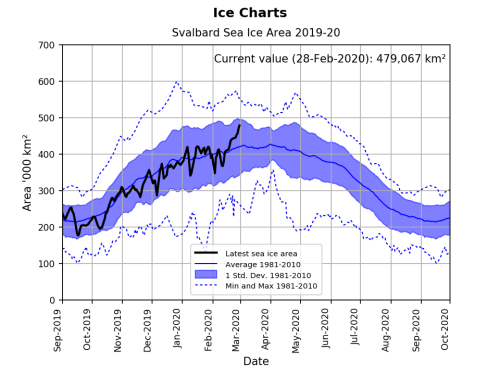
Svalbard Norway now has more polar bear habitat than it did two decades ago

Sea ice around Svalbard, Norway at the end of February 2020 is way above average, as the graph below shows – with more polar bear habitat now than there has been in two decades.

Svalbard ice extent 2020 Feb 28 graph_NIS

Some comparison charts below show that the graph above includes some very high ice years in the 1980s (reaching that dotted line above the mean) for which only global charts are available.

However, contrary to suggestions that more Svalbard ice is better for polar bears, there is no evidence that low extent of sea ice habitat in winter or summer over the last two decades harmed polar bear health, reproductive performance, or abundance. In fact, polar bear numbers in 2015 were 42% higher than they were in 2004 (although not a significant increase, statistically speaking) and most bears were found to be in excellent condition.

Svalbard polar bear_Aars August 2015-NP058930_press release

This suggests a return to more extensive ice to the Svalbard region in winter will have little impact on the health of the entire Barents Sea subpopulation, although it might change where pregnant females are able to make their maternity dens if ice forms early enough in the fall. In other words, the population should continue to grow as it has been doing since the bears were protected by international treaty in 1973.

UPDATE 3 March 2020: According to 28 February tweet by the Norwegian Ice Service, which I just saw today, “the last time there was this much sea ice around Svalbard on this day of the year [28 February] was 2004“. Somehow, I missed 2004 when I was looking through the archive, so I have modified the text below accordingly; see the 2004 chart below and here.

Continue reading

Polar bear habitat at mid-winter as extensive as 2013 & better than 2006

Arctic sea ice at the middle of winter (January-March) is a measure of what’s to come because winter ice is the set-up for early spring, the time when polar bears do most of their feeding on young seals.

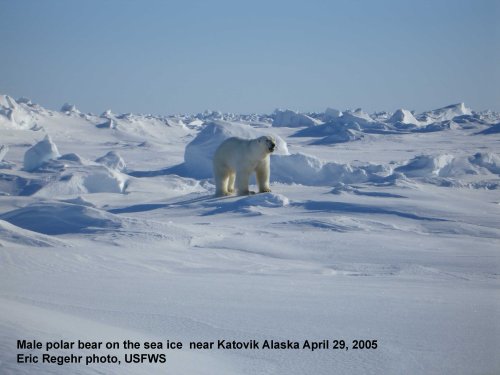
Polar_Bear_male on sea ice_Alaska Katovik Regehr photo_April 29, 2005_sm labeled

[Mid-winter photos of polar bears are hard to come by, partly because the Arctic is still dark for most hours of the day, it’s still bitterly cold, and scientists don’t venture out to do work on polar bears until the end of March at the earliest]

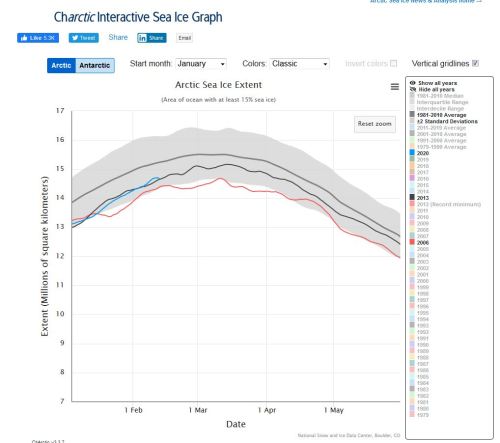
At 12 February this year, the ice was similar in overall extent to 2013 but higher than 2006.

Sea ice extent 2020 and 2013 and 2006 at 13 Feb 2020_closeup NSIDC interactive
Continue reading

New paper says Baffin Bay polar bears may have been affected by less summer sea ice

A new paper on Baffin Bay polar bears reports data on body condition and litter sizes collected as part of a major study of the region completed in 2013 compared to sea ice declines since the 1990s; based on a computer model, the authors predict that in 37 years time (if sea ice declines continuously), the incidence of twin litters could “largely disappear.” However, no decline in population numbers was predicted and a critical caveat acknowledges that factors other than changes in sea ice could have affected the body condition and litter size data the authors analyzed, which means the conclusions are scientifically inconclusive.

polarbearatthulerobindavies-500x349-sm

Fat polar bear, summer 2012 near Thule, NW Greenland (Baffin Bay subpopulation). Robin Davies photo.

The last (2013) polar bear population survey of Baffin Bay (SWG 2016) generated an estimate of almost 3,000 (2,826; range 2,059-3,593), which means that regardless of some slight changes in body condition and litter size over the last two decades (which may or may not have been caused by loss of sea ice), there are currently a lot of bears in Baffin Bay.

Continue reading

2019 Alaska aerial survey found the most polar bears since 2012 – dozens of fat healthy bears

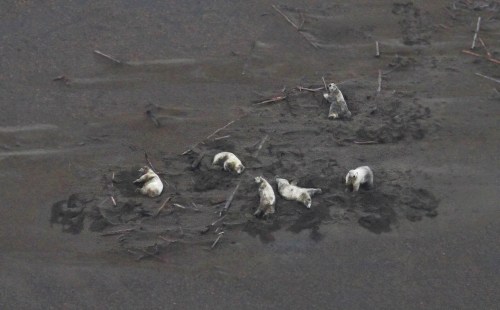
This aerial shot of six fat polar bears lolling around on a sand beach on the coast of the Southern Beaufort Sea, Alaska, was taken by NOAA employees in July 2019. It exemplifies the reality that bears in this subpopulation are currently abundant and healthy, negating the suggestion that numbers have continued to drop since 2006 because bears are starving.

Six fat polar bear wallow in SB sand_NOAA summer 2019

The above picture of polar bear health is not an exception but the rule for all 31 bears recorded onshore last July, as the photos below from other locations testify. Those who would blame this abundance of bears on lack of sea ice in 2019 should note that ice retreated as early and as extensively in 2017 yet only 3 bears were spotted onshore. Results of a recent (2017-2018) population survey, which have not yet been made public, will of course not reflect conditions seen in 2019.

Continue reading

Polar bear sea ice habitat at the start of the Arctic winter is abundant except off Labrador

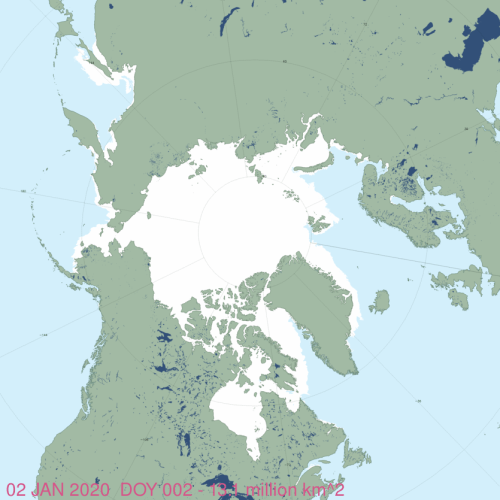
After a bit of ineffectual hand-wringing from polar bear specialists about low summer and fall sea ice conditions and unsubstantiated worries about impacts on bear survival – including Southern Beaufort Sea, Chukchi Sea and Hudson Bay  – I’ve heard no concerns expressed so far about the unusually low extent of ice off the East Coast of North America at the start of this winter. The Labrador Coast is just about the only region bereft of ice this winter but could catch up quickly at any time: ice coverage in the Barents Sea, East Greenland, and Bering Sea is similar to or above recent levels (last five years) so far, as is the overall extent.

masie_all_zoom_4km 2020 Jan 2

Continue reading

Polar bear cubs play on the thin ice that supposedly threatens them with extinction

This video tweet deserves a post of its own: two relatively inexperienced cubs-of-the-year in Russia deliberately break through thin ice, fall into the icy water and crawl back out – over and over again, for fun, as their mother watches in the background. Play is one way animals learn important survival lessons and for polar bears, this is one of them:

Thin ice was a natural component of the Arctic long before polar bears evolved to live there: it is nothing new but dealing with it requires a strategy that cubs must learn.

UPDATE 1 August 2020: here is the same video, better quality, on Youtube:

Continue reading

New video shows Attenborough & Netflix falling walrus deception as revealed by BBC

A new video with clips of critical footage not available outside the UK shows that Sir David Attenborough and Netflix producers (who insisted earlier this year that climate change – not polar bears – were to blame for Russian walrus falling to their deaths) had deceived audiences around the world.

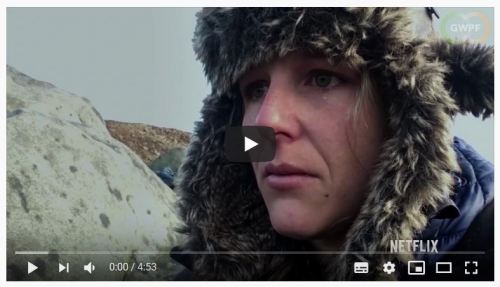
Falling walrus deception video 19 Dec 2019

Falling Walrus: Attenborough Tacitly Admits Netflix Deception (Susan Crockford/GWPF).

As I explained last month, footage from the Attenborough/BBC TV series Seven Worlds, One Planet (Asia) showed conclusively that events precipitating the walrus tradegy porn sequence in the Netflix film was a deception. It means that Attenborough, director Sophie Lanfear, cameraman Jamie McPherson, WWF in Chukotaka, and scientific advisor Anatoli Kochnev all knew this to be so.

In case you missed it, another episode of the same BBC One Planet TV series falsely claimed that polar bears hunting whales from shore are unprecedented effects of climate change.

European outrage over my loss of adjunct status and video of my Dutch school lecture

I’ve been home for just over 3 weeks now but even with all the demands on my time from family, friends, colleagues, and the media that I had to put off while I was away, I didn’t want to miss setting down a few final thoughts about my speaking tour across Europe. See previous posts here and here.

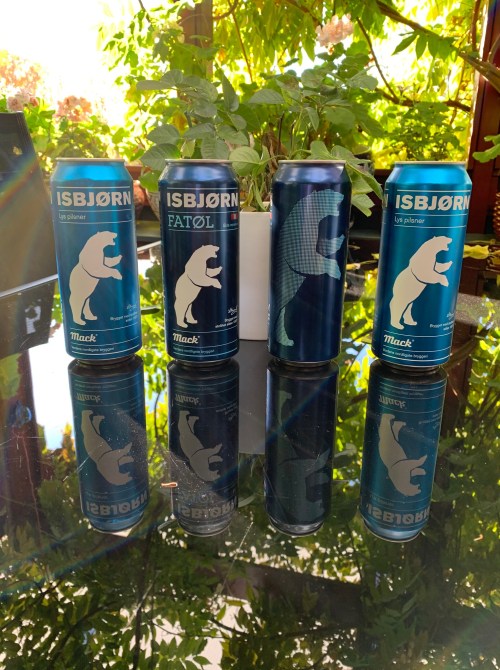
Polar bear beer ISBJORN_Jan Erik OSLO 23 Oct 2019

Polar bear beer had a prominent place at the post-conference dinner in Oslo.

Continue reading

BBC’s One Planet falsely claims that polar bears hunting whales from shore is an unprecedented effect of climate change

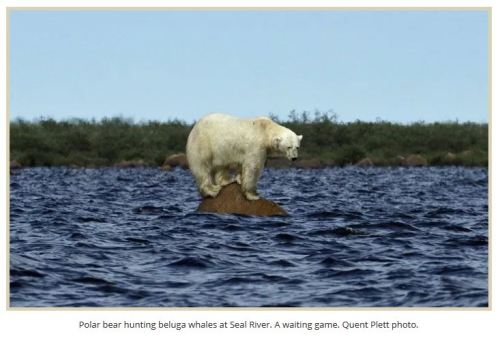
Polar bears leaping on the backs of belugas off Seal River, in western Hudson Bay, is being falsely promoted by the BBC’s new “Seven Worlds: One Planet” TV special as an unprecedented effect of climate change.

Bear hunting beluga Seal River Sept 2017 Quent Plett photo

More specifically, the Daily Mail (30 November 2019) this morning quoted the documentary, narrated by Sir David Attenborough, as saying:

‘This extraordinary behaviour has only been recorded here, in this remote corner of North America, and only in the last few years.’

Poppycock. More climate change hyperbole from Attenborough’s seemingly never-ending litany of nonsense that’s easily refuted. There is scientific literature documenting such behaviour in Canada’s far north in the 1980s, which I included in the blog post I wrote about this phenomenon a few months ago (after National Geographic published a similar scare-story), which I have reposted below.

And from the sounds of it, there was no mention in the BBC special that freeze-up along western Hudson Bay was early again this year: for the third year in a row. So if the footage was filmed any time since 2017, the claim of accelerating sea ice loss in this region and bears on land for longer than ever is pure fantasy. PS. Fat bears are not ‘starving’.

Continue reading