Category Archives: Summary

Climate mauling, polar bears, and the self-inflicted wounds of the self-righteous

The BioScience paper “Internet blogs, polar bears, and climate-change denial by proxy” (Harvey et al. 2018) is a smack-talk response to my pointing out that polar bear numbers did not plummet as predicted when mid-century-like sea ice conditions arrived unexpectedly in 2007 (Crockford 2017). Here is why this shoddy piece of work will go down in history as a self-inflicted wound for the polar bear community (and biologist co-authors Ian Stirling and Steven Amstrup) and an own-goal for their wanna-be climate-hero friends, Stephan Lewandowsky, Jeff Harvey, and Michael Mann.
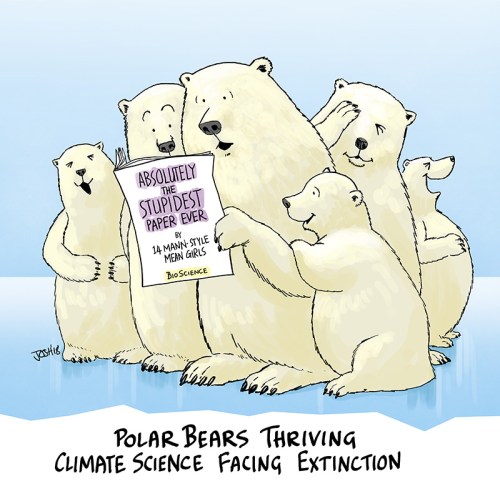
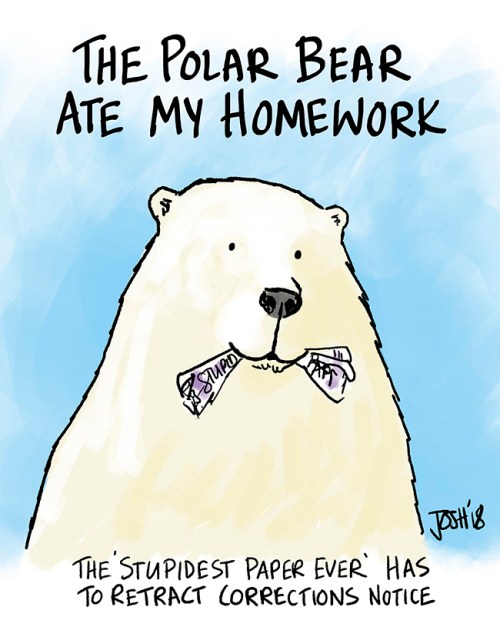
idea 1 final…absolutely the stupidest paper I have ever seen published” tweeted climate scientist Judith Curry, Emeritus Professor of Earth and Atmospheric Sciences at Georgia Institute of Technology (“Georgia Tech”).

Dr. Curry is a favourite target of colleague Michael Mann’s penchant for derogatory name-calling. Ironically, Mann often promotes something he calls the “Serengeti Strategy,” which he described to US Congress in 2017 in presenting himself as a victim of abused by others [my bold]:

“I coined the term “Serengeti Strategy” back in 2012 in “The Hockey Stick and the Climate Wars” to describe how industry special interests who feel threatened by scientific findings—be it tobacco and lung cancer, or fossil fuel burning and climate change—single out individual scientists to attack in much the same way lions of the Serengeti single out an individual zebra from the herd. In numbers there is strength, but individuals are far more vulnerable. Science critics will therefore often select a single scientist to ridicule, hector, and intimidate. The presumed purpose is to set an example for other scientists who might consider sticking their neck out by participating in the public discourse over certain matters of policy-relevant science.” Michael Mann, 2017 Congressional testimony.

Mann thinks others are using this strategy against him but if he had half an ounce of self-awareness he’d see it’s exactly what he and his long list of colleagues are doing with the Harvey et al. BioScience attack on me. Intimidation by numbers is the only rational explanation for a roster of 14 when two incompetent researchers could have produced a similar result.

Polar bear specialists Ian Stirling and Steven Amstrup knew they didn’t have a valid argument to refute my paper (Crockford 2017; Crockford and Geist 2018) on their failed polar bear survival model (Amstrup et al. 2007), which their responses to my International Polar Bear Day (27 February 2018) Financial Post op-ed revealed to the world (see here and here with references).

So when ignoring me didn’t work – or, more accurately, when the world started paying too much attention to me, by their own admission (Harvey et al. 2018:3) – they teamed up with Michael Mann, Jeff Harvey, and Stephan Lewandowsky (all with previous form attacking colleagues who don’t share their views) to publish an academic paper attacking my scientific integrity. In the words of Terence Corcoran, I was “climate mauled.”

Judith Curry stated recently (14 February 2018), regarding the Mann lawsuit against Rand Simberg, Mark Steyn and the National Review vs. the attacks on her integrity:

“Mann’s libelous statements about me (because he is a scientist with many awards) are far more serious than say Rand Simberg’s statements about Mann.”

In other words, like the attack on me in the Harvey paper (used to libel other internet bloggers by association), when senior scientists like Mann, Stirling, and Amstrup use derogatory and defamatory language against a colleague it’s a serious breach of professional ethics that impacts careers. Harvey et al.’s attack against me may be worse than those against Curry at a Congressional Hearing because it has been entered into the scientific literature in my own field.1

However, I expect BioScience (read mostly by teachers, students, and the general public, and therefore widely subscribed to by public libraries) was the only outlet willing to publish such unprofessional tripe. The editor’s refusal to retract the paper after numerous complaints about the language and the quality of the scientific content, tells you all you need to know about the journal’s low, sectarian standards. For example, the notice showing the two corrections they were willing to make at the end of March 2018 had to be pulled because such an egregious error occurred (it was posted to the wrong journal) it got the attention of online watchdog Retraction Watch! [Still not fixed as of 8 April]
Polar bear paper correction retraction_5 April 2018

It also tells us quite a lot about the bias of its publishers, the American Institute of Biological Sciences.

Did you know, for example, that this organization has an “actionbioscience” program that provides free idealogically biased content aimed at kids and teachers that’s not particularly different from the biased content produced (without references) for kids and teachers by activist conservation outfit Polar Bears International (employer of Harvey et al. co-author Steve Amstrup)? The AIBS actionbioscience program currently includes an out-of date, alarmist essay by litigious Center for Biological Diversity employee Shaye Wolf on the plight of penguins (from 2009) as well as one by pessimistic polar bear specialist Andrew Derocher (from 2008) .

If you are able, please support the work I do here at PolarBearScience, some of which will go to Josh for these fabulous cartoons:

Here is a list of issues regarding the Harvey et al. paper as well as responses to it: some of these you won’t have heard before. Because this is a long summary post, for convenience I offer it here also in pdf form (latest version with a few typos/spelling errors corrected): Climate mauling, polar bears, and self-inflicted wounds of the self-righteous.”
Continue reading

Amstrup & colleages can’t refute my critique of their 2007 polar bear survival model, Part 2

Polar bear specialists Andrew Derocher and Steven Amstrup recently spent inordinate energy trying to refute the opinion piece I’d written for the Financial Post in celebration of International Polar Bear Day last month, ignoring my fully referenced State of the Polar Bear Report for 2017 that was released the same day (Crockford 2018) and the scientific manuscript I’d posted last year at PeerJ Preprints (Crockford 2017).

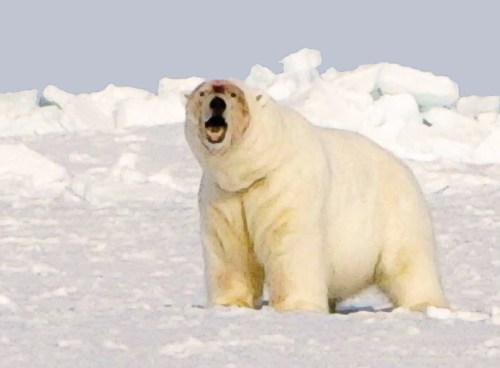
polar_bear_USFWS_fat Chukchi Sea bear

Their responses use misdirection and strawman arguments to make points. Such an approach would not work with the scientific community in a public review of my paper at PeerJ, but it’s perfect spin for the self-proclaimed “fact-checking” organization called Climate Feedback. The result is a wildly ineffective rebuttal of my scientific conclusion that Amstrup’s 2007 polar bear survival model has failed miserably.

This is Part 2 of my expose, see Part 1 here.
Continue reading

Amstrup & colleages can’t refute my critique of their 2007 polar bear survival model, Part 1

It’s been more than a year since I first published my scientific manuscript at PeerJ Preprints (a legitimate scientific forum) on the failure of Amstrup’s 2007 USGS polar bear survival model (Crockford 2017), a year waiting in vain for the polar bear community to comment. They either couldn’t be bothered or knew they couldn’t refute it – I haven’t known for sure which. But I do now.

Beaufort Sea male polar bear USGS_2005 Amstrup photo

Polar bear specialists didn’t comment because they couldn’t refute it in the scholarly manner required by PeerJ: all they could do is tear it down with derision, misdirection and strawman arguments.

I know this because the damage control team for the polar-bears-are-all-going-to-die-unless-we-stop-using-fossil-fuels message wasn’t activated over my fully-referenced State of the Polar Bear Report for 2017 (Crockford 2018) released on International Polar Bear Day last month, but for a widely-read opinion piece I’d written for the Financial Post published the same day (based on the Report) that generated three follow-up radio interviews.

By choosing to respond to my op-ed rather than the Report or my 2017 paper, biologists Andrew Derocher and Steven Amstrup, on behalf of their polar bear specialist colleagues1, display a perverse desire to control the public narrative rather than ensure sound science prevails. Their scientifically weak “analysis” of my op-ed (2 March 2018), published by Climate Feedback (self-proclaimed “fact checkers”), attempts damage control for their message and makes attacks on my integrity. However, a scientific refutation of the premise of my 2017 paper, or The State of the Polar Bear Report 2017, it is not (Crockford 2017, 2018).

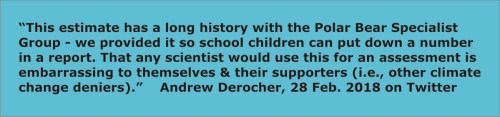
Derocher further embarrasses himself by repeating the ridiculous claim that global polar bear population estimates were never meant for scientific use, then reiterates the message with added emphasis on twitter:

Derocher tweet 2018 Feb 28 quote

Just as the badly written Harvey et al. (2017) Bioscience paper said more about the naked desperation of the authors than it did about me or my fellow bloggers, this attempt by the polar bear community’s loudest bulldogs to discredit me and my work reveals their frustration at being unable to refute my scientifically supported conclusion that Amstrup’s 2007 polar bear survival model has failed miserably (Crockford 2017).

Part 1 of my detailed, fully referenced responses to their “analysis” of my op-ed are below.  Part 2 to follow [here]. Continue reading

State of the Polar Bear Report 2017 shows polar bears are thriving

My new report reveals that polar bears are doing well despite recent reductions in sea-ice. It shows in details why this is so, with summaries of critical recent research.

Press release and pdf below. And read my op-ed in the National Post here.

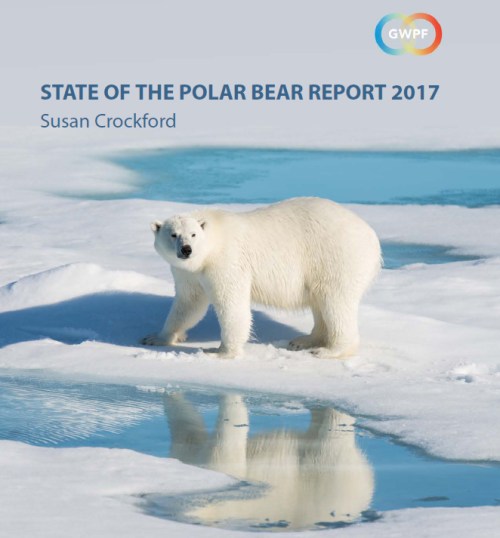
State of Polar Bear Report cover_12 Feb 2018 image with bottom
Continue reading

Coffee house discussion about polar bear science & conservation in Toronto on Tuesday

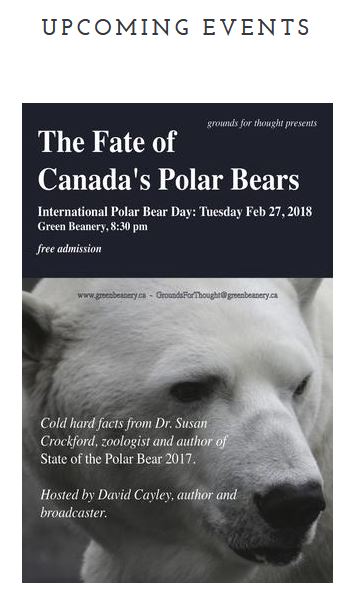
In conjunction with the launch of my State of the Polar Bear Report in Toronto next week, Benny Peiser (from the Global Warming Policy Foundation) and I will be participating in a coffee house discussion about polar bear conservation and survival issues on the evening of Tuesday, 27 February 2018 at 8:30 pm.

If you’re in town, come and celebrate International Polar Bear Day with a frank discussion about polar bear science.

Grounds for Thought at GreenBeanery_Feb 27 2018

I am very much looking forward to meeting the public at this evening discussion and to chat with media representatives and colleagues at the press luncheon in the early afternoon. Journalist/opinion writer Terry Corcoran recently billed the luncheon as part of a Polar Bear Battle since conservation organization Polar Bears International (where biologist Steven Amstrup, co-author of the Harvey et al. Bioscience paper and developer of the failed 2007 polar bear survival model, is employed as chief scientist) is holding a gala fundraiser dinner the same night, just a block away.

In addition to Benny Peiser from GWPF, a number of familiar names will be at the State of the Polar Bear launch and press luncheon, including Terry Corcoran,  Larry Soloman, Joe Oliver and Conrad Black (all journalist/opinion writers at the Financial Post and/or National Post), journalist/writer Donna Laframboise who blogs at No Frakking Consensus, as well as science colleagues Chris Essex, Ross McKitrick, and Steve McIntyre of Climate Audit fame. Details below.

Continue reading

State of the Polar Bear Report 2017 to be released Feb 2017 at press lunch Toronto

My “State of the Polar Bear Report 2017” will be unveiled at a Global Warming Policy Foundation press conference and luncheon in Toronto on Tuesday, 27 February, in celebration of International Polar Bear Day. There will be a video presentation as well.

State of Polar Bear Report cover_12 Feb 2018 image

The report summarizes clear, reliable and concise information on the current state of polar bears relative to historical records. It highlights up-to-date data and research findings in a balanced and factual format that avoids hype and exaggeration, all in one place. It is intended for a wide audience, including scientists, teachers, students, decision-makers and the general public interested in polar bears and Arctic ecology.

The launch will be held on Tuesday 27 February at 11:00am at the Toronto Public Library, Founders’ Room, 789 Yonge St, Toronto, ON M4W 2G8.

Programme

* Welcome (Dr Benny Peiser, Director of the GWPF)
* Introduction: Prof Chris Essex (Chairman of the GWPF’s Academic Advisory Council)
* Short video screening
* Presentation: Dr Susan Crockford (author of the report)

For further information and to schedule interviews, please contact Harry Wilkinson (harry.wilkinson@thegwpf.org)

A copy of the report will be posted on Polar Bear Science Tuesday.

Science, optimism, and the resilience of polar bears in an ever-changing Arctic

Optimism in conservation science — which the Smithsonian says we desperately need (Earth Optimism Summit 21-23 April 2017, apparently a huge success) — means it’s time to acknowledge and celebrate real conservation success stories. The Smithsonian folks probably won’t say it but I will — one of those successes is the recovery of polar bears.

Female with cub_Shutterstock_PolarBearScienceIt’s time to abandon the focus on prophesies of impending loss and accept that recovery of polar bears from the over-hunting of last century has continued despite a decade of low summer sea ice (Aars et al. 2017; Crockford 2017; Dyck et al. 2017; SWG 2016; York et al. 2016). Why not focus on the numerous images of fat, healthy bears rather than the anomalous starving ones?
It’s time to let go of imagined future catastrophes based on pessimistic failures of adaptation (Amstrup et al. 2007, 2008; Atwood et al. 2016; Stirling and Derocher 2012) and acknowledge that polar bears and Arctic seals, just like Pacific walrus (MacCracken et al. 2017; US Fish & Wildlife Service 2017), are resilient species with adaptive capabilities we are only just beginning to comprehend (Crawford and Quakenbush 2013; Crawford et al. 2015; Escajeda et al. 2018; Rode et al. 2014; Stirling and Lunn 1997; Stirling et al. 1975a; Vibe 1965). Continue reading

2017 in review: polar bear prophesies of doom more at odds with current reality

Tales of doom and gloom about polar bears reflect what some people think might happen in the future, not what is happening right now.  Currently, polar bears are doing just fine despite the low summer sea ice coverage they’ve experienced since 2007 (Crockford 2017a; York et al. 2016). In other words, there has been no global population decline as predicted: officially, the numbers were 22,000-31,000 (or 26,500 average) in 2015 (Wiig et al. 2015) but about 28,500 when estimates published since then are included (Aars et al. 2017; Dyck et al. 2017; Matishov et al. 2014; SWG 2016), up from about 22,500 in 2005).

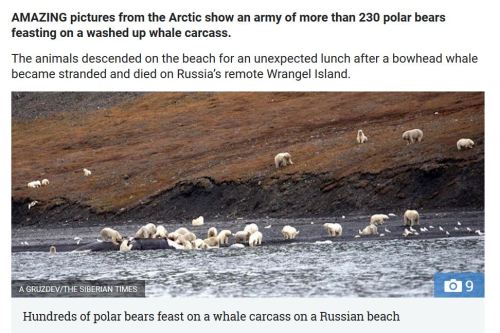
Wrangel Island bears on whale_29 Sept 2017 SUNThis increase might not be statistically significant but it is most assuredly not the decrease in abundance that was predicted by ‘experts’ such as Steve Amstrup and colleagues (Amstrup et al. 2007), making it hard to take subsequent predictions of impending catastrophe seriously (e.g. Atwood et al. 2016; Regehr et al. 2016; Wiig et al. 2015).
The doomsayers can’t stand to have someone provide the public with unbiased evidence of this failure so they attack my scientific integrity with an academically weak and aggressively vindictive ‘peer-reviewed’ paper (Harvey et al. 2017, in press) that you’ll hear more about in the new year.

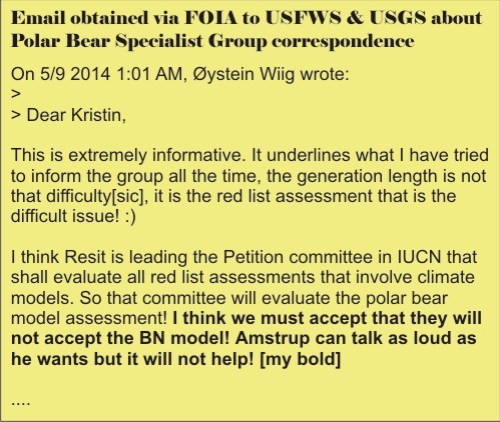
Wiig to Laidre_9 May 2014 follow up to Lunches with Resit_first part_redacted highlighted

Bottom line: 2017 saw abundant good news stories about polar bears, which I’ve summarized below. See also Crockford 2017b: Twenty reasons not to worry about polar bears, the 2017 update and my 2017 block-buster video, Polar Bear Scare Unmasked: The Saga of a Toppled Global Warming Icon:


Continue reading

Twenty reasons not to worry about polar bears, the 2017 update

Cover image_Twenty Reasons_polarbearscienceJust in time for Polar Bears International’s self-proclaimed fall Polar Bear Week (5-11 November 2017), here’s a new resource for cooling the polar bear spin. I’ve updated my 2015 summary of reasons not to worry about polar bears, which is now more than two years old. In this new version, you will find links to supporting information, including published papers and fully referenced blog posts of mine that provide background, maps and bibliographies, although some of the most important graphs and maps have been reproduced here. I hope you find it a useful resource for refuting the pessimism and prophecies of catastrophe about the future of polar bears. Please feel free to share it.

As global leaders meet in Bonn for COP23 (6-17 November 2017), it’s time to celebrate the proven resilience of polar bears to their ever-changing Arctic environment.

Twenty Reasons: the bullet points

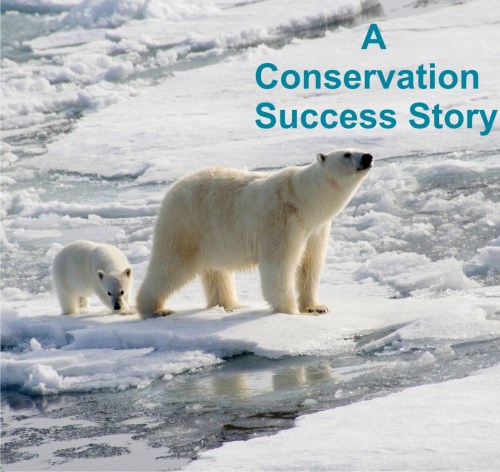
  1. Polar bears are still a conservation success story: there are more polar bears now than there were 40 years ago.
  2. Fewer populations are in decline than in 2010 (only one, officially) and only six are data deficient (down from nine).
  3. Abrupt summer sea ice decline has not affected polar bear numbers as predicted: even though sea ice levels dropped to mid-century levels in 2007, the expected decimation of polar bears failed to occur.
  4. The Chukchi Sea population is thriving despite a pronounced lengthening of the ice-free season since 2007.
  5. Less sea ice in the summer in the Chukchi Sea has meant a healthy prey base for polar bears because ringed seals feed primarily in the ice-free season.
  6. Polar bears have shown themselves to be adaptable to changing ice conditions in several regions.
  7. Southern Beaufort numbers have rebounded since the last survey count.
  8. Barents Sea numbers have probably increased since 2005 and have definitely not declined despite much less sea ice cover.
  9. There is no evidence that record-low summer sea ice in 2012 had a harmful effect on Southern Beaufort bear numbers.
  10. Other species are being negatively impacted by high polar bear numbers, especially nesting sea birds and ducks.
  11. Western Hudson Bay population numbers have been stable since 2004, despite what scientists are telling the media.
  12. Hudson Bay sea ice has not changed since about 1999: breakup dates and freeze-up dates are highly variable but the ice-free period was not any longer in 2015 than it was in 2004. However, this fall freeze-up is shaping up to be the earliest in decades.
  13. Problem bears in Churchill are not lean or starving.
  14. Churchill Manitoba had the most problem bears in 1983 and 2016, which were late freeze-up years, but many of the incidents in 2016 can be attributed to increased vigilance on the part of patrol officers after an attack in 2013.
  15. There have been only marginal sea ice declines during the feeding period in spring, when polar bears need sea ice the most.
  16. The is no evidence that subsistence hunting is affecting bear populations.
  17. Stressful research methods have been curtailed in much of Canada.
  18. There have been no reports of polar bear cannibalism since 2011.
  19. Polar bears appear unaffected by pollution: studies suggest only that harm is theoretically possible, not that it has happened.
  20. Polar bears have survived past warm periods, which is evidence they have the ability to survive future warm periods.

Conclusion

  • Polar bears are thriving: they are not currently threatened with extinction.
  • Tens of thousands of polar bears did not die as a result of more than a decade of low summer sea ice, as was predicted.
  • Polar bears don’t need sea ice in late summer/early fall as long as they are well-fed in the spring.

[full text below, pdf with footnotes and references here]

Continue reading

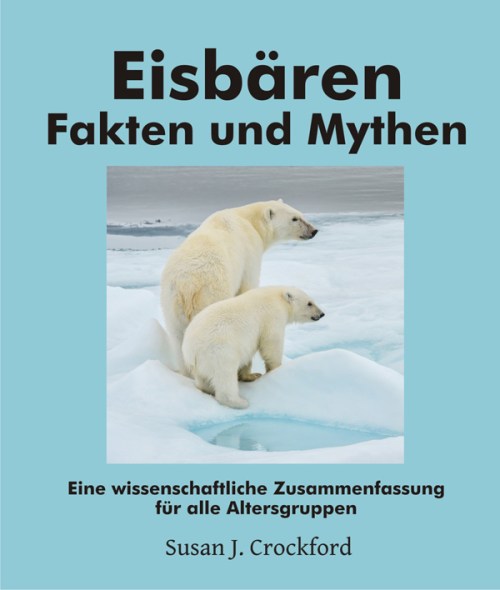
Fabulous polar bear science book for kids now available in French and German

Announcing the French and German translations of my popular science book, Polar Bear Facts and Myths (suitable for children aged seven and up), are now available through Amazon worldwide in paperback. Please pass along to your friends, relatives, and colleagues in North America and abroad. The English version still available in paperback and ebook formats.

FRENCH

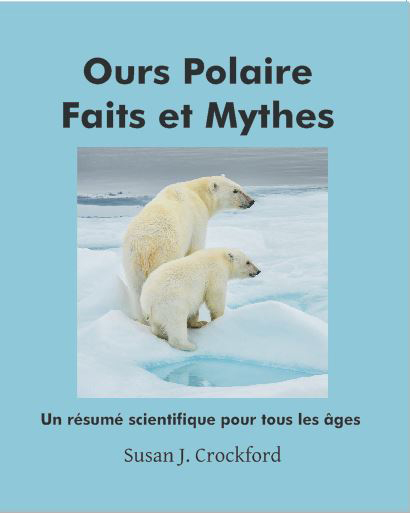
Crockford Ours Polaire_French front cover_web size_10 Sept 2017

Titre: Ours Polaire Faits et Mythes: Un résumé scientifique pour tous âges
L’autheur: Susan J. Crockford
Traduit par: Reynald Duberger
Date de publication: 10 September 2017
ISBN: 1976158362
Nombre de pages: 44
Le price: USD $12.99  €10.87  £9.94 [soon to be £10.03 to qualify for free shipping]  CAD $20.22 [with free shipping]

Acheter-le ici: Amazon.com [USA]; Amazon.ca [Canada, also in the French Immersion Store]; Amazon.fr [France]; Amazon.uk [UK]; Amazon.de [Germany]

On a fait croire aux enfants qu’il ne reste que quelques centaines d’ours polaires,  mais l’implacable message sur les ours polaires condamnés (par la faute de l’homme) est heureusement faux. Il est temps qu’on révèle la vérité aux jeunes.

Voici donc les bonnes nouvelles qu’on doit apprendre aux enfants: les ours polaires n’ont jamais été menacés d’extinction à cause d’un réchauffement global anthropique. Il y a effectivement davantage d’ours polaires qu’il y en avait il y a 50 ans, et la population globale est d’un taille respectable, en dépit du fait que la banquise d’été ait atteint des niveaux ayant dû, selon les prévisions, mener à la catastrophe depuis 2007.

Les ours polaires se sont adaptés admirablement bien à ces niveaux, et contre toute attente, leur nombre a augmenté et non pas diminué au cours des années.

L’ours polaire: Faits et Mythes est un livre scientifique inspirant sur la survie dans l’Arctique qui plaira aussi bien aux parents qu’aux enfants.

À propos de l’auteur: Susan Crockford est une zoologiste professionnelle. Depuis plus de 20 ans elle étudie l’écologie et l’évolution de l’ours polaire. Elle possède un PhD et maintient un blog sur le passé et le présent des ours polaires appelé http://www.polarbearscience.com.

Depuis longtemps, les lecteurs réclamaient un livre clair et simple sur la science de l’ours polaire s’adressant aux enfants comme aux adultes, offrant la même approche rationnelle que celle de ses publications scientifiques pour adultes. Susan leur livre enfin cet ouvrage.

Un livre d’accompagnement (en anglais) est aussi disponible (Polar Bears: Outstanding Survivors of Climate Change) présentant des détails bien référencés sur les questions et enjeux récents concernant la conservation de l’ours polaire. Pour les amateurs de fiction, elle propose aussi un thriller sur les attaques d’ours polaires (EATEN: A Novel), également en anglais.

GERMAN

Crockford FM FRONT cover only_German 10 Sept 2017 web size

Der Titel: Eisbären Fakten und Mythen: Eine wissenschaftliche Zusammenfassung für alle Altersgruppen
Der Autor: Susan J. Crockford
Übersetzt von: Marie McMillan
Datum der Veröffentlichung: 10 September 2017
ISBN: 1976305748

Seitenzahl: USD $12.99  €10.87  £9.94 [soon to be £10.03 to qualify for free shipping] CAD $20.22 [with free shipping]

Kauf es hier: Amazon.com [USA]; Amazon.de [Germany]; Amazon. ca [Canada]; Amazon.uk [UK]; Amazon.fr [France]

Beschreibung auf Deutsch

Vielen Kindern weltweit wurde erzählt, dass es nur noch ein paar hundert Eisbären auf der ganzen Welt gibt. Zum Glück ist die Nachricht, dass der Polarbär dem Untergang geweiht sei (und dass das allein die Schuld der Menschen sei) falsch. Es wird Zeit, dass die Kinder dies erfahren.

Die gute Nachricht, die Kinder hören müssen, ist diese: Eisbären sind nicht vom Aussterben bedroht aufgrund des Klimawandels. Tatsächlich gibt es heute viel mehr Polarbären als vor 50 Jahren und die Population weltweit hat eine gesunde Größe. Und das obwohl das Meereseis seit 2007 ein Niveau erreicht hat, von dem es hieß, dass es katastrophale Folgen haben würde. Eisbären kommen ganz gut mit weniger Meereseis im Sommer klar; entgegen allen Erwartungen ist ihre Zahl über die Jahre gestiegen, sie sind nicht weniger geworden.

Eisbär Fakten und Mythen ist ein ermutigendes wissenschaftliches Buch über das Überleben in der Arktis, welches Kindern und Eltern gleichermaßen gefällt.

Über die Autorin: Susan Crockford ist eine professionelle Zoologin, die seit mehr als 20 Jahren Polarbär-Ökologie und Evolution studiert. Sie hat einen Doktortitel und schreibt einen Blog über die historische und gegenwärtige Situation der Polarbären: http://www.polarbearscience.com. Seit Jahren fragten Leser sie nach einem wissenschaftlichen Buch dass sich auch an Kinder richtet und in gleichsam rationaler und umfassender Perspektive gehalten ist wie ihre wissenschaftlichen Texte für Erwachsene. Dieses Buch ist Dr. Crockfords Antwort.

English version of above descriptions copied below:

Continue reading