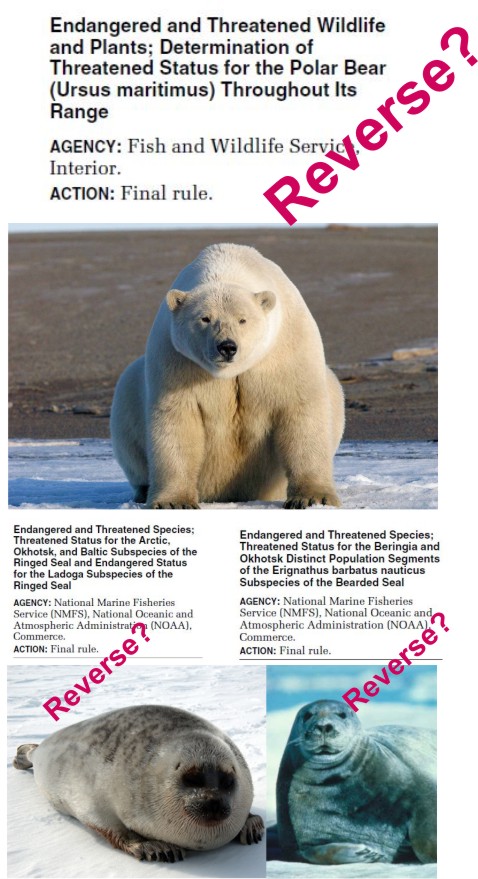
I’ve never been very interested in politics but this result has me wondering. Could the new president reverse the Endangered Species Act (ESA) decisions listing polar bears and other species as ‘threatened’ with extinction due to future threats from global warming?
Posted onJune 9, 2016|Comments Off on Some inconvenient polar bear facts supported by scientific literature
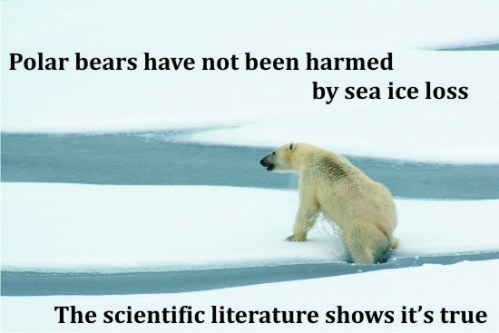
The evidence that polar bears have not been harmed by recent declines in sea ice is contained in the scientific literature, no matter what some researchers say when they talk to the media.
Here’s a few of those facts (not all, by any means), with the references to back them up: Continue reading
Comments Off on Some inconvenient polar bear facts supported by scientific literature
Posted onFebruary 27, 2016|Comments Off on Biggest threat to polar bears reconsidered
What presents a bigger risk to current polar bear populations: natural hazards that have already proven deadly or potential, yet-to-be-realized threats prophesied to occur due to human activities? That’s a perfect question for International Polar Bear Day.
Dag Vongraven, chair of the IUCN Polar Bear Specialist Group, remarked last year that “until 2001, everything was fine.”
Polar bear researchers thus assume that 2001 was the year climate change became the new over-hunting – but is it true? What are the relative harms presented by proven natural causes, potential human-caused threats, and predicted threats due to sea ice declines blamed on global warming? Considered objectively, is climate change really the single biggest threat to polar bear health and survival right now? Continue reading
Comments Off on Biggest threat to polar bears reconsidered
Posted onFebruary 25, 2016|Comments Off on Ten dire polar bear predictions that have failed as global population hits 22-31k
Grim predictions of the imminent demise of polar bears – their “harsh prophetic reality” as it’s been called – have been touted since at least 2001. But such depressing prophesies have so widely missed the mark they can now be said to have failed.
While polar bears may be negatively affected by declines in sea ice sometime in the future, so far there is no convincing evidence that any unnatural harm has come to them. Indeed, global population size (described by officials as a “tentative guess“) appears to have grown slightly over this time, as the maximum estimated number was 28,370 in 1993 (Wiig and colleagues 1995; range 21,470-28,370) but rose to 31,000 in 2015 (Wiig and colleagues 2015, [pdf here] aka 2015 IUCN Red List assessment; range 22,000-31,000).
These ominous prophesies have been promoted primarily by Ian Stirling, Steven Amstrup, Andrew Derocher and a few other IUCN Polar Bear Specialist Group (PBSG) members but ironically, it’s data collected by their colleagues that’s refuted their message of doom.
Here are the predictions (in no particular order, references at the end): Continue reading
Comments Off on Ten dire polar bear predictions that have failed as global population hits 22-31k
Posted onJanuary 9, 2016|Comments Off on Paleoclimate + genetic study confirms: Arctic species adapted to sea ice changes
A new paper that combines paleoclimatology data for the last 56 million years with molecular genetic evidence concludes there wereno biological extinctions [of Arctic marine animals] over the last 1.5M years despite profound Arctic sea ice changes that included ice-free summers: polar bears, seals, walrus and other species successfully adapted to habitat changes that exceeded those predicted by USGS and US Fish and Wildlife polar bear biologistsover the next 100 years.
Thomas Cronin is a USGS paleoclimatologist at the Eastern Geology and Paleoclimate Science Center, and Matthew Cronin is a molecular geneticist at the University of Alaska Fairbanks (see previous posts here and here about Matt’s work on the genetics of polar bear evolution).
From the Abstract:
Arctic climatic extremes include 25°C hyperthermal periods during the Paleocene-Eocene (56–46 million years ago, Ma), Quaternary glacial periods when thick ice shelves and sea ice cover rendered the Arctic Ocean nearly uninhabitable, seasonally sea-ice-free interglacials and abrupt climate reversals.
The final discussion and two summary graphics from this paper (copied below) are especially useful:
Posted onJune 21, 2015|Comments Off on Polar bear news: 1st fat bear ashore in WHB, trouble in S. Greenland, and more hybrid hype
Last week, among other events, the first fat polar bear of the season was photographed on shore in Western Hudson Bay, a fat bear was run out of town in South Greenland, and media outlets spread misinformation – apparently preferring global warming hype to rational facts.
1) First polar bears have been seen onshore in Western Hudson Bay in Wapusk National Park near Cape Churchill (map below) on 18 June this year, apparently fat and well prepared for the summer fast. My informants tell me a few bears usually come ashore in June near Churchill before ice conditions make this necessary; the bulk of the population will probably continue seal hunting for a few more weeks. Those bears will come ashore along the southwest coast (near Polar Bear Provincial Park, in Ontario, see Fig. 2 below). They’ll make their way north to the Churchill area in time for freeze-up in the fall. Watch one fat bear caught on camera on 18 June, below :
2) Fat polar bear spotted in Nanortalik, Southern Greenland 18 June 2015, a bit further south than usual. People from the community drove it away, but not before taking lots of pictures.
Some very cool photos, including the one above (taken by Henrik Hansen), worth a look. This bear was in excellent condition, well prepared for the summer fast ahead, whether he ends up spending it on shore somewhere (but not near this community!) or on the sea ice further north in SE Greenland (Fig. 1 below). The ice in that areas is probably broken up (~15-30% concentration) but this is enough for the bear to swim from flow to flow to make it’s way up the northeast coast where most East Greenland bears spend the summer. Continue reading
Comments Off on Polar bear news: 1st fat bear ashore in WHB, trouble in S. Greenland, and more hybrid hype
Posted onMarch 13, 2015|Comments Off on PolarBearScience has been ‘Carbon Briefed’ – success at last!
Not just anyone warrants the attention of the Europeanrapid response team: only those who get media attention and refuse to stay ‘on message’ about global warming issues get the Carbon Brief treatment.
After years of being ignored, I have finally been acknowledged as a worthy adversary [a force to be reckoned with] by those who spin the science of polar bears.
Posted onFebruary 27, 2015|Comments Off on International Polar Bear Day & Polar bears in the news this week
Today’s the day to celebrate the resilience and adaptability of polar bears.
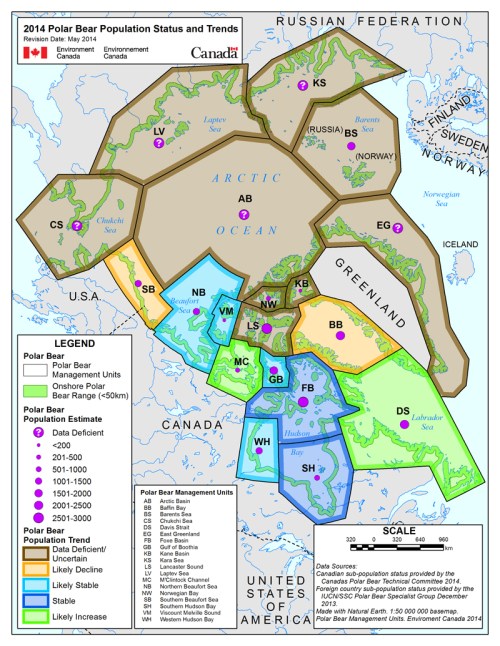
Not only did the record-breaking sea ice low of 2012 have virtually no effect on the bears but in 2014, only two subpopulations were classified as “declining” or “likely declining” – down from seven in 2010 and four in 2013 (see map below).
Kudos to the CBC for producing a propaganda-free polar bear “Fun Facts” page for kids that won’t give them nightmares – have a look.
Other news: Polar bears come early to Black Tickle, Labrador this year, a new population count is planned for the Barents Sea subpopulation, and The Times (UK) publishes some good news about polar bears. Details below.
UPDATE February 27, 2015. I’ve added another news item I missed below.
UPDATEAPRIL 7, 2015. Correction to the February 27 update below. Continue reading
Comments Off on International Polar Bear Day & Polar bears in the news this week
Posted onFebruary 19, 2015|Comments Off on Twenty good reasons not to worry about polar bears
Here’s a new resource for cooling the polar bear spin, all in one place. I’ve updated and expanded my previous summary of reasons not to worry about polar bears, which is now two years old. In it, you’ll find links to supporting information (including previous blog posts of mine that provide background, maps and extensive references), although some of the most important graphs and maps have been copied into the summary. I hope you find it a useful resource for refuting the spinand tuning out the cries of doom and gloom about the future of polar bears — please feel free to share. Pdf here of the text below.
This is the 1st anniversary of Canada providing population estimates and trends independent of the pessimistic prognostications of the IUCN/SSC Polar Bear Specialist Group (PBSG) — so let’s celebrate the recent triumphs and resilience of polar bears to their ever-changing Arctic environment.
“We admire polar bear biologists for their professional dedication to this iconic species, and rightly so. However, while it’s understandable that polar bear biologists are conservation-minded, the public and policy makers need them to be scientists first and advocates for polar bear protection second. Polar bears are currently doing well – data shenanigans to keep them classified as “threatened” undermine the whole point of doing science.”
I have written extensively about the Southern Beaufort issue — below are links to some of these, which have links to the rest.References are included in these individual posts. Contact me if there is a reference you cannot find: Continue reading
Comments Off on Faux polar bear figures – my editorial in the National Post
Watch polar bear habitat reform in the Canadian Arctic: “last 10 days” Canadian Ice Service animation (works anytime) HERE.
See Quote archive for details.




![Paul J. Richards/AFP/Getty Images [NP story]](https://polarbearscience.com/wp-content/uploads/2015/01/0115polarbear_np-story.jpg)






 polarbearscience
You must be logged in to post a comment.