Busy week for Churchill Polar Bear Alert Program in week 6, more problems than 2017

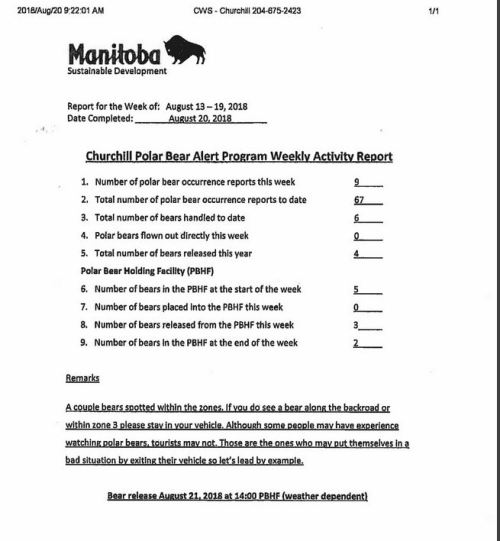
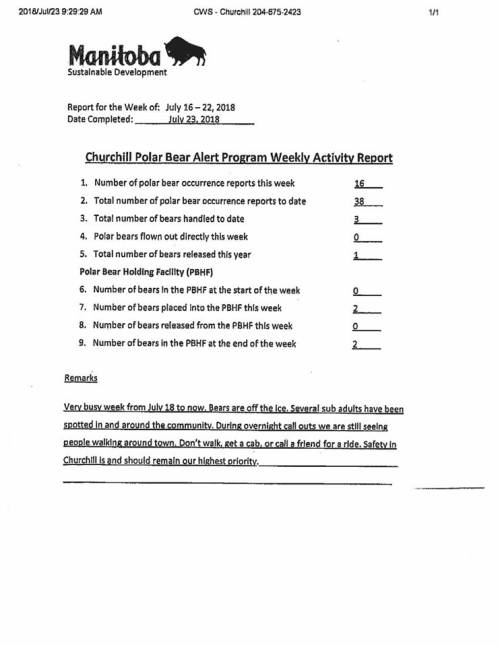
The Churchill Polar Bear Alert program has been busy in week 6 (Aug.13-19), with 67 occurrences to date: slower than last year but not quite as brisk as 2016. Some bears have already been released from the holding cells of “polar bear jail,” transported outside of Churchill and marked with a green dot to identify them as problem bears to residents of communities further north.

churchill-pb-reports_week-6_-aug-13-19-2018.jpg

Compare the above to other years below, as welll as weeks 4 and 5. Previous weeks here and here.

Continue reading

Brace yourself: more starving polar bear news stories in the pipeline from Svalbard

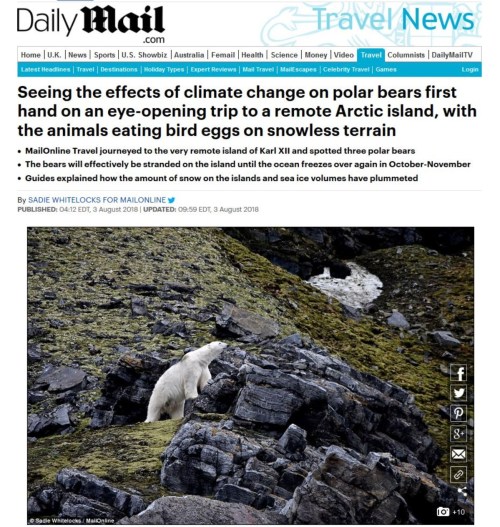
A few polar bears have become stranded on small islands north of Svalbard since the local sea ice retreated — of which the bear that mauled a cruise ship guard last month was but one — and if return of the ice is as late as last year, those handful of bears are likely doomed to die of starvation. This is not due to climate change but rather bad judgment on the part of these few bears. They were not forced ashore: if they’d stayed on the ice like the rest of the population, they’d have likely been just fine.

Daily Mail stranded bear headline_3 Aug 2018 all

Similar to the bear in northwestern Hudson Bay that fatally mauled a young father in early July, these bears were likely lured ashore by the prospect of masses of bird eggs present on island rookeries. But they overstayed their window of opportunity and the ice retreated without them.

Fledgling birds and bird eggs are not replacements for seals in a bear’s diet but when the season of easy seal kills winds down, as it does in late spring, easy-picking sea bird eggs may be enticing enough to lure a few bears ashore when they’d be better off on the ice.

That is not the fault of climate change.

Unlike bears in Hudson Bay and many other regions — including the Lancaster Sound area of Canada where the National Geographic “starving” bear was filmed last summer — these bears were not forced ashore by retreating ice: they chose to do so.
Continue reading

Brian Ladoon, saviour of Canadian Eskimo Dogs, has died in Churchill

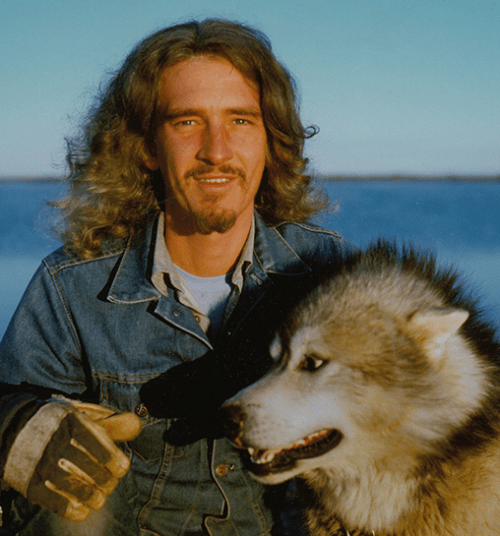
Early on Sunday 5 August 2018, Brian Ladoon died at the age of 65 in Churchill, Manitoba — and so far, the media have said nothing. Brian dedicated his life to the preservation of the Canadian Eskimo Dog — which often attracted polar bears to his property — but he was also an accomplished artist.

Ladoon and husky_Norbert Rosing obituary 6 Aug 2018

In the early days, (Norbert Rosing photo.

As a lover of Arctic dogs, I remember hearing of Brian’s work decades ago but only that “someone” was working hard to save the breed. I never dreamed I’d come to know so much more about his work through my research on polar bear ecology and evolution.

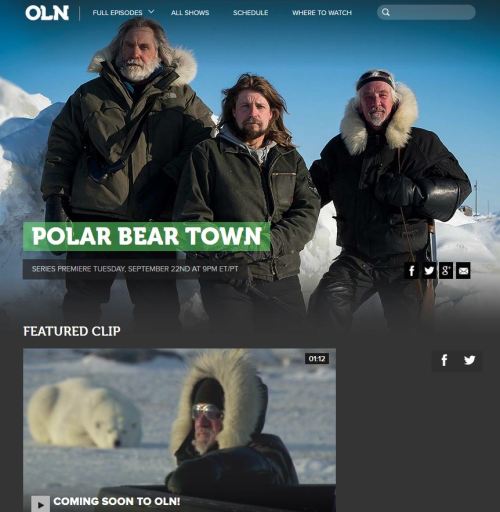
I never met the man. But he has clearly been an icon of Churchill for decades and because of that, the place will not be the same without him. He is on the right in the photo below, for the TV series “Polar Bear Town” that ran in 2015 (some episodes below).

Polar Bear Town premiere Sept 22 2015

UPDATE 9 May 2019: A reader asked what happened to Brian’s dogs and because I wondered myself, I asked around. Kelsey Eliasson responded:

“Penny his ex-partner is taking care of them with a small team of helpers… they are trying to formalize a board/non-profit for long-term needs”

Continue reading

Polar bears do not outnumber people in Svalbard and the backlash against ecotourism over a justified defensive kill

It is often said that there are more polar bears than people in Svalbard, Norway (see BBC, “Polar bear shot dead after attacking cruise ship guard29 July 2018). But that isn’t true now and probably hasn’t been for a very long time. This pseudo-fact (a misunderstanding made by tourism promoters) continues to be quoted as the story about the Svalbard polar bear shot by a cruise ship bear guard last week evolves in the online and print media. The media continue to focus on social media backlash against ecotourism, which is nothing like the pushback about the starving polar video from last year.

Svalbard dead bear_Gustav Busch Arntsen_Governor of Svalbard_NTB Scanpix via AP 28 July 2018

Continue reading

Churchill problem polar bear report for week 3, July 23-29 2018

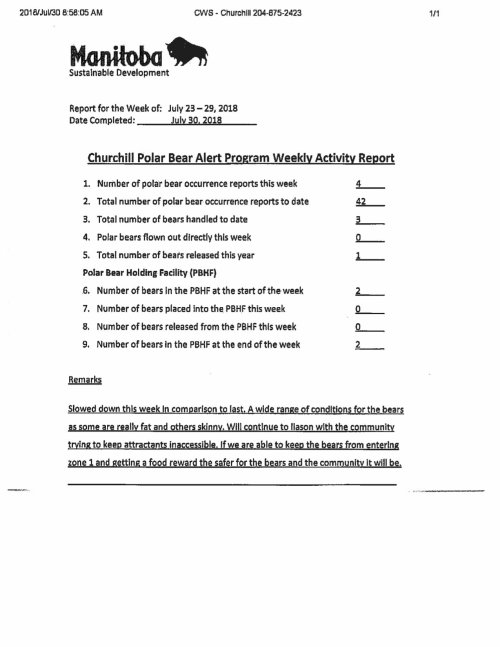
Polar bears that have come off the sea ice of Hudson Bay near Churchill, Manitoba in Western Hudson Bay are apparently in a wide variety of conditions, from very fat to skinny.  So, not all skinny despite the relatively early breakup of ice in the northwest.

Churchill PB reports_week 3_ July 23-29_July 2018

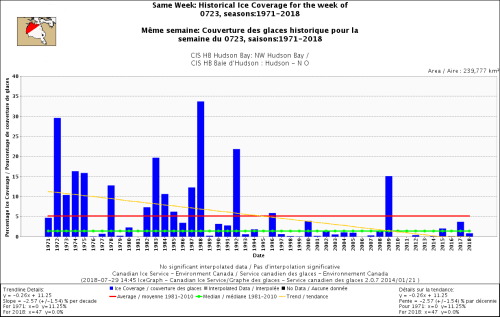
Most of the ice was gone from the NW of Hudson Bay for the week of 23 July 2018 and the graph below shows that this is a new pattern that began in 1997, with only 2009 being an outlier:

Hudson Bay NW same week_ ice coverage 23 July 1971-2018 with trend

Continue reading

Cruise ship bear guard survives being mauled by polar bear in Svalbard

Less than a month after a fatal polar bear attack near Arviat, Western Hudson Bay, European media reported this morning that one of two German polar bear guards escorting a group of tourists on a shore visit in northern Svalbard was mauled on 28 July by a polar bear before the second guard could kill it.

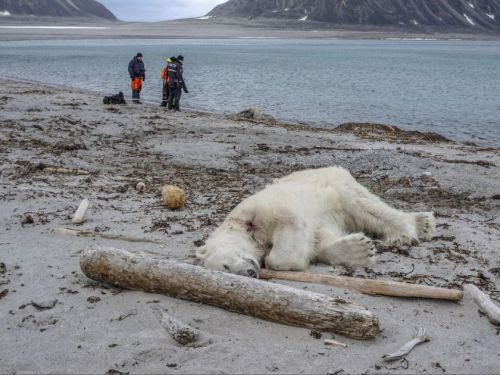
Svalbard dead bear_Gustav Busch Arntsen_Governor of Svalbard_NTB Scanpix via AP 28 July 2018

The man was air-lifted to hospital in Longyearbyen with non-life-threatening head injuries. Whether the bear was fat or thin was not mentioned but a necropsy will be performed.

More details are likely to be available within the next few days. The guards and tourists were from the German cruise ship MS Bremen, which apparently is operating a live web cam. The group landed on the Sjuøyane Islands, the northernmost group of islands in the Svalbard archipelago (see the top of the black box on the map below).

UPDATE 28 July 2018 11:00 pm PT: The photo of the dead bear (above, provided by the Governor of Svalbard), shows the animal was in poor condition. See my comments below regarding sea ice coverage for the area: the bear had likely been on the islands since early May and if he was not in good condition when he left the ice, he would have been desperate by now. However, we still do not know if he was sick or injured, young or old. That information will come with time.

UPDATE 29 July 2018: The cruise ship line has released a statement on Facebook that includes further details about the attack, see below.

Continue reading

The truth behind the Baffin Bay starving polar bear video is worse than we thought

Remember that video of an emaciated Baffin Island Somerset Island polar bear that went viral last December?1 In an unexpected follow-up (“Starving-Polar-Bear Photographer Recalls What Went Wrong“; National Geographic, August 2018 issue), photographer Cristina Mittermeier makes some astonishing admissions that might just make you sick.
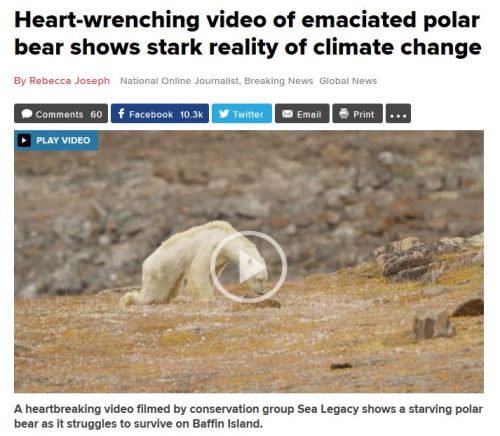
Baffin Island starving pb headline_GlobalNews_8 Dec 2017

It turns out they didn’t just come across the dying bear the day it was filmed: it was spotted at least two days earlier by Paul Nicklen. He must have had a satellite phone with him when he saw the bear but the only call he made was to his film crew — he made no attempt to find a local conservation officer to euthanize the bear, which would have been the right thing to do.

ADDED July 27 2018: Calling a conservation officer to euthanize the bear would have been the right thing to do not only out of compassion (and to know the cause of illness, because a necropsy would have been done), but because a starving bear is especially dangerous: it would have been a potential danger to any unsuspecting person who set foot on the island (he was strong enough to swim away, so was probably strong enough to kill a child, if not an adult).

The bear’s emaciated, near-death stagger2 was simply too tantalizing to pass up (video needs action: an emaciated dead bear would not been nearly as effective). Mittermeier claims they knew when they filmed the bear that he was sick or injured, but Nicklon presented it as an effect of climate change regardless. Mittermeier now says National Geographic simply “went too far” with their video caption (“This is what climate change looks like“), that she and Nicklan “lost control of the narrative.”

Actually, what they lost was their humanity.

Continue reading

Tracking polar bears in the Beaufort Sea May and June updates

At the end of June, there were nine bears remaining from the original 14 that were tagged with glue-on ear transmittors in April 2018 near Kaktovik, Alaska by US Geological Survey biologists.

putting_collar_on_polar_bear_slider_USGS

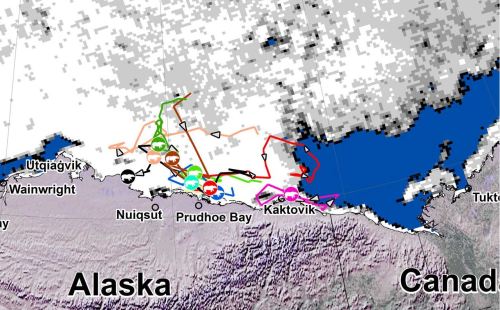
Below is the June 2018 tracking map (high resolution image is here):

Beaufort tracking USGS bear-movements-June 2018 sm

Original caption: “Movements of 9 satellite-tagged polar bears for the month of June, 2018. These bears received satellite eartag transmitters in 2018 on the spring-time sea ice of the southern Beaufort Sea. Polar bear satellite telemetry data are shown with AMSR2 remotely-sensed ice coverage for 30 June, 2018.”

See the close-up for June 2018 below:

Beaufort tracking USGS bear-movements-June 2018 closeup

As ear tags are notoriously short-lived, there may not be any remaining by the end of July but if there are, I will post the tracks. The map for May 2018 is below.
Continue reading

Churchill area polar bears off the ice as of third week in July say problem bear reports

Second week of Polar Bear Alert Activity reports (16-22 July) for 2018 and already two bears are in jail, making it the busiest 3rd week in July since 2015:

churchill-pb-reports_week-2_-july-16-22_july-2018-e1532401430601.jpg

Continue reading

US FWS proposes changes to Endangered Species Act, polar bear champions panic

Headline run by The Independent last Friday (20 July 2018):

‘A death sentence for polar bears’: Trump administration seeks changes to endangered species protections: Conservation groups are already vowing to sue the Donald Trump administration if the revisions go into effect

Beaufort Sea male polar bear USGS_2005 Amstrup photo

Such over-the-top rhetoric is as predictable as puddles after a cloud-burst (see a statement by the WWF here, and the Center for Biological Diversity (source of the “death sentence for polar bears” claim here) but the proposed changes only apply to future listings, not listings already in place. See the USFWS press release below.

However, both The Independent and ABC News featured polar bears in their stories, a species listed as threatened in 2008.

It would be hard to beat the irony of ABC: it ran video of fat Kaktovik polar bears behind their anchor as he delivered the ESA story. The Independent not only used the “death sentence to polar bears” quote but included the video clip from last year of the dying Baffin Island bear even though it is very likey the bear was emaciated due to cancer rather than lack of food (Crockford 2018).

Why would anyone mention polar bears? Why is the Center for Biological Diversity so afraid?

Because if polar bears face a delisting challenge, the new rules apply.

Continue reading