Fabulous polar bear science book for kids now available in French and German

Announcing the French and German translations of my popular science book, Polar Bear Facts and Myths (suitable for children aged seven and up), are now available through Amazon worldwide in paperback. Please pass along to your friends, relatives, and colleagues in North America and abroad. The English version still available in paperback and ebook formats.

FRENCH
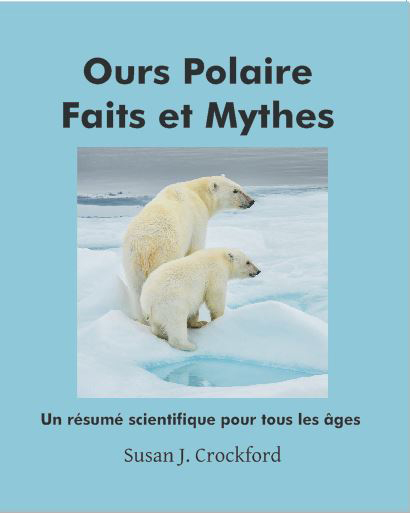
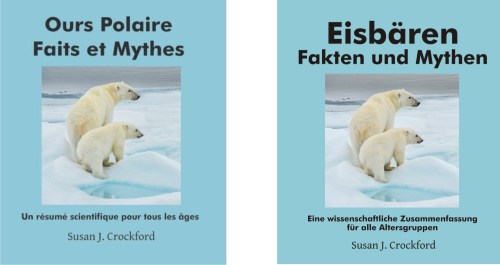
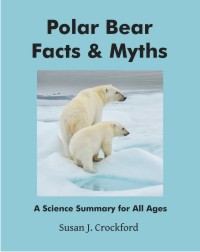
Crockford Ours Polaire_French front cover_web size_10 Sept 2017

Titre: Ours Polaire Faits et Mythes: Un résumé scientifique pour tous âges
L’autheur: Susan J. Crockford
Traduit par: Reynald Duberger
Date de publication: 10 September 2017
ISBN: 1976158362
Nombre de pages: 44
Le price: USD $12.99  €10.87  £9.94 [soon to be £10.03 to qualify for free shipping]  CAD $20.22 [with free shipping]

Acheter-le ici: Amazon.com [USA]; Amazon.ca [Canada, also in the French Immersion Store]; Amazon.fr [France]; Amazon.uk [UK]; Amazon.de [Germany]

On a fait croire aux enfants qu’il ne reste que quelques centaines d’ours polaires,  mais l’implacable message sur les ours polaires condamnés (par la faute de l’homme) est heureusement faux. Il est temps qu’on révèle la vérité aux jeunes.

Voici donc les bonnes nouvelles qu’on doit apprendre aux enfants: les ours polaires n’ont jamais été menacés d’extinction à cause d’un réchauffement global anthropique. Il y a effectivement davantage d’ours polaires qu’il y en avait il y a 50 ans, et la population globale est d’un taille respectable, en dépit du fait que la banquise d’été ait atteint des niveaux ayant dû, selon les prévisions, mener à la catastrophe depuis 2007.

Les ours polaires se sont adaptés admirablement bien à ces niveaux, et contre toute attente, leur nombre a augmenté et non pas diminué au cours des années.

L’ours polaire: Faits et Mythes est un livre scientifique inspirant sur la survie dans l’Arctique qui plaira aussi bien aux parents qu’aux enfants.

À propos de l’auteur: Susan Crockford est une zoologiste professionnelle. Depuis plus de 20 ans elle étudie l’écologie et l’évolution de l’ours polaire. Elle possède un PhD et maintient un blog sur le passé et le présent des ours polaires appelé http://www.polarbearscience.com.

Depuis longtemps, les lecteurs réclamaient un livre clair et simple sur la science de l’ours polaire s’adressant aux enfants comme aux adultes, offrant la même approche rationnelle que celle de ses publications scientifiques pour adultes. Susan leur livre enfin cet ouvrage.

Un livre d’accompagnement (en anglais) est aussi disponible (Polar Bears: Outstanding Survivors of Climate Change) présentant des détails bien référencés sur les questions et enjeux récents concernant la conservation de l’ours polaire. Pour les amateurs de fiction, elle propose aussi un thriller sur les attaques d’ours polaires (EATEN: A Novel), également en anglais.

GERMAN
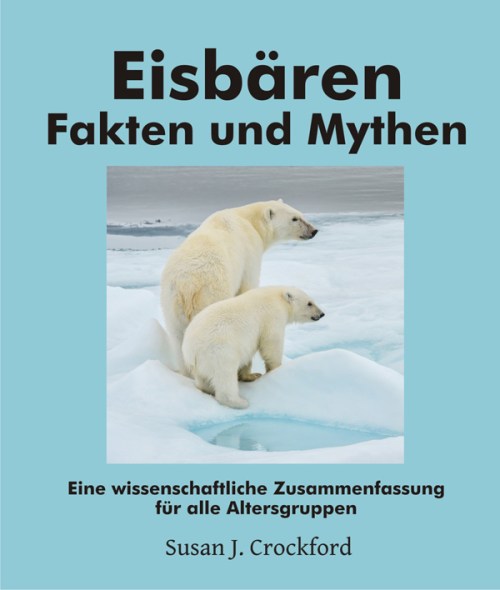
Crockford FM FRONT cover only_German 10 Sept 2017 web size

Der Titel: Eisbären Fakten und Mythen: Eine wissenschaftliche Zusammenfassung für alle Altersgruppen
Der Autor: Susan J. Crockford
Übersetzt von: Marie McMillan
Datum der Veröffentlichung: 10 September 2017
ISBN: 1976305748

Seitenzahl: USD $12.99  €10.87  £9.94 [soon to be £10.03 to qualify for free shipping] CAD $20.22 [with free shipping]

Kauf es hier: Amazon.com [USA]; Amazon.de [Germany]; Amazon. ca [Canada]; Amazon.uk [UK]; Amazon.fr [France]

Beschreibung auf Deutsch

Vielen Kindern weltweit wurde erzählt, dass es nur noch ein paar hundert Eisbären auf der ganzen Welt gibt. Zum Glück ist die Nachricht, dass der Polarbär dem Untergang geweiht sei (und dass das allein die Schuld der Menschen sei) falsch. Es wird Zeit, dass die Kinder dies erfahren.

Die gute Nachricht, die Kinder hören müssen, ist diese: Eisbären sind nicht vom Aussterben bedroht aufgrund des Klimawandels. Tatsächlich gibt es heute viel mehr Polarbären als vor 50 Jahren und die Population weltweit hat eine gesunde Größe. Und das obwohl das Meereseis seit 2007 ein Niveau erreicht hat, von dem es hieß, dass es katastrophale Folgen haben würde. Eisbären kommen ganz gut mit weniger Meereseis im Sommer klar; entgegen allen Erwartungen ist ihre Zahl über die Jahre gestiegen, sie sind nicht weniger geworden.

Eisbär Fakten und Mythen ist ein ermutigendes wissenschaftliches Buch über das Überleben in der Arktis, welches Kindern und Eltern gleichermaßen gefällt.

Über die Autorin: Susan Crockford ist eine professionelle Zoologin, die seit mehr als 20 Jahren Polarbär-Ökologie und Evolution studiert. Sie hat einen Doktortitel und schreibt einen Blog über die historische und gegenwärtige Situation der Polarbären: http://www.polarbearscience.com. Seit Jahren fragten Leser sie nach einem wissenschaftlichen Buch dass sich auch an Kinder richtet und in gleichsam rationaler und umfassender Perspektive gehalten ist wie ihre wissenschaftlichen Texte für Erwachsene. Dieses Buch ist Dr. Crockfords Antwort.

English version of above descriptions copied below:

Continue reading

Problem polar bears in Churchill at this date show 2017 less than 2016 and 2015

Comparing Churchill problem bear statistics over a few years provides some critical perspective: this year, the bears are causing much fewer problems.

This 2nd week in September is no exception, being the 9th week ashore in all cases: 2017 (4-10 September, where I think “total number of polar bear occurrence reports to date” should be 64, not 53, see week 7 report here), 2016 (5-11 September), 2015 (7-13 September), where there were about 1/2 the number of bears in “jail” this year compared to the last two years (i. e., 6 vs. 11 and 12) and slightly more than 1/2 the number of occurrence reports in 2017 than in 2016 and 2015 (64 vs. 107 and 99):

2017 week 9 Sept 4-11 may be typo

2016-sept-5-11_week-9.jpg

2015 Sept 7-13_at Sept 14


Problem bear reports confirm Churchill polar bears are in excellent condition

Now that all bears are ashore for the season, the folks at the Polar Bear Alert program in Churchill note in their report for week 7 (21-27 August, 2017) that the bears ashore are in excellent condition (confirming reports on the first bears ashore in July):

Churchill PB reports_week 7_ Aug 21-27_2017_Aug 28

Rather marked contrast to the pessimistic spin on conditions from the field a few months ago:

[yes, a few bears fail to make it through the winter, especially young bears; but that has always been the case — it’s not a sign of human-caused global warming catastrophe]

Last week’s problem bear report also confirmed news from the Churchill Polar Bears website a few weeks ago that showed several images of very fat bears:

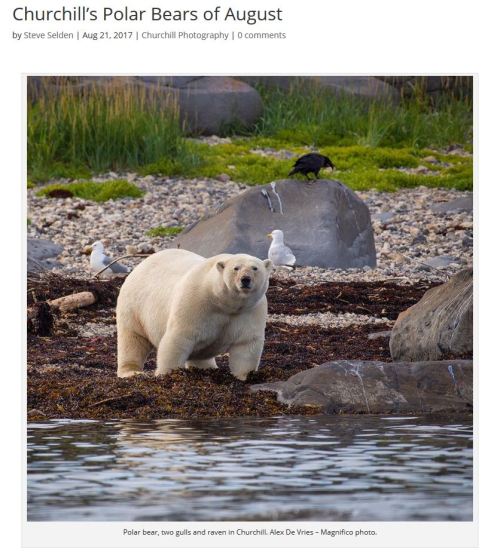
Churchill_PolarBears_FAT bear post_21 Aug 2017

See below for last year’s report for week 7 and this year’s report for week 8 (28 August-3 September). Western Hudson Bay polar bears that come ashore near Churchill, Manitoba are starting their third month on land this week, out of the five months or so they have spent ashore in recent years (about 3 weeks more than in the 1980s, no longer than they did in 2004 — conditions have not been getting worse).

Continuereading

Video: Death of a Climate Icon, the polar bear’s demise as a useful poster child

Last week I asked: “What’s causing the death of the polar bear as a climate change icon?”

I was echoing the conclusion of a commentator at the Arctic Institute (22 August 2017) who lamented: “The polar bear is dead, long live the polar bear” and climate scientist Michael Mann, who told a lecture audience a few months ago that polar bears are no longer useful for generating “action” on climate change.

Crockford 2017_Slide 15 screencap

This is slide 15 from my presentation at ICCC-12 in Washington, D.C. in March 2017.

Now here’s the video. Watch “The Death of a Climate Icon” (31 August 2017):

The video was made possible with the assistance of the Global Warming Policy Foundation.

Kind of makes you wonder: is Al Gore’s recent climate change movie, An Inconvenient Sequel: Truth to Power, tanking at the box office because he couldn’t include polar bears as an example of the effects of human-caused global warming as he did in his award-winning 2007 effort? Did too many polar bears doom Gore’s 2017 movie?

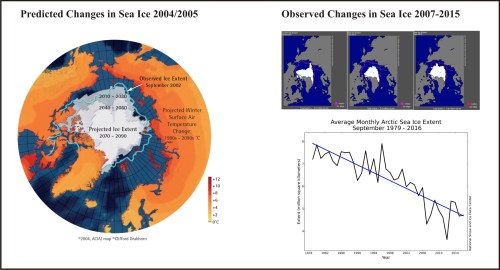
Conclusions in the video about the predictions of polar bear decline vs. the current status of polar bears and sea ice are documented in my 2017 published paper:

Crockford, S.J. 2017. Testing the hypothesis that routine sea ice coverage of 3-5 mkm2 results in a greater than 30% decline in population size of polar bears (Ursus maritimus). PeerJ Preprints 19 January 2017. Doi: 10.7287/peerj.preprints.2737v1 Open access. https://peerj.com/preprints/2737/

Crockford 2017 sea ice graphic

Polar Bear Facts & Myths translations in French and German coming soon

Translations of my popular polar bear science book Polar Bear Facts & Myths — suitable for readers aged seven and up — are almost complete. Versions in French and German will be available soon through Amazon.

FM French and German covers_10 Sept 2017


These translations have been done by native French and German speakers. They are particularly suitable for Canadian French immersion science classes and home school science lessons worldwide. But most importantly, they offer the chance for young children whose first language is French or German to read a sensible book about polar bears loaded with fabulous colour images.

Ours Polaire Faits et Mythes — Bientôt disponible!

Eisbären Fakten und Mythen — Bald erhältlich!

These translated versions of Polar Bear Facts & Myths will delight children of all ages as well as adults: they have the same question and answer format and are based on the most up-to-date science.

Please pass this notice along to teachers and parents you think might be interested.

Pacific walrus haulout two weeks early, US gov’t agency blames “earliest” ice loss

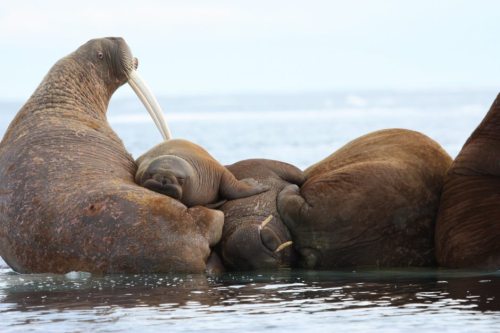
Walrus 2012 July USGSThis year’s baseless media frenzy over walrus survival and loss of summer sea ice blamed on human-caused global warming was initiated by a press release from US Fish and Wildlife last week (16 August 2017, pdf here: “Pacific walruses haul out near Point Lay earlier than in previous years“). Quote below, my bold:
In the first week of August, several hundred Pacific walruses were observed on a barrier island near the Native Village of Point Lay, a small, Iñupiaq community on the northwest coast of Alaska. This is the earliest date yet for the haulout to form…This year, sea ice has retreated beyond the continental shelf earlier than in previous years

But is this all true? In a word, no — and it didn’t take much research to uncover the truth.

UPDATE 24 August 2017: A few minutes after this post was published, I became aware that just yesterday, 20 conservation activist organizations, lead by the Center for Biological Diversity (who led the polar bear listing charge) issued a press release regarding a letter (pdf here) pressuring the US Fish and Wildlife Service to list Pacific walrus as threatened or endangered under the Endangered Species Act. Apparently, a decision must be made by the end of September on whether to actively list walrus or not. The text below has been amended to reflect this development.
Continue reading

Fat polar bears [and lots of them] drive public confidence in future of the species

What is causing the death of the polar bear as a climate change icon? Fat bears are part of it, but mostly it’s the fact that polar bear numbers haven’t declined as predicted.

Western Hudson Bay polar bears around Churchill, Manitoba appear mostly in good shape this summer despite the very late freeze-up last fall, including the very fat bear caught on camera below (see more great pictures here):

Churchill_PolarBears_FAT bear post_21 Aug 2017

Not only have we been seeing pictures of fat bears rather than starving bears in recent years but there are lots of them, in Western Hudson Bay and other seasonal sea ice regions where there should be none (if the models had been correct). No wonder polar bears are falling out of favour as an icon for catastrophic human-caused global warming.

[Here’s another picture of a fat bear, this one from Svalbard]

Excuses for why the public is no longer worried about the future of polar bears include a recent claim by climate scientist Michael Mann that “by making polar bears and penguins the poster child for climate change, we have wrongly conveyed that this is some exotic problem far off.

But none of these apologists acknowledge the simple truth: the models that  predicted catastrophe for polar bears due to diminished summer sea ice turned out to be wrong. The sea ice declined but polar bears flourished. Polar bears in seasonal sea ice ecoregions like Western Hudson Bay and Baffin Bay didn’t die off due to climate change as people were told would happen — why should they believe any of the other scare stories?

In and around Churchill, where tourists flock to see Western Hudson Bay polar bears up close and personal, one bear in good condition recently ran through town:

Overall, there have been fewer problems or conflicts this year in Churchill compared to last (after 6 weeks of onshore living), see below.

Polar bears are no longer a useful global warming icon because they are thriving despite diminished sea ice: Churchill area polar bears are a good example.

Continue reading

Churchill polar bear reports still showing fewer problems than last year

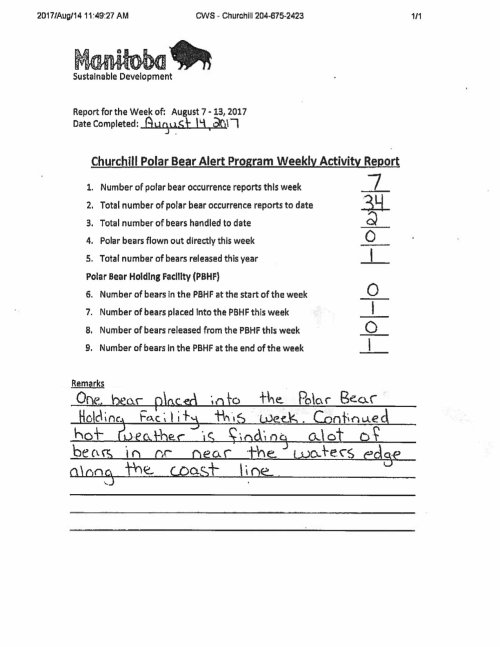
Churchill, Manitoba’s Polar Bear Alert Program is still reporting many fewer problems with polar bears onshore than it did last year at the same point in the ice-free season (week 5, 7-13 August):

Churchill PB reports_week 5_ Aug 7-13_2017

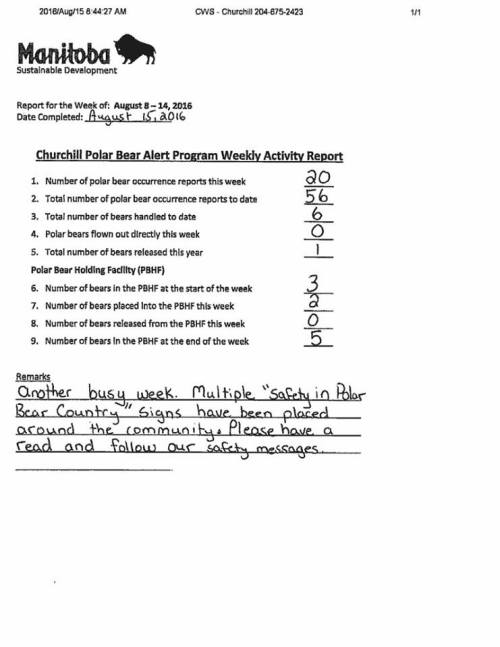
Compare to week five last year (2016), when bears came ashore in excellent condition:

2016 Aug 8-14_week 5

Although it’s been warmer than average recently (25.4 degrees C yesterday, expected to reach 29 degrees C today and 28 degrees C tomorrow), according to Environment Canada weather records, that’s not even close to an August record-breaker temperature for Churchill. Continue reading

Churchill polar bear reports to 6 August show fewer problems than last two years

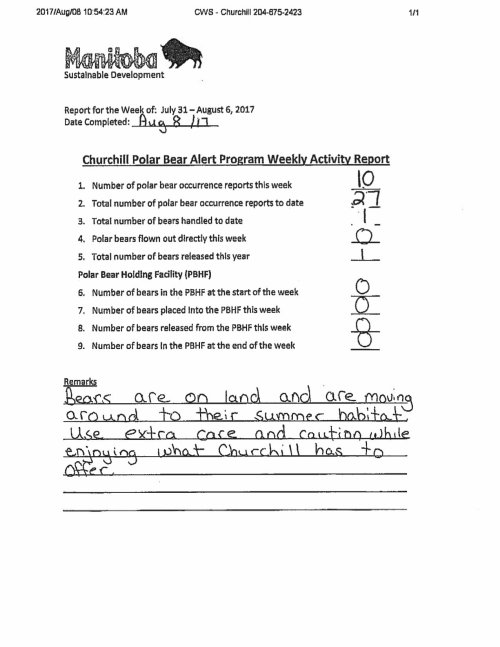
Churchill, Manitoba Polar Bear Alert Program problem bear reports for weeks 3 (24 July – 30 July 2017) and 4 (31 July – 6 August 2017) show much less activity and fewer problems in this Western Hudson Bay location than were reported for the last two years (2016 and 2015) at the same time (relative to the first reports of the season):

Churchill PB reports_week 4_ July 31- Aug 6_2017

Compare 2017 to last year (2016) at this time, where the problem bear report claims numbers were similar to 2015 (for which I don’t have a week 4 report), with more bears handled and placed in “jail”:

2016 Aug 1-7_week 4

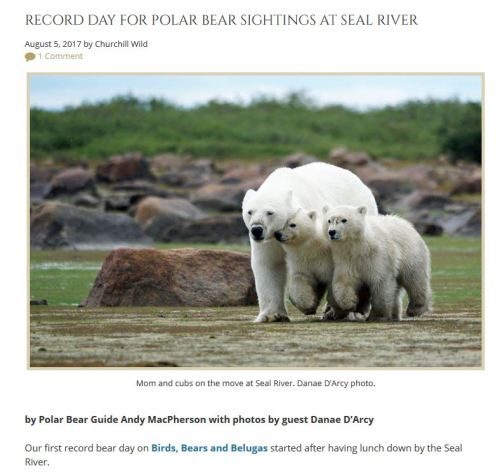
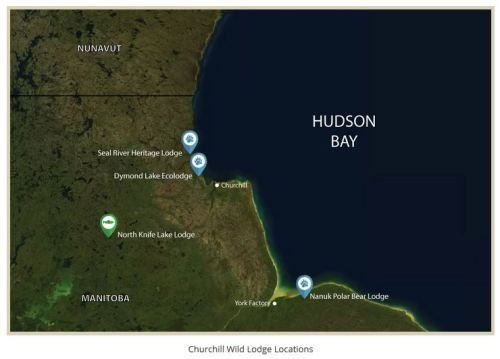
But most Western Hudson Bay bears are at their highest body weight when they come off the ice in early summer and present little risk to humans who keep their distance — few bears cause any real problems this time of year. Compare the above problem bear reports to the blog post from Seal River Lodge, just north of Churchill (5 August 2017, from Churchill Wild Eco-Lodge), which reports seeing 11 bears in one day of viewing. Great photos at this post confirm those bears are in good physical condition and interacting with each other without bothering people.

Seal River polar bear report for 2017 Aug 5

Seal River Lodge location 2017

Continue reading

Churchill polar bear report 24-30 July rather boring compared to last year

This is the third week of reports from the Churchill Polar Bear Alert Program but not much in the way of excitement or information, although more bears must be ashore by now.

Churchill PB reports_week 3_ July 24-30_July 2017

Compare to last year at this time, when there was much more activity:

2016 July 25_31_week 3

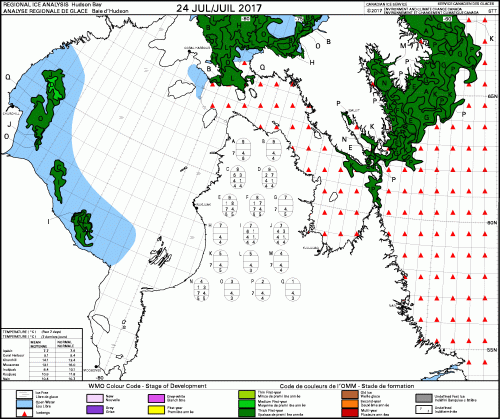
There was still some thick ice lingering off the coast of Western Hudson Bay last week, as this weekly ice chart shows:

Hudson Bay ice weekly stage of development 2017_July 24