Tag Archives: Amstrup

Polar bear biologists doing mark-recapture work in Hudson Bay may have misled the world

What exactly are Western Hudson Bay (WHB) polar bear researchers hiding? Since 2004, research on the body condition and cub production of Western Hudson Bay (WHB) polar bears has been carried out but none of the results of these mark-recapture studies have been made public.

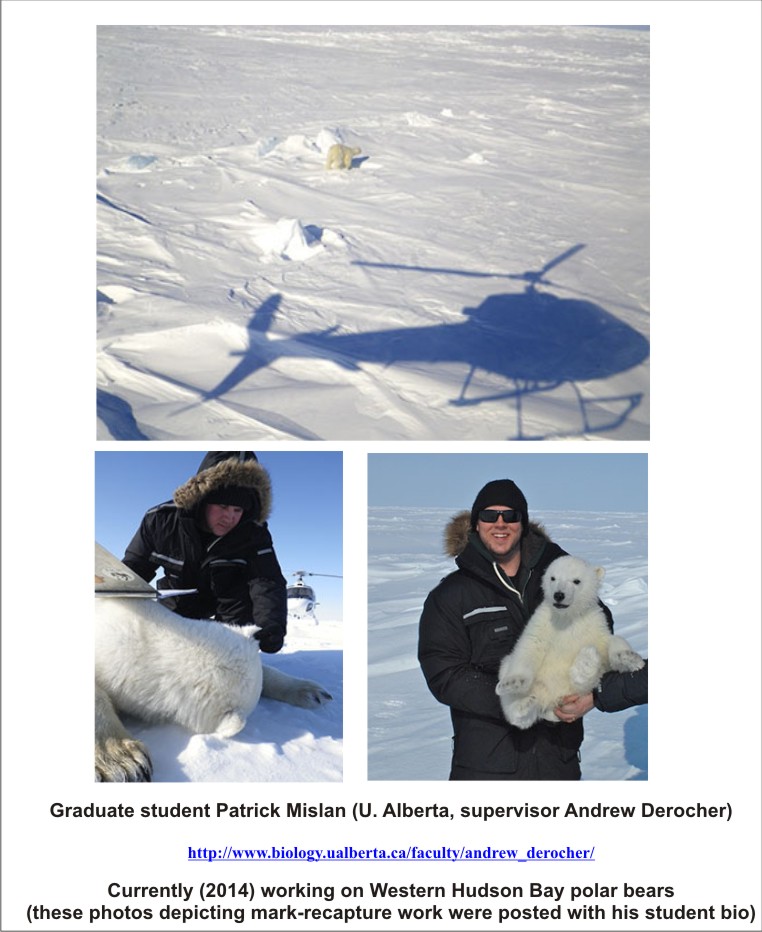
U Alberta student Mislan bio photos_PolarBearScience

The researchers all claim that WHB polar bears are struggling to survive because of recent sea ice changes but won’t release the 10 years worth of updated information they possess on the bears or the sea ice.

Continue reading

W Hudson Bay polar bear population no longer “declining” – where are the headlines?

Why are the #saveourseaice folks at Polar Bears International, who have being working in Western Hudson Bay for decades, not dancing in the streets of Churchill? Environment Canada’s Polar Bear Technical Committee upgraded the status of Western Hudson Bay polar bears from “declining” to “likely stable” four months ago (details here). Why has this fabulous news not made major headlines around the world?

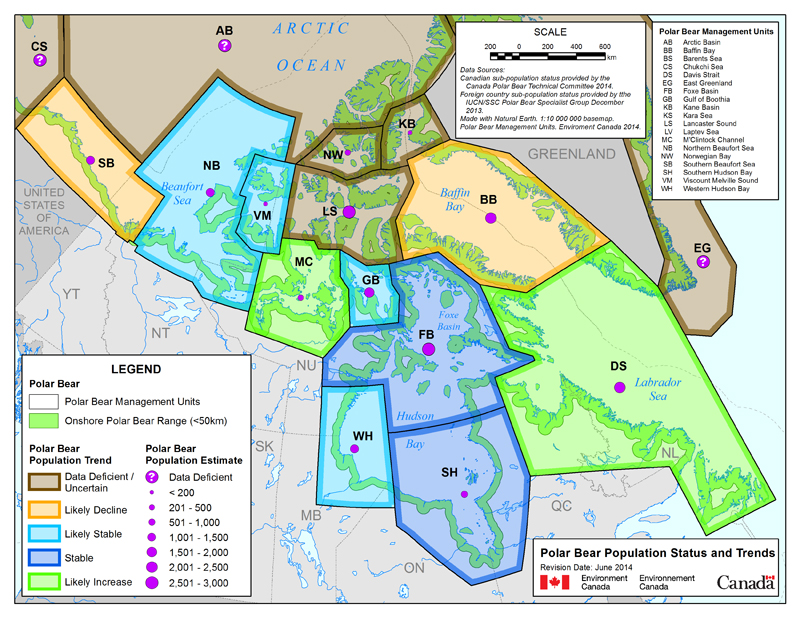
Figure 4. Environment Canada's "Map 3: 2014 Canadian Polar Bear Subpopulation and Status Map," original here.

Figure 1. Environment Canada’s “Map 3: 2014 Canadian Polar Bear Subpopulation and Status Map,” original here. Western Hudson Bay is “WH.”

After years of being told by polar bear specialists and activists organizations like Polar Bears International and the World Wildlife Fund that the Western Hudson Bay (WHB) population is already suffering mightily because of global warming, it now appears that is far from the truth.

Continue reading

Dodgy new clarification of global polar bear population estimate (yes, another)

In an attempt to get themselves out of a mess of their own making, the IUCN Polar Bear Specialist Group (PBSG) has just dug their hole even deeper.

pbsg logo

Although the minutes of their 2014 June meeting (pdf here) contained this statement…

K. Laidre summarized the need for the PBSG to do a better job of communicating accurate and balanced science about polar bears.” Pg. 28

…you might conclude, after reading the rest of this post, that polar bear specialists don’t really understand what these terms mean.

Due to the flack they have been catching over their global polar bear population estimates, the PBSG determined that another clarification was in order. [As opposed to the first clarification, a footnote the group planned to insert in an upcoming report, which PBSG chairman Dag Vongraven sent to me in May)]

The new clarification, apparently co-authored by Steve Amstrup and Andy Derocher (PBSG 17 minutes, pg. 33 – copied below), makes an astonishingly bold claim that I can easily show is untrue.

PBSG 17 minutes_global pop estimate explanation action p33 to post Continue reading

Low genetic diversity will not make polar bears more vulnerable to extinction

You’ve probably heard the argument: animal populations that have been through a major decline in numbers often have such low genetic diversity that they are extremely vulnerable to subsequent extinction.

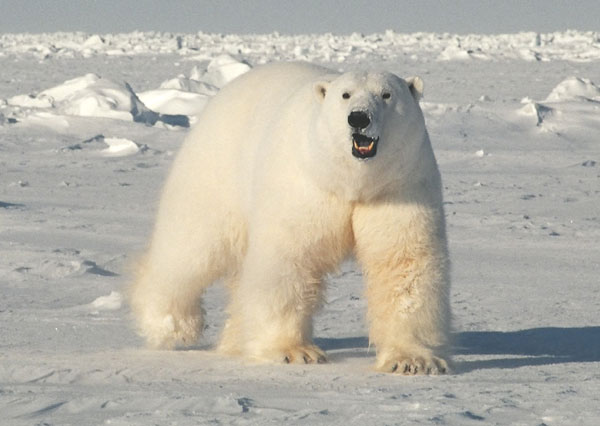
Photo credit USGS

Photo credit USGS

In an interview in late March regarding a new genetic paper on polar bear evolution (by Matt Cronin and colleagues), polar bear biologist and Polar Bears International spokesperson Steve Amstrup made a ridiculous statement: that polar bears have never experienced a rate of warming like they’ve seen over the last 30 years. I countered that easily here.

In that same interview about the Cronin et al. paper, fellow geneticist Charlotte Lindqvist offered an outdated argument against future polar bear survival that is as easy to refute as Amstrup’s “unprecedented rate of warming” nonsense.

I didn’t have time to deal with it back in April [where has the time gone?] but want to get back to it now because it’s important: there is lots of evidence to support my contention that polar bears are not more vulnerable to extinction just because they have low genetic diversity.
Continue reading

Polar bears and melting ice: three facts that shouldn’t surprise you

If I was invited by USA TODAY to discuss how climate change is affecting polar bears now – summed up in three talking points – this is what I’d say. I’d use some meaningful images rather than cute pictures of cuddly bear cubs and I’d provide links to my work with references and details to back up my answers.

Compare my responses to those supplied by Steve Amstrup in his capacity as spokesperson for Polar Bears International (“Save our sea ice!”) to Jolie Lee at USA TODAY last week, who’s word is expected to be taken as gospel.

AK PB N Shore-USFWS Barrow_labeled

Continue reading

Are Polar Bears Really Endangered?

Christina Wu at the Urban Times (July 3, 2014) recently asked this question. She came up with a surprisingly balanced argument but some predictable responses from IUCN Polar Bear Specialist Group (PBSG) biologists. As a consequence, she overlooked some critical facts that make a big difference to the answer.

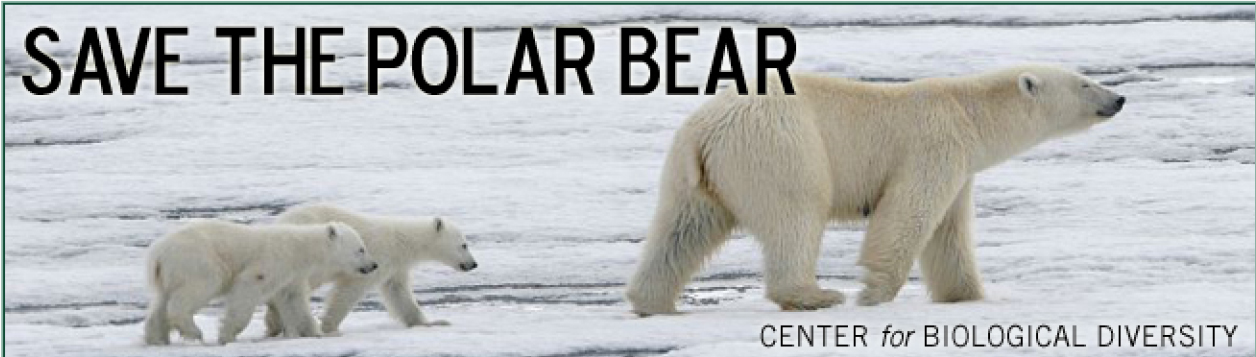
Figure 1. Are polar bears really endangered? The US Fish and Wildlife Service thinks so, but only because Steven Amstrup, based on a computer model projecting sea ice out to 2050, said so (Amstrup et al. 2007). This information has been used by the Center for Biological Diversity and other NGOs, like WWF and Polar Bears International (where Amstrup is now employed), to solicit donations.

Figure 1. Predictions of polar bear population declines by 2050 are being used by the Center for Biological Diversity, WWF and Polar Bears International to solicit donations.

UPDATED 18 May 2015 – see below.

Continue reading

Polar bears move around as sea ice habitat changes – this is what resilience looks like

Oddly, it seems some people expect polar bears to sit around and suffer (or die) when local conditions deteriorate, rather than move elsewhere.

PolarBear_2008_USGS

While there are perhaps a few places where moving is not really an option over the short term, over the long term (more than one season) polar bears are free to shift to another locale if ice conditions change (either too much ice or too little).

An announcement by the WWF last week (10 April) caught my eye, as it talked about bears moving from one area to another because of changing ice conditions — as if this was surprising, extraordinary and newsworthy. That said, at least they weren’t suggesting the bears are all going to die because of declining ice, which is a huge improvement.

See what you think of this part of the press release (below), in the context of what we know about the movement of bears between regions:

Continue reading

Amstrup grasps at straws to defend his polar-bears-are-doomed computer model

Polar bear activist Steven Amstrup made an astonishing statement in an interview earlier this week — he insisted that the current rate of warming in the Arctic is greater than anything polar bears have lived through before. He also said that optimistic comments on the future of polar bears made by geneticist Matt Cronin a few weeks ago were “incautious” and “misleading.”

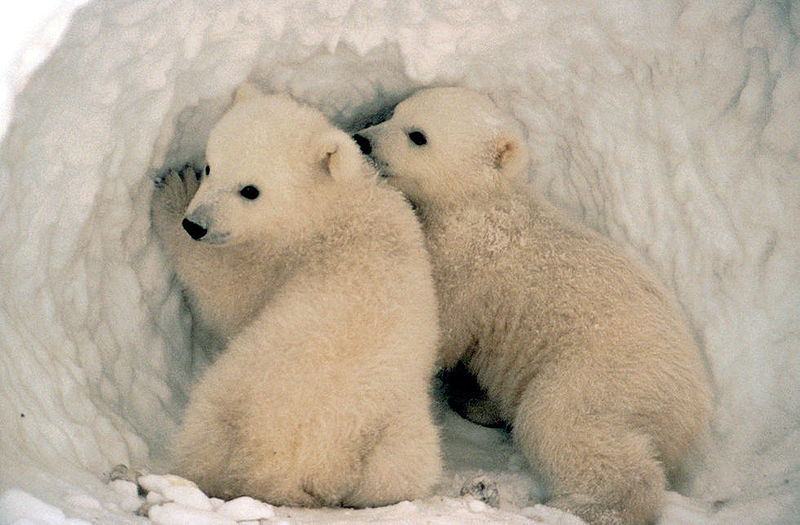
Polar bear cubs in den wikipedia

Previously, I described how a new paper by Cronin and colleagues confirmed that genetic evidence indicates polar bears have been around long enough to have survived several past Interglacial periods that were warmer than today (and therefore, would have had virtually no summer ice). Cronin, not unreasonably, had some critical things to say about computer modeled predictions that polar bears could not survive in an Arctic without summer sea ice.

On Monday, the Anchorage Daily News gave Amstrup a forum to rebuke Cronin for his comments. A similar story was also carried by the Washington Post. [In the same ADN article, geneticist Charlotte Lindqvist, offered an outdated argument against future polar bear survival that I’ll deal with later]

Today, I’ll address Amstrup’s ridiculous assertion that the current rate of warming, attributed by him primarily to human activities rather than natural variation, is something polar bears have never experienced in their evolutionary history (a period of more than 400,000 years!).

Let’s start with the offending portion of the news item (published March 31, 2014):

Continue reading

Oil money provided the foundation of polar bear research, now its “greenwash”

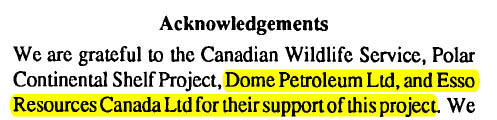
Much of the polar bear research in Canada and American Arctic in the 1970s-1980s was funded by oil and gas companies, because it was the right thing to do (and governments required it). Now, Greenpeace says providing such money is just oil company marketing, meant to make them look good.

Stirling et al 1993_oil acknowledgement

Stirling et al. 1993, oil funding acknowledgement for work in the Eastern Beaufort Sea.

Oil money helped fund the Ph.D. research of polar bear biologist and Polar Bears International spokesperson Steven Amstrup (Amstrup and Durner 1995), and made possible a number of other critical research projects in the early days of polar bear research that might not have been possible otherwise (Stirling et al. 1993; Stirling and Lunn 1997).

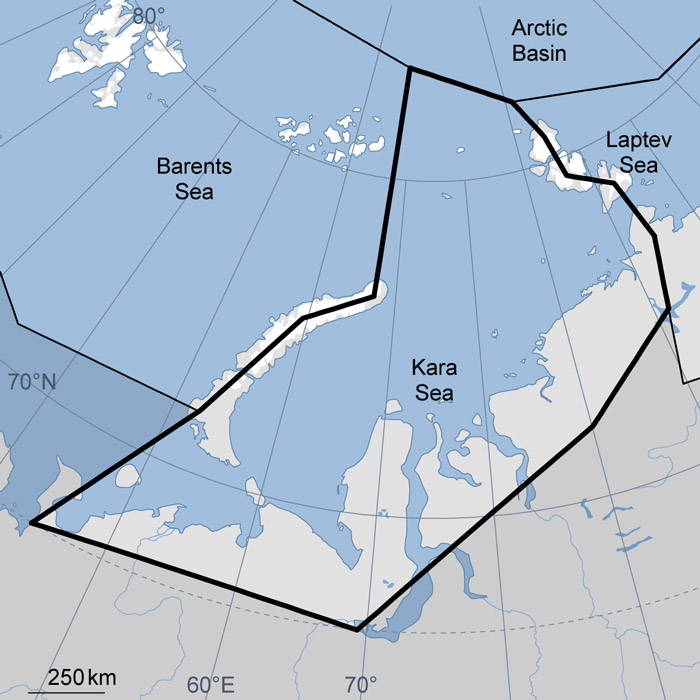
Yesterday, several media reports announced that ExxonMobil had advertised for a job counting polar bears in the Kara Sea (where very little research has been done), but a Greenpeace spokesperson called this an “obvious greenwash.

Have a look at the media reports and the oil funding acknowledgements from polar bear research papers (“References”) and see what you think.

Courtesy IUCN Polar Bear Specialist Group.

Courtesy IUCN Polar Bear Specialist Group.

Continue reading

Southern Beaufort polar bear ‘decline’ & reduced cub survival touted in 2008 was invalid, PBSG now admits

It is now clear that the phenomenon of bears moving across Southern Beaufort Seapbsg logo subpopulation boundaries compromised the US decision to list polar bears as ‘threatened’ and the IUCN Polar Bear Specialist Group (PBSG) knows that was the case.

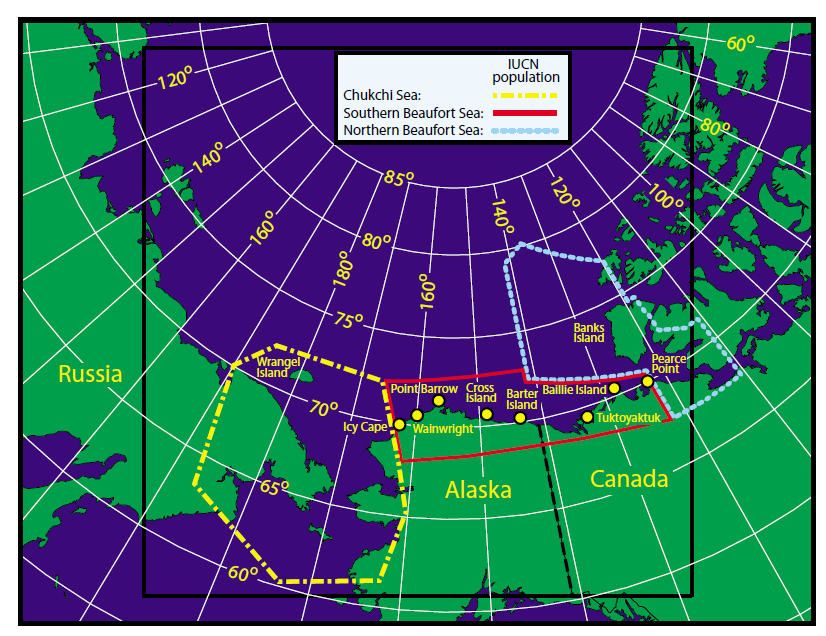
As I pointed out last week, the PBSG has admitted in their 2013 status table update (pdf here) that bears move around so much between the Chukchi Sea (CS), the Southern Beaufort (SB), and the Northern Beaufort (NB) subpopulations that major changes in the boundaries of the SB subpopulation are necessary (see Fig. 1 below).
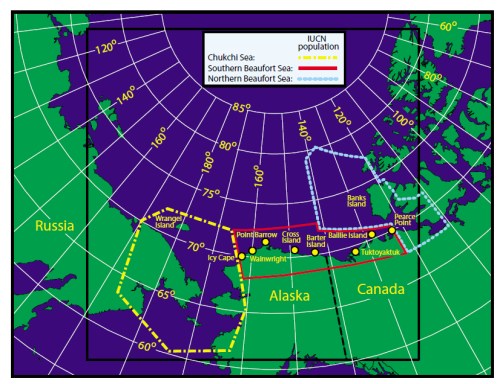
Figure 1. From the paper by Amstrup and colleagues (2005) describing the effect that movement of bears across subpopulation boundaries has on setting harvest quotas – and population estimates. Southern Beaufort boundary is solid red, Chukchi Sea is dashed yellow and Northern Beaufort is dotted light blue. “Point Barrow” is Barrow, AK (well inside the SB boundary). Click to enlarge.

Figure 1. From the paper by Amstrup and colleagues (2005) describing the effect that movement of bears across subpopulation boundaries has on setting harvest quotas and population estimates. Southern Beaufort (SB) boundary is solid red, Chukchi Sea (CS) is dashed yellow and Northern Beaufort (NB) is dotted light blue. “Point Barrow” is Barrow, AK (well inside the SB boundary). Click to enlarge.

Well, that’s not really news — changes to the SB boundaries were promised by the PBSG back in 2009 (Obbard et al. 2010), based on research by Steven Amstrup and colleagues published in 2001 and 2005. But now, in an astonishing admission, the PBSG have acknowledged that the last population survey for the SB (Regehr, Amstrup and Stirling, 2006), which appeared to register a decline in population size and reduced cub survival over time, did not take known movements of bears into account as it should have done.

In other words, that 2006 study almost certainly did not indicate bears dying due to reduced summer sea ice in the SB, as biologists said at the time — and which they presented as evidence that polar bears should be listed by the ESA as ‘threatened’ — but reflected capture of bears that were never part of the SB subpopulation and so moved out of the region.

As the PBSG said about the 2006 estimate:

“…it is important to note that there is the potential for un-modeled spatial heterogeneity in mark-recapture sampling that could bias survival and abundance estimates.” [my emphasis]

Spatial heterogeneity” means that the sampled bears could have come from more than one population, a possibility which violates a critical requirement of the statistics used to generate the population and survival estimates. “Un-modeled” means that the ‘movement of bears’ problem was not factored into the mathematical models that generated the 2006 population size and survival estimates as it should have been.

Ecologist Jim Steele pointed some of this out in his book and his guest post last year, so it’s not news that this was done.

What’s shocking is that the PBSG have now admitted that the ‘movement of bears’ issue essentially invalidates the 2006 population estimate and the much-touted ‘reduced survival of cubs.’ The reduced survival of cubs data from that SB study was a critical component of the argument that US bears were already being negatively impacted by global warming and thus, should be listed as ‘threatened’ under the ESA (US Fish & Wildlife Service 2008).

Since the population decline and reduced survival is now acknowledged to be unfounded — and perhaps deliberately so — I ask you this: will a new SB survey — soon to be released by the same lead author (Eric Regehr) — undo the broken trust in US and PBSG polar bear biologists? Continue reading