Tag Archives: Churchill

A more optimistic view of Churchill polar bears and Hudson Bay freeze-up

Finally, an unbiased first-hand report about Churchill polar bears and freeze-up on Hudson Bay.

Over the last few weeks, biologists Andrew Derocher and Steve Amstrup have been repeating their tired old tales of doom and gloom about the polar bears around Churchill and I’ve done my best to refute the worst of their nonsense.

Figure 1. Polar bear female with cub, 2009, Churchill, Western Hudson Bay. Wikipedia.

Figure 1. Polar bear female with cub, 2009, Churchill, Western Hudson Bay. Wikipedia.

To that effort we can now add this report from PolarBearAlley, where Kelsey Eliasson has posted a good-news story about the bears of Cape Churchill and the progress of freeze-up, including sightings of a number of mothers with cubs.
Continue reading

W Hudson Bay polar bear population no longer “declining” – where are the headlines?

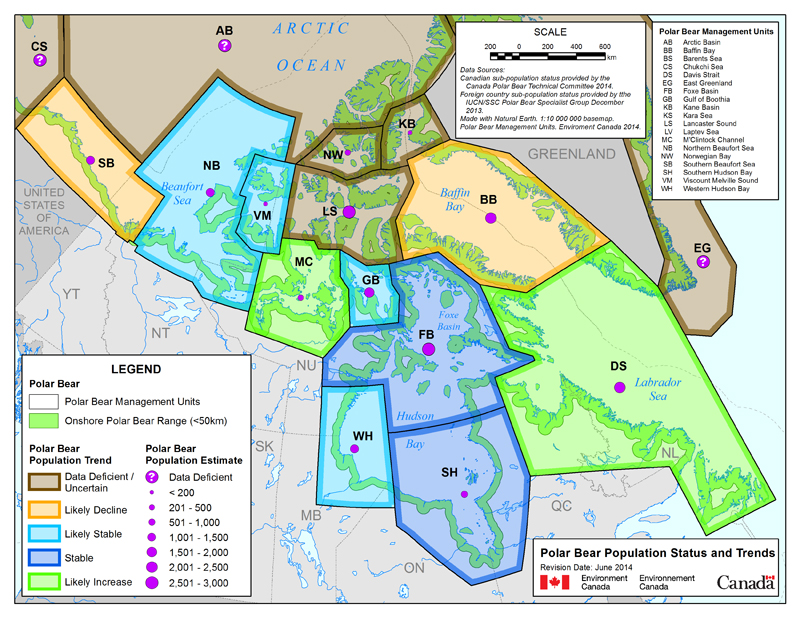
Why are the #saveourseaice folks at Polar Bears International, who have being working in Western Hudson Bay for decades, not dancing in the streets of Churchill? Environment Canada’s Polar Bear Technical Committee upgraded the status of Western Hudson Bay polar bears from “declining” to “likely stable” four months ago (details here). Why has this fabulous news not made major headlines around the world?

Figure 4. Environment Canada's "Map 3: 2014 Canadian Polar Bear Subpopulation and Status Map," original here.

Figure 1. Environment Canada’s “Map 3: 2014 Canadian Polar Bear Subpopulation and Status Map,” original here. Western Hudson Bay is “WH.”

After years of being told by polar bear specialists and activists organizations like Polar Bears International and the World Wildlife Fund that the Western Hudson Bay (WHB) population is already suffering mightily because of global warming, it now appears that is far from the truth.

Continue reading

Churchill problem bears and early breakup dates in WHB: The 1983 & 2004 anomalies

In this part of my critique of Stirling and Parkinson (2006), regarding breakup dates in Western Hudson Bay (see Part I here), I will show that these authors also left out critical data.

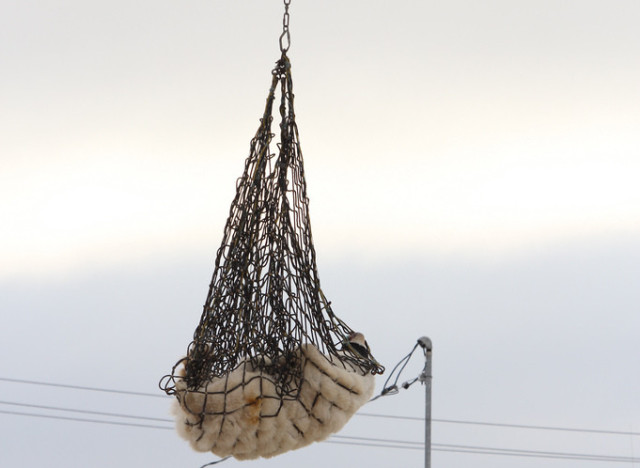
Figure 1. A bear is transported to Churchill’s polar bear holding facility, from a 2011 Huffington Post article “Polar Bear Prison.”

Figure 1. A bear is transported to Churchill’s polar bear holding facility, from a 2011 Huffington Post article “Polar Bear Prison.”

Their correlation between number of problem bears in Churchill and breakup dates for WHB worked because some very inconvenient data were simply left out: problem bear data for 1983 and 2004.

Inclusion of that information would have shown 1983 and 2004 were two of the worst years for polar bear problems in recent history despite being late breakup years (1983 also had the last human fatality from a polar bear attack). They could have explained why they did not use the data but they did not — they simply left it out.

Amazingly, this work is being touted as “evidence” that global warming is harming Western Hudson Bay polar bears.
Continue reading

Journalists still pushing the “polar bears eat snow geese story,” as if it matters

I wrote about this issue in January (January – and journalists are still pushing it).

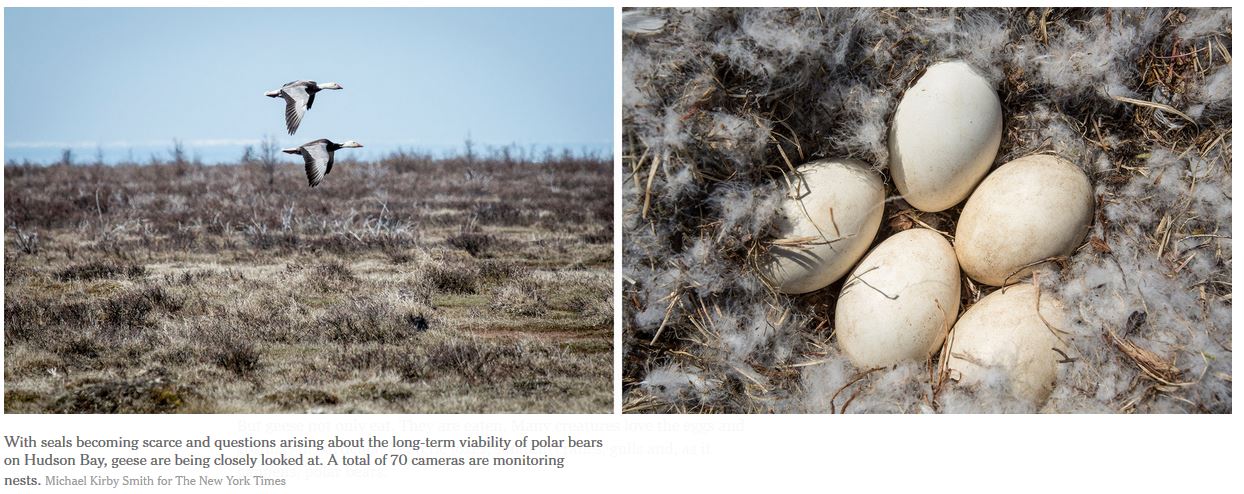
Courtesy NY Times, Sept. 22 2014.

Figure 1. Courtesy NY Times, Sept. 22 2014. Click to enlarge.

This month, the New York Times (September 22, 2014 James Gorman, “For Polar Bears, a Climate Change Twist”) is pushing it big-time (and so it’s been picked up elsewhere, like by the Anchorage Daily News).

Myths and misinformation about this phenomenon dispelled below.
Continue reading

Has the tide turned on polar bears as icons of global warming?

The CBC in Canada is pretty much a mirror image of the BBC in the UK, ABC in Australia and PBS in the US. So you might appreciate my shock at the almost unbelievable balance contained in the recently broadcasted CBC documentary, “The Politics of Polar Bears: Tracking the Celebrity Bear.

The film is a profound change from the hype and pessimism that has dominated the polar bear issue in Canada and abroad, supported unchallenged by the CBC. Finally, TV viewers were given some decently balanced perspective on the status of polar bears in  Western Hudson Bay.

If the take-away message tipped towards reason and optimism rather than panic over the status of polar bears, it’s because the evidence was strongly in that direction.

Politics of polar bears title

Continue reading

Breakup date average for W. Hudson Bay is July 1 – this year, it’s late again

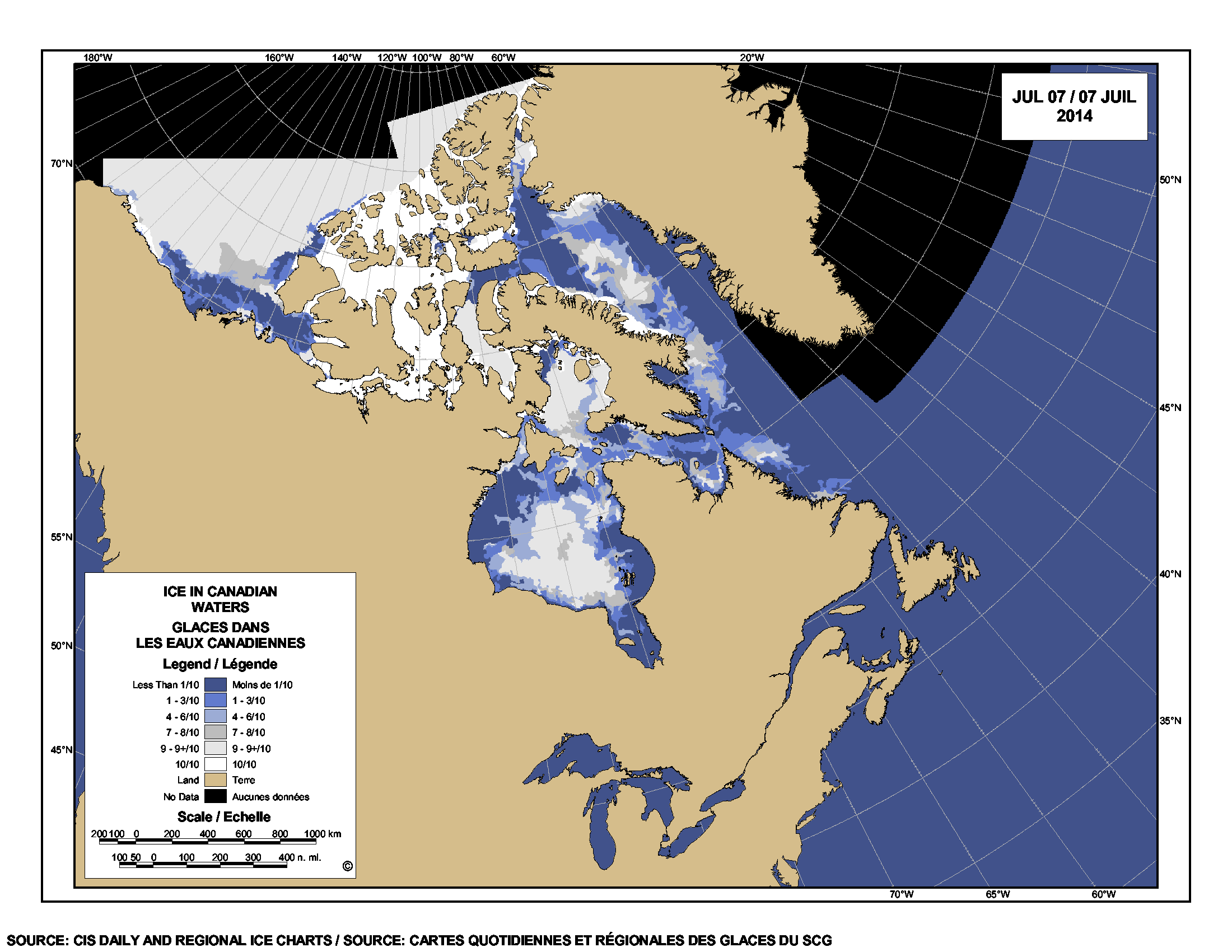
In the last few days, ice coverage on Western Hudson Bay finally dropped below the 30% level that now defines ‘breakup’ for polar bears: a few bears near Churchill started to come ashore late last week but most will stay on the ice until the end of July. That means breakup this year was unofficially July 8th, a week later than average (July 1) for the third year in a row.
Sea ice extent Canada 2014 July 7 CIS

Don’t’ tell that to the folks at Polar Bears International, though, because they’re busy telling people that the ice-free season for Western Hudson Bay bears is now longer than it was before the 1990s. What they mean is that the overall trend is toward early breakup dates.

But what they don’t admit is that over the last 44 years, breakup was a full two weeks earlier than average for Western Hudson Bay only six times and only three of those early breakups occurred within the last 13 years. See the calculations below and see what you think.

Continue reading

Guest Post: Invasive Research is Alive and Well in Canada

This is a guest post by Kelsey Eliasson, who blogs at Polarbearalley, with his thoughts on the issue of the invasive research involved in polar bear mark-recapture studies around Churchill, Manitoba — which, as you’ll see, is a far different situation than I described for Nunavut (previous posts here, here, and here on this topic. Map below to get you oriented).

Kelsey is a writer, artist and polar bear guide who has spent 14 bear seasons watching the polar bears of Churchill. For five years, he ran Churchill’s monthly newspaper published occasionally, the Hudson Bay Post. Currently, he divides his year between the Yukon, Churchill and, occasionally, Riverton, home of Manitoba’s largest moose statue.
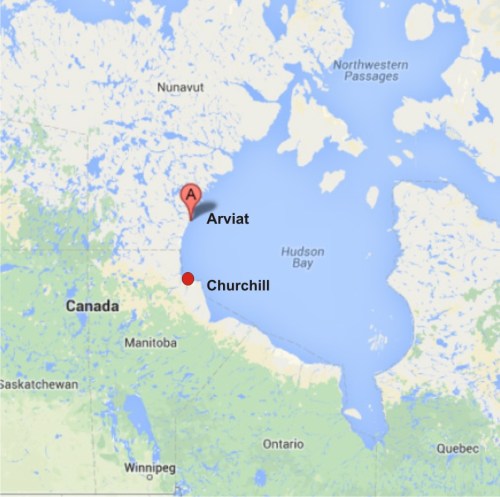
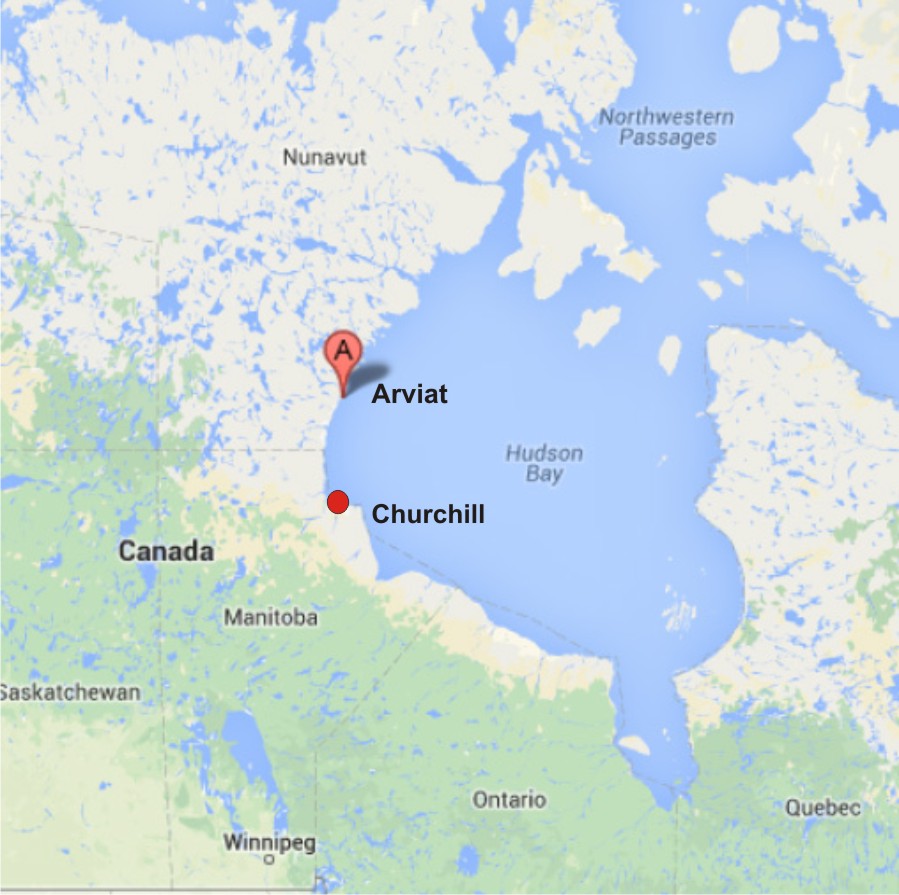
Churchill is in the Western Hudson Bay polar bear subpopulation, governed by the Province of Manitoba, while the community of Arviat, also in 'Western Hudson Bay' is overseen by the Government of Nunavut.

Churchill lies in the Western Hudson Bay (WHB) polar bear subpopulation, governed by the Province of Manitoba, while the community of Arviat, also in the Western Hudson Bay subpopulation, is overseen by the Government of Nunavut – different governments, different rules – as Kelsey points out below.

—————————————————————————-
Invasive Research is Alive and Well in Canada, by Kelsey Eliasson

The recent post about Foxe Basin was of particular interest to me, as I have been following the growing gap between the north and science for some time now. The stance taken by the Inuit is viewed as an inspiration by the guides over here in Churchill. For many years, we have tried to voice our deep concerns over the levels of handling and drugging that our bears (the Western Hudson Bay population) are subjected to on an annual basis.

This time last year, I tried to raise the topic for discussion after Andrew Derocher announced that ‘everything was on the table’ including feeding bears. At that time, the top polar bear researchers had sat down to discuss options for saving bears – except reducing handling and research – i.e. chasing bears down by helicopter and then shooting them with tranquilizers. Continue reading

Amstrup compares climate change to a Titanic for polar bears

Steven Amstrup, spokesperson for Polar Bears International, has ramped up his “save the polar bear” rhetoric over last week’s nonsense.

Last night (November 13), the NBC News online story (here) that accompanied their evening news clip (h/t DB) included this appalling analogy:

“…Amstrup said greenhouse gases created by humans threaten future generations of bears by threatening their ice. He said he likes to compare climate change’s effect on polar bears to the infamous Titanic ocean liner.

“[It] didn’t matter how many people were on the Titanic or how well they were doing,” he said. “When the Titanic slipped beneath the waves and they lost their habitat, that was it. So polar bears will also go away because of their dependence on sea ice.” [my bold]

Amstrup really wants people to believe that all the polar bears in the world will die some day, all at once, in some mega ice-loss catastrophe!
Continue reading

Hudson Bay freeze-up average this year – not late

Freeze-up in Western Hudson Bay is finally underway. It’s no later this year than average, similar to last year.

This rather contradicts the hysterical hue and cry from the tag-team of Polar Bears International (PBI) spokesperson Steven Amstrup and Guardian reporter Suzanne Goldenberg last week during PBI’s “Polar Bear Week” propaganda blitz (see previous posts here, here, and here), 

So much for the trend towards later freeze-up dates that PBI says is endangering polar bears in Western Hudson Bay.

On-the-ground observers confirm polar bears are preparing to move out and sea ice maps show the ice is forming very rapidly — see maps and quotes below.

Continue reading

Churchill polar bear attack shamelessly used to advance global warming agenda

I guess Suzanne Goldenberg, writing for The Guardian, just couldn’t help herself with this latest story (November 4):Polar bear attacks: scientists warn of fresh dangers in warming Arctic. Two people injured in latest attack as hungry bears deprived of access to sea ice increasingly look for food on land.

Reporting on the attack is one thing — several papers covered this over the weekend (see Featured Quote #46, posted yesterday, for links to two of them). However, Goldenberg shamelessly makes this about global warming, aided and abetted by Polar Bears International (PBI) representative Steven Amstrup, a claim that doesn’t hold up to even minor scrutiny.

Continue reading