Tag Archives: conservation

‘Threatened’ Arctic species comparison shows USA most assertive about global warming

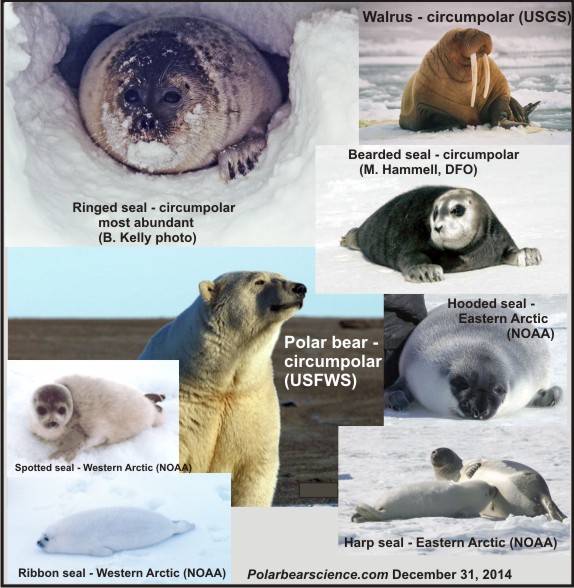
A cross-Arctic comparison shows that the US has been the most aggressive in designating polar bears and their main prey species as ‘threatened with extinction’ due to the predicted effects of human-caused (“anthropogenic”) global warming (AGW), even though the US has the least amount of sea ice habit of all circumpolar nations.

Arctic marine mammals_Dec 31 2014_Polarbearscience

I’ve made a chart listing the conservation status of these species across all Arctic nations (Canada, Russia, Norway, Denmark (for Greenland) and the USA), as well as the one international body that considers the conservation status of all species (International Union for Conservation of Nature, IUCN).

Oddly, the IUCN considers the polar bear vulnerable due to future threats from predicted sea ice losses but not ringed seals or bearded seals. This situation highlights the capricious nature of the use of “future threats” (almost exclusively based on predictions of AGW) as a valid criteria for evaluating the conservation status of Arctic marine mammals. It also suggests why the IUCN has tightened considerably its rules regarding this practice.

Continue reading

Amstrup knows his polar bear predictions are flawed – but continues to promote them

The largest conservation organization in the world says that predictive models developed by polar bear biologist Steven Amstrup are utterly unsuitable for scientifically estimating future populations. Earlier this year, mathematical modeling experts  at the International Union for the Conservation of Nature, who maintain the Red List of Threatened Species, made it clear that Amstrup’s models (used in 2008 to convince the US Fish and Wildlife Service to list polar bears as ‘threatened’ due to predicted global warming) do not meet IUCN standards.

I’d say this makes Amstrup’s polar bear projections (Amstrup et al. 2008, 2010) no more scientifically useful than a crystal ball prophesy, but you wouldn’t know it by his recent actions — or the silence of his fellows.

crystal ball_3c

Continue reading

Russia the first to ban polar bear hunting in 1956, not a surprise why

Soviet soldier in a tank, feeding condensed milk to polar bears c. 1950 (i.imgur.com), via Redditt 16 November 2014.

Soviet soldier in a tank, feeding condensed milk to polar bears c. 1950 - Imgur

Sponsored by the Russian Dash Cams Association. Reminding you to drive your tank safely and avoid hitting polar bears.”

Apparently, polar bears are attracted to tanks as they are to ships and submarines, which made them easy targets for men with guns. This, along with the rather extensive use of so-called ‘set guns’ (a baited apparatus fixed with a loaded shotgun), led to a significant decline of polar bears in the U.S.S.R. and the Barents Sea area by the 1950s. See also, “The slaughter of polar bears that rarely gets mentioned (ca. 1890-1930)

This was the real threat to polar bears and it was successfully halted by international agreement in 1973. We should not forget that polar bears are a conservation success story.

Andrew Derocher raises the “starving polar bears” issue in DailyMail interview

In what looks like a follow-up to last week’s CBC documentary, The Politics of Polar Bears, the London (UK) based DailyMail published interviews with polar bear biologists Mitch Taylor and Andrew Derocher (September 9, 2014).

The CBC film did have a one scientist vs. another” flavor about it and this article definitely echoes that approach. My comments below on Derocher’s insinuations and questions about starving bears and global warming.
Continue reading

Polar bear status changes in 2013 deconstructed, with a map to the good news

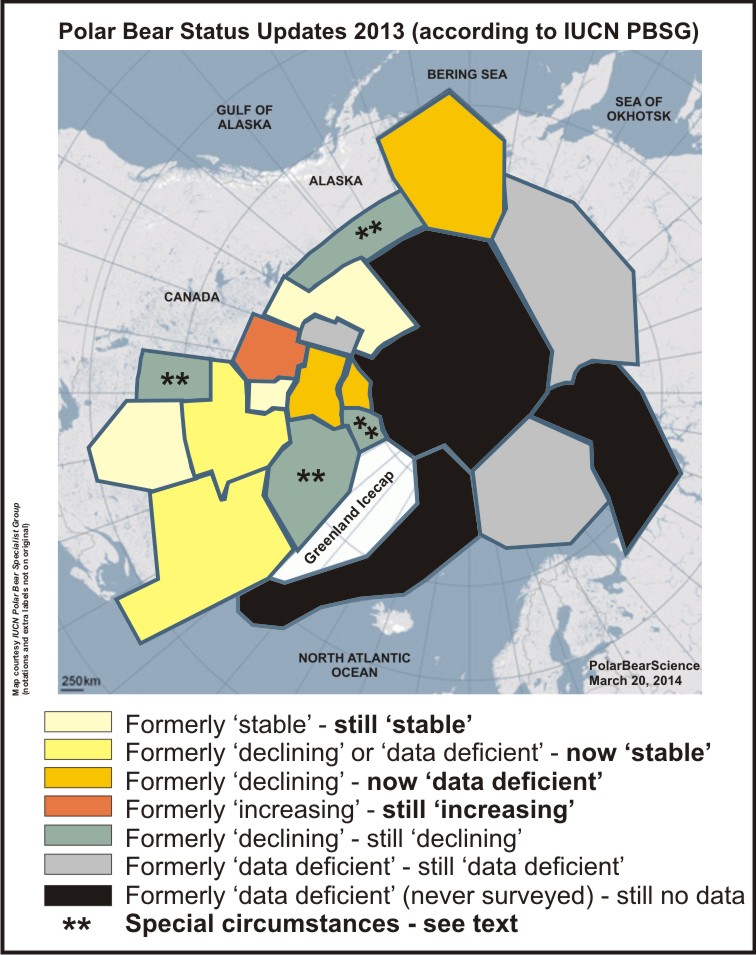
You can’t figure out what’s going on with status updates from the IUCN Polar Bear Specialist Group (PBSG) without deconstructing the spin and the 2013 update is no exception. Here’s my travel guide, with a map, to the good news.

Polar Bear Subpopulations 19_2013 updates_March 20 2014_sm

I’ve finally had a chance to go through all of the details provided with the 2013 PBSG status table (pdf here). It’s just about all good news, once you wade through the spin. Numbers aside, out of the 13 populations for which some kind of data exist, five populations are now classified by the PBSG as ‘stable’ (two more than 2009), one is still increasing, and three have been upgraded from ‘declining’ to ‘data deficient’ (I explain below why this is a promotion).

That leaves four that are still considered ‘declining’- two of those judgments are based primarily on concerns of overhunting, and one is based on a statistically insignificant decline that may not be valid and is being re-assessed (and really should have been upgraded to ‘data deficient’). That leaves only one population – Western Hudson Bay – where PBSG biologists tenaciously blame global warming for all changes to polar bear biology, and even then, the data supporting that conclusion is still not available.

Continue reading

Polar Bear Specialist Group population status update is much ado about nothing

I cannot for the life of me fathom why the IUCN Polar Bear Specialist Group (PBSG) bothered to insert an announcement on their website back in mid-December, promising an updated polar bear status assessment, since the posted January 31 “update” is nothing of the sort — there have been no changes of any consequence.

It therefore appears I interpreted the oddly worded announcement incorrectly and none of the anticipated changes were forthcoming. Baffling, to say the least. Have a look at the new updated documents that were posted yesterday and see what you think.

Continue reading

WWF and cohorts barred from Moscow polar bear forum

Despite the fact that the World Wildlife Fund (WWF) apparently provided a significant portion of the funding for the recently concluded International Forum on Conservation of Polar Bears (December 3-6, Moscow), it appears in the end they and their NGO cohorts were prevented from having an undue amount of influence at the meeting. For that we can thank the delegates of the five Arctic nations: three cheers for common sense!

This news did not emerge until late yesterday (Friday, Dec. 6), after the meeting had concluded: no mention was made of NGOs being excluded in the press releases and stories written before then. For example, see IUCN story, Dec. 5; WWF story, Dec. 4; Times of India report, Dec. 5 and this Arctic Journal story Dec. 6. There was nothing in any of them about NGOs and journalists being barred from parts of the meeting they thought they would be allowed to attend.

Note that biologist Mitch Taylor, booted-out of the Polar Bear Specialist Group because he did not agree with the group’s position on global warming, attended as part of the Canadian contingent (see list at the end of this post), which was a bit of a surprise. However, the exclusion from the meeting of WWF and their buddies is the big news as far as I’m concerned.

[The media seems more interested in the fallout from a twitter message sent on the final day of the meeting by Canada’s Environment Minister Leona Aglukkaq — more on that in my next post].

Continue reading

Polar bear conservation: the next 10 years

As 2013 marks the 40th anniversary of the signing of an international agreement to protect polar bears from commercial and unregulated sport hunting, many eyes are looking to the immediate future. What should polar bear conservation look like over the next 10 years?
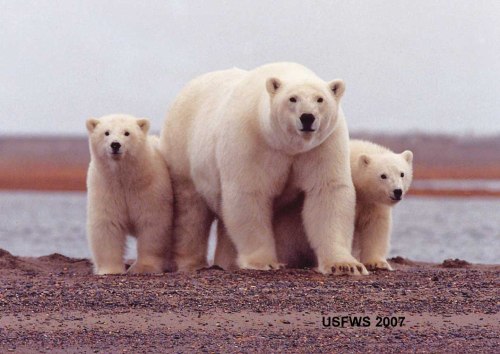
Do we base conservation measures over the next 10 years on the grim computer-generated scenarios predicted to occur decades from now or on the positive news from recent polar bear studies?

Should we base conservation measures over the next 10 years on the grim computer-generated scenarios predicted to occur decades from now or on the positive news coming from recent polar bear studies?

This week (December 3-6), the five Arctic nations that signed the original agreement are meeting in Moscow to examine this issue and renew the vows they took back in 1973 — but with a decidedly new focus (International Forum on Conservation of Polar Bears).

According to the draft agenda, the delegates will address among other things the perceived threats of future sea ice declines due to climate change and trade in polar bear trophies.

However, polar bears are currently doing well despite recent declines in summer sea ice, and CITES rejected a US-led proposal to ban polar bear trade at their meeting last March – as they did in 2010 – because it was deemed unwarranted.

At this time, polar bear numbers have not declined due to climate change: their “threatened” status in some countries is based on computer-modeled predictions of what might happen three or more decades from now, not ten years ahead.

In fact, polar bears are a conservation success story. Their numbers have rebounded remarkably since 1973: there are many more polar bears now than there were 40 years ago. While polar bear numbers appear to have been stable since 2001 (at 20,000-25,000 bears), this is based on creative accounting by the IUCN Polar Bear Specialist Group (PBSG). Numbers have actually increased by about 2,600 to 5,700 bears since 2001.

The last assessment made by the PBSG in 2009 showed only one polar bear population (Western Hudson Bay) had a statistically significant decline in recent years. Numbers of Western Hudson Bay bears declined 22% between 1998 and 2004, which has been blamed on declining sea ice cover over the last 20 years.

[While a new population estimate, showing a further decline in Western Hudson Bay bears, was released to The Guardian (UK) newspaper last week, that estimate comes from a report that has not yet been made public by Environment Canada. Details of the study are unknown.]

Compare this situation to the adjacent population that lives in Southern Hudson Bay. Polar bears in Southern Hudson Bay have experienced the same increase in length of ice-free season as bears in Western Hudson Bay, but the Southern Hudson Bay population has remained stable over the last 30 years.

Why would a slight lengthening of the ice-free season devastate Western Hudson Bay bears but leave Southern Hudson Bay bear numbers unaffected? Perhaps, it’s because the population in the west has been returning to a smaller, sustainable level after rapid population growth in the 1980s: bears had been heavily over-hunted in Western Hudson Bay before the 1973 protection treaty was enacted.

Aside from the documented declines in Western Hudson Bay, a few other populations were assumed by the PBSG in 2009 to be declining. However, these assessments were based on computer projections over 10 years rather than an actual decline in numbers. Since then, there has not been an official PBSG update of the global population estimate.

We do know that in many regions of the Arctic, polar bears are doing just fine. For example, a recent study shows that bears in the Chukchi Sea are in excellent condition and reproducing very well, despite a dramatic decline in summer sea ice. Contrary to what the computer models predicted, Chukchi bears (shared between the US and Russia) are doing better than virtually all other polar bear populations.

In the Chukchi Sea, ringed seals – the primary prey of polar bears everywhere, now listed as “threatened” in the USA – are also doing better now than they were 20 years ago. As a consequence, bears had more food the next spring, not less, despite the marked decline of summer sea ice.

In fact, polar bear populations in a number of regions have not responded as predicted to recent summer sea ice losses, calling into question the accuracy of models that predicted a decline of 2/3 of the world’s polar bears by mid-century.

This is not really surprising, since we know that over geological time, polar bears have survived extended periods of much less ice than today. A recent genetic study indicated that polar bears survived the Eemian interglacial (130,000 to 115,000 years ago) with a relatively large population, despite much less ice than today. Computer models, on the other hand, predicted almost total extinction of polar bears under similar conditions.

Why this disconnect between predictions and reality? It turns out that summer ice melt (the level recorded in September, announced with much fanfare every year) has impacted polar bears much less than expected. That’s because spring is the prime feeding period for the big white bears, and spring ice coverage (March to June) has changed little over the last 30 years.

In other words, the focus on declines in summer sea ice as a major threat to polar bear survival is a red herring.

Polar bears were indeed threatened with extinction by the early 1970s and Arctic nations were quite correct to sign a treaty to protect them from unregulated hunting. But today, polar bears have a large population that is well distributed throughout their available territory, a recognized characteristic of a healthy species.

Polar bears were brought back from the brink of extinction and are now thriving. Instead of rejoicing over the success of 40 years of good conservation practices and planning to do more of the same, the focus of this week’s meeting of Arctic nations appears to be speculating what awful things might happen decades from now.

Everyone wants to see polar bears continue to thrive. In my opinion, what we need over the next 10 years is dispassionate scientific information — something that has been sorely lacking over the last decade. More polar bear research is absolutely a requirement but we need the results presented without emotional appeals for a particular agenda. Objective scientific information will most effectively guide rational polar bear conservation and sound management practices.

What we don’t need is a computer-manufactured crisis to replace a problem that’s already been solved — or a ban on trade of a healthy species, unless there is very strong evidence of organized poaching and illegal trade.

Ultimately, what will the meeting in Moscow accomplish? It appears that any agreement signed by government representatives will not be a legally binding contract, in contrast to the 1973 treaty. Over the next few days, the press releases and news reports will tell us what the parties involved think they achieved.

International polar bear forum, Moscow: who’s invited

Re: International Forum on Conservation of Polar Bears: December 3-6, Moscow.

[Updates added Dec. 2 and Dec. 3, 2013, as noted below]

[Updated Dec. 4, 2013: Final agenda here; and as noted below]

On Tuesday, setup begins for the Moscow meeting of all Arctic nations that signed the original agreement to protect polar bears back in 1973. In my post last week, I introduced the agenda (pdf here).

I’ve also made notes on the interesting mix of folks who’ve been invited.
Continue reading

Polar bear researchers still withholding Hudson Bay data

The latest polar bear propaganda emanating from The Guardian is unscientific nonsense fed to them by activist Canadian polar bear researchers: Polar bear numbers in Hudson Bay of Canada on verge of collapse.

This episode of Goldenberg’s polar bear grandstanding includes a photo caption with a totally unsubstantiated claim that some folks might call a lie:

Melting ice is cutting polar bears off from their food source in Hudson Bay, and death rates have soared.

“Death rates have soared”? Where are all the bodies? Show us the starving bears!

In fact, the ice of Hudson Bay melts every summer and always has done. When it does, polar bears go ashore and live off the many inches of stored blubber they put on during their spring feasting on fat baby seals. The last three years, the open-water season has been only about two weeks longer than it was in the 1980s. There has been no steady increase but lots of variability.

Below I dismantle the rest of this transparently political posturing ahead of the international polar bear forum next week.
Continue reading