Posted onJune 25, 2024|Comments Off on Arctic sea ice at the summer solstice: more polar bear habitat than 2022 after hottest year on record
We are just into the 2024 sea ice melt season in the Arctic with no signs of any big, dramatic changes despite claims that 2023 was the warmest year on record (since 1850). There is still abundant sea ice habitat for polar bears ahead of the summer months (July-September) when Arctic ice melts back considerably.
Polar bears in Western Hudson Bay are still on the ice despite vast open water levels normally signaling “breakup” has happened: the wind-driven ice is packed tight against the western shore and the bears are still on it.
Posted onJuly 9, 2023|Comments Off on Natural flexibility explains W Hudson Bay polar bear movements at breakup better than climate change
Hudson Bay in early July this year is a mosaic of more-than-average and less-than-average sea ice coverage but apparently, only the less-than-average ice areas constitute the “early breakup” caused by climate change, and only “deniers” would say otherwise.
I say some folks are cherry picking the ice conditions that support a story line they prefer, forgetting that polar bears know better than they do when to come in off the ice.
Posted onJuly 4, 2023|Comments Off on Early sea ice breakup in W Hudson Bay caused by “record breaking” warmth in 2023 but not 2015?
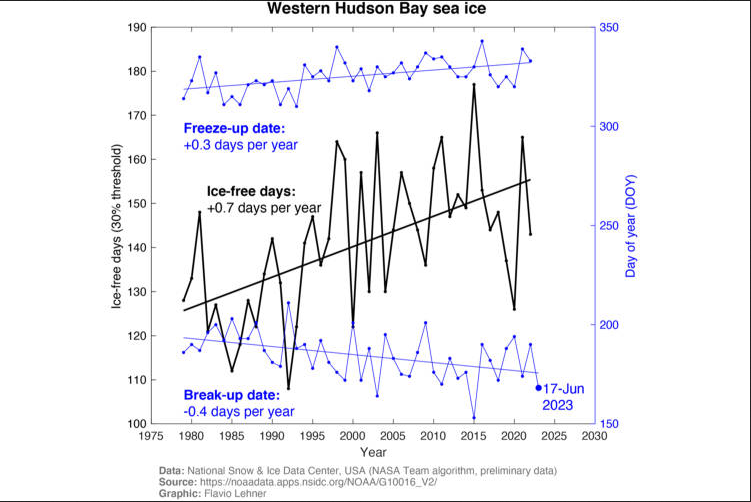
According to Polar Bears International, the “3rd-earliest” breakup date for Western Hudson Bay was caused by a “record breaking” heat wave in May. Western Hudson Bay sea ice hit the 30% coverage threshold used by PBI to define “breakup” on 17 June this year, prompting speculation about potential future impacts on polar bear survival should breakup come even earlier.
“This year’s break-up date of June 17 is the 3rd earliest in the 45 years of satellite-based sea ice data from Western Hudson Bay, after 2015 and 2003.” [Flavio Lehner, PBI]
17 June 2023 is day 168 on the Julian calendar used to graph the data in the image included in the PBI essay (see copy below). However, the data point for 2003 is about three days earlier, on day 166 (14 June) and the point for 2015 is on day 152 (1 June).
If “record-breaking” heat caused this year’s early ice retreat, what caused the ice to retreat more than two weeks earlier in 2015? May was warm that year along the west coast as well but obviously not “record-breaking” warmth, because the records were broken this year. In fact, whatever warmth that occurred only affected ice melt in the western sector, while very thick ice over the rest of the bay resisted melt and allowed bears to stay out many weeks later than usual.
Posted onJuly 11, 2022|Comments Off on First tagged W Hudson Bay polar bear comes ashore
On the 8th July, the first of almost two dozen tagged or collared polar bears came ashore in Western Hudson Bay (WH) under unusual sea ice conditions. How does this compare to previous years?
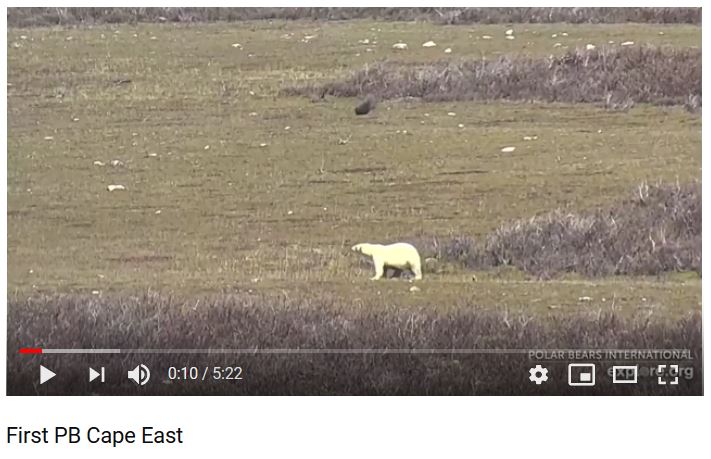
Image above is from last year (6 July 2021): we haven’t yet had a sighting from the live cams on the shore of Wapusk National Park near Churchill reported at Explore.org.
Perhaps the last bear leaving Cape Churchill for the sea ice, 4 December 2021.
Moreover, considering that 2021 fall ice formation for the Arctic in general is well ahead of 2016 (and every year since, except 2018), it’s hard to see why human-caused global warming caused by ever-increasing CO2 emissions explains the slow freeze-up of Hudson Bay. Timing of Hudson Bay freeze-up has always been highly variable from one year to the next (Castro de la Guardia et al. 2017: Fig. 3, copied below). The average freeze-up date in the 1980s was 16 November ± 5 days, while from 2005-2015 this had shifted about a week to 24 November ± 8 days (Castro de la Guardia et al. 2017:230). This year freeze-up was later than usual but last year and the three years before that the ice froze as early as it did in the 1980s. Cue the zombie apocalypse.
UPDATE 11 December 2021: see chart below from Andrew Derocher on the position of tagged WH bears at 10 December.
Posted onAugust 11, 2021|Comments Off on Foxe Basin polar bear attack leaves three people seriously mauled, airlifted to hospital
The attack happened yesterday afternoon (10 August) about 2:30 PM local time near the community of Sanirajak (listed as Hall Beach on ice charts), which is in Foxe Basin, Nunavut (population about 800). There are few details yet on the human victims of the mauling other than that they were two women and a man. All three were badly injured. They are now in hospital and expected to survive.
It appears the bear died as a consequence of the attack but there has been no mention of its condition, age, etc., or the circumstances of the attack. There is no ethical reason for blaming this broad-daylight attack on lack of sea ice (although some will try), since there is abundant ice in the region at the moment, as the charts below show. Expect an update as the story unfolds.
Posted onMay 8, 2020|Comments Off on Sea ice more than 1.2m thick over Hudson Bay portends a good year for polar bears
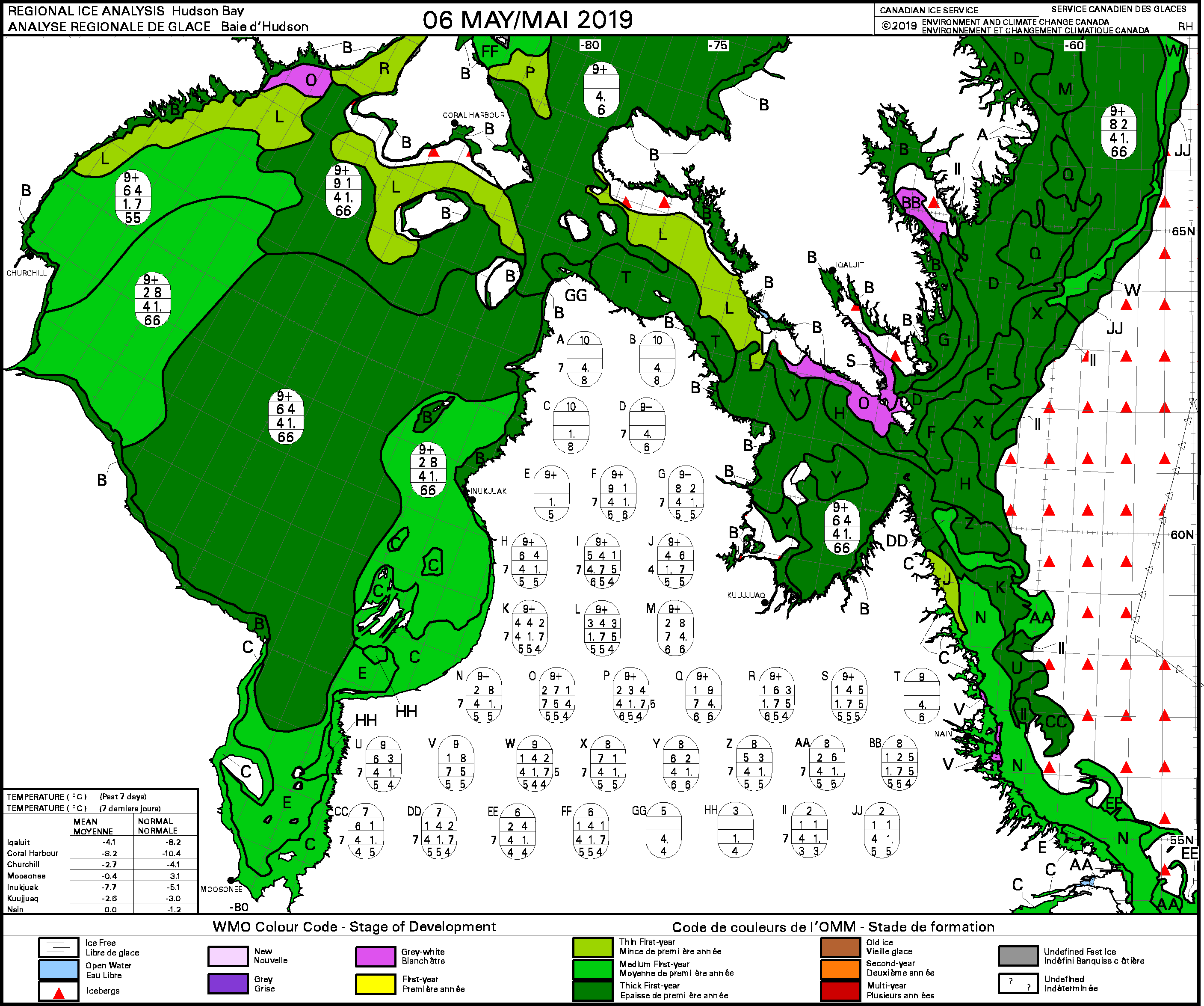
The chart below shows what sea ice thickness over Hudson Bay was like at the first week of May in a so-called a‘good year’(2019) – when polar bears came off the ice in excellent condition late in the summer and left early in the fall (‘thick first year ice’ is dark green and indicates ice greater than 1.2m thick):
Hudson Bay ice conditions this year appear to be shaping up to be as good or better than last year for polar bears yet specialist researchers and their cheerleaders have still been claiming that bears in this region – Western and Southern Hudson Bay – are doomed because of poor ice conditions. It’s no wonder they still haven’t published the data they’ve been collecting on polar bear body condition and cub survival over the last 15 years or so (Crockford 2020). With most field work cancelled for this year, what’s their excuse for not getting that done? Continue reading
Comments Off on Sea ice more than 1.2m thick over Hudson Bay portends a good year for polar bears
Posted onSeptember 5, 2019|Comments Off on Western Hudson Bay polar bears in great shape after five good sea ice seasons
Polar bear researcher Andrew Derocher says it takes four years of good sea ice conditions to recruit a polar bear from birth but implies that 2019 is the first year in decades that conditions for bears have been ‘good’ in Western Hudson Bay. He thinks he can get away with saying this because he hasn’t published any of the data on body weight and body condition he’s collected on these bears over the last 25 years (apparently, whatever funding agency pays for his research does not require him to publish the data he collects).
But independent observations such as dates of ice freeze-up in fall, ice breakup in summer, dates and condition of bears recorded onshore, suggest he’s blowing smoke: at least five out of five of the last sea ice seasons for WH bears have been good. That means we should be seeing more bears in the next official population count.
Posted onJuly 8, 2019|Comments Off on First polar bear spotted off the ice in Western Hudson Bay is fat and healthy
One of the first of hundreds of polar bears expected to come off the sea ice of Hudson Bay along the west and south coasts was captured on video on 5 July. This is only the first wave, as there is still so much ice remaining that most of the bears are likely to remain offshore: not because there is so much food available (few seals are caught at this time of year) but because the ice is where they are most comfortable.
Watch polar bear habitat reform in the Canadian Arctic: “last 10 days” Canadian Ice Service animation (works anytime) HERE.
See Quote archive for details.












 polarbearscience
You must be logged in to post a comment.