Tag Archives: extinction

Winnipeg zoo unashamedly frightens children about polar bear extinction, for a price

The Assiniboine Park Zoo in Winnipeg is selling Polar Bears International-style1 “save our sea ice” global warming propaganda to children, which it calls “messaging.”

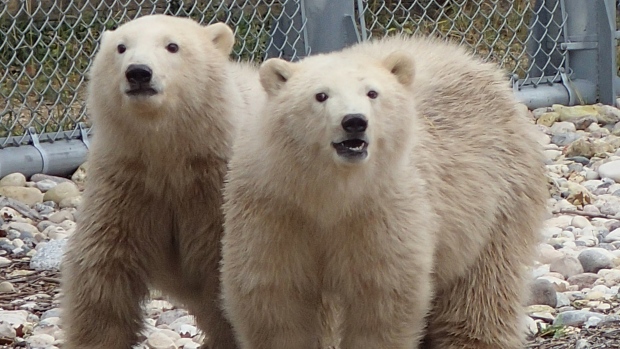
“The centre is deliberately targeting children, fully aware that there is a magical connection between the cuddly, entertaining orphan cubs and young visitors.”

Orphaned cubs from Churchill now on display in Winnipeg

Orphaned cubs from Churchill now on display in Winnipeg

That’s the money quote, in more ways than one, from an article at The Globe and Mail earlier this week (23 November 2014), “Innovative Winnipeg zoo experiment shares the plight of polar bears” in which the author promotes the new “Journey to Churchill” exhibit at the Assiniboine Park Zoo in Winnipeg as “an ambitious experiment.”
Continue reading

“Meltdown: Terror at the Top of the World” — new book exploits polar bear attack to sell fear of sea ice decline

The polar bear attack that was all over the news last summer is now an ebook about global warming. The Maine lawyer who was mauled by a bear while on a hiking trip to Labrador (and lived to tell the tale) has allowed his story to be co-opted by an activist journalist to promote fears of sea ice decline, polar bear extinction, and man-made global warming.

Melt-down_Terror at the Top of the World_Nov 12 2014 press release book cover

The press release issued yesterday by the news group that published the book and employs author Sabrina Shankman (InsideClimateNews), described it this way:

“A riveting new e-book about the battle between man, beast and Nature in a warming world. Called Meltdown: Terror at the Top of the World, the e-book tells the story of the hikers’ harrowing encounter with a polar bear; of the plight of the polar bear in general, facing starvation and extinction as the sea ice melts and its habitat disappears; and of the Arctic meltdown, the leading edge of man-made climate change.”

I have little doubt the man mauled by the bear was indeed terrified and that his companions were as well. However, that horror is exploited shamelessly in this book as a means to promote anxiety over the future survival of polar bears and instill panic over a prophesied Arctic “meltdown.”
Continue reading

A more optimistic view of Churchill polar bears and Hudson Bay freeze-up

Finally, an unbiased first-hand report about Churchill polar bears and freeze-up on Hudson Bay.

Over the last few weeks, biologists Andrew Derocher and Steve Amstrup have been repeating their tired old tales of doom and gloom about the polar bears around Churchill and I’ve done my best to refute the worst of their nonsense.

Figure 1. Polar bear female with cub, 2009, Churchill, Western Hudson Bay. Wikipedia.

Figure 1. Polar bear female with cub, 2009, Churchill, Western Hudson Bay. Wikipedia.

To that effort we can now add this report from PolarBearAlley, where Kelsey Eliasson has posted a good-news story about the bears of Cape Churchill and the progress of freeze-up, including sightings of a number of mothers with cubs.
Continue reading

Low genetic diversity will not make polar bears more vulnerable to extinction

You’ve probably heard the argument: animal populations that have been through a major decline in numbers often have such low genetic diversity that they are extremely vulnerable to subsequent extinction.

Photo credit USGS

Photo credit USGS

In an interview in late March regarding a new genetic paper on polar bear evolution (by Matt Cronin and colleagues), polar bear biologist and Polar Bears International spokesperson Steve Amstrup made a ridiculous statement: that polar bears have never experienced a rate of warming like they’ve seen over the last 30 years. I countered that easily here.

In that same interview about the Cronin et al. paper, fellow geneticist Charlotte Lindqvist offered an outdated argument against future polar bear survival that is as easy to refute as Amstrup’s “unprecedented rate of warming” nonsense.

I didn’t have time to deal with it back in April [where has the time gone?] but want to get back to it now because it’s important: there is lots of evidence to support my contention that polar bears are not more vulnerable to extinction just because they have low genetic diversity.
Continue reading

Center for Biological Diversity provides a public disservice on polar bear status

Media agency Aljazeera gave free advertizing the other day (June 16, 2014, “New TV ads focus on plight of polar bears in warming world, by Renee Lewis) to the Center for Biological Diversity’s TV fear-mongering campaign about polar bears.

USFWS photo

USFWS photo

With unmitigated gall, it’s being billed as a “public service announcement.”
Continue reading

Amstrup repeats starving polar bear nonsense, features “Ursus bogus”

As if on cue just before an important polar bear announcement, Steven Amstrup, full time employee of Polar Bears International (PBI), is crying “starving polar bears” yet again, with a laughable twist.

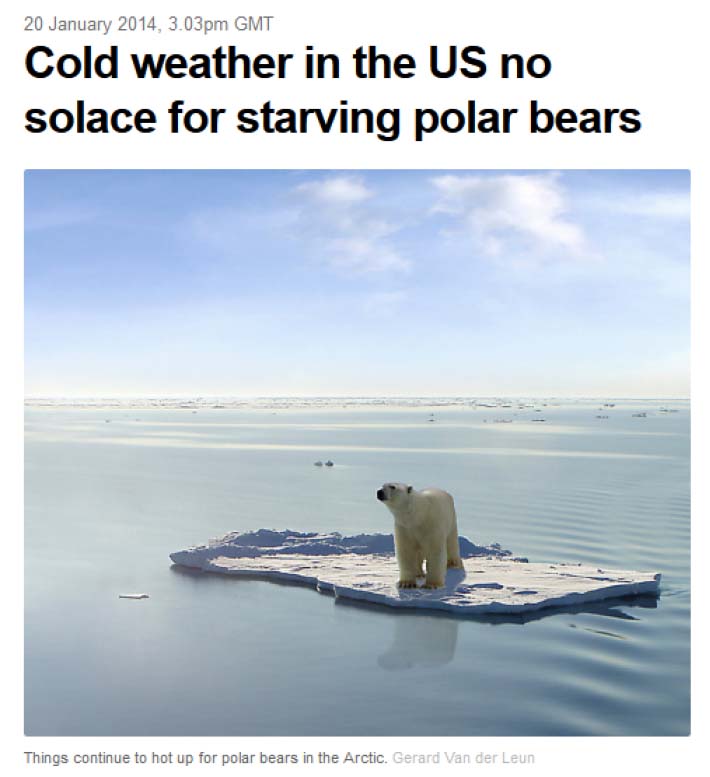
Over at “The Conversation” (a university supported forum for academics), in a piece titled “Cold weather in the US no solace for starving polar bears,” Amstrup uses his adjunct affiliation at University of Wyoming to unleash a bit of unpaid advertising for PBI’s alarmist message (I put it this way because while Amstrup  does disclose his affiliation at PBI, he is more than just an affiliated member, he is their paid spokesperson).

Ironically, the headline photo (Fig. 1) is the notorious “Ursus bogus,” the photoshopped image used by the journal Science back in May 2010 to feature an article on the integrity of science, It was quickly exposed by Tim Blair at The Telegraph (also covered at WUWT), and the journal was obliged to acknowledge the error, replace the image and issue a correction.

In this case, commenter Brad Keyes at The Conversation defends the use of the “Ursus bogus” image with this astonishing statement [UPDATE Jan. 25/14: it has since transpired that this was almost certainly meant to be satire]:

The problem is, only sensational exaggeration makes the kind of story that will get politicians’—and readers’—attention. So, yes, climate scientists might exaggerate, but in today’s world, this is the only way to assure any political action and thus more federal financing to reduce the scientific uncertainty.

Figure 1. The headline photo from Steven Amstrup’s article at The Conversation. This infamous “Ursus bogus” image (for sale at IStock photos, listed under “Global warming images”), says “This image is a photoshop design. Polarbear, ice floe, ocean and sky are real, they were just not together in the way they are now.”

Figure 1. The headline photo from Steven Amstrup’s article at The Conversation. This infamous “Ursus bogus” image (for sale at IStock photos, listed under “Global warming images), says “This image is a photoshop design. Polarbear, ice floe, ocean and sky are real, they were just not together in the way they are now.”

However, we now know that Amstrup is crying wolf — summer sea ice has been declining despite a hiatus in global warming and unusual numbers of polar bears are not starving. He seems to think that if he keeps repeating his Chicken Little message (with nary a recent photo of an actual starving polar bear) he will convince more people to believe him and donate to PBI. It’s his job to do so of course, so he’s not likely to stop. [pardon my mixed metaphor – Amstrup, if you recall, prefers a Titanic metaphor]
Continue reading

Eemian excuses: the warm was different then, polar bears were fine

Today I’ll discuss the response by Polar Bears International representative Steven Amstrup to a comment submitted during their recent “webchat” at The Guardian (Wednesday, November 6), which had to do with the fact that polar bears survived warm periods in the geological past, particularly interglacials.

[Here’s a pdf file of all the questions that were answered by PBI staff: PBI webchat Q&A, also available here]

This is the comment (the first portion of #4 on my list), submitted by MarkBLR:

There was a paper in Science magazine last year (link …) indicating that polar bears became a distinct species about 600kya (+/- 300k years).

This means that they have survived at least two (and possibly eight) previous inter-glacials, in particular the Eemian (130kya to 110kya), when temperatures in the Arctic were 5 to 8 degrees Celcius warmer than current temperatures for several thousand years.

Note that their numbers apparently decreased significantly during the Eemian, and slowly increased as temperatures cooled, but “climate change” was not enough on its own to make them extinct. [my bold]

[We can perhaps forgive Mark for not being able to spell “Celsius” correctly, but Amstrup (see below) has no excuse. The paper in Science Mark refers to is Hailer et al. 2012, discussed in a previous post here. Note that the actual question Mark asked is not included here because Amstrup responded to this portion of his comment only]

Amstrup tries to convince Mark and other readers that polar bear resilience through Eemian warming is irrelevant to the issue of future survival, which I’ll demonstrate is not the case at all.

Here is what Amstrup had to say:
Continue reading

Polar bears at Kaktovik, Alaska not stranded due to retreating ice

“I’ve lived here all my life and there are more bears every year. I read stories about polar bears being on the brink of extinction because of global warming, look out of my window and start to laugh.” Tori Sims, Kaktovik (Mail on Sunday, Sept. 28, 2013).

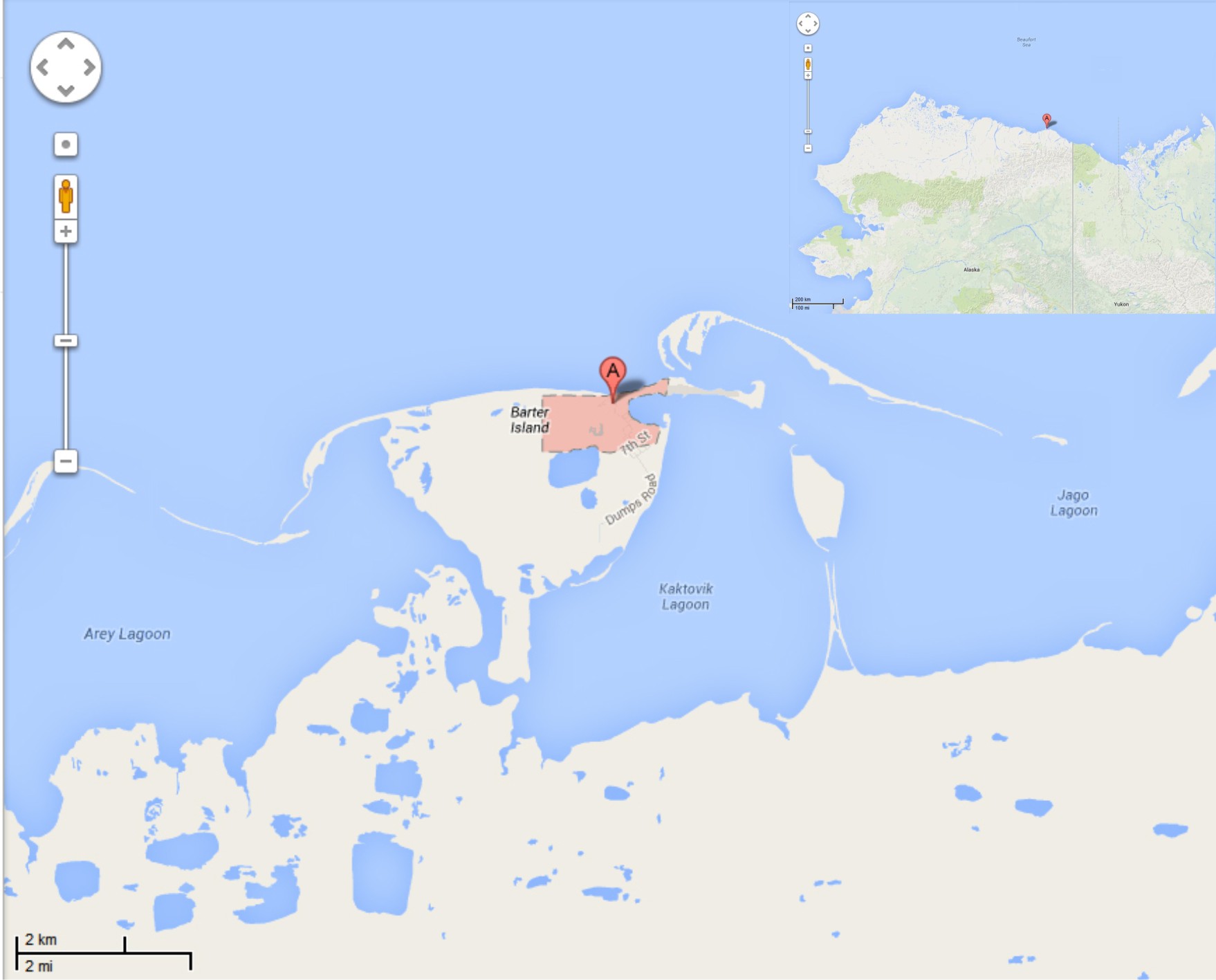
As you can see, Kaktovik is in the news again. This tiny community sits on the edge of the Beaufort Sea, on Barter Island on the North Slope of Alaska (Fig. 1). It lies within the Southern Beaufort polar bear subpopulation, which has been classified as “declining” by the IUCN Polar Bear Specialist Group (Obbard et al. 2010).

The determination of “declining” was based on a small dip in population numbers between 2001 and 2006 (not statistically significant), plus a decline in body size and condition, and smaller litter sizes documented between 1986 and 2006 (Rode et al. 2010). A new population survey is underway.

Figure 1. Kaktovik, Alaska, from Google maps.

Figure 1. Kaktovik, Alaska, from Google maps. Click to enlarge.

There have been suggestions that bears become “stranded” along the Alaska coast near Kaktovik because of retreating sea ice, and that more bears present in this area in recent years are an indication that they are in trouble due to global warming.

I’ve compiled some quotes, maps, and links to stories, photos and videos about Kaktovik polar bears to show that this claim is false.

Continue reading