Tag Archives: facts

The polar bear problem no one will talk about – the downside to large populations

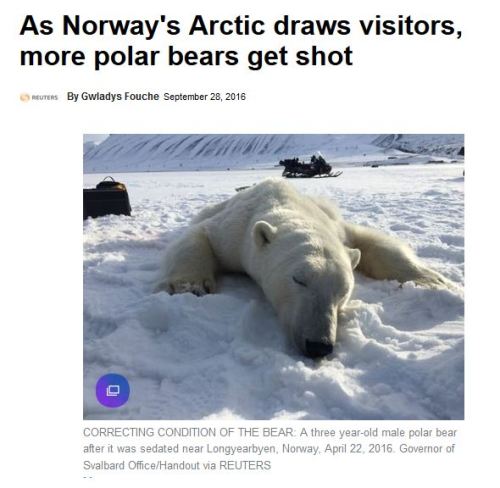
A large polar bear population with lots of adult males – due to bans on hunting – means more survival pressure on young bears, especially young males. To blame more problems with young male bears on lack of sea ice due to global warming ignores the downside to the reality Norway asked for when it banned hunting more than 40 years ago.

More hungry young males coming ashore looking for food is one of the potential consequences of living with a large, healthy population of polar bears. Biologist Ian Stirling warned of such problems back in 1974.

UPDATE: added below 6 Oct. 2016, statistics of defense of life shootings of polar bears in Svalbard since 1973.

svalbard-more-visitors-more-bears-shot_28-sept-2016-yahoo

Svalbard area polar bear numbers have increased 42% since 2004 and more hungry young polar bears almost certainly mean more polar bear problems, as folks in Svalbard (see map and quotes below) have experienced this year.
Continue reading

Polar bears seldom catch seals they stalk in summer – it’s why they fast

This short BBC video shows why polar bears are so often unsuccessful in their summer hunts – adult bearded seals are the species most often available on the ice. These seals are not only predator-savvy but there are lots of escape routes in the melting ice, and this has always been so.

“Hungry polar bear surprises a seal – The Hunt: Episode 2 Preview – BBC One”

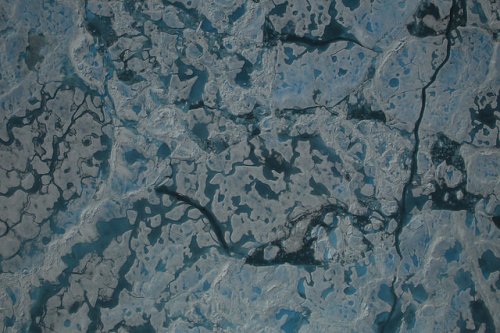
Melting ice in summer is not a new phenomenon (e.g. NASA photo below from mid-July 2016) – Thomas Grenfell and Gary Maykut described the process of melt pond development back in the 1970s:

“Melt ponds reach the maximum extent shortly after the disappearance of the snow, when they may cover upwards of 50% of the ice.”

sea-ice_melt-ponds_nasa-taken-13july2016_sm

Melting summer ice has always made it challenging for polar bears to catch seals, as this quote from Ian Stirling (1974) show, based on his work in the Central Canadian Arctic in the summer of 1973 (July and August):

There is a great abundance of natural holes in the ice during summer, anyone of which a seal could surface through.

This is still true in areas like the Southern Beaufort Sea today (e.g. Whiteman et al. 2015): the ice melts and in some areas, disappears completely in summer.

It’s why polar bears – unlike other species of bears in summer – depend on their stored fat to see them through until the ice reforms in the fall.

The meme “If there’s no ice, there’s no ice bear” is political-style rhetoric, not science.

[When polar bear scientists say “sea ice” or “ice” – they mean summer sea ice. Sea ice in winter and spring are not predicted to decline by 2100 to any appreciable degree and that has been true since sea ice predictions began]

Polar bears in Hudson Bay and Davis Strait routinely go 4-5 months without sea ice in the summer and have done since studies on them began. Yet, all of the polar bear subpopulations in Hudson Bay and Davis Strait are stable or increasing.

Continue reading

Climate change not forcing polar bears to hunt humans but lack of baby seals might

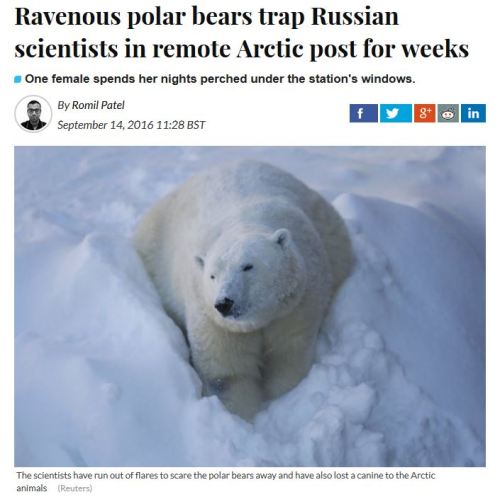
At least a dozen polar bears that besieged a remote Russian weather station on an island in the Kara Sea during the first two weeks of September prompted a few media pundits to suggest that loss of summer sea ice due to global warming may be forcing polar bears to hunt humans for food. Headlines like the one below, from the IB Times, fueled such notions:

russian-scientists-trapped-by-polar-bears-14-sept-2016_ib-times

Eye-catching though such headlines might be, this is more sensationalism than reality.  These particular bears have been onshore since early July this year (about the time some Western Hudson Bay bears come ashore) and sea ice conditions have been similar this time of year since 2007. In other words, despite what some writers are claiming, sea ice conditions this year are nothing new.

A few bears usually visit this station each summer when the sea ice leaves – but this year there were more than a dozen bears rather than a few. My opinion as a scientist is that more bearsmore bears that are increasingly unafraid of people – are likely the cause of the sudden increase in numbers of bears being a problem at this location. Note that of the 14 bears, four were cubs, which is a good crop of youngsters.

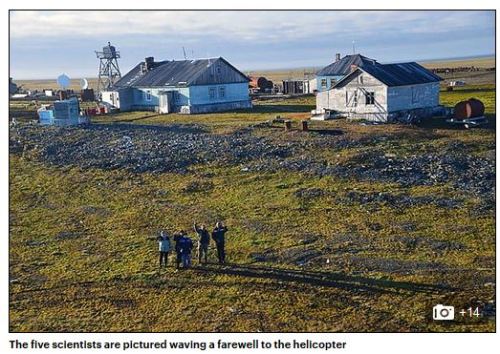
In addition, hunting polar bears is banned in Russia and this incident shows to what lengths people must go to avoid killing them – the population must be booming and may be higher yet than the last population count (in 2013) of about 3,200 bears. More bears means more competition for food, which means more assertive bears get the goods. None of these bears were described as thin or starving – see more photos, like the one below, from the Russian weather station (Daily Mail, 18 September 2016).

russian-weather-station-troynoy-island_mailonline-18-sept-2016

While polar bears are always on the look-out for food (and thus always a potential threat to humans), they are most apt to be truly dangerous in winter (when they are at their lowest body weight)  and in spring if seals are in short supply.

That’s why my new polar bear attack thriller EATEN is set in early spring, in a year when seals happen to be scarce. Imagine the damage those Russian polar bears could have done if they’d been truly desperate for food – a mere door or window would not have stopped them.

Imagine if dozens of truly ravenous polar bears stalk and ambush people across a great frozen landscape, taking them by complete surprise because no one considers a bear attack in spring to be a real possibility. What if dozens of people have been killed and eaten by hungry polar bears and there is no end in sight? That is the premise of EATEN – a science-based novel set in Newfoundland that will scare your pants off.

This is a great read for fall, when polar bear encounter stories abound. Hopefully the reports this year won’t include the kind of serious mauling that happened in 2003.

sept-reading-promo_eaten
Continue reading

Polar bear tragedy porn dressed up as science features in new BBC Earth video

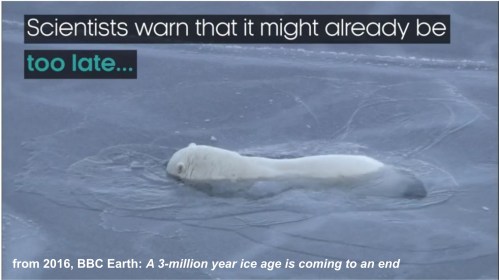
This new effort by the BBC would make the PR department of the Center for Biological Diversity proud, with it’s prominent use of animal tragedy porn pretending to be science. In contrast, the actual science shows something quite different: though summer sea ice since 2007 has declined to levels not predicted until 2040-2070, there has been virtually no negative impact on polar bear health or survival, a result no one predicted back in 2005.

bbc-video-15-sept-2016-screencap-breaking-ice-02

Bizarrely entitled  A 3-million-year ice age is coming to an end (15 September 2016), this slick video pretends it’s promoting the recently released paper by Harry Stern and Kristen Laidre (2016) that got a lot of media attention last week (see here and here).

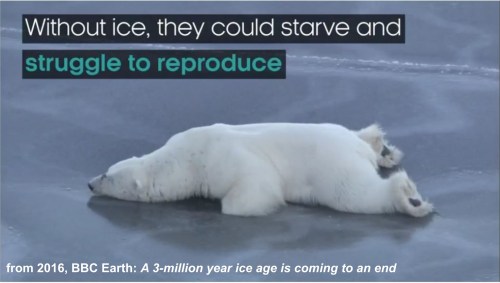
Who exactly suggested the profound prophesy stated in their chosen title, the BBC Earth folks don’t say: the Stern and Laidre paper certainly does not. And the use of a bear that appears to drown before our eyes is Hollywood-style emotional manipulation. Note the careful use of “might” (above) and “could” (below).

bbc-video-15-sept-2016-screencap-breaking-ice-01

Watch the videos below and weep not for the plight of the polar bear, but for the downfall of science journalism. Continue reading

Recent studies show Sept ice of 3-5 mkm2 did not kill polar bears off as predicted

The annual Arctic sea ice minimum for 2016 is imminent and the hand-wringing about polar bear survival has already begun. While this year is shaping up to be another very low sea ice minimum in the Arctic – not as low as 2012 but lower than as low as 2007 (previously the 2nd lowest since 1979) – contrary to predictions, several recent studies show that such low sea ice coverage in summer has had no (or very limited) negative effects on polar bear health and survival. In fact, for polar bears in some areas low summer sea ice has been quite beneficial (although these are not the populations that polar bear specialists predicted would do better).
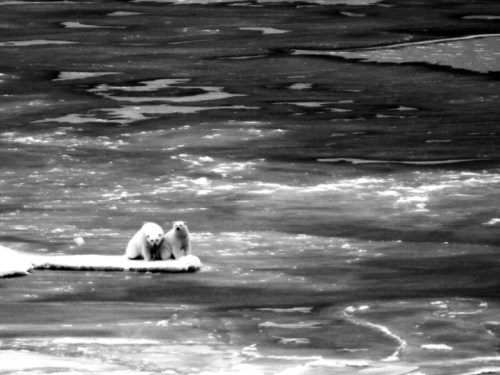
polar_thin_ice Jessica Robertson_USGS

Since low summer extents of recent magnitude (3.0 – 5.0 mkm2) are clearly not any sort of threat to polar bears, it seems improbable that even an ice-free (≤ 1.0 mkm2) summer (e.g. Wang and Overland 2015) would be devastating to the species [don’t forget Cronin and Cronin 2016: they’ve survived such conditions before] – as long as conditions in spring allow for the necessary concentrated feeding on young seals.
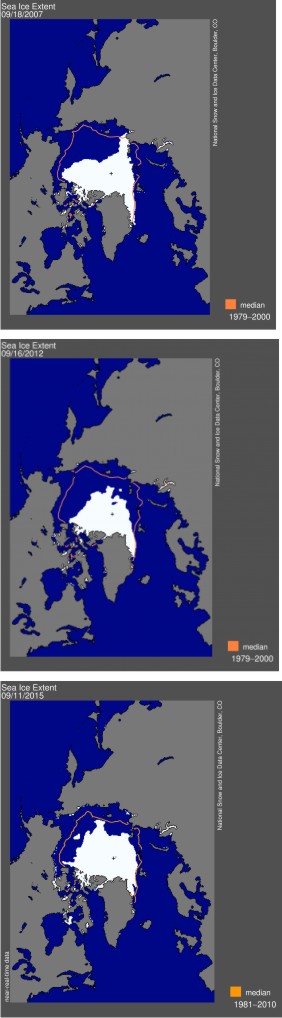
sea-ice-mins_2007_2012_2015_polarbearscienceAbove: Top, minimum at 2012 (16 Sept, 3.41 mkm2, lowest since 1979); Center, 2007 (18 Sept, 4.17 mkm2); Bottom, 2015 (9 Sept, 4.50 mkm2), from NSIDC. Below: sea ice at 10 Sept 2016, 4.137 mkm2 – minimum not yet called).
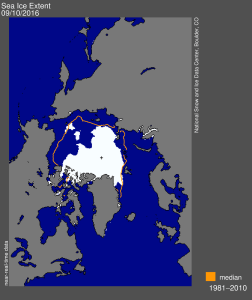
sea-ice-extent-2016-sept-10_nsidc

Recall that in 2006, the IUCN Polar Bear Specialist Group based their conservation status of ‘vulnerable’ (likely to become threatened within the next 45 years due to reduced habitat) on the predictions of sea ice specialists (see 2008 update here).

Sea ice experts in 2005 predicted such low summer sea ice extents as polar bears have endured since 2007 (3.0 – 5.0 mkm2) would not happen until 2040-2070, at which time PBSG biologists said that >30% of the world’s bears would be gone.

Evidence to the contrary comes from polar bear specialists working in the Chukchi, Beaufort, and Barents Seas – and in Southern Hudson Bay – since 2007. Overall, the latest IUCN Red Book assessment (2015) put the global population size at 22,000-31,000 (or about 26,500).

All of this means that those polar bear experts were wrong: polar bears are more resilient to low summer sea ice conditions than they assumed.

UPDATE 2 January 2017: I’ve added some quotes from the original USGS reports that explicitly state their dire predictions for 2050 that differ from the predictions made by the IUCN Polar Bear Specialist Group.
Continue reading

Columnist admits video on polar bears and global warming contained a serious error

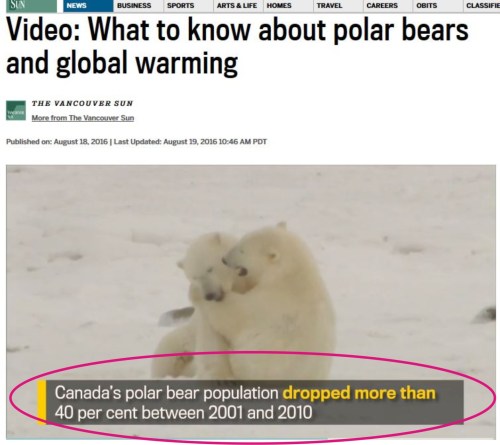
Since mid-August,  Vancouver Sun columnist Daphne Bramham has been filing a series of articles from an expedition cruise through the Northwest Passage for a feature called “Above the Arctic Circle”. One of these appeared on August 18, along with a video called “What to know about polar bears and global warming” and it contained an egregious error that should have stood out to any educated person as being wrong by several orders of magnitude:

What to know about pbs GW_Video_screencap 2_SUN_18 Aug 2016 marked

We are not talking about a difference of opinion or interpretation but a simple fact that was outrageously wrong by a wide margin. You see it, don’t you? Continue reading

Narwhal and beluga ice entrapment is natural – not caused by global warming

A part-time Arctic researcher eager for media attention suggested earlier today that the ice entrapment of narwhals in 2008 and again in 2015 at Pond Inlet (that made headlines around the world) was the result of “sudden changes in temperature” caused by climate change. This grossly misleading claim ignores the facts: ice entrapment of narwhals is an entirely natural feature of the Arctic that has been known about for hundreds of years.

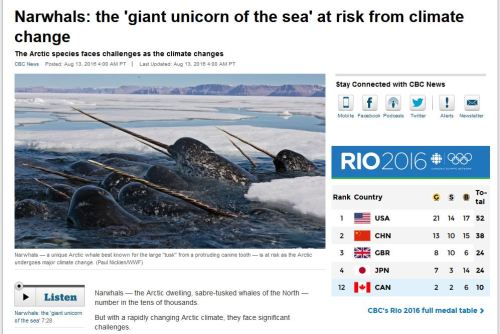
Narwhals_at risk from climate change_CBC 13 Aug 2016 headline

Narwhals: the ‘giant unicorn of the sea’ at risk from climate change” (CBC, 13 August 2016), a print version of a CBC Radio interview with Clint Wright that aired 8 August 2016. Wright is the general manager at the Vancouver Aquarium and apparently has “joined a team of researchers to tag and study” narwhals for several years – but does not seem to know much about the history or circumstances of natural ice entrapment.

Ice entrapment of small whales is nothing new. The first formally documented incident – in English – occurred in 1915 (Porsild 1918) and the phenomenon has probably occurred as long as there has been ice in the Arctic (millions of years).

Animals routinely become trapped in a few specific areas due to local geography: when ice that forms in the north moves south quickly, it blocks the entrances to inlets or coastal bays that still have open water. The presence of the pack ice causes nearby  temperatures to drop quickly. Rapid development of ice on the bay proceeds from the mouth toward the head of the bay. Any whales present cannot escape to open water and will eventually die or be eaten.

Pond Inlet at the north end of Baffin Island is one such place but Disko Bay in western Greenland is another. In fact, Pond Inlet and Disko Bay are almost identical in geographic layout even though they lie on opposite sides of Baffin Bay, so it’s not surprising that both are locations of repeated entrapment events.

Three highly informative journal articles on the phenomenon of ice entrapment of narwhals and beluga are open access documents that reveal some fascinating details of such incidents, including polar bear predation on trapped whales. h/t T. Nelson Continue reading

Tracking polar bears in the Beaufort Sea in July & sea ice comparison with 2007/2012

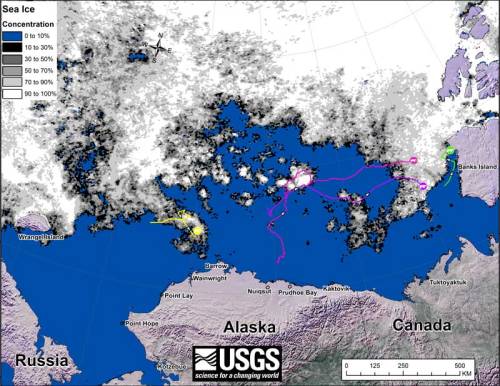
Only four Alaskan polar bear females had USGS satellite collars left transmitting locations in the Beaufort Sea and all four of these bears were on the ice during July, 2016. The same was true in June and May.

Beaufort tracking USGS bear-movements-July 2016 sm

Original caption: “Movements of 4 satellite-tagged polar bears for the month of July, 2016. Polar bears were tagged in 2015 and 2016 on the spring-time sea ice of the southern Beaufort Sea. All 4 of these bears have satellite collar transmitters. Polar bear satellite telemetry data are shown with AMSR2 remotely-sensed ice coverage from 31 July, 2016.” Original here.


There looks like a lot of open water for this time of year but in terms of absolute extent there is somewhat less ice than there was in 2007 and only slightly less than 2012, according to NSIDC Masie charts. And of course, what we know is that polar bears of the Chukchi Sea and the Southern Beaufort not only survived the low ice summers of 2007 and 2012, they thrived: CS bears were in great condition and reproducing well, and BS bears were recovering from the devastating thick ice conditions of the 2004-2006. Have a look at the maps below. Continue reading

USGS report on history of walrus haulouts leaves out correlation with population size

Walrus researchers from the US Geological Survey have a new report on the history of walrus haulouts in the Chukchi and Bering Seas – yet their media efforts (via press release and interviews) fail to mention the relationship between fluctuating size of walrus haulouts and fluctuating walrus population size that is evident in that history. In fact, overall population size is not mentioned at all.

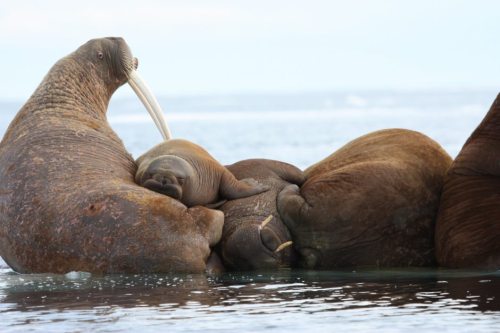
Walrus 2012 July USGS

Two articles came out over the weekend that announced the results of this new joint US-Russian initiative [PBS, Walrus beaching in Alaska might not be as harmful as it looks. Here’s why – 31 July 2016 and ADN, Alaska and Russia join forces to create 160-year database of walrus haulouts – 31 July 2016]

But neither articles nor the new USGS paper they are touting (Fischback et al. 2016) mention the huge summer/fall haulouts of females, calves, and juveniles that were documented in the 1970s that coincided with the huge population size at that time, which crashed in the 1980s.

Only now has the population grown (to at least 200,000) to the point that huge haulouts are again being reported – conservation has done it’s job. But when walrus numbers get too high the animals out-strip their food source and numbers plummet, as they did in the 1980s (Fay et al. 1989; Garlich-Miller et al. 2011). See my fully referenced summary paper, Crockford 2014 (On The Beach: Walrus Haulouts are Nothing New).

Here’s the concern: When (not if) a population crash happens again, will it be blamed on global warming rather than natural causes? According to the PBS article:

“The database is supposed to help federal officials with conservation, especially as more ships start sailing through the newly open waters. The U.S. Fish and Wildlife Service is determining whether walrus should be listed as a threatened species.[my bold]

My GWPF video on the issue (The Walrus Fuss) below:

See excerpts from the USGS database below, with a map:

Continue reading

Why is polar bear conservation such a contentious issue?

Are polar bears in decline or not? Who is to blame for the fact that there is no clear answer about how polar bears are doing? Apparently, everyone except polar bear specialists are at fault for the way polar bear issues have been handled in recent years (including me), at least according to one northern journalist.

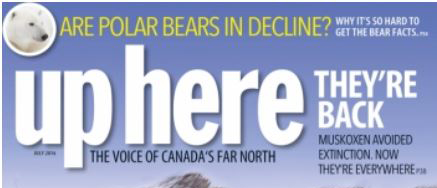
UpHere Magazine_July 2016 cover cropped

Back in February, I wrote a rather critical review of an exclusive interview with polar bear researcher Ian Stirling that was published in the February issue of UpHere Magazine called, He speaks for the polar bears – with this lede under the title:

“No fear-mongering. No exaggeration. For Ian Stirling, it’s purely about the science.”

I said “Yeah, well – judge for yourself,” and pointed out some rather critical inaccuracies and obfuscations in Stirling’s answers that I backed up with references.

Well, the editor of that magazine, Tim Edwards, emailed me a few days later and said:

“...we wanted to try to clarify the issues and just talk hard science, no rhetoric. Lo and behold, we’re learning that even his opinion is by no means universally agreed-upon. So thank you for your criticism.”

In May, I was contacted by UpHere writer Dan Campbell, who spoke to me several times before writing this month’s article (15 July 2016), Lost in the numbers: The polar bear is getting more attention than ever, but that may be harming the animal more than helping. Have a look and decide if it clarifies any of the polar bear issues for you. Continue reading