Tag Archives: facts

Climate Hustle knows: Ten dire predictions that have failed as global polar bear population hits 22-31k

[Reposted today from earlier this year in support of the 2 May release of the intentionally funny documentary, Climate Hustle (across the US and a few Canadian locations) because host Marc Morano knows that polar bear numbers have not declined as people have been led to believe, see the trailer below]

Climate Hustle_May 2 2016

Grim predictions of the imminent demise of polar bears – their “harsh prophetic reality” as it’s been called – have been touted since at least 2001. But such depressing prophesies have so widely missed the mark they can now be said to have failed.

While polar bears may be negatively affected by declines in sea ice sometime in the future, so far there is no convincing evidence that any unnatural harm has come to them. Indeed, global population size (described by officials as a “tentative guess“) appears to have grown slightly over this time, as the maximum estimated number was 28,370 in 1993 (Wiig and colleagues 1995; range 21,470-28,370) but rose to 31,000 in 2015 (Wiig and colleagues 2015, pdf here of 2015 IUCN Red List assessment; range 22,000-31,000).

Here are the failed predictions (in no particular order, references at the end):
Continue reading

Polar bear habitat update end of April 2016: Plenty of sea ice for feeding

So, here we are near the end of the first month of the Arctic spring and there is still more ice than usual off Labrador and conditions in the Barents Sea are improving daily. The fear-mongers can blather all they like about the potential risks of bears swimming in summer – but spring is the critical season as far as sea ice is concerned for polar bears and all polar bear biologists know it. Polar bears consume 2/3 of all the food they need for the year during April-June and so far, ice conditions are looking just fine.

Cambridge Bay_we re OK_from Joe Prins

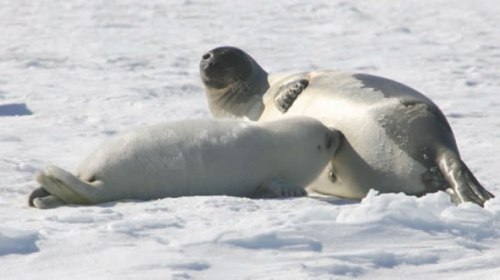
There is enough ice where there needs to be ice for polar bears to gorge themselves on new-born ringed and bearded seals – and that’s really all that matters. More ice off Labrador means more hunting ground for the Davis Strait polar bears that depend on the tens of thousands of young harp seals born this year off the Front.

Harp seal pup_DFO Newfoundland
Continue reading

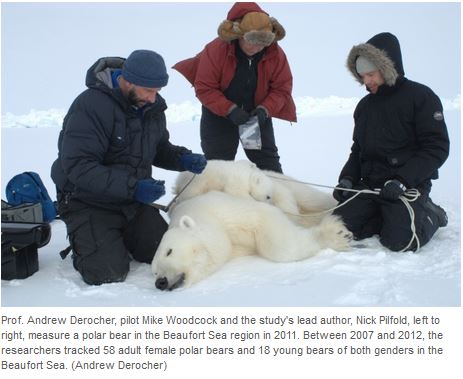
No evidence that long-distance swimming contributed to Beaufort Sea polar bear population crash of 2004-2006

The air is thick with desperation on the polar bear front:

“[Andrew] Derocher said the polar bear population in the Beaufort Sea has fallen more than 50 per cent in the past 10 years.

“So it is a concern that this is probably one of the factors associated with the population decline,” he said.

Derocher_CBC news 19 April 2016

As the CBC report in which this quote appears states immediately afterwards, there is no evidence for such a thing in the paper under discussion:

“The study found no direct evidence of that – all polar bears appeared to survive the swims recorded in the study.”

There is no truth to Derocher’s first statement either. Desperation – you don’t have to be a scientist to sense it. And the media wonder why people don’t trust them…

Continue reading

Polar bear biologists imply “summer sea ice” and “sea ice” are synonymous

According to sea ice experts, winter sea ice habitat for polar bears is not expected to decline at all by 2050 and the critical spring sea ice that polar bears need for gorging on young seals and for mating is not predicted to change much (Durner et al. 2007, 2009), which is why computer modelled predictions about the dire future for polar bears only assessed the potential future effects of declining summer sea ice (e.g. Amstrup et al. 2007; Stirling and Derocher 2012). Note spring is April-June.

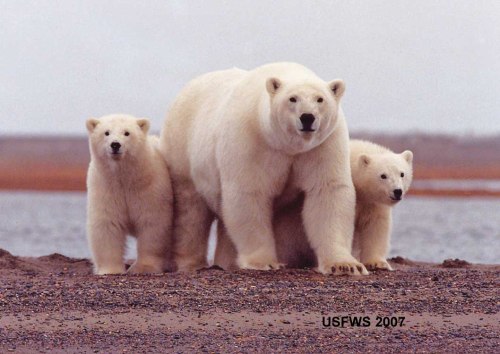
Female with cubs Beaufort_USFWS credit 2007 w label_sm

See if that fact is clear in the interview responses by out-spoken polar bear biologists that has just been published in the polar bear portion (“Beyond the polar bear”) of this year’s University of Alberta magazine spring climate change feature. If you can get past the “canaries in the coal mine” opener…
Continue reading

Southern Hudson Bay polar bears are not starving to death

Reposted from 23 March 2016: Despite the fact that the polar bears of Southern Hudson Bay (SHB) live further south year round than any others, a recent study found their average body weight has declined relatively little since the 1980s. There has been no decline in the size of the population over that time either.

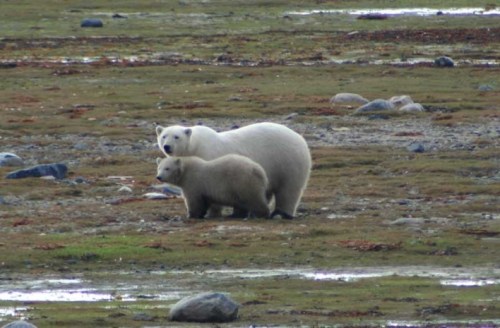
James Bay female and cub_Ontaro Govt

Remarkably – despite what we are told about how critical breakup dates are to polar bear health and survival in Hudson Bay – this study found that for SHB bears, the small decline in body condition index correlated only with freeze-up dates, not breakup dates or length of the ice-free season. They also found that regional breakup and freeze-up dates relevant to polar bears in this area was the day when ice cover reached 5% (not 50%).

In other words, SHB polar bears left the ice (or returned to it) when the average ice cover near the coast was about 5%. This finding is yet more evidence that the meteorological definition of “breakup” (date of 50% ice cover) used by many researchers (see discussion here) is not appropriate for describing the seasonal movements of polar bears on and off shore.

The news (two weeks after this post originally went up, see also here), however, is about the bit of weight decline, hyped to the maximum.

Continue reading

Late winter surge in sea ice habitat and the resilience of Svalbard polar bears

The Barents Sea – and Svalbard in particular – has had very little sea ice this winter but recent evidence suggests pregnant females adapted by moving east to Franz Josef Land to have their cubs. The surge in ice that’s come over the last few weeks will, however, be welcome habitat for the critical hunt of fat newborn seals that takes place primarily in April and May.

Svalbard polar bear_NP015991-isbjorn-JA

It was only last fall that Norwegian biologist Jon Aars (photo above taken by him in August 2015) was touting the fat condition of Svalbard-area polar bears he and his team saw in August and admitted the population had increased by a whopping 42% since 2004 – despite dire predictions of a drastic decline. In fact, 2014/2015 was a great year for the area’s polar bears.

However, in the fall of 2015 sea ice was so late forming around Svalbard that it seemed impossible that any females would get to traditional denning grounds on the east coast in time to give birth. There was no sea ice to speak of until late December, so it seemed virtually certain that all females had gone to Franz Josef Land further east (in Russia) – as they are known to do – to utilized its alternative denning sites.

It’s called resilience – the ability to shift behaviour in response to changing conditions. In this case, all indications are that shifting den locations to Franz Josef Land is a long-standing response of Svalbard area polar bears to low ice conditions. This shift does not even require a movement outside their subpopulation boundaries, let alone a movement outside the ill-defined “sea ice ecoregions” originally defined by Steven Amstrup and colleagues (2008) to support their prediction that polar bears will likely be extinct by 2100, taken up later by others since.

Some polar bear specialists appear to believe that if Barents Sea conditions are not precisely what they were in the 1980s (examples here and here), polar bears cannot possibly survive. But the bears are showing them otherwise – and demonstrating how they likely survived previous warm periods like the Holocene Optimum ~9,000 years ago and the Eemian Interglacial ~115,000-130,000 years ago (CERQA 2014:66) without population numbers getting anywhere near extinction levels.
Continue reading

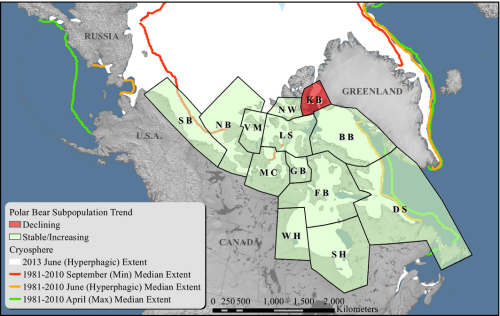
Both sides now: New paper critiques Canadian polar bear population status

Demographic and traditional knowledge perspectives on the current status of Canadian polar bear subpopulations. 2016 (in press). Jordan York, Martha Dowsley, Adam Cornwell, Miroslaw Kuc and Mitchell Taylor. Ecology and Evolution 6(9):2897-2924. DOI: 10.1002/ece3.2030

York et al 2016 fig 1_numbers 2013

Take home quote:

“We see reason for concern, but find no reliable evidence to support the contention that polar bears are currently experiencing a climate crisis. We suggest that the qualitative projections for dramatic reductions in population numbers and range are overly pessimistic given the response of polar bears, climate, and sea ice to the present.”

Continue reading

Condition of S Hudson Bay polar bears varies with freeze-up only says new study

Despite the fact that the polar bears of Southern Hudson Bay (SHB) live further south year round than any others, a recent study found their average body weight has declined relatively little since the 1980s. There has been no decline in the size of the population over that time either. Perhaps that’s why there was neither a press release nor a massive media blitz when this paper came out earlier this month.

James Bay female and cub_Ontaro Govt

Remarkably – despite what we are told about how critical breakup dates are to polar bear health and survival in Hudson Bay – this study found that for SHB bears, the small decline in body condition index correlated only with freeze-up dates, not breakup dates or length of the ice-free season. They also found that regional breakup and freeze-up dates relevant to polar bears in this area was the day when ice cover reached 5% (not 50%).

In other words, SHB polar bears left the ice (or returned to it) when the average ice  cover near the coast was about 5%. This finding is yet more evidence that the meteorological definition of “breakup” (date of 50% ice cover) used by many researchers (see discussion here) is not appropriate for describing the seasonal movements of polar bears on and off shore.

Continue reading

Challenging Alaska polar bear research sound bites and bewildering ESA status

Beaufort Sea male polar bear USGS_2005 Amstrup photo

It’s easy to take polar bear research papers at face value but it’s not very scientific. The snappy sound bites provided for the benefit of the media – whether they’re embedded in press releases or in published abstracts – don’t cut it with trained scientists. Trained scientists read the whole report, critically examine the evidence it contains and assess that evidence within the context of previous knowledge. That’s what they are trained to do.

I challenge the superficial summary on the status of Alaskan polar bear populations provided by FactCheck.org journalist Vanessa Schipani.  Schipani disputed a comment made by Alaska Senator Lisa Murkowski that, according to the latest research Alaskan polar bear population numbers are strong and healthy. I’m not especially interested in the political context of the statement, only Schipani’s bald claim that Murkowski’s declaration is false.

I’ve read all the relevant papers in full and I contend that the evidence supports Murkowski’s statement. Schipani is confusing the issue by regurgitating ‘facts’ that don’t tell the truth of the matter. By the sum of accounts, Alaskan polar bear populations are indeed healthy and strong – whether or not this status will continue is an entirely different question. Continue reading

A new count planned for Southern Beaufort polar bears

I know I was not the only one that thought the last polar bear count conducted by the US Geological Survey (USGS) in the Southern Beaufort generated an untenable result but it appears that some of those challengers are in a position to demand a recount.

polar_bear_usfws_no date_sm

CBC News ran a story late last week announcing a plan is in the works to do an aerial survey of Southern Beaufort Sea polar bears across their entire range over two years starting in 2017 (11 March 2016, “Joint U.S.-Canada Beaufort Sea polar bear survey planned“).

With luck, this period will not include another bout of the same thick spring ice conditions that decimated the population in the mid-2000s (which many reporters concluded was due to reduced summer sea ice because that’s what leading biologists implied). Even if it does, lucky timing will not negate the fact that this population is routinely subjected to devastating population declines caused by natural changes to spring sea ice conditions from which they have recovered on numerous occasions. Continue reading