Tag Archives: fasting

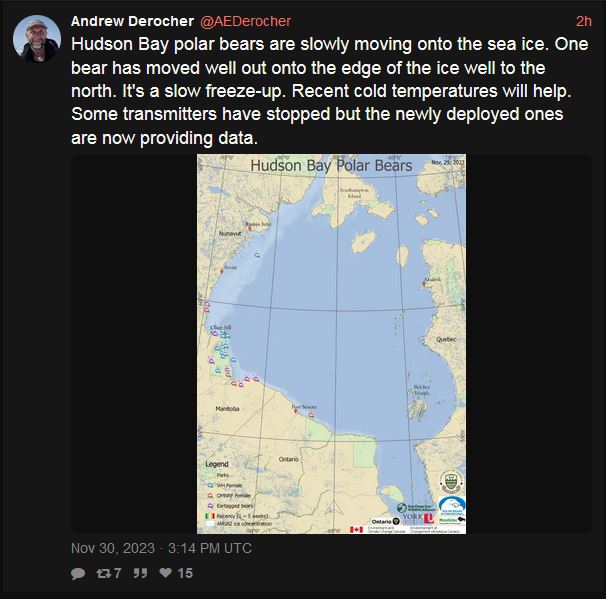
Western Hudson Bay polar bears on their way offshore to hunt seals: freeze-up has begun

Official confirmation has come in this morning that polar bears that have spent the summer fasting along Western Hudson Bay now have enough ice to move offshore. That makes this year a bit later than usual (average is 16 November) but is not one of the extremely late freeze-ups, as happened in 1981, 2016 and 2021 when bears didn’t leave until the first week of December (Castro de la Guardia et al. 2017; Miller et al. 2022). Since breakup of sea ice came earlier than usual this summer, this means (as of 30 November) many bears will have been off the ice and without food for 166 days or 5.5 months.

However, so far, there have been no reports from this region of incidents of cannibalism, starving bears found wandering the landscape like zombies, or desperate attacks on people that polar bear specialists have warned us to expect (Abrahms et al. 2023; Stirling and Derocher 2012; Wilder et al. 2017).

Tracking WH Bears

Courtesy Andrew Derocher, University of Alberta, who monitors WH bears:
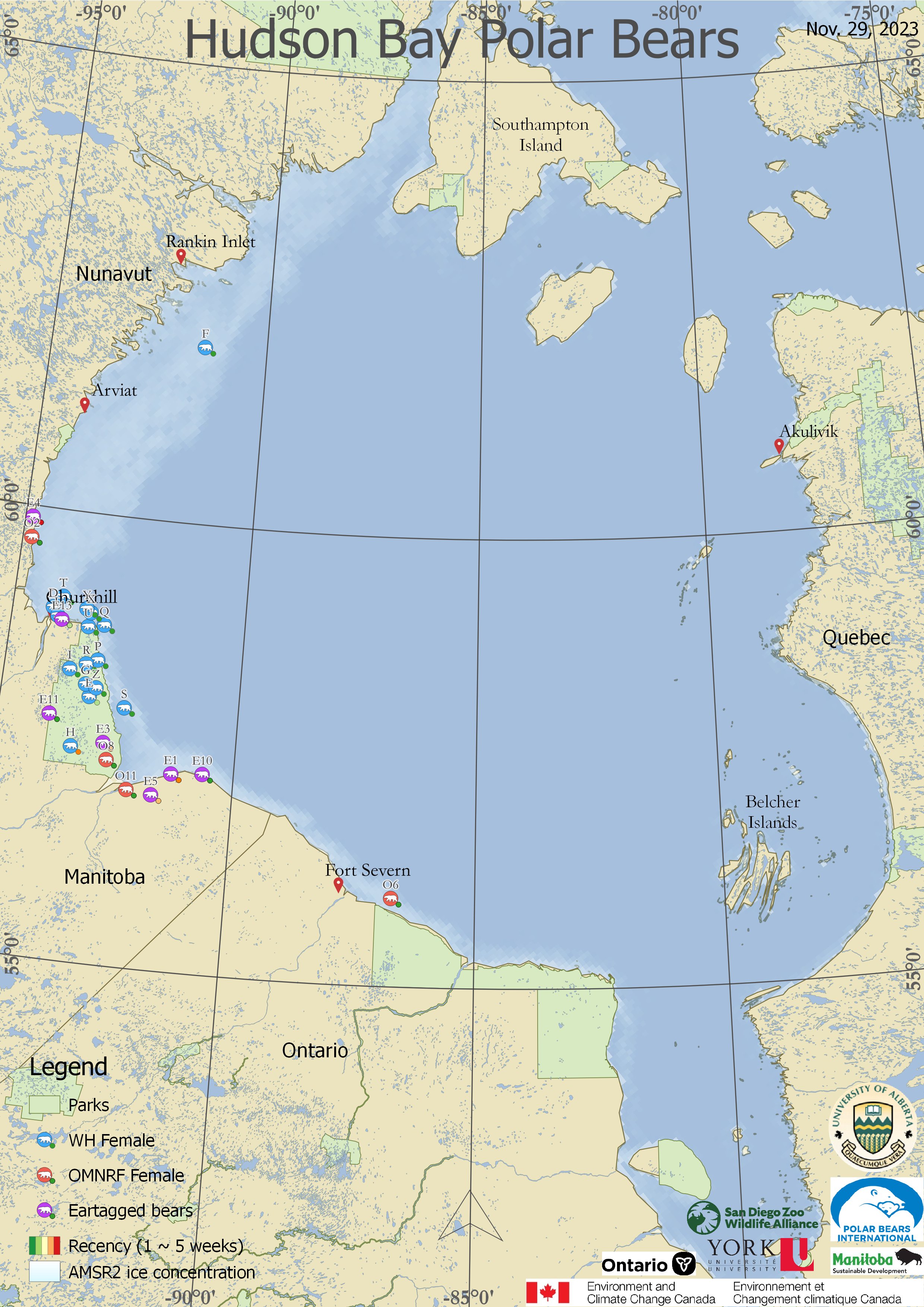
Close-up of the tracking map below. Note that pregnant females will stay ashore to give birth so not all of these tagged bears are expected to head onto the ice this fall to hunt for seals:
Still not a word from the Polar Bear Alert folks in Churchill, who as of today, haven’t released any of their weekly reports since 23 October 2023.

Ice Conditions in Canada

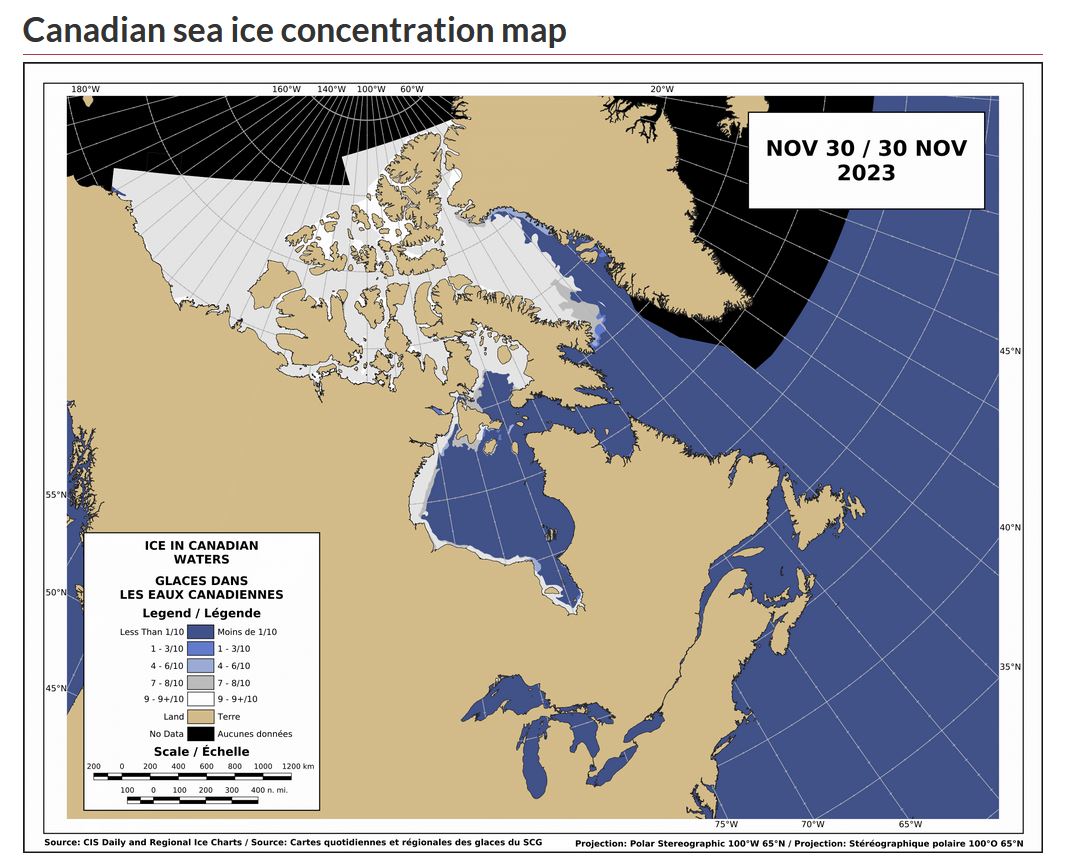
At 30 November 2023, courtesy Canadian Ice Services shows the expanding band of ice developing along the western shore of Hudson Bay but note also that the rest of the Canadian Arctic, as well as the Beaufort Sea, is completely covered in ice, as is most of Baffin Bay and Foxe Basin:
References

Abrahms, B., Carter, N.H., Clark-Wolf, T.J., et al. 2023. Climate change as a global amplifier of human–wildlife conflict. Nature Climate Change 13:224-234. https://doi.org/10.1038/s41558-023-01608-5

Castro de la Guardia, L., Myers, P.G., Derocher, A.E., Lunn, N.J., Terwisscha van Scheltinga, A.D. 2017. Sea ice cycle in western Hudson Bay, Canada, from a polar bear perspective. Marine Ecology Progress Series 564: 225–233. http://www.int-res.com/abstracts/meps/v564/p225-233/

Miller, E.N., Lunn, N.J., McGeachy, D., and Derocher, A.E. 2022. Autumn migration phenology of polar bears (Ursus maritimus) in Hudson Bay, Canada. Polar Biology 45:1023-1034.

Stirling, I. and Derocher, A.E. 2012. Effects of climate warming on polar bears: a review of the evidence. Global Change Biology 18(9): 2694–2706.

Wilder, J.M., Vongraven, D., Atwood, T., et al. 2017. Polar bear attacks on humans: implications of a changing climate. Wildlife Society Bulletin 41(3):537-547.  https://doi.org/10.1002/wsb.783
Thick sea ice in the Western Arctic is not good habitat for polar bears, seals, or walrus

A few weeks into the Arctic summer (July-September), sea ice in the Beaufort and Chukchi Seas is dominated by thick, multi-year ice.

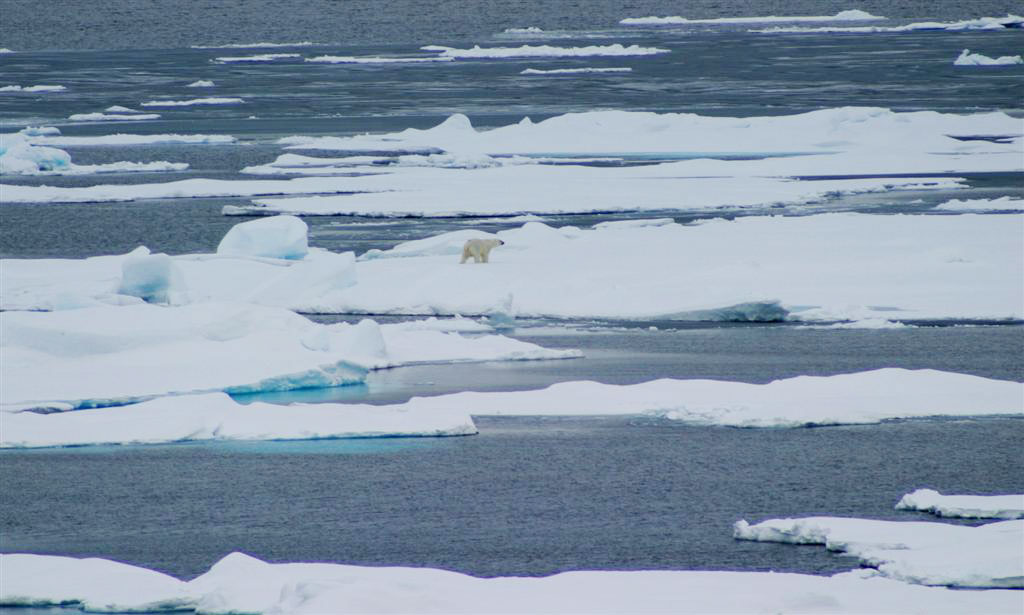
At this time of year, multi-year ice is an important refuge habitat for many polar bears when seasonal ice melts out. However, it provides few opportunities for hunting seals. In fact, it is nearly as devoid of food as is the shore during the melt season. Consequently, most polar bears eat little over the summer whether they are on land or on sea ice due to the scarcity of seals.

Continue reading

Summer habitat for most polar bears is either shoreline or sea ice in the Arctic Basin

At this time of year, sea ice extent numbers are meaningless for polar bears.  The extreme low September minimum of 2012 – when masses of polar bears didn’t die – showed rational people that this is true. Even the low 2007 summer extent, which hit earlier in the season than 2012, had little to no negative impact.

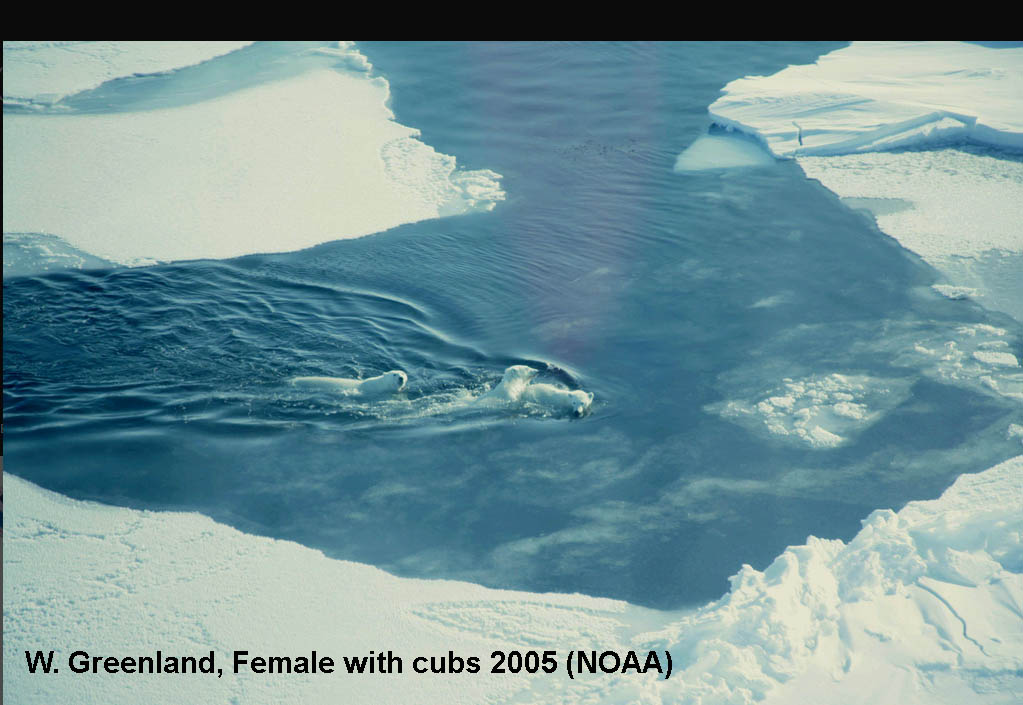
Greenland W coast_Female w cubs_2006_Mads Heide-Jorgensen_NOAA sm

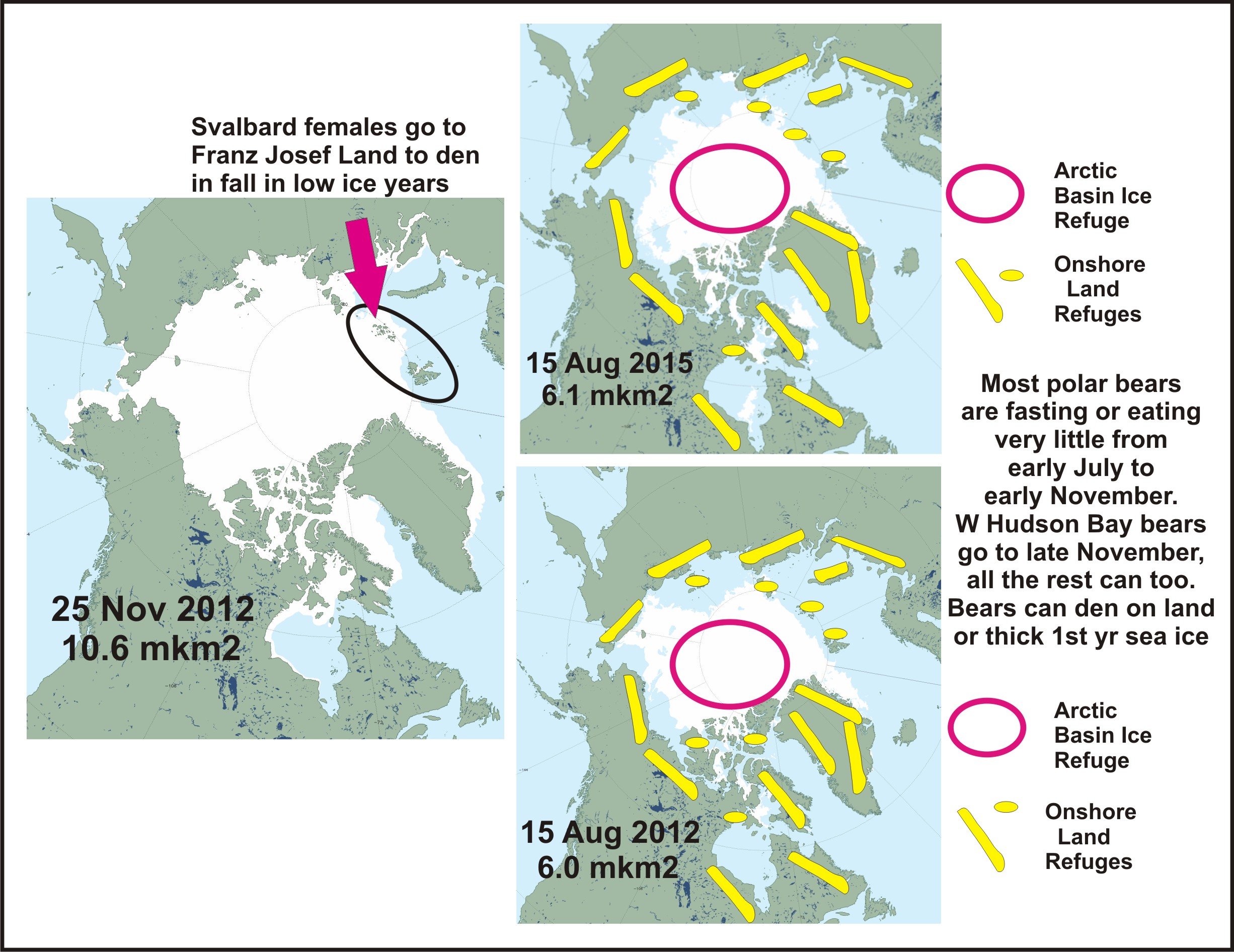
In late summer, bears outside the Canadian Archipelago either retreat to shore or stay on the sea ice as it retreats north into the Arctic Basin (see image below, click to enlarge).  Most bears in the Archipelago have ice year round, so life doesn’t change much. This means that it does not matter to polar bears how much area the Arctic Basin ice covers in September – for their needs, 1.0 mkm2 would be plenty.

Sea ice and summer refuges for polar bears_17 Aug 2015

Still, Southern Hudson Bay polar bears had extended hunting opportunities in July this year (whether or not they hunted successfully) and for this date, Hudson Bay had more ice remaining than any year on record. Yes, more than even 1992 but only by a few percent. See charts and maps below.

Continue reading

Polar bear habitat looking good for early summer – last days before the fast

Some polar bears may already be living mostly off the fat put on over the spring but others may catch a seal or two on the sea ice before the summer fast begins – since the ice hasn’t left the coast in most regions quite yet. Polar bears eat little in summer, whether they spend their time on land or on the sea ice.

PolarBearCV1LG_USGS

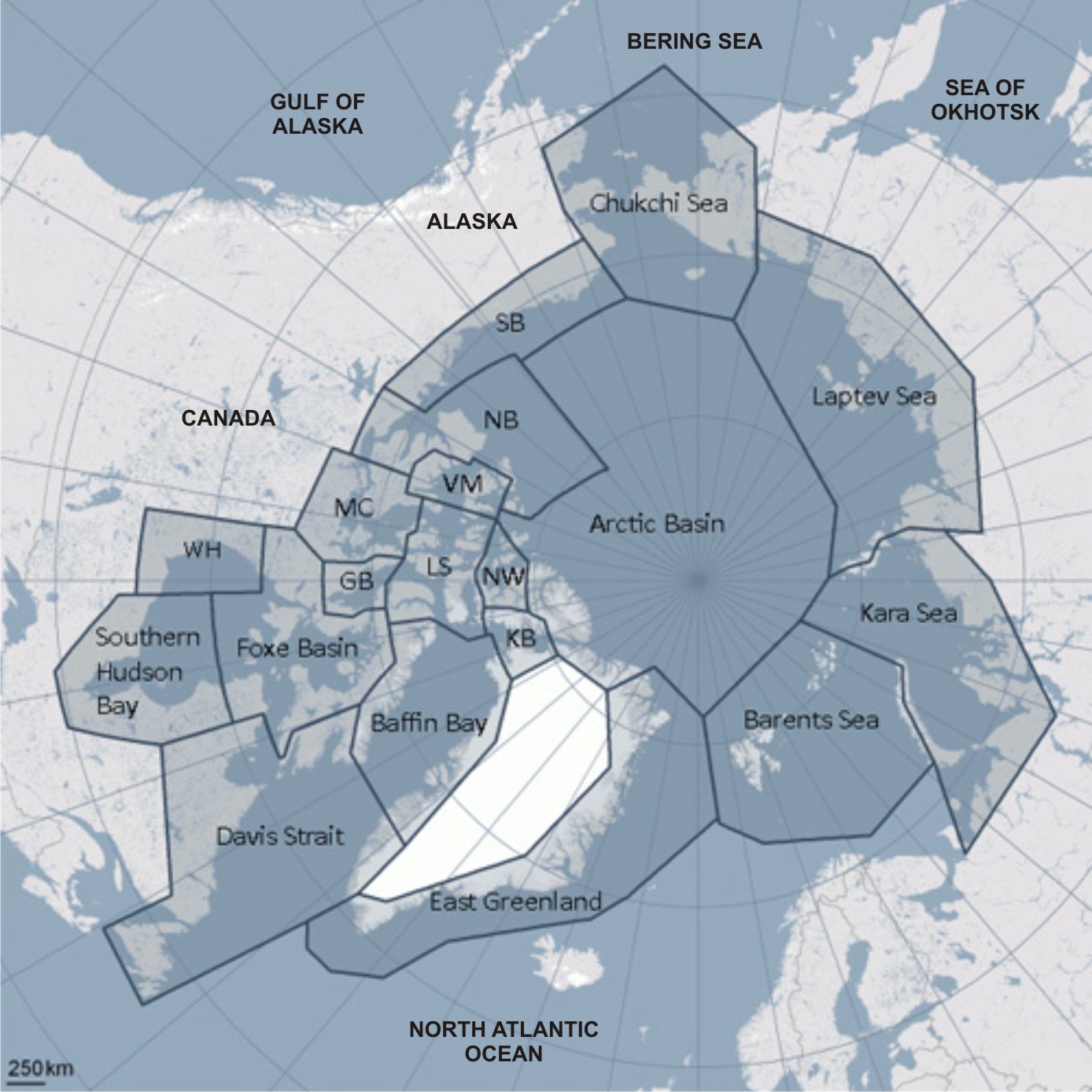
Sea ice is still high over Hudson Bay – for this time of year, it hasn’t had this much polar bear habitat since 2009. Davis Strait and Foxe Basin are also above average – Davis Strait hasn’t had this much ice since 1992 (the Mt. Pinatubo cold year). Polar bear subpopulation refresher map below.

PB map-all-populations PBSG original plus Okhotsk
Continue reading

Andrew Derocher raises the “starving polar bears” issue in DailyMail interview

In what looks like a follow-up to last week’s CBC documentary, The Politics of Polar Bears, the London (UK) based DailyMail published interviews with polar bear biologists Mitch Taylor and Andrew Derocher (September 9, 2014).

The CBC film did have a one scientist vs. another” flavor about it and this article definitely echoes that approach. My comments below on Derocher’s insinuations and questions about starving bears and global warming.
Continue reading

Polar bears and melting ice: three facts that shouldn’t surprise you

If I was invited by USA TODAY to discuss how climate change is affecting polar bears now – summed up in three talking points – this is what I’d say. I’d use some meaningful images rather than cute pictures of cuddly bear cubs and I’d provide links to my work with references and details to back up my answers.

Compare my responses to those supplied by Steve Amstrup in his capacity as spokesperson for Polar Bears International (“Save our sea ice!”) to Jolie Lee at USA TODAY last week, who’s word is expected to be taken as gospel.

AK PB N Shore-USFWS Barrow_labeled

Continue reading

Churchill polar bear attack shamelessly used to advance global warming agenda

I guess Suzanne Goldenberg, writing for The Guardian, just couldn’t help herself with this latest story (November 4):Polar bear attacks: scientists warn of fresh dangers in warming Arctic. Two people injured in latest attack as hungry bears deprived of access to sea ice increasingly look for food on land.

Reporting on the attack is one thing — several papers covered this over the weekend (see Featured Quote #46, posted yesterday, for links to two of them). However, Goldenberg shamelessly makes this about global warming, aided and abetted by Polar Bears International (PBI) representative Steven Amstrup, a claim that doesn’t hold up to even minor scrutiny.

Continue reading

Ian Stirling’s latest howler: “the polar bear who died of climate change”

Will wildlife biologist and Polar Bear Specialist Group member Ian Stirling now say anything – no matter how unscientific – to garner more sympathy and media attention for polar bears? It appears so.  [see followup post published Aug. 11, here]

A tabloid-style picture-is-worth-a-thousand-words article appeared in the environment section of the UK newspaper The Guardian yesterday (August 6, 2013) with a picture of a dead polar bear meant to wring your heart. The picture is a vehicle for statements from Ian Stirling and others that this polar bear died from climate change. A longer article was alongside.

The caption below the photo of a dead polar bear (animal tragedy porn) is this:

This 16-year-old male polar bear died of starvation resulting from the lack of ice on which to hunt seals, according to Dr Ian Stirling.”

Many folks have been asking questions about this and so have I.

I suggest this is what really happened: the polar bear biologists working in Svalbard earlier this year knew this bear was going to die back in April when they captured him – they simply waited, with a photographer on hand, until he died. It was an orchestrated photo-op.

[Update, Aug. 8, 2013: I suggest it was not necessary for anything more to happen to “orchestrate” this photo than for the researchers who captured the bear in April to tell colleagues and local tour boat operators (who always have avid photographers on board) to “keep an eye out for a dead bear, we don’t think this guy is going to make it.” However, very little real information is provided. Who knows when (or from whom) we’ll get the whole story — if ever? That’s why anecdotal accounts like these aren’t “evidence” of anything, in the scientific sense. That’s the real take-home message here.  If this dead bear was being presented as scientific evidence, we’d have been given all the details, including necropsy results, local ice conditions, precise dates, locations, and photos of any other bears that were seen that were in poor condition. In other words, a proper scientific report. ]

Continue reading