Posted onJuly 11, 2024|Comments Off on Last month of Arctic spring fails to bring sea ice to its knees, even in Southern Hudson Bay
Polar bear habitat for June — the last month of spring in the Arctic — is still within 2 standard deviations of the long-term average despite sea ice experts’ predictions that catastrophic declines can be expected any year now.
The Arctic sea ice cover in June 2024 retreated at a below average pace, leading to a larger total sea ice extent for the month than in recent years. NSIDC, 3 July 2024
Oddly, the National Snow and Ice Data Center (NSIDC) employees who wrote up the sea ice summary for June felt it appropriate to bring up a recently-published prediction of impending doom for Southern Hudson Bay polar bears based on a sea ice prediction (Stroeve et al. 2024), which I covered here. The inclusion of this topic is a naked promotion of the Stroeve sea ice modelling paper which not only doesn’t fit the reality of this year’s sea ice conditions but their discussion doesn’t include a single piece of evidence that Southern Hudson Bay polar bears came off the ice earlier than usual.
Posted onAugust 4, 2021|Comments Off on Polar bear attack in Greenland gratuitously blamed on recent ‘heat wave’
A polar bear bit the hand of a member of a film crew near the Danish military base of Daneborg in East Greenland on Monday (2 August) and predictably, this has been blamed on recent warm temperatures in the region. There is no specific evidence of cause and effect, of course. The news outlet reporting the incident cites some non-specified ‘experts’ as providing the generic ‘warming makes polar bears starve or behave badly’ excuse that makes no sense in this particular instance.
Here is what the news report had to say (3 Aug), my emphasis:
Early on Monday, while the sun does not set in summer at this latitude, the bear poked his head through a poorly closed window of a research station where the documentary team was staying about 400 metres from the small base of Daneborg.
A Danish Arctic military unit based in Greenland said the bear bit the hand of one of the three male team members before they used warning pistols to force the animal to flee.
Transported first to Daneborg, the injured documentary maker had to be evacuated to Akureyri, a town in Iceland.
Already blamed for five incidents until now, the bear returned again later in the morning and then again overnight Monday to Tuesday when it broke a window of the research station before fleeing.
“The local authorities have from now on categorised the bear as ‘problematic,’ which allows for it to be shot dead, if it returns,” the Danish military unit said.
Any bear causing problems in this region would have just come off the ice, since three weeks ago there was plenty of ice available offshore a bit to the north (see chart below for 7 July). Virtually all bears are at their best condition at this time of year, except for young, inexperienced bears or those that are sick or injured. Warm temperatures would not be causing any bear to be desperately looking for food unless it was desperate for some other reason (sick, injured, or an under-nourished young bear). However, nothing is stated in this report about the physical condition of the bear, its approximate age or its sex, even though it has been seen multiple times. Young male bears, for example, are far more likely to become problems near communities than any other age class (Wilder et al. 2017), because these bears have to compete with older, larger bears to keep whatever seals they manage to kill.
Note the reliance on un-named ‘experts’ at the end of the same news report:
Experts say the retreat of the ice pack, the hunting ground of the polar bear, forces them to stay on land more often and they find it harder to find food and sustain a species already considered vulnerable.
Although still rare, the close encounters with humans are increasing as bears more frequently approach inhabited areas in their search for food, environmental protection officers say.
What generic pap! The community has a problem bear on its hands, a situation which northern communities across the Arctic must contend with on a continual basis. Even if there was ice offshore, there would be the possibility of bears coming ashore and causing problems.
Wilder, J.M., Vongraven, D., Atwood, T., Hansen, B., Jessen, A., Kochnev, A., York, G., Vallender, R., Hedman, D. and Gibbons, M. 2017. Polar bear attacks on humans: implications of a changing climate. Wildlife Society Bulletin, in press. DOI: 10.1002/wsb.783 http://onlinelibrary.wiley.com/doi/10.1002/wsb.783/full
Comments Off on Polar bear attack in Greenland gratuitously blamed on recent ‘heat wave’
Posted onMay 15, 2021|Comments Off on Wandering polar bears are the new starving polar bears, falsely blamed on climate change
Back in 2017, we famously had National Geographic falsely blaming a starving polar bear on climate change but since then we have been inundated (relatively speaking) with stories of ‘wandering’ bears sighted far from Arctic coastlines. These wandering bears are oddities to be sure but are not in any way an indicator of melting Arctic sea ice or lost habitat, as The Times (UK) has claimed in this latest example (Polar bear treks 1,500 miles south as Arctic hunting zone melts away).
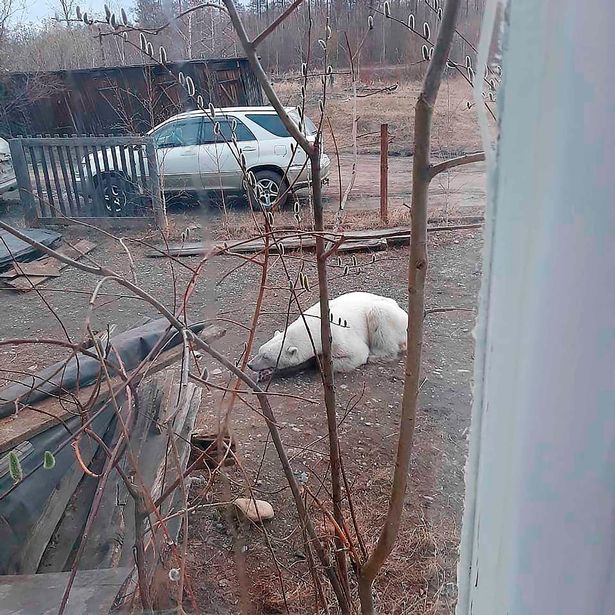
Similar to three other recent examples, from 2019 – in Alaska in winter, in Chukotka in early spring, and Siberia in late spring – this month’s example cannot rationally be blamed on lack of sea ice. This year’s bear took at least eight weeks to travel from the Lena River Delta area of the Laptev Sea to a small village in Yakusk, Russia where it was captured on 11 May, shown below on the map of the route it took included in the story at The Daily Mail (11 May).
Posted onJuly 10, 2017|Comments Off on Polar bears of W Hudson Bay utilizing a substantial patch of thick first year ice
There’s been no word as yet, either from tour operators or polar bear researchers, that Western Hudson Bay polar bears have come ashore for the summer/fall season. Andrew Derocher reportedat the end of June that the bears tagged by his team were still on the ice and as I write this, has not yet reported them ashore.
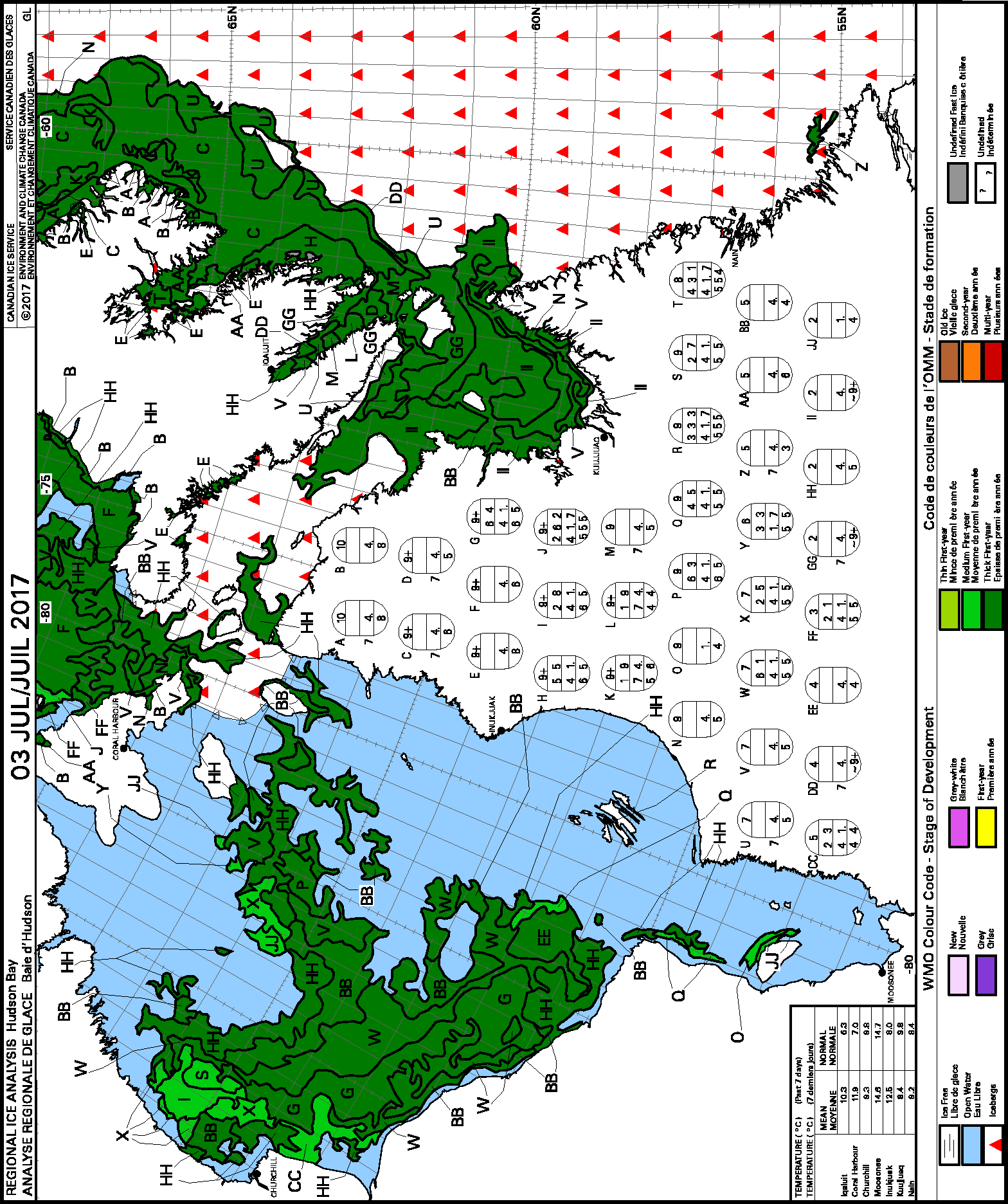
That pattern is consistent with the presence of thick ice along the west coast of the Bay — from well north of Churchill to the south of Wapusk National Park — for the last few weeks. The weekly chart for 3 July 2017 below from the Canadian Ice Service shows that virtually all of the ice remaining is thick first year ice (>1.2m, dark green on this map):
By the 9 July, the extent of this patch of ice was somewhat reduced but still a very prominent feature over the Bay, suggesting that if adult seals are using this ice as a refuge while molting, some bears may still be attempting to hunt even though their success rate may not be very high:
Bottom line: As has been the pattern for more than a decade, 2017 will not go down in history as an especially early year for WHB polar bears coming off the ice for the summer/fall season but instead may be as late as last year, whenlots of bearswere reported off the ice by mid-July at Seal River (just north of Churchill), all in excellent condition.
It remains to be seen if the condition of bears will be as good this year as they were in 2016, given thelate start to the season.But it does mean that the lack of trend in breakup dates since 2001 continues: breakup of the sea ice in WHB since 2001 has been about one week later than it was before 1998 (Castro de la Guardia 2017; Cherry et al. 2013; Lunn et al. 2016).
If some polar bear struggle to survive this year it will be due to the late freeze-up date last fall combined with challenging winter conditions over Hudson Bay, not because of an early breakup of the sea ice.
And while it is certainly true that the overall trend in time spent onshore by WHB polar bears since 1979 has increased by about three weeks, the lack of a continued trend since 2001 is not what was expected or predicted, especially given the marked decline in global sea ice levels that have made headlines since 2007 (Crockford 2017), and the predictions of how devastating such low levels of ice would be to polar bears in areas like Hudson Bay that have to deal with a total disappearance of sea ice in summer and early fall.
Posted onMay 3, 2016|Comments Off on Longest-swimming polar bear lost less weight than if she had stayed onshore
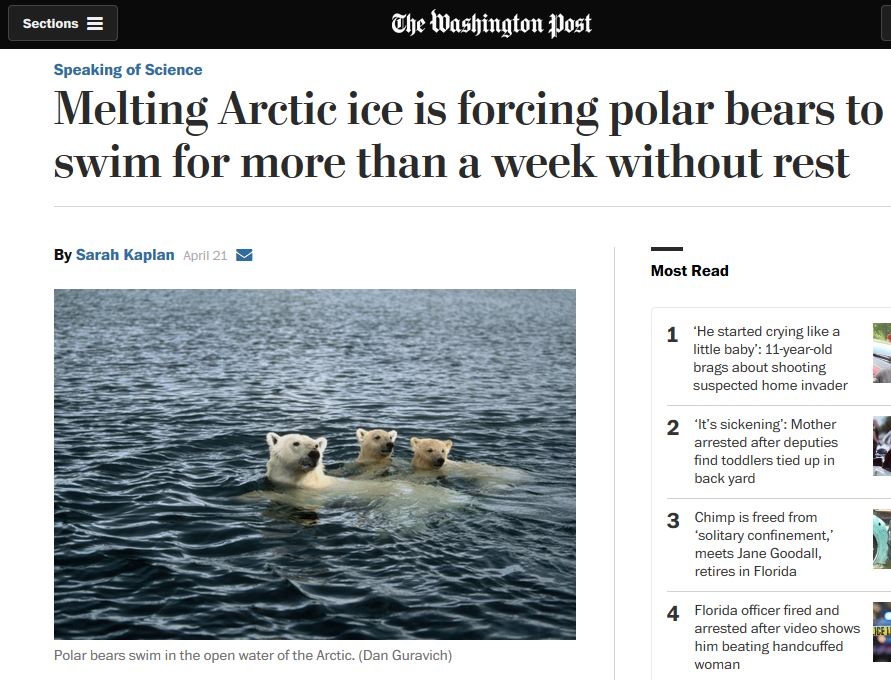
Recent media hype over swimming polar bears in the Southern Beaufort has been quite spectacular (still going strong today at the Washington Post here) but a close look at relevant data shows the message is bogus. Researchers admit (in their methods section) they couldn’t tell if bears said to have swum “non-stop” actually hauled out for half a day or more to rest on small ice flows invisible to satellites and astonishingly, the bear getting all the media attention – who swam the longest of any bear – lost less weight than a bear would have done simply sitting on shore for the same length of time.
Posted onOctober 18, 2014|Comments Off on Polar bear habitat update: regional differences, melting vs. freezing
The freeze is on: from an annual low of ~5.1 m sq km at 15 September 2014, the sea ice that provides a hunting platform for polar bears is rapidly reforming.
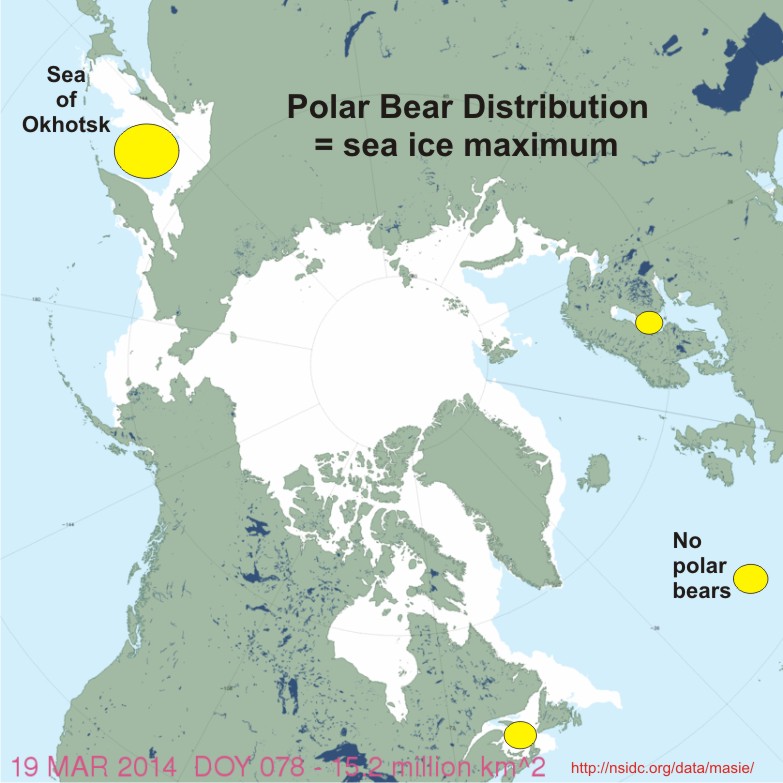
Note that polar bear habitat world-wide is pretty well defined by the extent of sea ice in spring, with three notable exceptions. There are no polar bears (or fossil evidence of polar bears), in the Sea of Okhotsk, the Gulf of St. Lawrence, or the Baltic Sea.
Bears in some areas spend time on land in late summer/early fall but the amount of time varies widely.
Have a look at the maps below: the difference in regional coverage between the sea ice at 4 August and 16 October (73 days apart, both covering 7.3 mkm2) might surprise you. Continue reading
Comments Off on Polar bear habitat update: regional differences, melting vs. freezing
Posted onJuly 20, 2014|Comments Off on Polar bears and melting ice: three facts that shouldn’t surprise you
If I was invited by USA TODAY to discuss how climate change is affecting polar bears now – summed up in three talking points – this is what I’d say. I’d use some meaningful images rather than cute pictures of cuddly bear cubs and I’d provide links to my work with references and details to back up my answers.
In fact, the ice of Hudson Bay melts every summer and always has done. When it does, polar bears go ashore and live off the many inches of stored blubber they put on during their spring feasting on fat baby seals. The last three years, the open-water season has been only about two weeks longer than it was in the 1980s. There has been no steady increase but lots of variability.
Watch polar bear habitat reform in the Canadian Arctic: “last 10 days” Canadian Ice Service animation (works anytime) HERE.
See Quote archive for details.










 polarbearscience
You must be logged in to post a comment.