Tag Archives: sea ice

Activist explorer blames more polar bear encounters since 1985 on reduced sea ice

Activist polar explorer Børge Ousland’s told National Geographic that more polar bear encounters on land are due to reduced sea ice –  without any reference to population changes over that time or revealing when or where these observations were made.

IceLegacy_NG video Sept 30 2015

More vague anecdotal observations and opinions posing as scientific evidence.
Continue reading

Churchill problem polar bear report for 14-20 September 2015

Latest report on problem bears in Churchill, Manitoba, from the town’s Facebook page. See previous post here for map and background. Last week’s report here.

Polar bear-TRANSPORTED-TO-POLAR-PRISON_w Huff Post 2011

Photo above: A bear is transported to Churchill’s polar bear holding facility (from a 2011 Huffington Post article, “Polar Bear Prison”).

22 polar bears handled to date this year; 15 bears in the holding facility this week. See also last post on Polar Bear Town – a new TV reality show about Churchill polar bears.

Polar Bear Alert Program Activity Report as of Sep 21 (click to enlarge):

2015 Sept 14_20_at Sept 21

September minimum 2015 looks like the earliest end of Arctic melt season since 2007

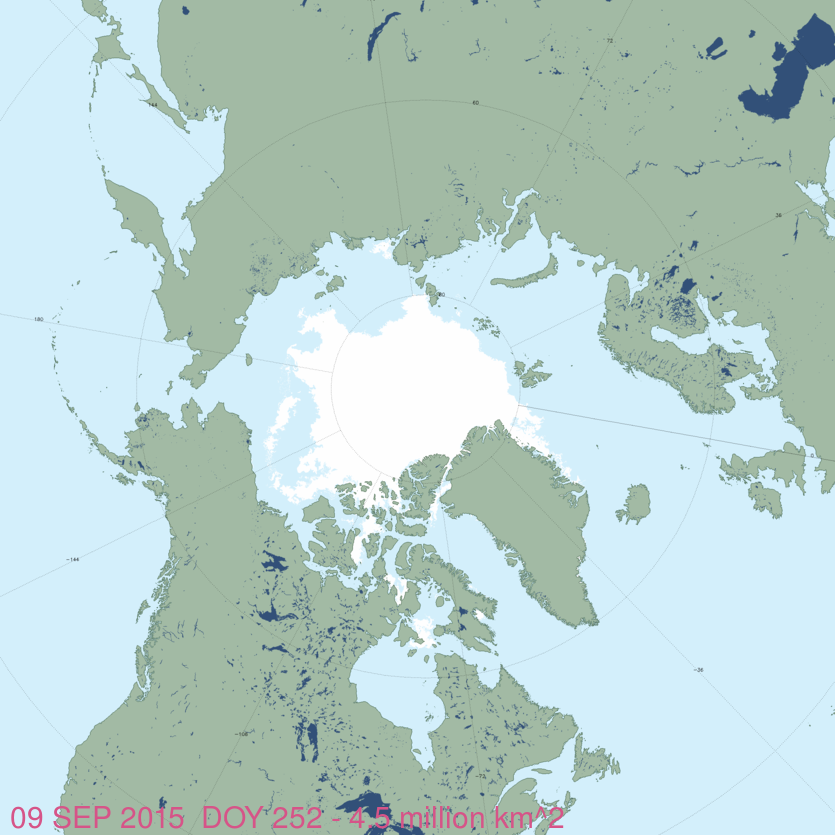
Polar bear habitat in the Arctic Basin this year appears to have reached its apex days earlier than average. As of 12 September, freeze-up of Arctic sea ice had begun. Unless something dramatic happens over the next few days, this will make 2015 the earliest September minimum since at least 2007, using NSIDC data.1

masie_all_zoom_v01_2015252_4km

The two lowest September ice extents (2007 and 2012) were also both later than average; this year’s minimum is the fourth lowest (see chart below).

Of course, all this fuss about how low the September minimum gets is irrelevant to polar bears: they are either on land or in the Arctic Basin, and virtually all are living off stored fat no matter where they are (see Arctic Basin bear here). What matters is when the refrozen ice reaches pregnant females that have preferred denning spots onshore (like in Svalbard) or for bears onshore waiting to return to the ice to hunt (like Davis Strait, and Western and Southern Hudson Bay bears). We won’t know that until October (for Svalbard) or November (for E. Canada).

Again, no sea ice death spiral or polar bears in peril because of it.

UPDATE 15 September 2015, 11:00 am PDT: Just published at the NSIDC website, 2015 minimum has been (tentatively) called at 4.41 mkm2, confirming my figure taken from their interactive graph (see below). However, despite the fact that their own data show that sea ice extent stayed at that value for three days, NSIDC has chosen the last day of that 3-day period rather than the first to represent the 2015 minimum. Go figure. That makes 2015 tied with 2011 for the earliest date for their official records, which seems more than a little self-serving and means I’m not changing the title of my post. NSIDC have also modified slightly some of the official extent figures for past minimums (added below) but it doesn’t really change anything.
Continue reading

Pacific walrus herd hauled out in Alaska during August was as large as last year’s

So, I guess they didn’t all die because of lack of sea ice in the Chukchi Sea. I said back on 28 August, just after the some unauthorized photos were publicized, that this haulout looked just as large as last year’s, if not larger (walruses are occasional prey of polar bears).

Walruses_USFWS photo_030515_March 2015

Now confirmed by an official US Fish and Wildlife Service estimate of 35,000 – not 36,000 mind you, or 34,000 – it was definitely 35,000. Odd, that. And surprisingly, they didn’t bother going out to count them until the day President Obama came to town. Would FWS have even bothered to get a count if there hadn’t been something newsworthy to tie it to?

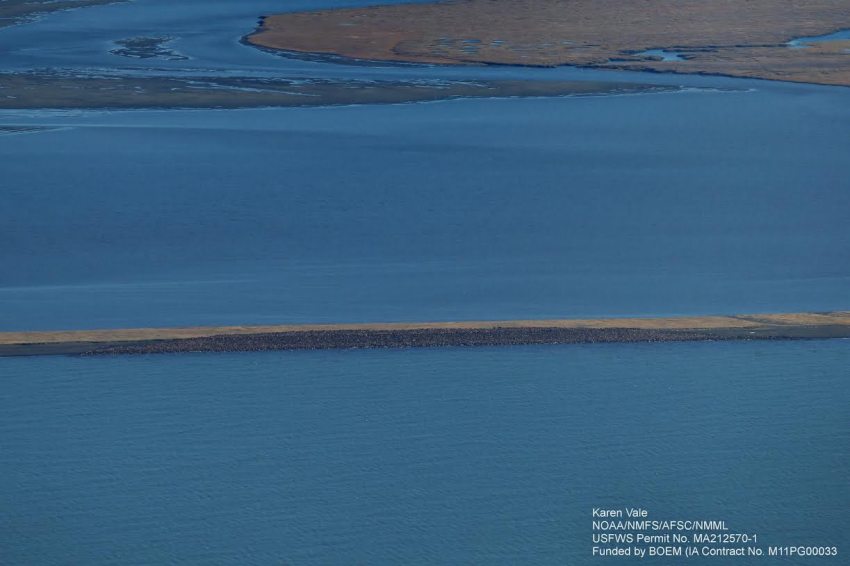
Even more strange is the fact that this year, there was no accompanying hype. There were no links in any of the stories to FWS or USGS propaganda website pages, like there were last year (nor even a link to a press release). No mention of the FWS plan to have walruses declared ‘threatened with extinction because of global warming. And no mention of prosecution of the photographer who took the photos on 23 August, from the required distance, but without a permit. Note the permit number stamped on the official NOAA photo provided below (taken 2 September 2015), which few outlets carried, probably because it looks nothing like a photo of walruses on a beach:

walrus haul out NOAA Sept 2 2015

It appears that this year 35,000 walruses on a beach is a non-story. Go figure. Excerpts from the one, widely-circulated story below, from three days ago. See previous post for more walrus background, map, and video.
Continue reading

Last year’s dead Svalbard polar bear used for this year’s propaganda

Via Mashable yesterday: “Global warming may have led to the death of this polar bear, researcher says”  Note this is about a death that occurred last year (2014), but Mashable author Andrew Freedman implies it happened this year.

Stirlings other pb that died of climate change_Sept 8 2015

The polar bear death occurred last year in Svalbard in the Barents Sea after a fall (2013) and winter (2014) of poor ice conditions due to well-known cyclical sea ice and weather patterns (not global warming). There is no doubt that 2014 was an unusually bad year for sea ice around Svalbard during the fall and winter. This year, however, conditions improved markedly: Norwegian researchers earlier this year reported a good crop of females with cubs this spring, many more than last year (see previous post Many polar bears cubs seen in Svalbard this year, says Norwegian biologist).

The photo above was taken by National Geographic photographer Paul Nicklan, who sent the instagram on 6 September 2015, with a photo and comments about a trip he’d taken to Svalbard in 2014.

Yet the Mashable article says the photo was taken “in recent days” and includes some quotes from Ian Stirling suggesting that the death relates to low summer sea ice and makes no mention of the fact that condition this year were excellent from fall 2014 through at least early July 2015 (see sea ice map below).

I guess if sea ice won’t cooperate and cause polar bears to die this year, it’s OK to use last years’ deaths instead and imply this year was just as bad. Oh, and none of them mention that starvation is the leading cause of death for all polar bears and always has been.

UPDATE 9 September 2015:Mashable’s Andrew Freedman has amended his article:

UPDATED 9:10 a.m. ET: This story was updated to indicate that Micklen’s photo was taken in 2014, not 2015. As Ian Stirling told Mashable, 2015 was also a year that featured extensive sea ice loss in parts of the Svalbard archipelago.”

Freedman’s update, especially the second sentence, is clearly a response to this post. The implication is that any amount of late summer sea ice that’s below average around Svalbard is a threat to polar bear survival. However, there is no published scientific evidence to support that. The evidence that links sea ice levels with polar bear body condition for Svalbard area bears is for spring and early summer ice, and for denning success, fall ice arrival dates. Many Barents Sea bears never come to land, they travel with the sea ice as it expands and contracts, and females den on the ice.

As I tweeted last month, with two maps (3 August 2015)

“Svalbard #polarbears den in the EAST, critical #seaice levels in fall, vary by yr; lots of hunting habitat N & E”

Low ice levels in western Svalbard in late summer are of little consequence for the polar bear population there. Sea ice in the Barents Sea varies with the state of the Atlantic Multidecadal Oscillation (AMO) — even the US National Snow and Ice Data Center says so.  Those changes are not evidence of global warming. And I reiterate: starvation is the leading cause of death for polar bears.

Continue reading

Polar bears are not hungriest in summer when scientists are busy in the Arctic

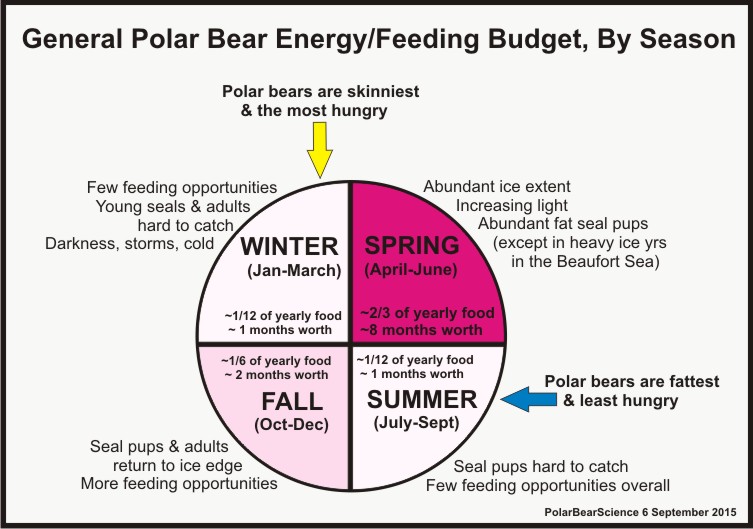
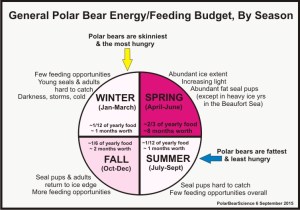
Polar bears are leanest – and therefore, hungriest – at the end of March, not in the summer, as chemist Crispin Halsall stated in a recent article about working in the Arctic.
Polar bear feeding budget_PolarBearScience_6Sept2015

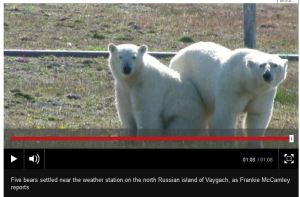
Recent September 1st stories by CNN and the BBC, based on a press release by WWF Russia on 27 August 2015, that five bears in the southern Kara Sea were hanging around a weather station and frightening workers there, apparently prompted chemist Crispen Halsall to make a nonsensical statement about polar bears being at their “hungriest” in summer (first here, reproduced here and picked up yesterday (September 5) by The Guardian here).

“In the path of the polar bears: what it’s like to be an Arctic scientist” (4 September 2015; Crispin Halsall, Reader in Environmental Chemistry at Lancaster University) had this to say:

“The case of Russian scientists trapped in their remote Arctic base by a group of inquisitive yet hungry polar bears does not come as a surprise. By late summer, Arctic sea ice is at a minimum and polar bears are effectively landlocked in coastal areas eagerly awaiting the return of ice during the autumn freeze and the chance to hunt seals again.

The Arctic summer is also the time of year when scientific activities are at their maximum, with bases operating at capacity and fieldwork operations at full flow, particularly in tundra and coastal regions. Polar bears are hungriest when scientists are busiest – “encounters” are inevitable. [my bold]

Polar bears are leanest – and therefore, the hungriest – at the end of winter (when it is more likely to kill with the intent to consume human prey) as stated clearly by Stirling and Øritsland (1995:2603):

Polar bears reach their lightest weights for the year in late March, just prior to the birth of the next cohort of ringed seal pups, which also suggests that it is the success of their hunting in spring and early summer that gives them the body reserves they need to survive through the rest of the year.” [my bold]

A polar bear that has not fed properly in spring – because it was young and inexperienced, too old or too young to defend its kills from bigger, stronger bears, or simply sick or injured – it might be unusually hungry in summer but it’s not the norm.  Polar bears eat nothing or very little over the summer (whether on land or on the ice) because they live off their stored fat – the physiological condition known as ‘fasting.’

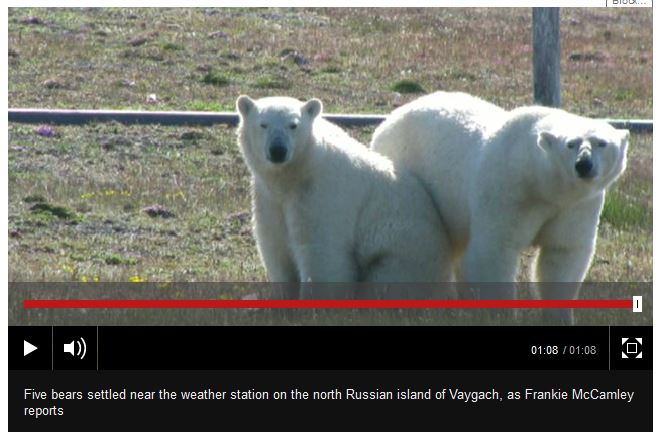
The photos and video in the September 1, 2015 BBC story of the Russian bears shows this: the bears are fat, not skinny (“Video caption: Five bears settled near the weather station on the north Russian island of Vaygach, as Frankie McCamley reports”):
Beseiged by bears Russia BBC video Sept 1 2015

Polar bears might approach humans working in the Arctic during the summer because they are curious and/or bored, and they might attack and even eat humans because they have a drive to eat whenever the opportunity arises. But it’s not because they are “hungriest” in the summer.

References
Stirling, I. and Øritsland, N. A. 1995. Relationships between estimates of ringed seal (Phoca hispida) and polar bear (Ursus maritimus) populations in the Canadian Arctic. Canadian Journal of Fisheries and Aquatic Sciences 52: 2594 – 2612. http://www.nrcresearchpress.com/doi/abs/10.1139/f95-849#.VNep0y5v_gU

Polar bears will not be considered for severe CITES trade restrictions

The CITES working group meeting that just concluded in Tel Aviv, Israel a few days ago decided it would not recommend a vote to move polar bears from Appendix II, where they are now, to Appendix I, at the next general CITES meeting in 2016.

CITES 2015 meeting logo

It appears, however, that the US – which was behind failed petitions in the past (in 2010 and 2013) and voiced an official objection to this 2015 decision – is threatening to raise the issue again at the next all-nations meeting of CITES in September 2016 (probably with a petition at that meeting).

The USA is trying to bully Canada and the international community to adopt its own shaky interpretation of what constitutes good polar bear science and it looks like it may refuse to give up until it has won.

UPDATE: 7 September 2015,  CITES press release (pdf here, relevant passage marked by me):

“The Committee’s Review of Significant Trade concluded that the current level of trade in polar bears, amongst others, is not detrimental to the survival of the species in the wild.
Continue reading

Tracking polar bears – two S. Beaufort bears spent August 2015 on ice that doesn’t exist

Two out of seven polar bears with collars in the Southern Beaufort Sea either spent the month of August on ice that satellites couldn’t see – or they spent the entire month swimming around the Beaufort. Which seems most likely?

Thin ice Lisa Robbins Sept 15 USGS_04

See previous discussions here and here regarding the problem satellites have in accurately detecting melting ice. The presence of these two bears is evidence that there is more polar bear habitat than satellites record as officially present. This was also an issue for Hudson Bay bears earlier this year.

Five out of the seven visible females were on the ice in August – but are the other six bears that were visible last month spending the summer in the Arctic Basin like the one I reported last week? Or have their collars actually failed or dropped off? USGS isn’t saying.

See the August track map below, from the USGS Tracking Polar Bears website1 and a sea ice map.
Continue reading

Pacific walruses hauled out at Point Lay Alaska again this year

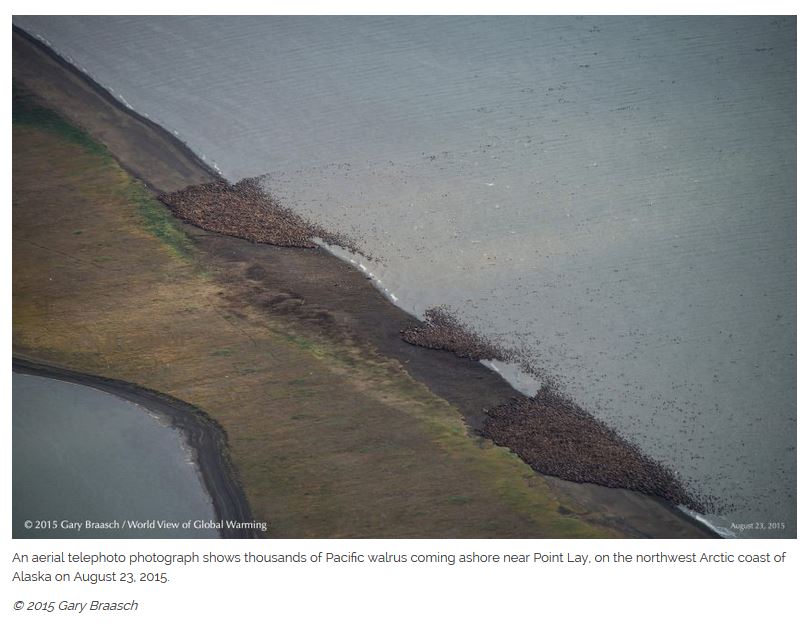
A photo of a mass walrus haulout at Point Lay, Alaska taken a few days ago from a distance show thousands of animals. But no one’s counting because apparently, no one’s interested.

Walrus Pt Lay ADN story Aug 27 screencap
The picture on the left (above, courtesy Alaska Dispatch News) was taken 23 August by global warming activist photographer Gary Braasch, the day after a news report appeared about the US Fish & Wildlife Service and aviation authorities asking the media to approach USFWS about walrus photos and information that gave no hint that a large haulout of walruses was already in place (22 August 2015, “Federal agencies, Point Lay seek to minimize walrus disturbances” ):

“Federal agencies are stepping in to shield a North Slope village from the possibility of a deluge of international attention should a large walrus haulout develop nearby, as it has in years past — agreeing to act as an information clearinghouse on behalf of the Native Village of Point Lay.” [my bold]

Here is what the global warming activist site that published the pictures says about the haulout:

“Thousands of Pacific walrus are coming ashore near Point Lay, NW Arctic coast of Alaska. The huge sea mammals and young began coming up on this barrier island along Kasegaluk Lagoon about August 20, according to local natives. This is one of the earliest known summer haul outs of the walrus along the Alaska coast of the Chukchi Sea, according to wildlife biologists.” [my bold]

They say “thousands.” But the photos taken, reproduced in the Alaska Dispatch News story I read, were taken from a greater distance than the famous photo of ~35,000 animals released by government officials last year and looks like the total could be as large, or larger, than the 2014 haulout.

Said a Washington Post story (27 August 2015):

The U.S. Fish and Wildlife Service confirmed to the Post Wednesday evening that a mass of walruses had “hauled out,” or gathered on shore, near the remote community of Point Lay. The service did not estimate the number or provide images. But photojournalist Gary Braasch has posted dramatic photographs, taken during an Aug. 23 flyover, of what appear to be at least several thousand walruses crowding onto a barrier island.” [my bold]

Continue reading

Polar bear habitat update – more ice than 2012 when all the bears didn’t die

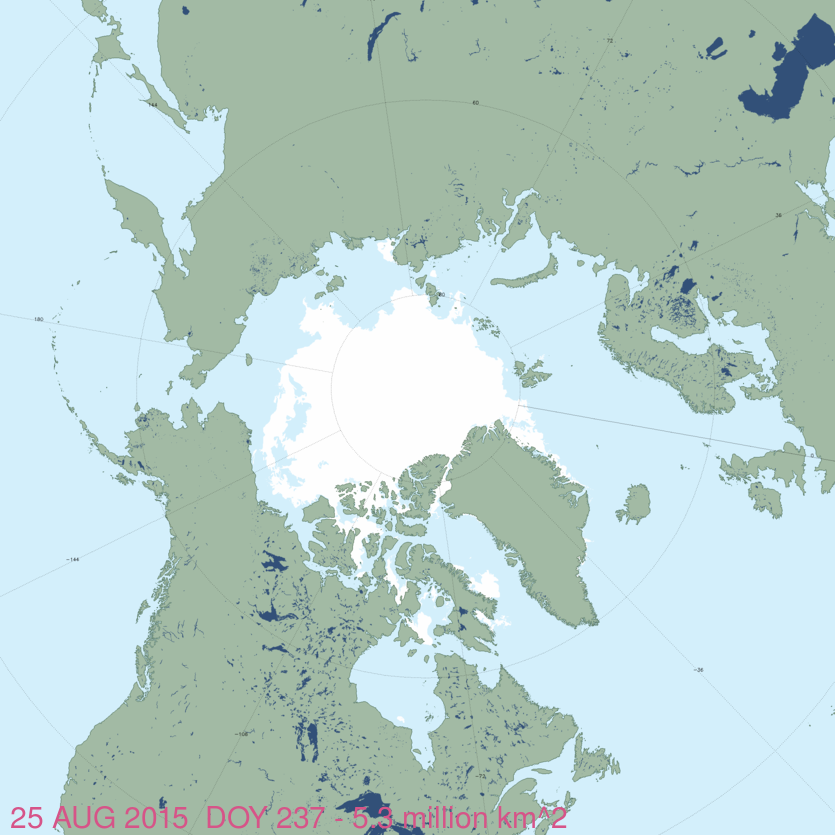
Overall, the situation is better than many recent years – lower than average but higher than even 2012 and 2007, when all the polar bears didn’t die despite record-low extents for September. In several areas of the Eastern Arctic, sea ice levels continue to run higher than average. There is plenty of ice in the Arctic Basin for polar bears spending the summer under the midnight sun.

masie_all_zoom_v01_2015237_4km

According to NSIDC MASIE (see map above):

2007 at 25 August – 5.2 mkm2
2012 at 25 August – 4.9 mkm2
2015 at 25 August – 5.3 mkm2
Continue reading