Tag Archives: WWF

Walrus mass haulout hype refuted, the video

Produced by the Global Warming Policy Foundation, there is now a short video summary of my recently-released GWPF briefing paper, which I wrote and narrated.

Walrus fuss_GWPF video Crockford

Watch it below:

Available also at GWPF TV“The Walrus Fuss – Walrus haulouts are nothing new.”

The briefing paper is here.

Save

Walrus and sea ice, a summary

I’ve written a briefing paper for the GWPF refuting claims that huge herds of Pacific walruses hauled out on land are a sign of global warming.

Here’s the GWPF press release:

London, 20 October: A briefing paper published today by the Global Warming Policy Foundation refutes claims that Arctic walruses are in distress and danger due to global warming.

The paper, written by Canadian zoologist Dr Susan Crockford, assesses the recent mass haulouts of walrus females and calves on the beaches of Alaska and Russia bordering the Chukchi Sea. The events have been blamed by US government biologists and WWF activists on lack of summer sea ice, amplified into alarming scare stories by news media around the world.

Such claims ignore previous haulouts that suggest a different cause. Scientific reports about large walrus haulouts that have occurred repeatedly over the last 45 years show that they are not new phenomena for this region.

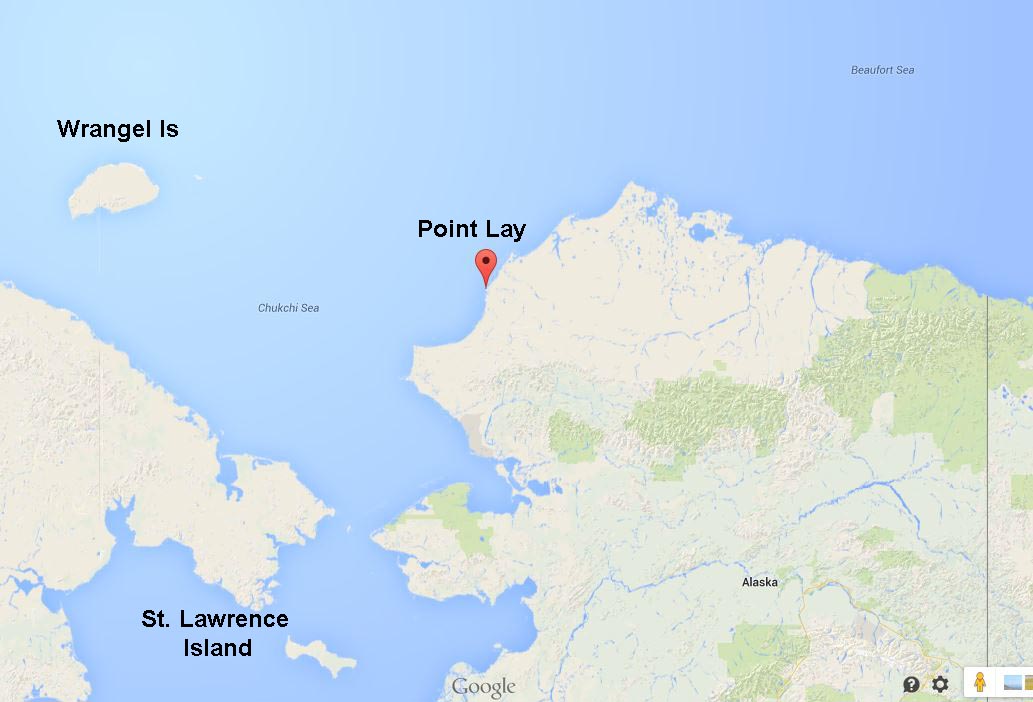
At least two documented incidents of similar magnitude have occurred in the recent past: one in 1978, on eastern St. Lawrence Island and the other in 1972, on the western end of Wrangel Island. The 1978 event involved an estimated total of almost 150,000 walrus hauled out within in a small geographic area.

Moreover, sea ice maps for the months when known mass haulouts occurred, compared to years when they did not, suggest no strong correlation with low sea ice levels.

“The WWF and American walrus biologists have categorically linked the Point Lay mass haulout event to global warming, but available evidence suggests that’s alarmist nonsense,” Dr Crockford said.

“Blaming lack of sea ice for recent events ignores the documented factor – large population size – that drove walruses onto beaches en masse in the past, when plenty of ice was available. Conservation measures have almost certainly led to a spectacular recovery of walrus numbers over the last few years. This suggests that recent mass haulouts are more an indicator that Chukchi walrus are nearing maximum capacity than a sign of impending global warming catastrophe,” Dr Crockford added.

Here’s the paper. [Link fixed, h/t HO]

Save

Where have all the walrus gone?

Yes, I wondered too. After all the kerfuffle at the beginning of the month there’s been rather dead silence [see my last post here]. So I Googled and found some tidbits.

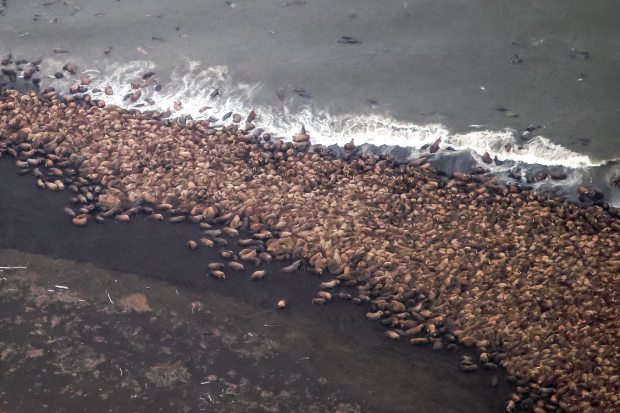
Chukchi Sea walrus, June 2014. US Fish and Wildlife Service.

Chukchi Sea walrus, June 2014. US Fish and Wildlife Service.

An article a few days ago at one media outlet (October 8, 2014) asked someone from the WWF what happened to the ~35,000 females and calves onshore near Point Lay, Alaska — because really, who else would you ask? Or, perhaps more to the point, would anyone at USGS be expected to answer?

And one online media outlet found walrus specialists in Alaska unwilling to lay all the blame for the recent massive haulout at Point Lay at the feet of low Arctic ice levels due to global warming. See what you think.

UPDATE added below October 13, 2014
Continue reading

Mass gatherings of walrus follow-up – sea ice maps for 1978 and 1972

Walruses as polar bear prey and sea ice were on my mind last night and I remembered that we DO have detailed sea ice information for 1978 and 1972 – from the sea ice atlas put together by University of Alaska Fairbanks (UAF), which has ice concentration maps for Alaska going back to 1850 — and for every year up to 2013 (reported previously here).

Chukchi Sea walrus, June 2014. US Fish and Wildlife Service.

Chukchi Sea walrus, June 2014. US Fish and Wildlife Service.

I’ve copied some of the ice maps below.

It is clear that ice was available close to Wrangel Island in 1972 when walruses chose to haul out on the island in huge numbers. And in 1978, there was ice present to the north of the walrus herd, but they had moved away from the ice to get to St. Lawrence Island, where they hauled out in large numbers.

This means it is more likely that food resources were the issue, not sea ice.
UPDATE OCTOBER 3 2014:

See another interesting follow-up elsewhere: Walrus inconsistencies
Continue reading

Mass haulouts of Pacific walrus and stampede deaths are not new, not due to low ice cover

Large haulouts of walruses — such as the one making news at Point Lay, Alaska on the Chukchi Sea (and which happened before back in 2009) — are not a new phenomenon for this region over the last 45 years and thus cannot be due to low sea ice levels. Nor are deaths by stampede within these herds (composed primarily of females and their young) unusual, as a brief search of the literature reveals.

Pt Lay map Google marked

The attempts by WWF and others to link this event to global warming is self-serving nonsense that has nothing to do with science.

UPDATE October 3, 2014: See below. Also, do see follow-up posts here, here, and especially, here.

UPDATE October 23, 2014: A briefing paper summary is here and a video version of that paper (“The Walrus Fuss” — 3 1/2 minutes long) here.

There is also a follow-up post on the situation here.

Continue reading

“Polar bears miss the message on global warming” – my article in RANGE Magazine

Here’s an excerpt of my article “Polar bears miss the message on global warming,” just out in the Fall 2014 issue of RANGE Magazine.

AK PB N Shore-USFWS Barrow_labeled Continue reading

Polar bears move around as sea ice habitat changes – this is what resilience looks like

Oddly, it seems some people expect polar bears to sit around and suffer (or die) when local conditions deteriorate, rather than move elsewhere.

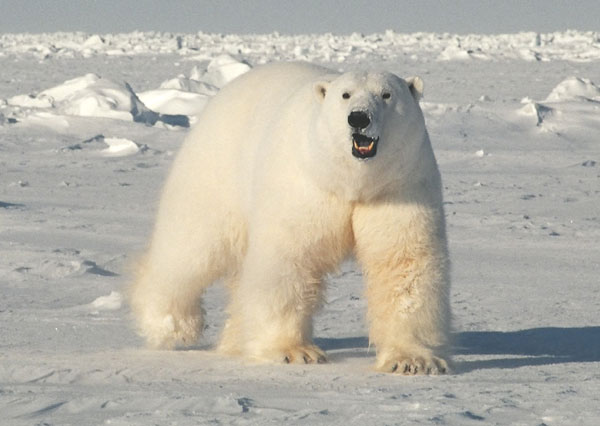
PolarBear_2008_USGS

While there are perhaps a few places where moving is not really an option over the short term, over the long term (more than one season) polar bears are free to shift to another locale if ice conditions change (either too much ice or too little).

An announcement by the WWF last week (10 April) caught my eye, as it talked about bears moving from one area to another because of changing ice conditions — as if this was surprising, extraordinary and newsworthy. That said, at least they weren’t suggesting the bears are all going to die because of declining ice, which is a huge improvement.

See what you think of this part of the press release (below), in the context of what we know about the movement of bears between regions:

Continue reading

WWF and cohorts barred from Moscow polar bear forum

Despite the fact that the World Wildlife Fund (WWF) apparently provided a significant portion of the funding for the recently concluded International Forum on Conservation of Polar Bears (December 3-6, Moscow), it appears in the end they and their NGO cohorts were prevented from having an undue amount of influence at the meeting. For that we can thank the delegates of the five Arctic nations: three cheers for common sense!

This news did not emerge until late yesterday (Friday, Dec. 6), after the meeting had concluded: no mention was made of NGOs being excluded in the press releases and stories written before then. For example, see IUCN story, Dec. 5; WWF story, Dec. 4; Times of India report, Dec. 5 and this Arctic Journal story Dec. 6. There was nothing in any of them about NGOs and journalists being barred from parts of the meeting they thought they would be allowed to attend.

Note that biologist Mitch Taylor, booted-out of the Polar Bear Specialist Group because he did not agree with the group’s position on global warming, attended as part of the Canadian contingent (see list at the end of this post), which was a bit of a surprise. However, the exclusion from the meeting of WWF and their buddies is the big news as far as I’m concerned.

[The media seems more interested in the fallout from a twitter message sent on the final day of the meeting by Canada’s Environment Minister Leona Aglukkaq — more on that in my next post].

Continue reading

International polar bear forum, Moscow: who’s invited

Re: International Forum on Conservation of Polar Bears: December 3-6, Moscow.

[Updates added Dec. 2 and Dec. 3, 2013, as noted below]

[Updated Dec. 4, 2013: Final agenda here; and as noted below]

On Tuesday, setup begins for the Moscow meeting of all Arctic nations that signed the original agreement to protect polar bears back in 1973. In my post last week, I introduced the agenda (pdf here).

I’ve also made notes on the interesting mix of folks who’ve been invited.
Continue reading

How and why great news about Chukchi polar bears has been suppressed

A new peer-reviewed report (Rode et al. 2014 [in print] 2013, accepted), released last month (announced here), documents the fact that polar bears in the Chukchi Sea are doing better than virtually any other population studied, despite significant losses in summer sea ice over the last two decades – even though the Polar Bear Specialist Group (PBSG) said this population was declining (Obbard et al. 2010).
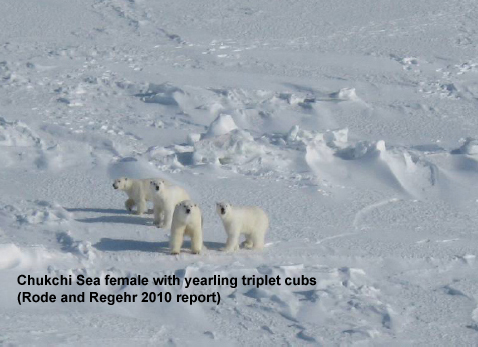
Rode and Regehr 2010_Chukchi_report2010_Fig1_triplets_labelled

Rather than this good news being shouted far and wide, what we’ve seen so far is a mere whisper. The strategy for suppressing the information appears to have several parts: make it hard to find; don’t actively publicize it; down-play the spectacularly good nature of the news; minimize how wrong they were; keep the focus on the future.

Something similar happened with the newly-published paper on Davis Strait bears (Peacock et al. 2013, discussed here and here) but the news there wasn’t quite so shockingly different from expected. The suppression of good news stands in marked contrast to anything with a hint of bad news, which gets reported around the world — for example, Andrew Derocher and colleagues and their prepare now to save polar bears” policy paper in February, 2013.

US Fish & Wildlife biologist Eric Regehr, co-investigator of the Chukchi study and co-author of the newly-published report, wrote an announcement about the paper. It wasn’t a real press release, since it was not actually sent to media outlets. It was a statement, with a brief summary of the paper, posted on a regional US Fish & Wildlife website, with no mention of lead author Karyn Rode. Not surprisingly, lack of active promotion = no media coverage.

The posted announcement also down-played how well the Chukchi bears are doing. In fact, the news documented in the paper is much better than any of them let on: Chukchi polar bears are doing better than virtually all other populations studied.

But Regehr also had to do some damage control to counter the evidence this paper contains of how wrong they had all been — not only about the Chukchi population today but about their predictions for polar bears in the future.

After all, the computer models used to predict a dire future for polar bears combined the Chukchi Sea with the Southern Beaufort, as having similar ice habitats (“ice ecoregions”). The published paper and Regehr’s statement now say these two regions are very different and that polar bear response to loss of sea ice is “complex” rather than a simple matter of less summer ice = harm to polar bears. Regehr goes on to say that polar bear scientists expected this would happen. I call total BS on this one, which I explain in full later (with a map).

Finally, Regehr’s statement emphasizes that good news for 1 subpopulation out of 19 today should not be celebrated because the overall future for polar bears — prophesied by computerized crystal balls — is bleak. Focus on the future, they say. Did they forget that for years they’ve been telling us that polar bears are already being harmed and that this foreshadows what’s to come? Now we have the results of yet another peer-reviewed study showing bears not being harmed by declines in summer ice (see the full list here).

So, in the end, all of this double-talk and contradiction is not just about suppressing this particular paper. There’s much more at stake.

The Rode et al. Chukchi paper is strong evidence that their predictions of a grim future for polar bears – based on theoretical responses to summer sea ice declines that should already be apparent – have been refuted by their own studies. It’s no wonder they want to keep the media away from this story.

Details below.  [Update September 11, 2013: another news outlet picks up the story, see Point 2 below]

Continue reading