Author Archives: susanjcrockford

Amstrup repeats starving polar bear nonsense, features “Ursus bogus”

As if on cue just before an important polar bear announcement, Steven Amstrup, full time employee of Polar Bears International (PBI), is crying “starving polar bears” yet again, with a laughable twist.

Over at “The Conversation” (a university supported forum for academics), in a piece titled “Cold weather in the US no solace for starving polar bears,” Amstrup uses his adjunct affiliation at University of Wyoming to unleash a bit of unpaid advertising for PBI’s alarmist message (I put it this way because while Amstrup  does disclose his affiliation at PBI, he is more than just an affiliated member, he is their paid spokesperson).

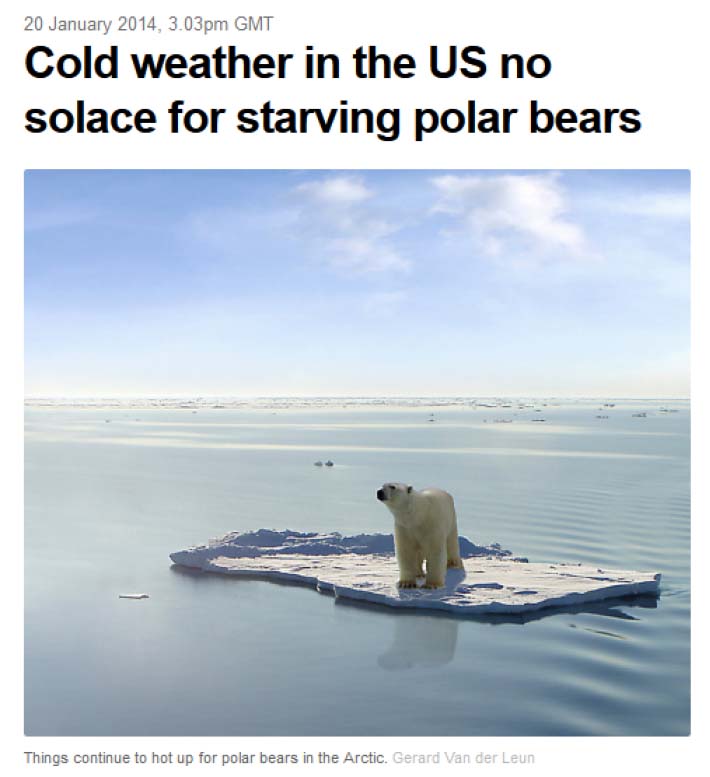
Ironically, the headline photo (Fig. 1) is the notorious “Ursus bogus,” the photoshopped image used by the journal Science back in May 2010 to feature an article on the integrity of science, It was quickly exposed by Tim Blair at The Telegraph (also covered at WUWT), and the journal was obliged to acknowledge the error, replace the image and issue a correction.

In this case, commenter Brad Keyes at The Conversation defends the use of the “Ursus bogus” image with this astonishing statement [UPDATE Jan. 25/14: it has since transpired that this was almost certainly meant to be satire]:

The problem is, only sensational exaggeration makes the kind of story that will get politicians’—and readers’—attention. So, yes, climate scientists might exaggerate, but in today’s world, this is the only way to assure any political action and thus more federal financing to reduce the scientific uncertainty.

Figure 1. The headline photo from Steven Amstrup’s article at The Conversation. This infamous “Ursus bogus” image (for sale at IStock photos, listed under “Global warming images”), says “This image is a photoshop design. Polarbear, ice floe, ocean and sky are real, they were just not together in the way they are now.”

Figure 1. The headline photo from Steven Amstrup’s article at The Conversation. This infamous “Ursus bogus” image (for sale at IStock photos, listed under “Global warming images), says “This image is a photoshop design. Polarbear, ice floe, ocean and sky are real, they were just not together in the way they are now.”

However, we now know that Amstrup is crying wolf — summer sea ice has been declining despite a hiatus in global warming and unusual numbers of polar bears are not starving. He seems to think that if he keeps repeating his Chicken Little message (with nary a recent photo of an actual starving polar bear) he will convince more people to believe him and donate to PBI. It’s his job to do so of course, so he’s not likely to stop. [pardon my mixed metaphor – Amstrup, if you recall, prefers a Titanic metaphor]
Continue reading
Nature acknowledges warming hiatus, but does not explain continued declines in Arctic sea ice

Although there have been jumps and dips, average atmospheric temperatures have risen little since 1998, in seeming defiance of projections of climate models and the ever-increasing emissions of greenhouse gases.” Jeff Tollefson, January 15, 2014, Nature. [open access]

The eminent science journal Nature has finally acknowledged that global average temperatures have not behaved as predicted by climate models over the last 16 years. [h/t A. Watts]

Note that predictions of future sea ice declines and associated predictions of future polar bear declines are totally dependent on these climate models.

Here’s my question: if global temperatures have basically flat-lined since 1998, why has Arctic sea ice continued to decline?

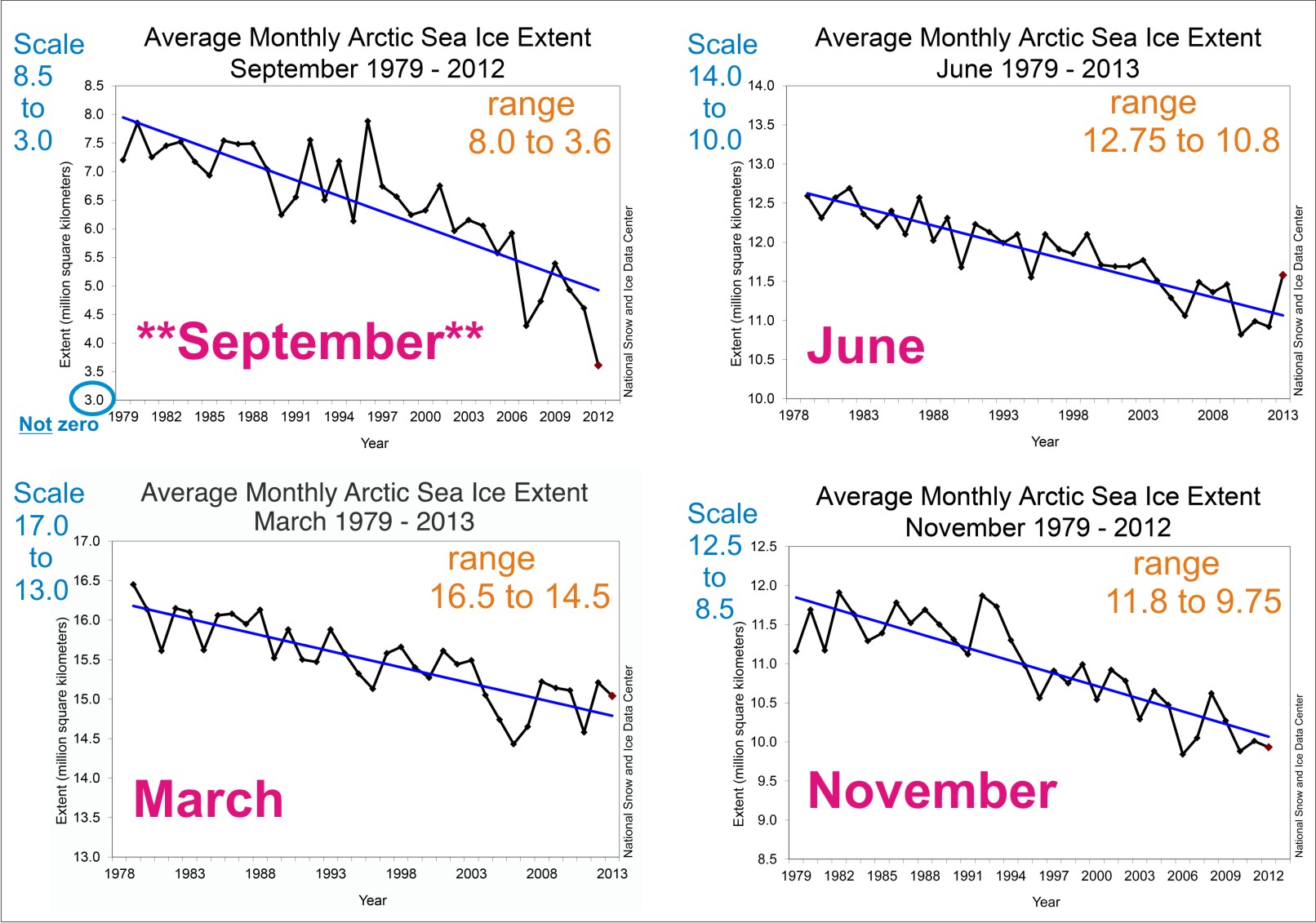
If average global temperatures govern Arctic sea ice behavior, why was 1998 (or the year after) not the lowest September sea ice extent reached over the last 30 years? Oddly, 2012 was the lowest September extent (see graphs below, from NSIDC).

Paradoxically, not only has sea ice continued to decline since 1998 – despite the hiatus in global warming – but since 1998, all but one polar bear populations have either increased in size, not declined, or are doing very well by other measures (see previous summary post, Polar bears have not been harmed by sea ice declines).

Sea ice extent graphs for September (which all the hysteria is about) compared to selected months from March, June and November. Ranges given are approximate; note the differences in scale for each graph. NSIDC graphs, colored labels added.

Sea ice extent graphs for September (which all the hysteria is about) compared to selected months from March, June and November. Ranges given are approximate; note the differences in scale for each graph. NSIDC graphs, colored labels added.

Continue reading

The scientific abomination that is the “Circumpolar Monitoring Framework for Polar Bears”

I keep coming across mentions of a grandiose plan for future polar bear research and conservation called the “Circumpolar Monitoring Framework for Polar Bears.”

This “framework” plan was referred to extensively at the recent International Polar Bear Forum (aka the “Meeting of the Parties” that signed the 1973 conservation treaty) held in Moscow, December 3-6, 2013 (see posts about the meeting here, here, and here). In fact, government representatives of all Arctic nations present at that meeting agreed in principle to support the proposed plan.

No media reports that I’ve come across after the Moscow polar bear meeting explained what the “monitoring framework” involved, so I’ve composed a brief summary and commentary, aided by some images from Dag Vongraven’s presentation in Moscow (Vongraven 2013; pdf here).

In short, Arctic government representatives at the Moscow forum agreed that all future polar bear research should be constrained by the premise that increases in global temperatures over the next century will occur exactly as predicted by climate models and will negatively affect polar bears precisely as predicted by models devised by polar bear biologists. Under the plan, subpopulations that are already showing predicted effects of global warming will get the bulk of research funds, while regions that are paradoxically not responding as predicted will get much less money for research and survey efforts. 

This strategy proposes a coordinated research plan that is blatantly agenda-driven: implementing it would seriously compromise the usefulness of all research results generated for decades to come. I don’t think it’s anything close to being a scientifically valid plan, but decide for yourself. 

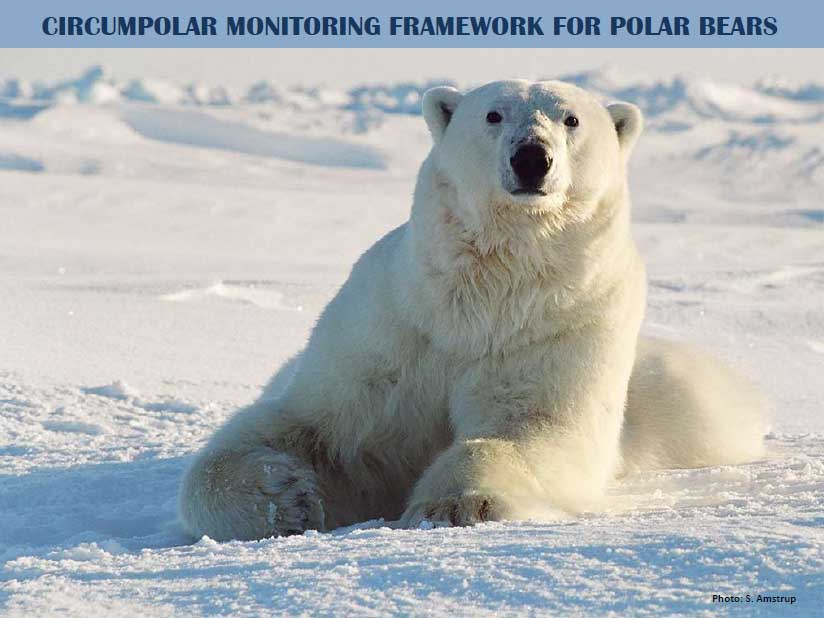
Figure 1. Vongraven 2013, Slide 1.

Figure 1. Vongraven 2013, Title slide.

Continue reading

Polar bear gives birth in Munich zoo, with photos and video

Fabulous photos of 3 week old twin polar bear cubs (born December 9, 2013), have been released by the Hellabrunn Zoo in Munich, Germany. There’s video of the births as well. The newborn cubs are so tiny  — it’s hard to imagine them being born in the dead of winter in a snow den!

PB newborn with mother Munich Zoo Dec 2013

All but one of the photos shown here, including the one above, are of the newborns at 3 weeks of age. The one below is a screen cap taken from the video of the birth, and is the only one that shows the cubs just hours old. They seem to have grown a bit in 3 weeks.

PB newborns birth_11PolarBearTwins2_Zoo screen cap

From this January 1, 2014 account (Hellabrunn Zoo Welcomes Polar Bear Twins”):

“On December 9, a Polar Bear named Giovanna gave birth to two cubs at Munich’s Hellabrunn Zoo. Both births were seen on cameras installed in the birthing den and the connecting corridor to the main den. This is remarkable on two counts: for both births, Giovanna positioned herself so that she was directly in the cameras’ field of view. Secondly, this is the first time that a Polar Bear birth has been filmed in color worldwide!

The cubs were born at 08:39 and 09:43 respectively, to parents Giovanna (7) and Yogi (14). The zoo’s director, Dr. Andreas Knieriem, enthused, “It is as if we were there live watching the labour and birth of a Polar Bear and, as if that weren’t enough, Giovanna showed us not one, but two very different births!”

Continue reading

Polar bears in winter: starving bears and attacks on humans

Winter in the Arctic can be a tough time for polar bears. Between the cold, darkness and ever-thickening sea ice with fewer open leads, polar bears often find that seals are hard to come by.

So it should not be surprising to find out that polar bears are at their lowest body weight at the end of winter (Ramsay and Stirling 1988:613; Stirling 2002:68).

In other words, polar bears lose weight over the winter – not just during the ice-free summer period. That’s why the spring and early summer feeding period is so critical: gorging on young seals rebuilds the polar bears’ fat reserves lost over the winter and packs on even more fat to tide them over the late summer/early fall ice-free period.

Last fall, a potentially serious attack by a polar bear on a Churchill, Manitoba resident on Hallowe’en night (early hours of November 1) got a lot of attention worldwide. Some media outlets suggested that the bear involved in this attack was either starving or so hungry that he was driven to attack. However, this assertion was not supported by any evidence — we simply don’t know whether he was in poor condition or not. While the bear was undoubtedly leaner at the end of October than he was in July, that doesn’t mean he was actually ‘starving.’

So, here’s the question: given that polar bears have a tough time finding seals to eat during the dark and cold Arctic winter and are presumably at their hungriest then, do serious polar bear attacks on humans also happen in winter?
Continue reading

Tracking polar bears in the Beaufort Sea: December map

Here is the December 2013 follow-up to my post on the July track map for female polar bears being followed by satellite in the Beaufort Sea by the US Geological Survey (USGS) – Ten out of ten polar bears being tracked this summer in the Beaufort Sea are on the ice.

See that post for methods and other background on this topic, and some track maps from 2012 (also available at the USGS website here).

The track map for December 2013 is copied below (Figure 1).

There has been little change from November: six of the bears that were being tracked in October were still present (down from ten in July) and one bear that went Arctic walkabout in October has returned and is still in the area. The same seven bears present in November were still being tracked in December but did not move very much. Continue reading

New polar bear population status documents completed but have been withheld

I suggested in my last post of 2013 that the biologists of the IUCN Polar Bear Specialist Group (PBSG) might have learned some lessons over the last year about the folly of withholding evidence, fudging data, and trying to hide good news. However, it appears that was wishful thinking.

In the course of writing the essay on my top posts of 2013, I went to the PBSG website to check something, and blow me over with a feather, found an announcement that had been added a few weeks ago (December 16, 2013) without a whisper to the media.

The old PBSG page, “Population status” – which used to say “The total number of polar bears worldwide is estimated to be 20,000 – 25,000” – has been replace by a notice entitled “Population status reviews.

The former estimate population estimate (“20,000 – 25,000”) can no longer be found on the website and no other figure is offered.

The sidebar menu option “Status table” says “will be published soon.”

I’ve copied the short PBSG notice in its entirety below (pdf here):
Continue reading

Biggest PBS stories of 2013 involved polar bear experts fudging data

The two top posts I published this year had one thing in common – they exposed polar bear researchers dodging full disclosure of scientific information in a way that outraged a lot of people. These two posts still draw a regular crowd of readers.

#1. “Global population of polar bears has increased by 2,650-5,700 since 2001” (published July 15, 2013) – 8,786 views as of December 30.

#2. “Ian Stirling’s latest howler: the polar bear who died of climate change” (August 7, 2013) – 7,872 views as of December 30.

[Note that #3 was the summary essay, “Ten good reasons not to worry about polar bears” (February 26, 2013), at 5,491 views. Dr. Matt Ridley wrote a foreword introducing that essay (“We should be listening to Susan Crockford”) that appeared in Canada’s Financial Post]

On this last day of the year, I thought I’d make an attempt to put these results into a wider perspective.

Continue reading

Another unsupported claim of starving polar bears in Western Hudson Bay

This time it was Steven Amstrup of Polar Bears International (PBI), via a radio interview on Saturday December 28 “A Scientist’s New Job: Keeping The Polar Bears’ Plight Public.

Amstrup – co-author of the models that predict the extinction of polar bears by the end of this century – had this to say about the polar bear situation in Hudson Bay:

This year, the ice was frozen longer, so he says the bears seem to be in pretty good shape.

“But over the last two or three years, my impression has been, ‘Man, there’s a lot of skinny bears out here.’ “

On average, the sea ice in the Hudson Bay is frozen about a month less per year than it was 30 years ago. Amstrup says bears don’t eat much on land, so they lose about 2 pounds of body fat every day they’re off the ice.

“They’re 60 pounds lighter now than they might have been at this time of year 30 years ago,” he says.” [my bold]

For the last two or three years Amstrup has been seeing “a lot of skinny bears” but hasn’t taken a single photograph that he’s offered for publication or posted at PBI? Makes you wonder, doesn’t it – where are the photos of all the starving bears these guys keep talking about?

Here is a picture of a polar bear that was spending the summer on the shore of Western Hudson Bay 30 years ago, taken in July [bears were on the shore in July this year as well]. Continue reading

Christmas collage

Warmest regards and heartfelt thanks for your support over the last year. Have a wonderful holiday.

Susan

Christmas collage 2013 PolarBearScience