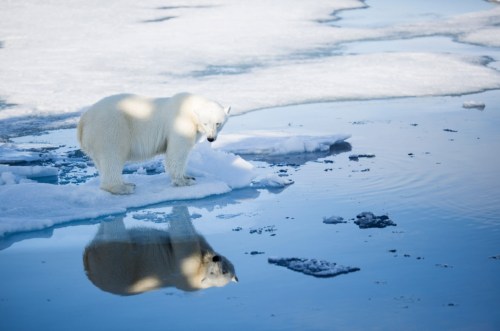
Two years old today, this polar bear video is more relevant than ever:
“The polar bear as an icon for climate change is dead because the distorted predictions made by polar bear specialists were wrong.”

Most polar bears that spend the spring feeding in the peripheral seas of the Arctic Basin (such as the Beaufort, Chukchi, Kara, and Barents Seas) remain on the persistent pack ice of the central Arctic during the summer and this August, that refugium is still larger than Greenland. Most of these bears do not use this July-September Arctic Basin ice as a hunting platform unless they are very lucky: the few seals available are hard to catch. For the most part, polar bears fast or eat very little during the summer whether they are on land or on ice (see references in this post).
Since early June, sea ice experts have been wringing their hands over the melting of Arctic sea ice and offering breathless speculation that this year’s September minimum could be – gasp! – as low as or less than 2012 or even less. But now, as the graph of ice cover at 28 August shows below, that outcome is looking not just unlikely but virtually impossible (the blue line is 2019 extent, red dashed line is 2012, and the brown line is 2016):
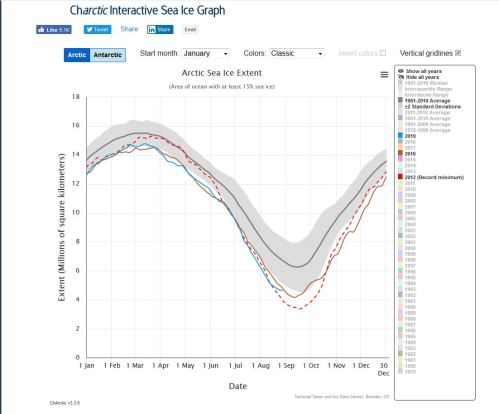
As expected, the failure of the ice to remain on track to set a new record September low due to global warming is shrugged off with a reminder that summer ice extent “is sensitive to changes in daily weather conditions.”
Comments Off on Sea ice melt in the Arctic Basin leaves an area for polar bears larger than Greenland
Posted in Conservation Status, Sea ice habitat
Tagged Arctic basin, Barents Sea, catastrophe, Northwest Passage, refugium, St. Roch, State of the Polar Bear Report, Svalbard, thick ice
Despite a demand by radical protest group Extinction Rebellion that governments “tell the truth” about climate change, it’s apparent that when it comes to walrus extinction risk they prefer the contrived walrus tragedy porn compiled by David Attenborough and his Netflix cronies over scientific evidence.
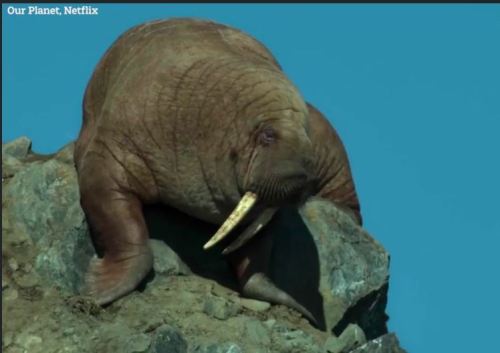
For this group of radical protesters, ‘the truth‘ is a narrative that serves their traffic-disrupting purposes. Since many gullible people – young and old – were horrified by the Netflix claim that hundreds of walruses in the western Arctic had hurled themselves off a cliff because of human-caused climate change, Extinction Rebellion plan to exploit this emotional connection during upcoming protests, apparently believing that what Attenborough told them was a fact. But in accepting docu-drama content without question, they are rejecting the best available science produced in 2017 by biologists who determined that Pacific walrus are not being harmed by the effects of climate change and are not threatened with extinction.
Comments Off on Fear promoted by young activists is based on false walrus & polar bear narratives
Posted in Advocacy, Conservation Status, Sea ice habitat, walrus
Tagged Attenborough, climate change, extinction, Greta Thunberg, lies, Netflix, polar bear, protest, rebellion, science, skeleton, tragedy porn, truth, walrus
Just out this morning:
“Today, U.S. Secretary of the Interior David Bernhardt unveiled improvements to the implementing regulations of the ESA designed to increase transparency and effectiveness and bring the administration of the Act into the 21st century.” USFWS Press Release, 12 August 2019.
Although much hue-and-cry will be written by conservation organizations and the media (here is one), I am providing for easy reference here links to the original press releases and documents issued this morning by the Department of the Interior and the US Fish and Wildlife Service. I am also providing pdf copies of the official documents to appear shortly in the Federal Register and quote the above USFWS press release in full.

It remains to be seen whether polar bears or other Arctic species of interest to me and readers of this blog will be affected. The new changes affect both the listing and delisting process as well as designation of critical habitat.
Comments Off on USA finally updates Endangered Species Act after 45 years & the decision is final
Posted in Conservation Status
Tagged critical habitat, delisting, development, ecosystems, endangered, environment, ESA, extinction, Federal Register, listing, regulations, rules, species, threatened, Trump
For all the hand-wringing over sea ice extent this year and its supposed similarity to 2012, what is truly remarkable is that at the end of July ice remains adjacent to every single major terrestrial summer refugia known to be important for polar bears. Those refugia sites include (from west to east, starting in the Chukchi Sea): Wrangel Island, western Chukotka, Severnaya Zemlya, Franz Josef Land, East Greenland, virtually all the islands of the Canadian Arctic Archipelago (including Southampton Island in Foxe Basin and the southwest and eastern coasts of Baffin Island), and Western Hudson Bay.
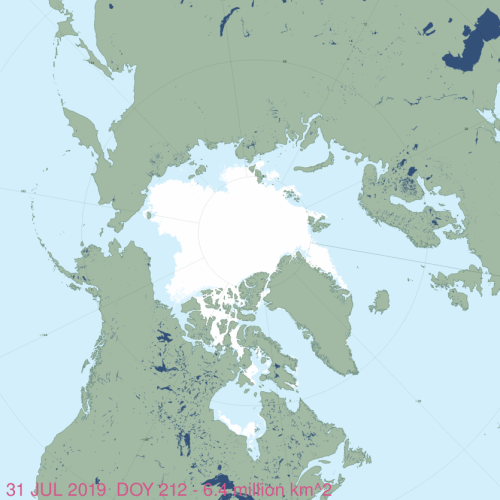
Few bears spend the entire summer onshore along the Alaska coast: most still spend the summer on the sea ice and move with it as it contracts toward the Arctic Basin, as do many bears in the Barents, Kara, East Siberian, and Chukchi Seas. Until a few weeks ago, however, there was enough ice present that Beaufort Sea bears could go ashore if they wanted to do so. Continue reading
Comments Off on Sea ice adjacent to all major polar bear onshore summer refugia at 31 July 2019
Posted in Advocacy, Conservation Status, Population, Sea ice habitat
Tagged 2012, Churchill, extent, facts, Hudson Bay, July, onshore, polar bear, problem bears, refugia, sea ice, summer, terrestrial
Summer sea ice loss is finally ramping up: first year is disappearing, as it has done every year since ice came to the Arctic millions of years ago. But critical misconceptions, fallacies, and disinformation abound regarding Arctic sea ice and polar bear survival. Ahead of Arctic Sea Ice Day (15 July), here are 10 fallacies that teachers and parents especially need to know about.
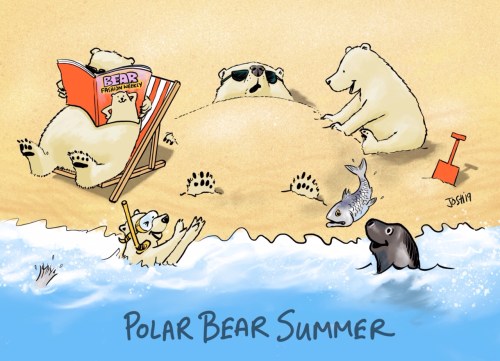
The cartoon above was done by Josh: you can drop off the price of a beer (or more) for his efforts here.
As always, please contact me if you would like to examine any of the references included in this post. These references are what make my efforts different from the activist organization Polar Bears International. PBI virtually never provide references within the content it provides, including material it presents as ‘educational’. Links to previous posts of mine that provide expanded explanations, images, and additional references are provided.
Comments Off on 10 fallacies about Arctic sea ice & polar bear survival: teachers & parents take note
Posted in Conservation Status, Life History, Sea ice habitat, Summary
Tagged Arctic, Arctic sea ice day, facts, feeding, hunting, misinformation, myths, polar bear, sea ice, spring, summer, survival
This essay explains in simple terms why so many people still believe that polar bears are in peril when nothing could be further from the truth: it is an essential lesson that shatters the basis of the shameful indoctrination of young school children and undermines the baseless claims of activist protestors. It was written and translated into French for a special climate change feature issue (July) of the monthly French magazine Valeurs Actuelles (reviewed here) and reprinted by the French hunting magazine Chasses Internationales. It has also been translated into German for a dedicated climate change issue (11 July) of the Swiss weekly magazine Die Weltwoche.

I have added a couple of figures to illustrate this English version of the essay.
Comments Off on Polar bears are thriving despite global warming: this short essay explains why
Posted in Conservation Status, Population, Sea ice habitat, Summary
Tagged abundance, catastrophe, Chasses Internationales, climate change, conservation, Die Weltwoche, ESA, extinction, facts, Le Spectacle du Monde, polar bear, population size, Red list, school strike, sea ice, status, threatened
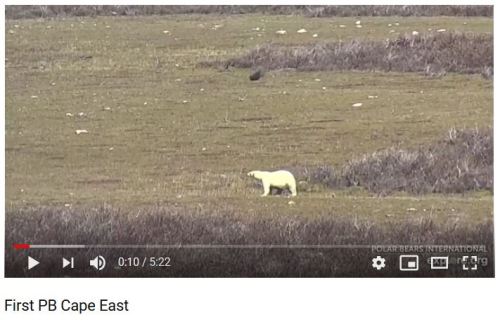
One of the first of hundreds of polar bears expected to come off the sea ice of Hudson Bay along the west and south coasts was captured on video on 5 July. This is only the first wave, as there is still so much ice remaining that most of the bears are likely to remain offshore: not because there is so much food available (few seals are caught at this time of year) but because the ice is where they are most comfortable.
Comments Off on First polar bear spotted off the ice in Western Hudson Bay is fat and healthy
Posted in Conservation Status, Life History, Sea ice habitat
Tagged breakup, Churchill, condition, Derocher, explore, fat, migration, polar bear, sea ice, western hudson bay
Results from spring Norwegian fieldwork in the Svalbard region of the Barents Sea are in and they show that despite having to deal with the most extreme loss of summer sea ice in the Arctic, polar bears in this region continue to thrive.
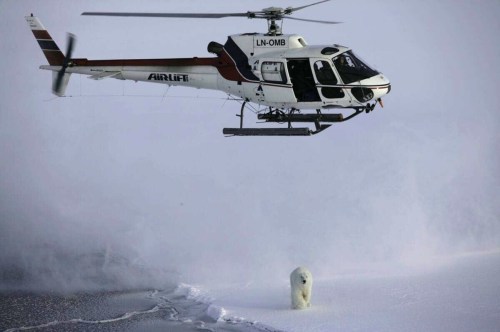
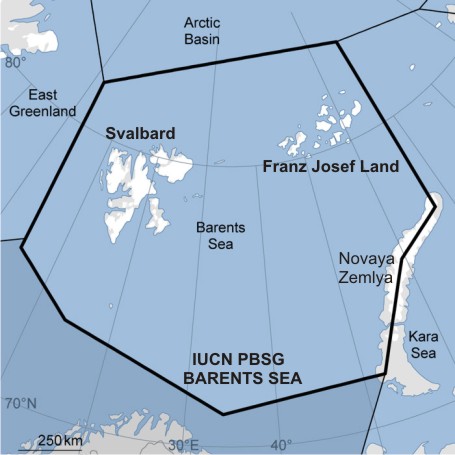
Svalbard polar bear territory (managed by Norway) includes sea ice to the Russian boarder to the east as well as the area around the Svalbard archipelago: the map below is from Aars et al. 2017.
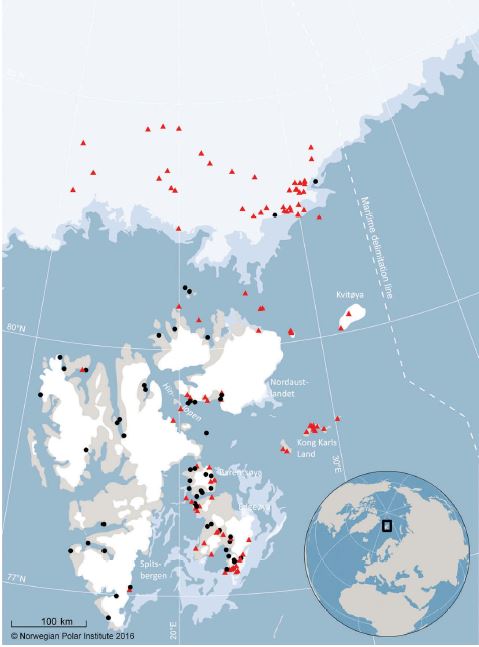
Observations were collected around Svalbard by a team lead by Jon Aars and Magnus Andersen of the Norwegian Polar Institute between March and May this year, and posted online 4 June 2019. Kudos to them for making their on-going observations and analysis available, in a timely manner for all to see.
Note that Svalbard is the western half of the ‘Barents Sea’ polar bear subpopulation: in recent years, most of the region’s polar bears have been living around Franz Josef Land in the eastern (Russian) sector where Norwegian researchers are not permitted to work.
Comments Off on Norwegian polar bears continue to thrive in 2019: Svalbard spring study results are in
Posted in Conservation Status, Population, Sea ice habitat
Tagged Barents Sea, condition, data, litter size, males, Norway, number of cubs, observations, polar bear, sea ice, Svalbard
Straight from the horse’s mouth: all polar bear females tagged by researchers around Churchill in Western Hudson Bay last year were still on the ice as of 25 June. With plenty of ice still remaining over the bay, spring breakup will be no earlier this year than it has been since 1999. Contrary to predictions of ever-declining ice cover, the lack of a trend in sea ice breakup dates for Western Hudson Bay is now twenty years long (a hiatus, if you will) and yet these bears are repeatedly claimed to have been seriously harmed in recent years by a loss of sea ice.
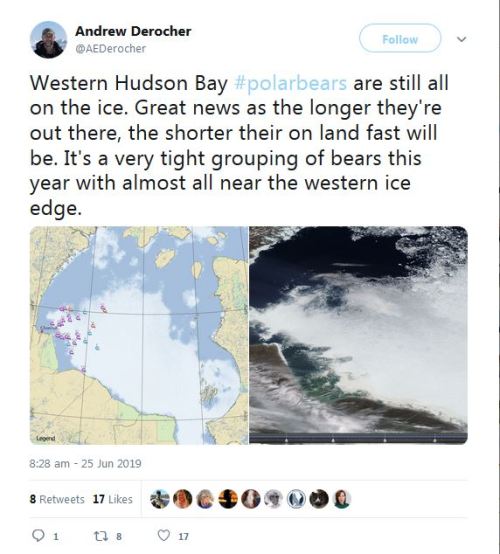
In fact, WH bears have faced relatively few ‘early’ years of sea ice breakup and breakup has never come before the 15th of June. The earliest recent spring breakup date did not come in 2012 – when sea ice hit a summer record low – but in 1999, when Hudson Bay sea ice suddenly began to melt by late June rather than mid-July (Cherry et al. 2013; Castro de la Guardia et al. 2017; Lunn et al. 2016). And this year, as has been the case since 1999, breakup looks to be about two weeks later (give or take a week or so, at around 1 July), than was the case in the 1980s and early 1990s.
In other words, there has been no escalation of breakup dates since 1999: there has been no declining trend in breakup dates for Western Hudson Bay polar bears for 20 years (and no trend in fall freeze-up dates either).
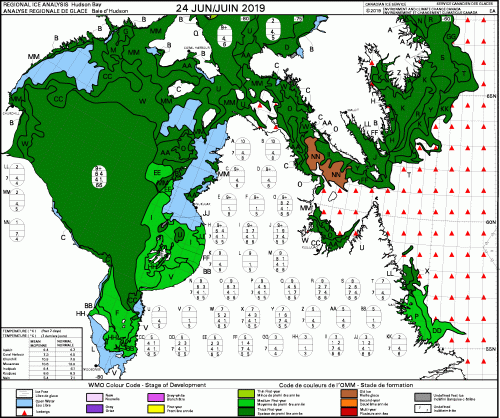
UPDATE 26 June 2019: Here is the latest sea ice chart for the week of 24 June 2019 from the Canadian Ice Service (all that dark green is thick first year ice >1 m thick):
Comments Off on Now 20 years with no trend in ice breakup dates for Western Hudson Bay polar bears
Posted in Conservation Status, Life History, Sea ice habitat
Tagged breakup, Hudson Bay, observations, polar bear, sea ice, sea ice loss, studies, trends, variation, western hudson bay





 polarbearscience
You must be logged in to post a comment.